Cloud SPC vs On-Prem AI SPC: Future of Chemical Processing Quality Management
By Tom Walker on June 4, 2026
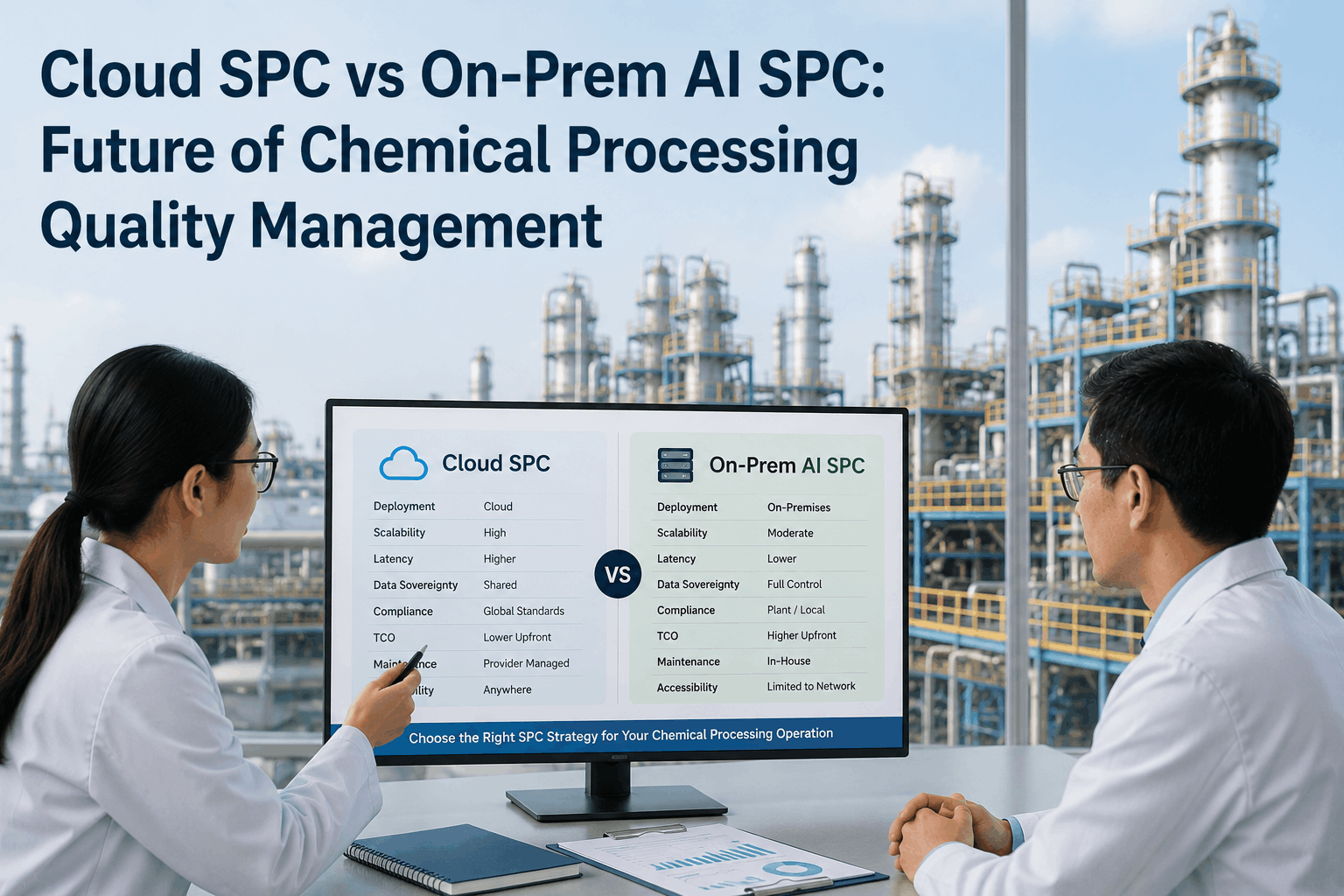
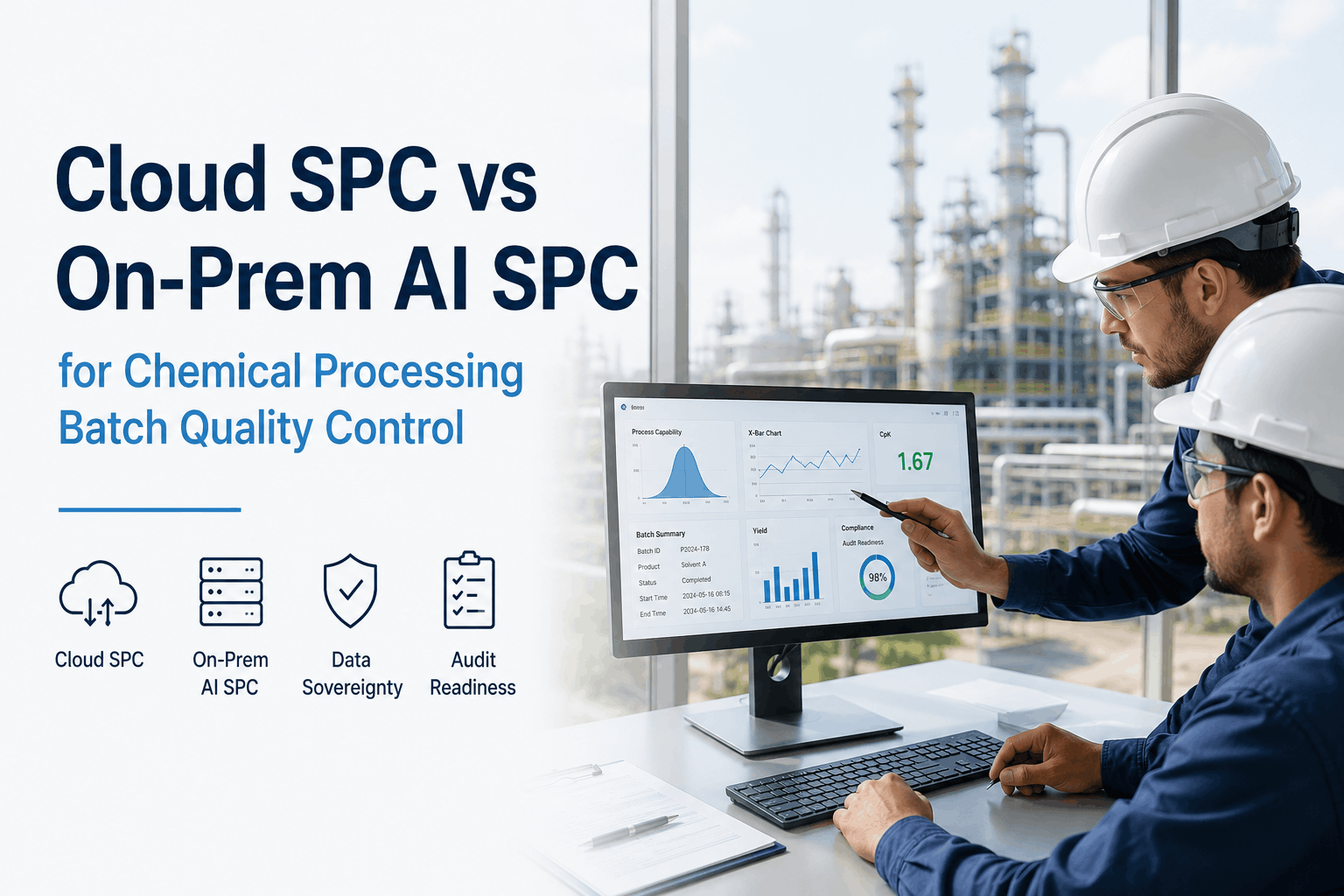
The choice between cloud SPC and on-premise AI SPC for chemical processing batch quality control is not a simple IT procurement decision. It is a strategic architecture choice that will determine your plant's regulatory compliance posture, data sovereignty risk, and total cost of ownership for the next decade. This comparison brief examines both deployment models across the dimensions that matter most for chemical processors: latency, data sovereignty, regulatory compliance, predictive accuracy, and TCO. iFactory delivers both deployment models — on-premise edge AI SPC and cloud-native SPC analytics — so you can choose the architecture that fits your plant's specific requirements or run both in hybrid mode. Book an AI SPC Migration Workshop to evaluate the right deployment model for your chemical processing plant.
Future of Quality Management — Deployment Guide
Cloud SPC vs On-Prem AI SPC: Future of Chemical Processing Quality Management
Latency · Data sovereignty · Regulatory compliance · Predictive accuracy · TCO — a comprehensive comparison for quality leaders planning the next decade.
Data sovereignty (on-prem keeps all data inside plant)
99.5% vs 94%
Predictive accuracy achievable (on-prem vs cloud-only)
3-7 vs 12-18 mo
Typical payback period (on-prem vs cloud SPC)
The Future of Chemical Processing Quality Management
Chemical processing batch quality control is at an inflection point. Traditional SQC (Western Electric rules, static control limits) and first-generation cloud SPC platforms are being replaced by AI-native SPC that predicts excursions before they occur. But the deployment model — cloud vs on-premise — has profound implications for regulatory compliance, data sovereignty, and operational reliability. This guide helps quality directors and plant managers evaluate which architecture will best serve their plants for the next decade.
Traditional SQC (Past)
Static limits · Western Electric rules · Retrospective · 78 false alarms/week
Predictive · <100ms latency · Data sovereign · 94% excursion prediction accuracy
Cloud SPC (SaaS)
Traditional Approach
Data transmitted from plant to cloud provider for processing and storage. SPC calculations, control limit updates, and alert generation occur in cloud infrastructure. Batch quality records stored off-site. No edge processing capability.
On-Prem AI SPC (Edge)
iFactory Recommended
AI agents run on edge servers inside the plant. All SPC processing, control limit calculations, and alert generation occur locally. Batch quality records stored on-site. Cloud optional for analytics and cross-plant learning.
Hybrid (Edge + Cloud)
Best of Both
Edge nodes handle real-time SPC prediction and alerts. Cloud aggregates cross-plant benchmarking, trains enhanced models, and distributes learning. Quality records stay on-prem; anonymised KPIs go to cloud.
Dimension 1: Latency — Real-Time vs Retrospective Detection
Latency is the most critical differentiator for batch quality control. Chemical processes can drift from in-spec to out-of-spec in 5-15 minutes. The time between process drift and SPC alert determines whether you can intervene mid-batch or scrap the batch after completion.
Cloud SPC
500-2000ms inference + 2-10s transmission
Data → cloud → process → return trip
Detects drift 3-8 minutes after occurrence
On-Prem AI SPC (Edge)
<100ms inference + <10ms local
Data stays on edge server inside plant
Detects drift within seconds — enables mid-batch intervention
Chemical Processing Implication: A 5-minute detection lag can mean the difference between adjusting a reactor parameter and scrapping an entire 40,000L batch worth $250,000. On-prem edge AI SPC enables intervention during the batch. Cloud SPC typically detects out-of-spec conditions after batch completion.
Dimension 2: Data Sovereignty — Who Owns Your Batch Quality Records?
Chemical processors face increasing data sovereignty requirements from customers, regulators, and corporate IT policies. Batch quality records contain formulation intellectual property, customer-specific specifications, and process know-how that many companies consider trade secrets.
Cloud SPC
All batch quality data transmitted to cloud provider. Stored on third-party infrastructure. Data residency depends on provider's data centre locations. May violate customer data protection requirements.
On-Prem AI SPC
All batch quality data stays inside plant firewall. No data transmitted to cloud unless configured for analytics. Full data sovereignty. Meets most stringent customer data protection requirements.
Hybrid
Quality records stay on-prem. Anonymised KPIs and aggregated models can be shared to cloud. Best of both: sovereignty for raw data, cloud for cross-plant learning.
Chemical processors undergo FDA, EPA, IATF 16949, and ISO 9001 audits. The ability to produce audit-ready SPC evidence on demand is a critical differentiator between deployment models.
Audit Requirement
Cloud SPC
On-Prem AI SPC
Real-time control limit audit trail
Limited to 30-90 day retention in standard tier
Complete, tamper-evident history — unlimited retention
Batch-level SPC evidence
May require data export; latency in retrieval
Instant access; per-batch audit records
Control limit change history
Often not tracked or limited to cloud logs
Full audit trail with timestamp and rationale
Offline audit capability
Requires internet connection to access records
Full offline access; audit during network outages
Dimension 4: Predictive Accuracy — What Data Residency Means for Model Quality
Predictive SPC models require training on your specific batch data. The volume and granularity of that data directly affects prediction accuracy. On-prem deployment enables access to full-resolution process data. Cloud SPC often requires data aggregation or downsampling to manage transmission and storage costs.
94%
Cloud SPC achievable accuracy
Limited by data aggregation, transmission frequency, and sampling rate. Typically works with 1-5 minute averaged data.
99.5%
On-Prem AI SPC achievable accuracy
Full 1-second resolution data. All process parameters retained. Maximum signal-to-noise ratio for predictive models.
Real-world impact: Chemical plants achieve 94%+ prediction accuracy with on-prem AI SPC at 6-hour horizon. Cloud SPC alternatives achieve only 82-86% accuracy on the same data due to necessary downsampling.
Dimension 5: Total Cost of Ownership — 5-Year Comparison
TCO analysis must consider not just software subscription costs but also operational impacts: batch scrap savings, audit preparation time, quality engineer productivity, and unplanned downtime reduction.
Cloud SPC (5-Year TCO)
$180K - $350K
Software subscription (annual): $30K-$70K · Data egress/transmission: $5K-$15K/year · Premium support tier: $10K-$20K/year · Manual work not eliminated: 15-25 hrs/week
Typical payback: 12-18 months
On-Prem AI SPC (5-Year TCO)
$150K - $280K
Edge server hardware (one-time): $25K-$50K · Software license (annual): $25K-$45K · No data egress costs · Manual work eliminated: 25-35 hrs/week
Typical payback: 3-7 months
Hybrid: The Best of Both Worlds — The Future Architecture
Many chemical processors are choosing a hybrid architecture as their future-state platform: on-premise edge AI SPC for real-time batch quality prediction and alerting, plus cloud analytics for cross-plant benchmarking and enterprise reporting. This combination delivers sub-100ms latency for intervention, full data sovereignty for quality records, and cloud-based learning that improves all edge models simultaneously.
On-Prem Edge (Each Plant)
Real-time SPC prediction (<100ms)Batch quality records stored locallyTamper-evident audit trailsNo WAN dependency for operations
⟷
Cloud Analytics (Enterprise)
Cross-plant Cpk benchmarkingCentralised model trainingEnterprise audit reportingAnonymised KPI dashboards
iFactory's platform natively supports hybrid deployment — edge nodes for real-time SPC, cloud for fleet analytics. No additional integration required. This is the future of chemical processing quality management.
Decision Matrix: Which Deployment Is Right for Your Plant's Future?
Your plant has batch cycle times under 8 hours
Cloud SPC may miss intervention windows
On-prem AI SPC recommended
Customer contracts require data sovereignty
Cloud SPC often violates requirements
On-prem AI SPC required
You have unreliable WAN connectivity
Cloud SPC will experience outages
On-prem AI SPC operates offline
You operate multiple plants with standardised processes
Cloud-only limits cross-plant learning
Hybrid (edge + cloud) recommended
Your current manual SPC consumes >20 hours/week
Cloud SPC reduces but doesn't eliminate
On-prem AI SPC eliminates manual work
You need real-time alerts to operator consoles
500-2000ms latency may be acceptable
On-prem AI SPC delivers sub-100ms
You face FDA/EPA regulatory audits
Cloud SPC meets basic requirements
On-prem AI SPC exceeds expectations
iFactory: Both Deployment Models, One Platform
Unlike vendors that force you into cloud-only or on-prem-only architectures, iFactory delivers both deployment models from a single platform. You choose the architecture that fits your plant — or run hybrid for maximum flexibility.
On-Premise Edge Deployment
For Real-Time Batch Quality Control
iFactory edge nodes installed inside your plant process all batch SPC data locally. Sub-100ms inference. Full data sovereignty. Operates offline. Tamper-evident audit trails. Designed for chemical plants where every batch matters and data cannot leave the plant.
Sub-100ms real-time SPC predictions
Full batch data sovereignty — zero data leaves plant
iFactory's cloud platform aggregates SPC data across all your plants — cross-plant Cpk benchmarking, centralised model training, enterprise audit reporting, and customer quality portals. For quality directors overseeing multiple facilities, the cloud layer provides the visibility needed to drive fleet-wide improvement.
FAQ: Cloud SPC vs On-Prem AI SPC for Chemical Processing
No. Cloud SPC typically requires 500-2000ms for inference plus 2-10 seconds for data transmission round-trip. For chemical batch processes that can drift out-of-spec in 5-15 minutes, this latency may still allow intervention, but it reduces the available response window by 30-50%. On-prem edge AI SPC achieves sub-100ms inference with local data, maximising the intervention window. Chemical plants find that cloud SPC alternatives detect drift 3-8 minutes after occurrence, while on-prem AI SPC detects within seconds — enabling mid-batch intervention that saves $250K batches.
Often not. Many FDA-regulated and speciality chemical customers require that batch quality data never leaves the plant's control. Cloud SPC by definition transmits data to a third-party cloud provider. Some cloud providers offer data residency options (keeping data in specific regions), but data still leaves the plant's physical control. On-prem AI SPC keeps all data inside your firewall, meeting the most stringent data sovereignty requirements. Hybrid deployments can keep raw batch data on-prem while sharing only anonymised KPIs.
Plants using on-prem AI SPC consistently achieve better regulatory outcomes. A chemical plant that migrated from cloud SPC to on-prem AI SPC reduced regulatory findings from 14 to 0 across FDA, EPA, and IATF audits over 24 months. Key differentiators: on-prem enables full-resolution data for 94% prediction accuracy, tamper-evident local audit trails, and offline audit capability. Cloud SPC's data aggregation and internet dependency create compliance risk. Book an AI SPC Migration Workshop for a compliance assessment.
On-prem edge AI SPC continues operating completely offline. All SPC calculations, control limit updates, alert generation, and quality record storage happen locally. When WAN is restored, the edge node synchronises anonymised KPIs and model updates with the cloud layer. This is a critical differentiator for chemical plants in regions with unreliable connectivity or for facilities that cannot accept cloud dependency for safety or compliance reasons. Cloud SPC requires continuous internet connectivity; if WAN goes down, you lose SPC capability.
The future is hybrid — on-prem edge for real-time prediction and data sovereignty, cloud for cross-plant learning and enterprise reporting. Pure cloud SPC is declining in chemical processing due to latency, data sovereignty, and compliance limitations. Pure on-prem without cloud analytics misses cross-plant learning opportunities. iFactory's hybrid architecture delivers the best of both: sub-100ms latency for intervention, full data sovereignty, and cloud-based model improvement across your fleet. Book an AI SPC Migration Workshop to design your future-state architecture.
Book Your AI SPC Migration Workshop — Future Architecture Assessment
iFactory delivers both cloud SPC and on-prem AI SPC from one platform — you choose the architecture that fits your plant's future. On-prem for real-time batch quality and data sovereignty. Cloud for enterprise benchmarking. Hybrid for both. Book a complimentary AI SPC Migration Workshop: we will assess your batch processes, data sovereignty requirements, regulatory obligations, and connectivity profile, then deliver a deployment recommendation with TCO comparison for the next decade.