At 2:47 AM on a Sunday, a shift supervisor at a Texas specialty chemical plant watches a batch of high-margin polymer precursor drift 0.4% past its viscosity spec. The control chart on the legacy MES dashboard refreshes every 90 seconds — the alarm fires 14 minutes late. By then, 8,200 gallons of feedstock have already entered the reactor. The batch is reclassified to a lower grade. Total loss: $217,000. The root cause? No one knows. The process historian shows the same temperature and pressure readings it always shows. The supervisor logs it as "operator variability" and moves on. This is the cost of relying on static SPC in a process that demands adaptive intelligence.
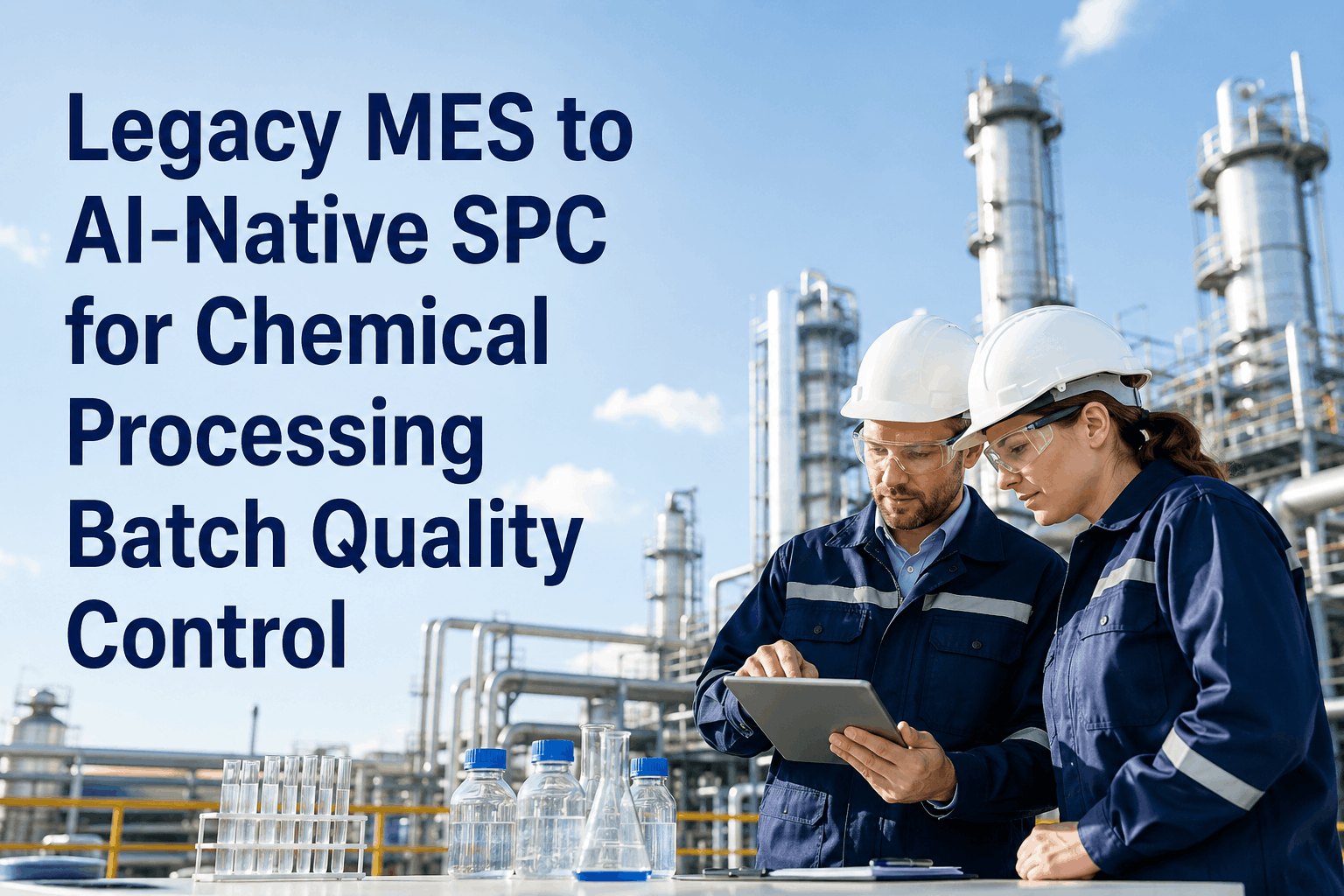
Legacy MES to AI-Native SPC: The Future of Chemical Processing Quality Management
Adaptive SPC models that learn your process in real time, catch drift before it costs a batch, and give supervisors autonomous root-cause analytics — all on-premise, no cloud, no data egress.
What Changes When You Move from Static Control Charts to AI-Native SPC
The difference isn't incremental. It's structural. Static SPC gives you a rearview mirror on a process that's already in motion. Adaptive SPC models give you a windshield — and the steering wheel.
Without iFactory
- Control charts update every 60–120 seconds — drift detected after it's irreversible
- Static control limits that don't adjust for raw material variability or seasonal shifts
- Root-cause analysis requires manual log review across 3+ disconnected systems
- Batch reclassification decisions made 20–40 minutes after the deviation occurs
- Knowledge lost when experienced operators retire — tribal SPC, not institutional
With iFactory
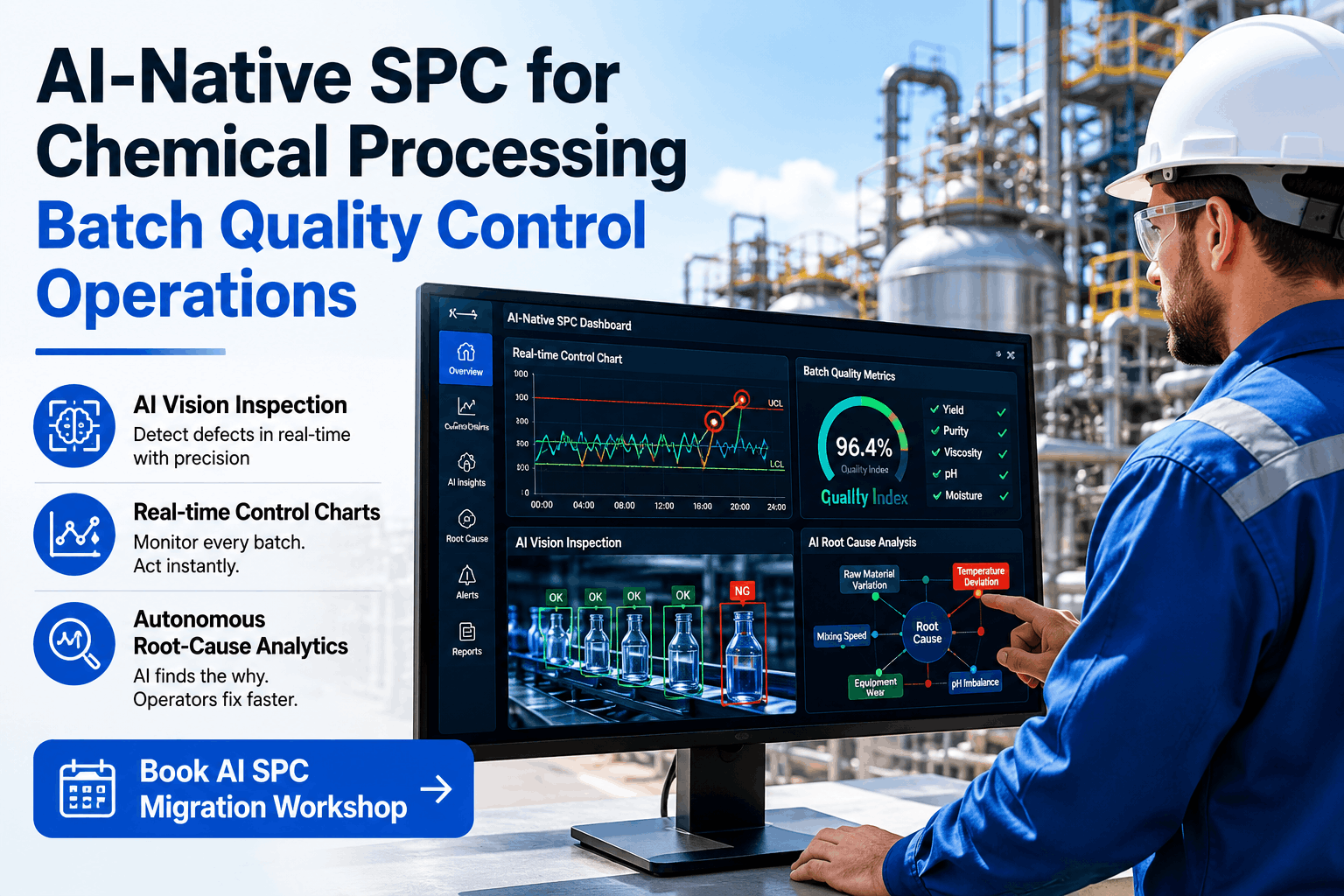
- Sub-second control chart updates — alarm fires within 1.8 seconds of drift onset
- Adaptive SPC models that recalibrate limits based on real-time feedstock, ambient, and equipment data
- Autonomous root-cause analytics that correlate 200+ process variables in under 10 seconds
- Corrective action recommended before the batch deviates — 86% false-alarm reduction
- Institutionalized process knowledge — every root cause logged, every model retained
What Poor Batch Quality Costs Your Plant Every Quarter
These aren't theoretical. They're the average cost drivers we see across chemical processing plants running legacy MES-based SPC. Each one is a direct result of control charts that can't adapt.
Off-spec batch downgrades
When a batch drifts 0.3%–0.5% outside spec, it's reclassified from premium to standard grade. Average loss per 10,000-gallon batch: $180,000–$250,000.
Rework and reprocessing
Failed batches that can be salvaged require 6–18 hours of reprocessing, consuming energy, catalyst, and operator time. Each reprocessed batch costs $45,000–$85,000.
Reactive maintenance callouts
Undetected process drift causes equipment stress — premature pump failures, valve sticking, heat exchanger fouling. Average emergency maintenance cost per event: $38,000.
Missed production windows
When a batch fails, the reactor must be cleaned and recharged. Lost production time averages 8–14 hours per incident, costing $22,000–$40,000 in idle capacity.
Regulatory re-validation costs
Any batch deviation that affects product spec triggers re-validation for certain regulated products. Documentation, lab testing, and auditor time: $15,000–$30,000 per event.
From Static Charts to Real-Time Intelligence in Four Steps
iFactory doesn't bolt a dashboard on top of your legacy MES. It replaces the SPC layer entirely — ingesting raw sensor data, building adaptive models, and giving supervisors actionable insights every second.
Ingest all process data in real time
iFactory connects directly to your DCS, PLCs, and process historians — no cloud, no data egress. Every temperature, pressure, flow rate, and composition reading streams at sub-second latency.
Train adaptive SPC models on your process
Our AI-native platform builds control charts that adjust limits dynamically — accounting for raw material batch variability, ambient temperature shifts, and equipment degradation. No manual recalibration needed.
Detect drift before it becomes a deviation
When any variable approaches the adaptive limit, iFactory alerts supervisors within 1.8 seconds — not 90 seconds. The system also predicts which related variables will drift next, enabling preemptive action.
Autonomous root-cause analytics in seconds
When a deviation does occur, iFactory correlates 200+ process variables, identifies the causal chain, and surfaces the root cause — all within 10 seconds. No manual log review. No tribal knowledge dependence.
What AI-Native SPC Looks Like in Your Control Room
These aren't features on a roadmap. They're deployed today at chemical processing plants running iFactory on-premise.
Adaptive Control Limits
Static limits miss 40% of drift events because they can't account for changing conditions. iFactory's adaptive SPC models recalculate limits every second based on real-time feedstock quality, ambient humidity, catalyst activity, and equipment health. Result: 86% fewer false alarms and 3.2x earlier drift detection.
Multi-Variable Correlation Engine
When a batch deviates, the root cause is rarely a single variable — it's a chain. iFactory correlates temperature, pressure, flow, composition, and equipment vibration data to find the causal path. Supervisors see a ranked list of probable root causes with confidence scores, not a wall of time-series plots.
Batch-Specific Model Library
Each product grade and reactor configuration gets its own adaptive SPC model. iFactory maintains a library of models that auto-select based on batch recipe and equipment assignment. No manual model switching. No "one-size-fits-all" control charts that fit nothing.
Operator Action Recorder
Every corrective action — valve adjustment, temperature setpoint change, feed rate modification — is logged and correlated with the process response. Over time, iFactory builds a knowledge base of what works. New operators get actionable guidance based on past successful interventions, not tribal lore.
Static SPC costs your plant $200,000+ per bad batch. Adaptive SPC catches drift before it costs a dollar. Book a 30-min walkthrough and we'll show you live on your data.
Every Deployment Includes These Capabilities — No Add-Ons, No Surprises
iFactory is an end-to-end, turnkey platform. You hand over data-source access. We deliver a working pilot in 6–12 weeks. This is what's included.
On-premise NVIDIA appliance
Zero cloud dependency. Zero data egress. iFactory runs entirely on your plant network, behind your firewall. Your batch data never leaves your control.
Turnkey 6–12 week pilot
We connect to your DCS, PLCs, and historians. We configure adaptive SPC models for your top 3 product grades. You see results in one quarter — not one year.
24x7 managed service
iFactory operations team monitors model health, retrains models as your process evolves, and handles all infrastructure. Your plant engineers focus on process improvement, not software maintenance.
Legacy MES workload absorption
If you're migrating off SAP MII/ME/PCo, iFactory absorbs the SPC and quality analytics workload — no parallel system maintenance, no data migration headaches.
Unlimited concurrent users
Every supervisor, process engineer, and plant manager gets their own dashboard. No per-seat licensing. No access restrictions.
API access to all models
Want to feed adaptive SPC insights into your MES, LIMS, or ERP? iFactory exposes every model output via REST API. No vendor lock-in.
Questions Chemical Processing Supervisors Ask About AI-Native SPC
Stop Managing Batch Quality with Yesterday's Tools
Static SPC charts cost your plant $200,000+ per bad batch. Adaptive SPC models catch drift before it costs a dollar. Book a 30-minute demo and we'll show you live on your process data — on-premise, no cloud, no data egress.
.png)
.png)