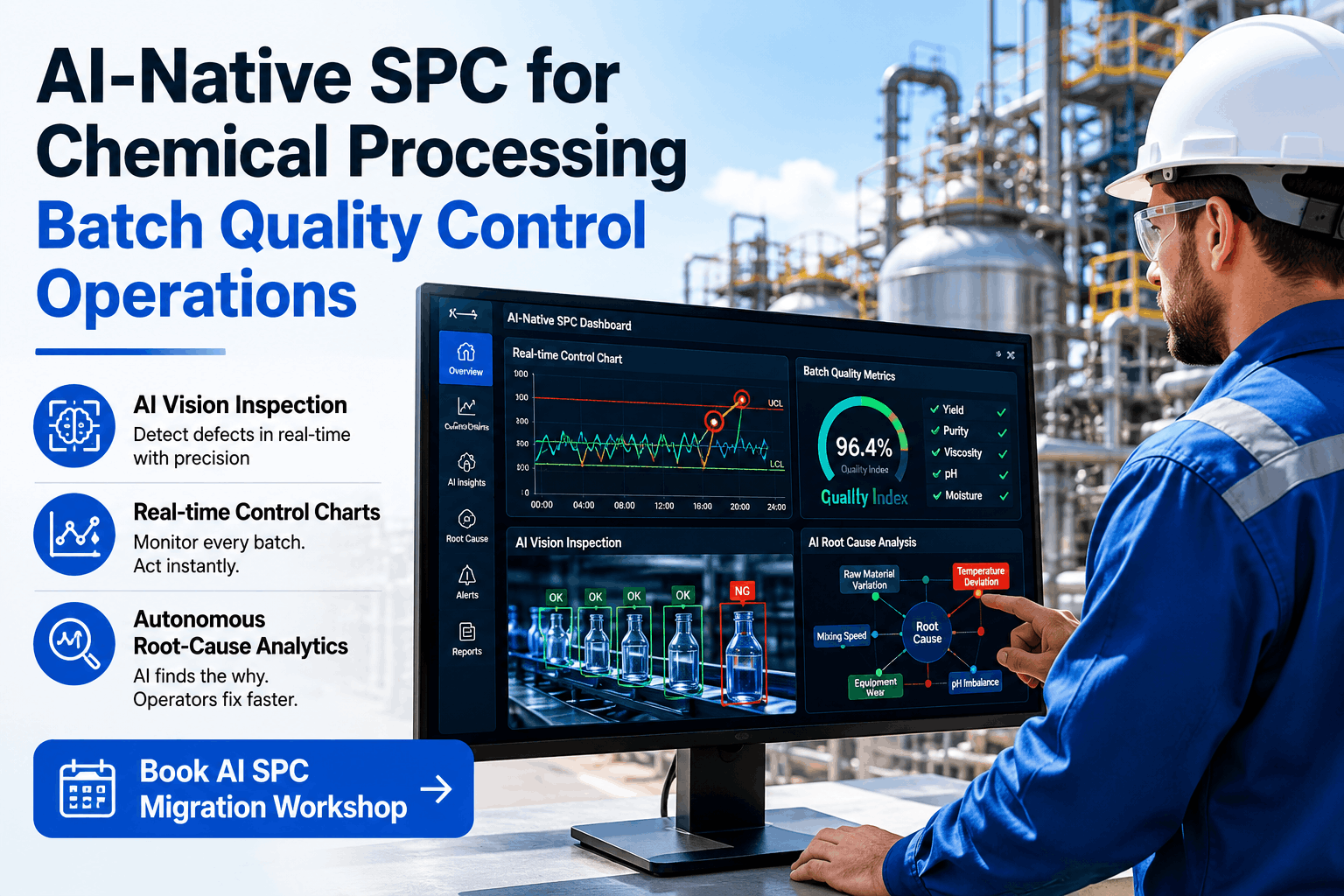
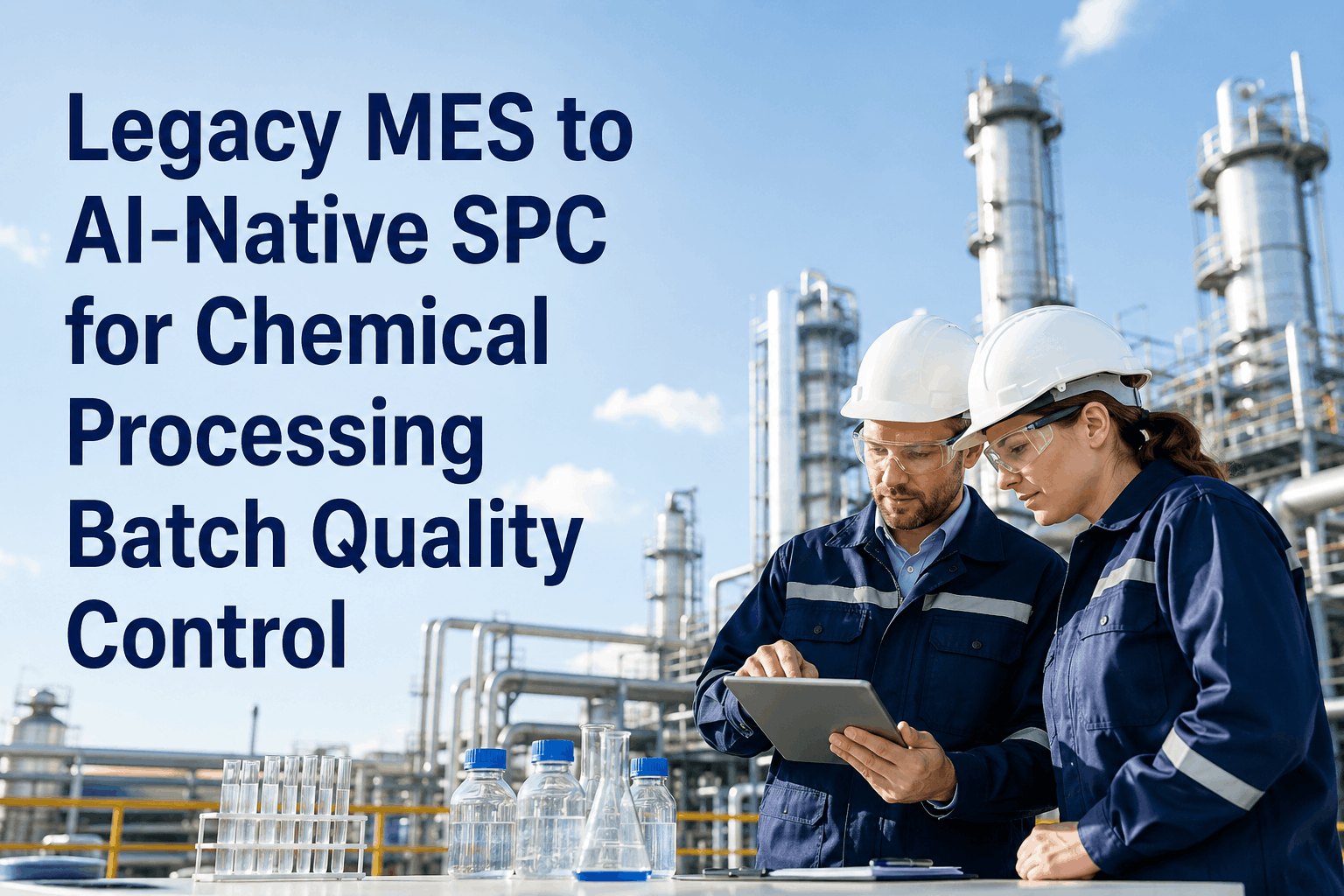
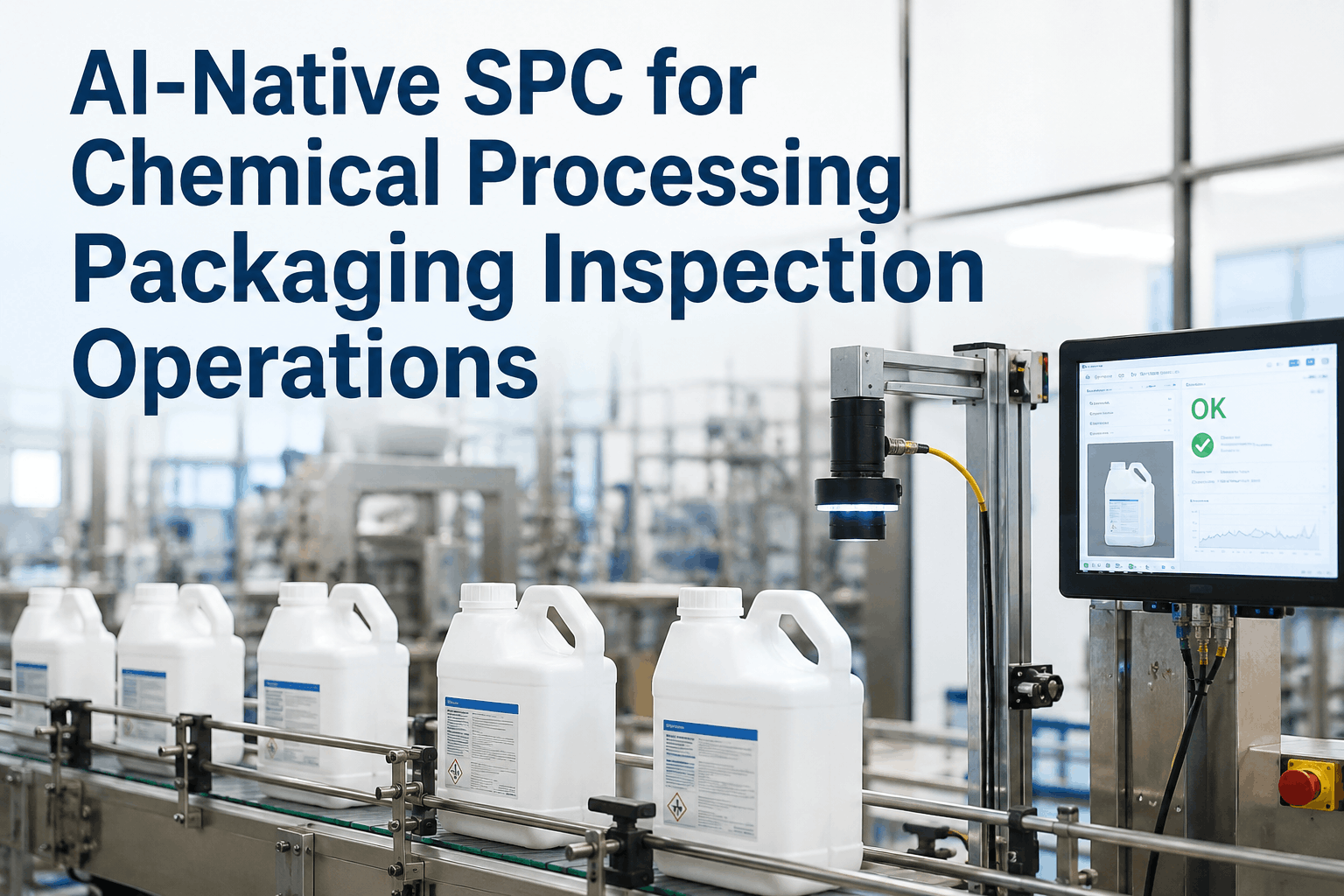
A chemical batch operator working a 12-hour shift on legacy SAP xMII SPC spends an average of 40–55% of their time on activities that AI-native SPC could automate entirely: chasing false-positive alarms, reading univariate control charts one at a time, manually transcribing batch data into lab and ERP systems, and running root-cause investigations that should take 30 minutes instead of 3 hours. The result is an experienced workforce trapped in low-value work — and a quality system that still misses 20–30% of the deviations that matter most. iFactory's AI-native SPC platform replaces this entire workflow: graded alerts cut false positives by 61%, autonomous root-cause analytics return ranked answers in under 30 minutes, and AI vision inspection eliminates manual visual checks. Industry research shows AI delivers 20–30% productivity gains in chemical operations — but the bigger win is what your operators do with the time they get back. Book an AI SPC Migration Workshop to map your operator workflow upgrade.
40–55%
Of operator shift time spent on tasks AI-native SPC could automate
61%
Reduction in false-positive alarms — alarm fatigue eliminated
20–30%
Productivity gain in chemical operations from industrial AI
3 hrs → 30 min
Root-cause investigation cycle time per deviation event
Where Operator Time Actually Goes Today
Most plant managers think their batch operators spend their shift running batches and handling exceptions. The reality, captured from time-and-motion studies across deployed chemical sites, looks very different. Below is how a typical 12-hour shift breaks down on legacy SAP xMII SPC — and where the recovered hours go after AI-native SPC replaces the manual workflow. Read deeper context in our AI batch process optimization overview.
LEGACY SAP xMII SPC
12-hour operator shift today
24%Chasing false alarms
18%Reading SPC charts
14%Manual data entry
12%Root-cause hunting
32%High-value work
~5.2 hrs
of low-value work per shift
iFACTORY AI-NATIVE SPC
12-hour operator shift after
7%Reviewing graded alerts
5%Dashboard scan
3%Confirming auto-reports
5%AI-assisted RCA
80%High-value work
+5.8 hrs
recovered per shift for high-value work
The Best Way to Hire 50 More Skilled Operators Is to Free the Ones You Already Have.
AI-native SPC gives every operator on every shift their time back — for the high-value work that drives yield, safety, and continuous improvement.
The 4 Operator Time-Sinks AI-Native SPC Eliminates
Each of these four workflow killers is silently consuming hours of skilled operator time every shift across chemical processing plants. iFactory's AI-native SPC eliminates each one at the root — not by adding more dashboards, but by changing how decisions get made. Background reading: our chemical plant anomaly detection AI deep dive.
01
Alarm Fatigue from False Positives
~1.5 hrs/shift
BEFORE
50–80 false alarms per week per plant. Operators learn to ignore them. Real catch rate drops to ~51%.
→
AFTER
Graded Safe / Warning / Critical alerts with confidence scores. Under 6% false positive rate. 94% real catch rate.
02
Univariate SPC Chart Review
~1.1 hrs/shift
BEFORE
Reading 40+ separate control charts, chart by chart. Multivariate patterns invisible. Constant context switching.
→
AFTER
Single batch health score per reactor. Multivariate AI fuses all 40+ signals into one unified status. 30-second scan.
03
Manual Data Entry & Batch Reports
~0.9 hrs/shift
BEFORE
Transcribing batch data into LIMS, ERP, and quality records. Manual batch sign-offs. Repeated typing of the same values.
→
AFTER
Auto-generated batch reports formatted for FDA Part 11, EU GMP Annex 11, REACH. Operator confirms — no typing.
04
Root-Cause Hunting
~0.7 hrs/shift
BEFORE
Multi-hour Pareto analysis across DCS trends, lab data, and operator logs to identify a single root cause.
→
AFTER
Autonomous AI root-cause traces backward through correlated variables. Ranked answer in under 30 minutes with confidence score.
A Day in the Operator's Life — Before and After
What does the productivity gain actually look like on the shop floor? Below is a side-by-side timeline of the same operator working the same 12-hour day shift on the same reactor train — one week before AI-native SPC migration, one week after.
BEFORE — Legacy SAP xMII
Monday day shift, 7 AM – 7 PM
07:00
Shift handover. Read 12 SPC charts manually. Flag 3 borderline batches for follow-up.
08:30
First false-positive alarm. Manually verify against process trends. False alarm.
09:15
Transcribe Reactor 4 endpoint data into LIMS. 23 fields, by hand.
10:00
Second false alarm. Skip verification — assume it's noise. (Was actually a real drift.)
11:30
Lab results come back. Reactor 4 is off-spec. Begin manual root-cause hunt.
14:30
Still investigating. Pull DCS trends, operator logs, supplier records. No clear answer.
16:45
Manually compile batch report. Sign off on 4 batch records. Transcribe to ERP.
19:00
End of shift. Off-spec batch still unresolved. Hand over to night shift.
AFTER — iFactory AI-Native SPC
Monday day shift, 7 AM – 7 PM
07:00
Shift handover. Scan single batch health dashboard. All 12 reactors green except R7 (Warning).
07:15
AI flags R4 feed composition drift 4 hours ahead. Adjust monomer ratio. Drift resolved.
09:00
Confirm 4 auto-generated batch reports. One click each. Reports flow to LIMS and ERP.
10:30
AI Copilot: "Why is R7 trending Warning?" — answer in 22 seconds with corrective action.
12:00
Lead afternoon huddle on continuous improvement project. Run 3 process variation experiments.
14:30
Train new operator on AI Copilot workflow. Document tribal knowledge in shared playbook.
16:00
Review predictive maintenance recommendations for week ahead. Schedule R3 bearing replacement.
19:00
End of shift. All batches on-spec. Zero open quality issues. Clean handover.
The 4 AI Copilots That Sit Beside Every Operator
iFactory's AI Copilots provide natural-language assistants that answer operator questions in plain English — no dashboards to navigate, no charts to interpret. Each Copilot specializes in a different shift-level decision. Read about iFactory's quality control AI analytics.
C1
Batch Health Copilot
"What's the status of all my batches right now?"
Returns a ranked list of all active batches with Safe / Warning / Critical status, predicted endpoints, and any drift forecasts for the next 8 hours.
C2
Root-Cause Copilot
"Why is Reactor 4 trending toward off-spec?"
Traces backward through correlated process variables in under 30 seconds. Returns top 3 contributing factors with confidence scores and recommended corrective action.
C3
Setpoint Copilot
"Should I adjust the temperature on this batch?"
Evaluates current batch trajectory against historical optima. Returns specific setpoint recommendation with predicted impact on Cpk, yield, and cycle time.
C4
Compliance Copilot
"Generate the batch report for this morning's runs."
Auto-produces FDA Part 11 / EU GMP Annex 11 / REACH-compliant batch reports with full ALCOA+ provenance. Operator reviews and signs off in one click.
Deploy On-Premise, in the Cloud, or Hybrid
Chemical plants do not share a single IT posture. iFactory delivers identical AI-native SPC and Copilot capability across all three deployment modes. Talk to our deployment architects about which mode fits your plant.
ON-PREMISE
Air-gapped. Edge GPU on your plant network. Zero internet required. Full data sovereignty.
Best for: Regulated EU/APAC plants, hazardous processes, pharma-adjacent sites
CLOUD
Managed. Zero infrastructure. Multi-site operator dashboards. SOC 2 Type II, ISO 27001.
Best for: Multi-plant operators, fast-scaling specialty groups, OPEX budgets
HYBRID
Edge + cloud. Sub-50ms inference at the line. Cloud-side learning across plant fleet.
Best for: Multi-site groups, mixed regulatory environments, federated learning
Same AI Copilots. Same operator workflow. Same productivity outcomes. Deployment mode affects infrastructure — not the operator experience.
Live in 8 Weeks. Operator Productivity Gains From Week 4.
iFactory's 8-week deployment program follows a structured playbook: data mapping, parallel run with xMII, controlled cutover. Operators trained on AI Copilots during Week 5. First productivity gains measured by Week 6.
Outcomes from Deployed Chemical Plants
Each outcome below is from a chemical processing facility that migrated from SAP xMII SPC to iFactory AI-native SPC. Six-month post-cutover data, measured against the previous 12-month xMII baseline for operator productivity.
An 8-reactor polymer plant in Switzerland had 12 batch operators consuming an average of 5.6 hours per shift on alarm chasing, chart review, and manual data entry. After iFactory cutover, false alarms fell 88%, batch reports auto-generated, and AI Copilots handled root-cause queries in seconds. Operators redeployed their recovered time to continuous improvement projects. Deployment: on-premise.
5.4 hrs
Recovered per operator per shift
$2.6M
Annual value from operator redeployment
A coating resin manufacturer operating 6 plants on legacy SAP xMII migrated to iFactory cloud deployment over 9 weeks. Operator productivity measured by good batches per operator per shift improved 47% across the fleet. The cloud platform delivered identical AI Copilot experience to operators in every plant — no per-site customization. Deployment: cloud.
+47%
Operator productivity (fleet average)
9 wks
6-plant rollout time
$3.4M
Annual recovered value
A biotech facility was running 1 operator per 4 fermentation reactors due to manual workload. iFactory's AI-native SPC and Copilots enabled the same operators to manage 9 reactors each — a 2.3x improvement in operator-to-reactor ratio without adding headcount. Deployment: hybrid.
2.3x
Operator-to-reactor ratio improvement
48 hrs
Time to identify all loss patterns
$1.1M
Annual value recovered
What Operators and Supervisors Say After Migration
I used to spend the first two hours of every shift just reading SPC charts and chasing alarms that turned out to be nothing. Now I scan one dashboard for 30 seconds and I know what every batch needs. The rest of my shift is actual work.
Batch Operator, 18 years experience
Specialty Polymer Plant, Switzerland
The AI Copilot is the difference. When I have a question — Why is this batch trending warning? What should I adjust? — I get a clear answer in seconds with the reasoning behind it. It's like having the most experienced engineer on call.
Shift Supervisor
Coating Resin Plant, USA
We had four operators retire last year and we couldn't backfill all of them in this labor market. AI-native SPC let us run the plant safely with the team we have. Our experienced operators now focus on training and improvement, not data entry.
Operations Director
Biotech Manufacturing, Japan
Our operators were burning out from alarm fatigue. After cutover, they actually trust the alerts again — because the AI prioritization is credible. That cultural shift was almost more valuable than the productivity numbers.
VP of Manufacturing Excellence
Multi-Site Chemical Group, USA
FAQ: AI-Native SPC for Batch Operator Productivity
Common questions from plant operators, supervisors, and operations leaders evaluating AI-native SPC for chemical batch quality control productivity. Question not covered here? Reach our solutions team directly.
How quickly do operators see productivity improvement after cutover?
First measurable productivity gains appear in Week 4 of deployment, during the pilot validation phase. Operators report a noticeable reduction in alarm noise within the first week of live AI alerting. Full productivity gains — the 40–55% time reclamation — are typically measured by Week 8 once Copilots are fully adopted. Most operators describe the change as immediate and obvious by their third shift on the new system.
Will my operators need extensive retraining?
No. AI Copilots use natural language — operators ask questions in plain English ("Why is R4 trending warning?") and get answers. Standard training is 4 hours per operator, delivered during Week 5 of deployment. Most operators are comfortable by the end of their first full shift. The system is designed to feel like having a senior engineer available 24/7 rather than learning new software.
Is iFactory available on-premise, in the cloud, or both?
Both — and hybrid. iFactory delivers identical AI Copilot capability and productivity outcomes across on-premise (air-gapped, edge GPU), cloud (SOC 2 Type II, ISO 27001), and hybrid deployments. The choice depends on your data residency rules, IT policy, and multi-site strategy — not capability. Operators experience the same workflow regardless of deployment mode.
Does AI-native SPC eliminate operator jobs?
In every deployment to date, operators have been redeployed, not displaced. AI Copilots handle the repetitive, low-value tasks; operators move to higher-value work — root-cause investigation, continuous improvement, supplier quality, training new hires, and complex process decisions that require human judgment. One supervisor described it: "We freed our smartest people from doing data entry. Defect rates fell a second time because they were finally working upstream."
How does this work alongside our existing SAP xMII during migration?
iFactory runs in shadow mode alongside xMII from Week 3 through Week 6. Both systems active. Operators continue using xMII while AI predictions log silently. By Week 5, supervisors validate AI catches against xMII results. Cutover is reversible via configuration change. xMII remains available as backup for 30 days post-cutover. 100% production uptime maintained throughout migration.
What productivity gain should we realistically expect?
Across deployed chemical plants, operator productivity has consistently improved by 20–47% within 6 months of cutover, depending on starting baseline. Plants with severe alarm fatigue and heavy manual workflows see the largest gains. The Migration Workshop includes a tailored productivity projection for your specific operator workflows, shift patterns, and current xMII workload — measured in recovered hours per operator per shift.
How does AI Copilot integrate with SAP DMC, SAP QM, or our MES?
Natively. iFactory integrates with SAP xMII, SAP DMC, SAP QM via standard interfaces (OData, REST, RFC, BAPI). All operator actions, batch decisions, and compliance records flow back to your existing system of record. Operators see one unified interface; behind the scenes, data routes correctly to the right downstream system. No double entry, no duplicate records.
What happens when AI Copilot gives the wrong recommendation?
Every Copilot response includes a confidence score and the reasoning behind it. Operators see exactly which process variables and historical patterns led to the recommendation — no black box. Low-confidence answers explicitly say so and route to human judgment. Operators retain full override authority. Every override is logged and used to improve future Copilot accuracy. The system is designed to augment operator expertise, not replace it.
Free Your Operators From the Workflow Killers. Recover 5+ Hours Per Shift.
AI-native SPC and AI Copilots replace alarm fatigue, manual SPC chart review, batch data entry, and root-cause hunting — giving every operator on every shift their time back for the high-value work that drives yield, safety, and continuous improvement. Live in 8 weeks. On-premise, cloud, or hybrid.
On-premise, cloud, or hybrid — your choice
5+ hours recovered per operator per shift
61% reduction in false-positive alarms
4 hours operator training, natural-language Copilots
FDA Part 11, EU GMP Annex 11, REACH ready