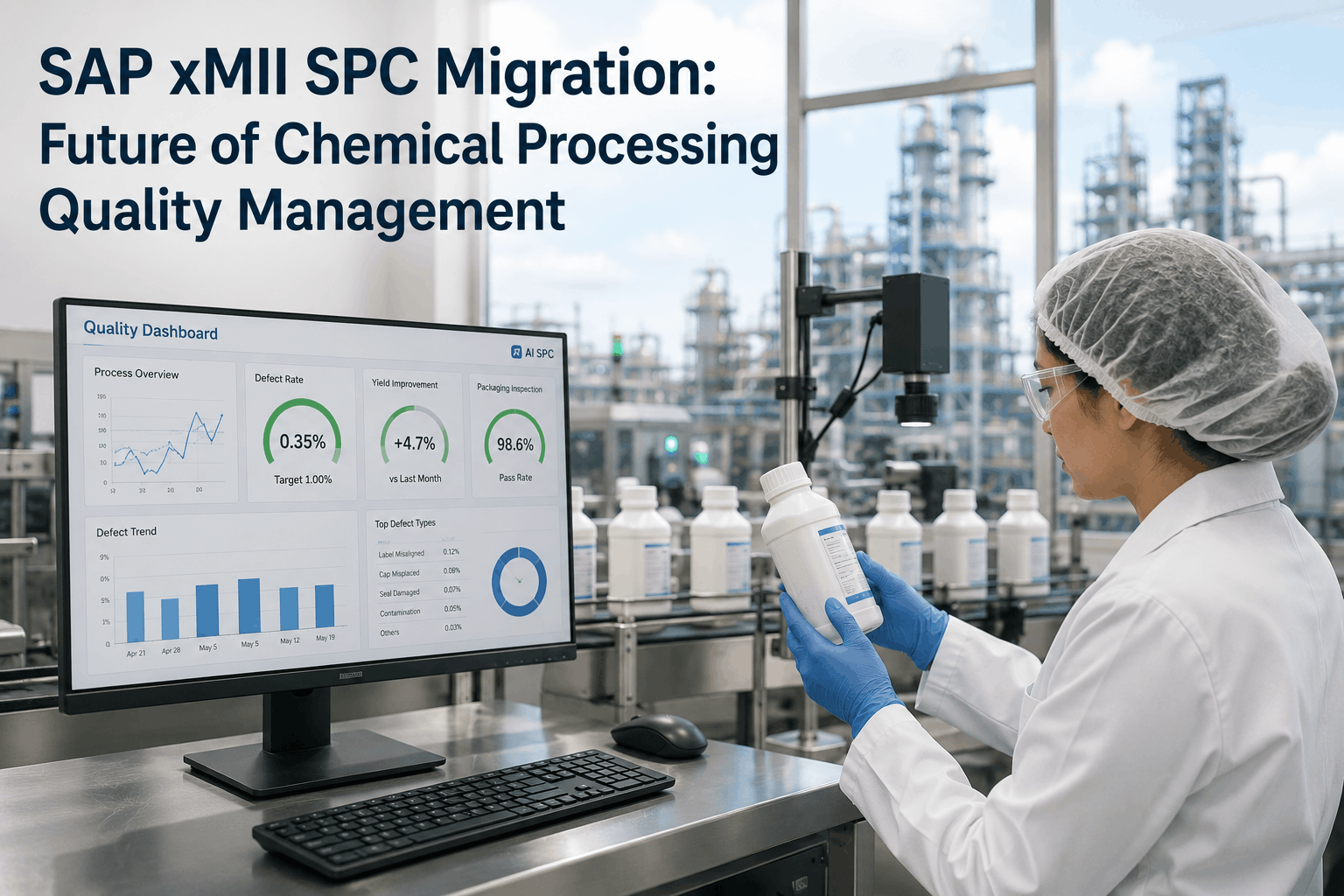
Every chemical processing plant running SAP xMII is managing a countdown — whether they know it yet or not. SAP's formal end-of-support for xMII lands on December 31, 2030. But the real deadline is not 2030. It is the moment your plant's batch inconsistency, compliance gap, or quality escape becomes more expensive than the migration you have been deferring. AI-native Statistical Process Control (SPC) with integrated vision inspection is not a future-state concept — it is already running in 155+ chemical facilities, delivering 36% reductions in off-spec batches and 44% batch consistency improvements. The question is no longer whether to replace SAP xMII. It is whether your plant leads that migration or scrambles at the end. Book an AI SPC Migration Workshop with iFactory.
Chemical Processing · SAP xMII Migration
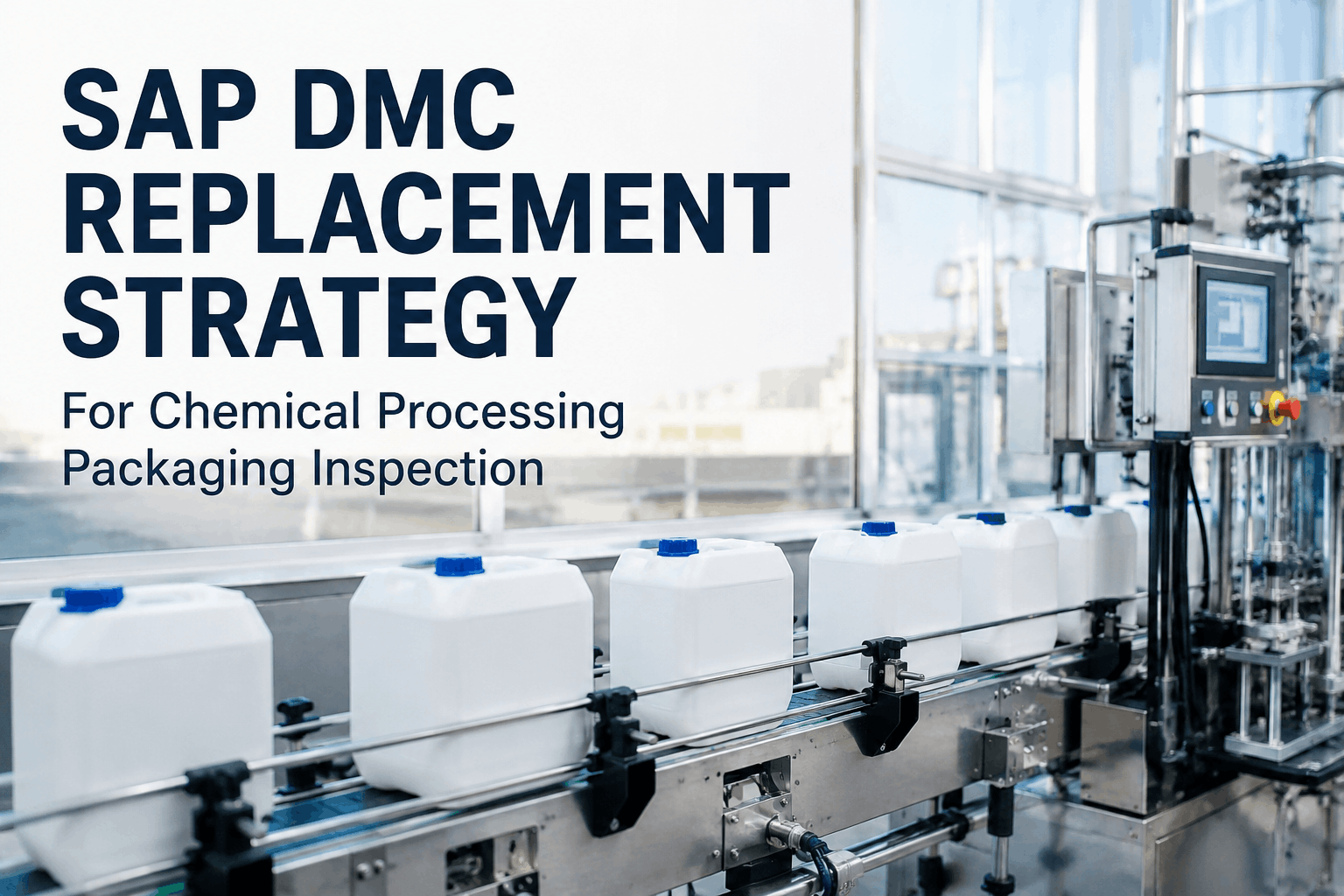
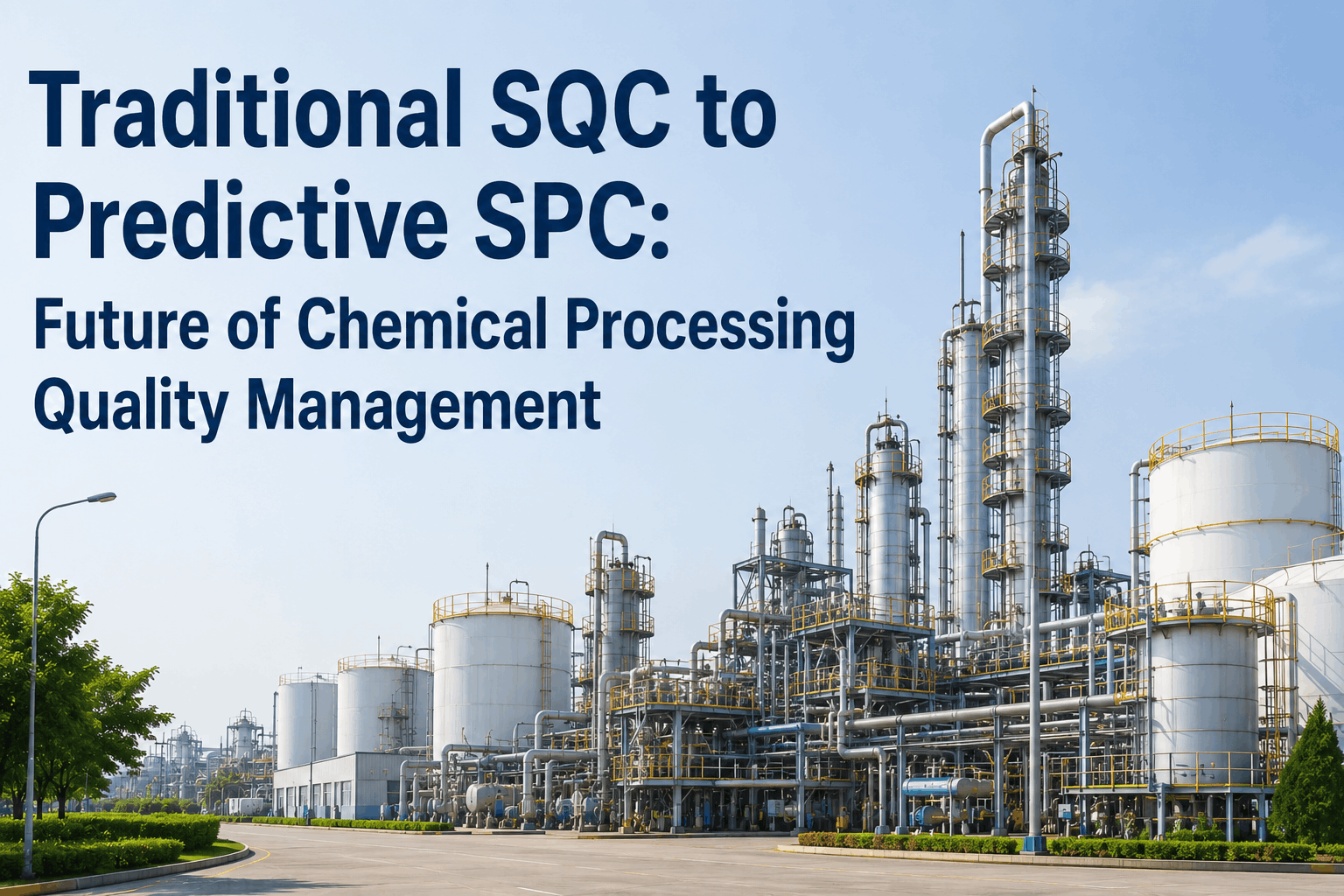
SAP DMC Replacement Strategy: The Future of Chemical Processing Quality Management
Replace SAP xMII with AI-native SPC and vision inspection — batch consistency gains, faster compliance, and zero disruption to your SAP ERP investment.
SAP xMII Support Ends
2030
Dec 31 · Less than 5 years
36%
Reduction in off-spec batches
44%
Batch consistency improvement
$540K+
Annual value per facility
155+
Chemical facilities deployed
Why SAP xMII Can No Longer Deliver Batch Quality in 2026
SAP xMII was purpose-built to bridge shop-floor data with enterprise ERP at a time when "intelligence" meant structured data collection and rule-based alerts. In chemical batch processing — where product quality is determined by multivariate interactions between temperature, pressure, pH, agitation speed, reagent concentration, and residence time — those rule-based approaches produce systematic blind spots. The batch has already drifted before a single-variable alarm fires. Talk to our chemical processing team about mapping your current SAP xMII quality gap.
The SAP xMII Quality Intelligence Gap
Batch Drift Detection
Single-variable alarm — fires late
Multivariate AI — detects 4–12h early
Vision Inspection
Manual sampling & offline lab
AI vision — every batch, real-time
Off-Spec Prediction
Found at end-of-batch testing
Predicted mid-batch, corrected in-run
Operator Guidance
Static control charts, manual review
Live AI recommendations on screen
Compliance Audit Trail
Batch records manually assembled
Automated, timestamped, regulator-ready
Cross-Site Visibility
Siloed per plant, no benchmarking
Cloud-unified across all facilities
AI Vision Inspection: The Capability SAP xMII Was Never Built For
The most significant gap in SAP xMII-era quality management is visual inspection. Chemical batch quality includes attributes — color consistency, particle distribution, surface contamination, foam level, crystallization uniformity — that cannot be captured by process sensors alone. Traditional plants resolve this with manual sampling and laboratory analysis, introducing 2–6 hour delays between product condition and quality decision. AI vision inspection eliminates that gap entirely. Book a demo to see AI vision inspection integrated with iFactory SPC.
V
Real-Time Visual Quality Gates
Computer vision cameras positioned at batch discharge, packaging lines, and inspection stations capture high-resolution images of every product unit. AI models trained on your specific batch attributes — color delta, particle size distribution, surface uniformity — flag deviations in under 200 milliseconds, before non-conforming material moves downstream.
Detection latency: <200ms vs 2–6h manual
B
Batch-to-Batch Visual Consistency Scoring
AI vision models build a statistical baseline of your target product appearance across hundreds of reference batches. Every new batch receives an automated consistency score against that baseline. Operators see which visual attributes are drifting — and by how much — before the batch is committed to packaging or shipment.
Consistency tracking: 100% of batches, not 5% sampled
C
Compliance Documentation Without Manual Records
Every vision inspection result — image capture, AI score, pass/fail decision, timestamp, batch ID — is automatically written into the iFactory quality record and linked to the corresponding SAP batch number. Compliance audits require no manual assembly of batch records. The documentation is already complete.
Audit prep time: 90% reduction vs. manual batch records
P
Process Parameter Correlation
Vision inspection results are automatically correlated with upstream process parameters — reactor temperature, agitation speed, reagent ratios. AI identifies which process variables most strongly predict visual quality outcomes, enabling process engineers to correct upstream conditions before visual failures appear — not after.
Root cause identification: hours vs. weeks
On-Premise or Cloud: iFactory Fits Your Data Architecture
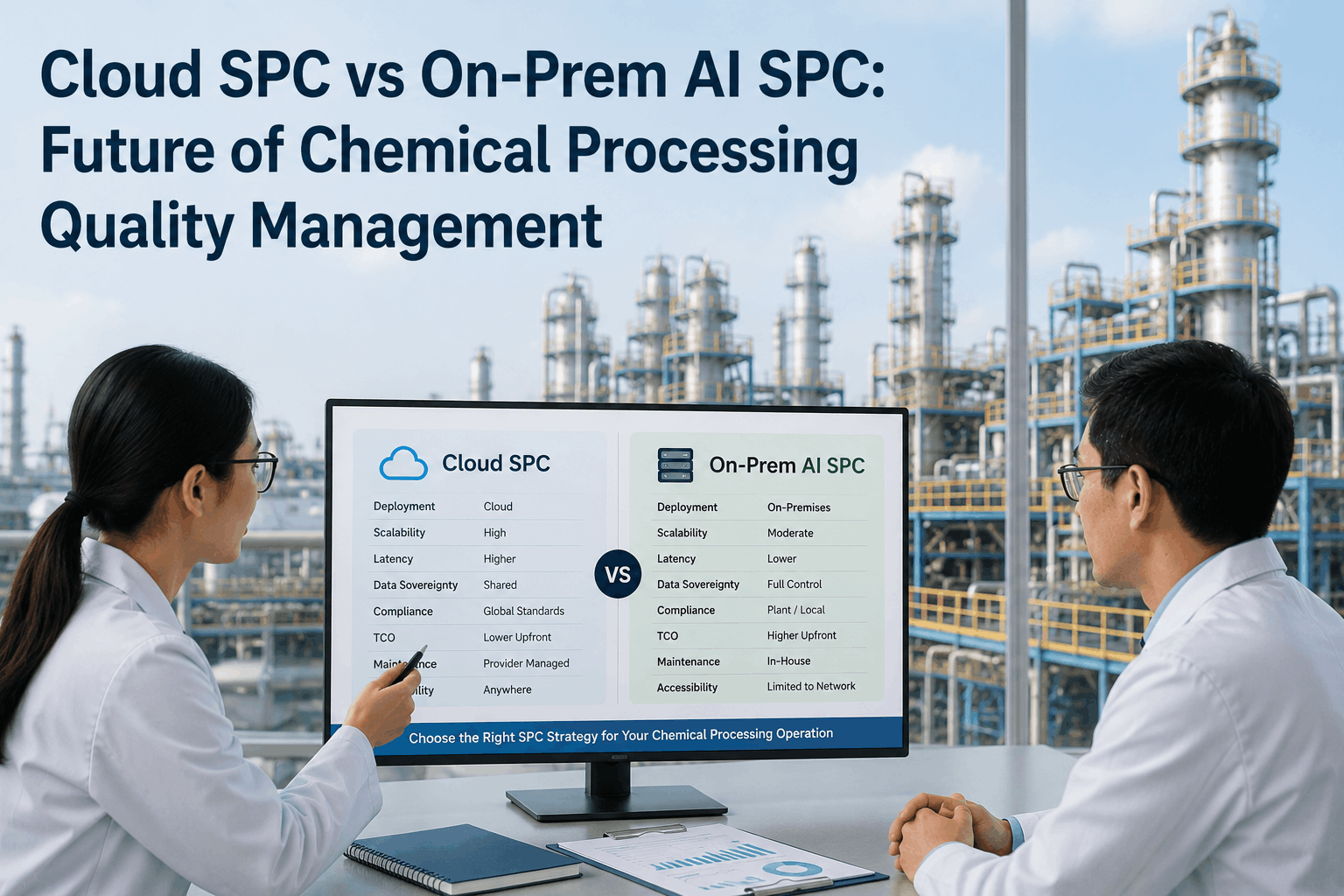
Chemical processing plants have specific data governance requirements. Batch formulations, process parameters, and quality specifications represent proprietary IP. Some plants require all data to remain on-site; others need multi-facility consolidation across global networks. iFactory delivers both — with full feature parity across deployment models.
On-Premise
Data Sovereignty & Control
Batch & vision data never leaves facility
Formulation IP protected — zero cloud routing
Direct DCS / historian / LIMS integration
Air-gap mode available for secure environments
Real-time SPC alerts without internet dependency
OR
Both deliver identical SPC intelligence & vision quality integration
Cloud
Multi-Site Visibility & Scale
Batch quality consolidated across all plants
Cross-site consistency benchmarking
Mobile dashboards — quality anywhere, any device
Automatic AI model updates — always current
Scales from single pilot line to enterprise network
The 5-Phase Migration Roadmap
Replacing SAP xMII in a batch-critical chemical plant cannot be a big-bang project. Every phase must be designed so production never stops and quality records remain uninterrupted. Here is the architecture that 155+ facilities have used successfully. Talk to our migration specialists to map this framework to your specific plant configuration.
xMII Workload Inventory
Catalogue all BLS transactions, xMII queries, SSCE pages, and custom action blocks. Tag each as: keep, transform, replace, or retire. Identify data residency constraints that determine deployment architecture. Output: Complete migration scope with effort estimates.
Single-Product AI SPC Pilot
Deploy AI-native SPC on your lowest-risk batch product. Validate DCS integration, SAP batch record linkage, and vision inspection accuracy. Measure batch consistency improvement against SAP xMII baseline. Output: Proven ROI before plant-wide commitment.
Parallel Run — Both Systems Live
Run AI-native SPC and SAP xMII simultaneously. All batches flow through both systems. Operators validate that new platform decisions match expected outcomes while experiencing AI-enhanced insights side by side. Output: Operator confidence and validated system behavior.
Batch-By-Batch Cutover
Redirect production batches from SAP xMII to AI-native SPC product category by product category. Not a big-bang switch. SAP xMII stays live in read-only mode for legacy records during transition. Output: 80%+ of batch production on new platform.
Decommission & Continuous Optimization
Retire SAP xMII (archive-only for compliance history). Activate advanced AI model optimization using 6+ months of production data. Configure cross-site benchmarking if multi-facility cloud deployment. Output: Full migration complete, optimization phase begins.
Plant Operator View: What Changes Day-to-Day
Before: SAP xMII
Checks control charts manually every 30–60 minutes
Learns about batch drift at end-of-batch lab report
Relies on paper sampling logs for visual quality records
Cannot tell if current batch will match previous batch
Files compliance records manually at shift end
→
After: AI-Native SPC
AI alerts appear automatically before drift becomes failure
Mid-batch prediction shows off-spec risk 4–12h early
Every batch auto-documented by vision inspection AI
Live consistency score vs. last 50 batches on screen
Compliance records built automatically — always audit-ready
Frequently Asked Questions
Can we keep our SAP ERP and only replace the shop-floor quality layer?
Yes — and that is the recommended migration path. iFactory replaces SAP xMII's shop-floor quality and SPC functions while integrating directly with SAP S/4HANA, SAP ECC, or SAP DMC via standard APIs. Your ERP batch records, production orders, and financial data remain in SAP. Only quality execution and SPC analytics move to the AI-native platform.
How does AI vision inspection integrate with our existing batch inspection stations?
iFactory's vision inspection layer connects to IP cameras, line-scan systems, or hyperspectral imaging systems already installed or newly deployed at your inspection stations. If your plant has no existing vision hardware, we specify the minimum camera configuration for your batch attributes. Vision data is linked to batch records automatically via iFactory's LIMS integration.
Book a workshop to scope your vision inspection configuration.
What is the risk of batch record gaps during the migration transition?
Zero risk if the parallel-run phase is followed. Phase 3 keeps both SAP xMII and iFactory running simultaneously, so every batch has a dual record. Migration only proceeds to cutover once iFactory batch records match SAP xMII records in parallel validation. The transition is a controlled switch, not a record gap.
Does iFactory work with our LIMS and DCS systems?
Yes. iFactory connects to leading DCS platforms (Honeywell, Emerson, Yokogawa, Siemens) via OPC-UA and REST APIs, and integrates with standard LIMS platforms (LabVantage, STARLIMS, Thermo Fisher SampleManager) for bidirectional lab result exchange. On-premise deployment keeps all data local; cloud deployment enables multi-site consolidation.
Talk to our integration team to confirm compatibility.
iFactory · AI-Native SPC
Your SAP xMII Replacement Strategy Starts With One Workshop
In a 60-minute AI SPC Migration Workshop, iFactory engineers map your current SAP xMII workloads, identify your fastest-ROI batch product for pilot deployment, and produce a migration roadmap aligned to your 2026–2030 timeline. No commitment required. Available for both on-premise and cloud deployments.
On-Premise Available
Cloud Available
SAP ERP Compatible
AI Vision Inspection
5-Phase Migration Framework



.png)