It's 2:47 AM on a Sunday at a specialty chemical plant in Louisiana. The night shift operator watches the SPC chart on his screen — a perfectly stable trend for batch viscosity, well within the control limits he's used for the past three years. Then the morning shift lab result comes in: the entire batch run is off-spec. 48,000 gallons of polymer intermediate, headed for rework at a cost of $340,000. The SPC chart never flinched because it was blind to the catalyst feed drift that started six hours earlier. Traditional Statistical Quality Control tells you when you've already failed. Self-learning quality systems tell you before the failure happens. The future of chemical processing batch quality control isn't about better control charts. It's about replacing reactive SQC with predictive SPC that learns from every batch.
Move from Traditional SQC to Predictive SPC: Self-Learning Quality Systems for Batch Chemical Processing
Stop discovering off-spec batches at the lab. iFactory's AI-native platform reads every process variable in real time, learns normal drift patterns, and predicts quality deviations 30–90 minutes before they happen. No cloud dependency. No data egress. A working pilot in 6–12 weeks.
Reactive SQC vs. Predictive SPC: What Changes When Quality Learns
Every batch chemical plant runs SPC charts. But traditional SQC is reactive — it flags a violation only after the data has already crossed a fixed control limit. By then, the batch is compromised. iFactory replaces this with self-learning quality systems that build a dynamic model of normal process behavior, then flag deviations the moment they start to form. Here's what that changes in practice.
Without iFactory
- Operator watches static SPC charts that only flag limits after the fact
- Lab results arrive 2–6 hours after batch completion — off-spec discovered too late
- Quality team spends 40% of time investigating false alarms from fixed control limits
- Batch-to-batch variability accepted as normal; no learning from past drifts
- Each off-spec event costs $150K–$500K in rework, blending, or write-off
With iFactory
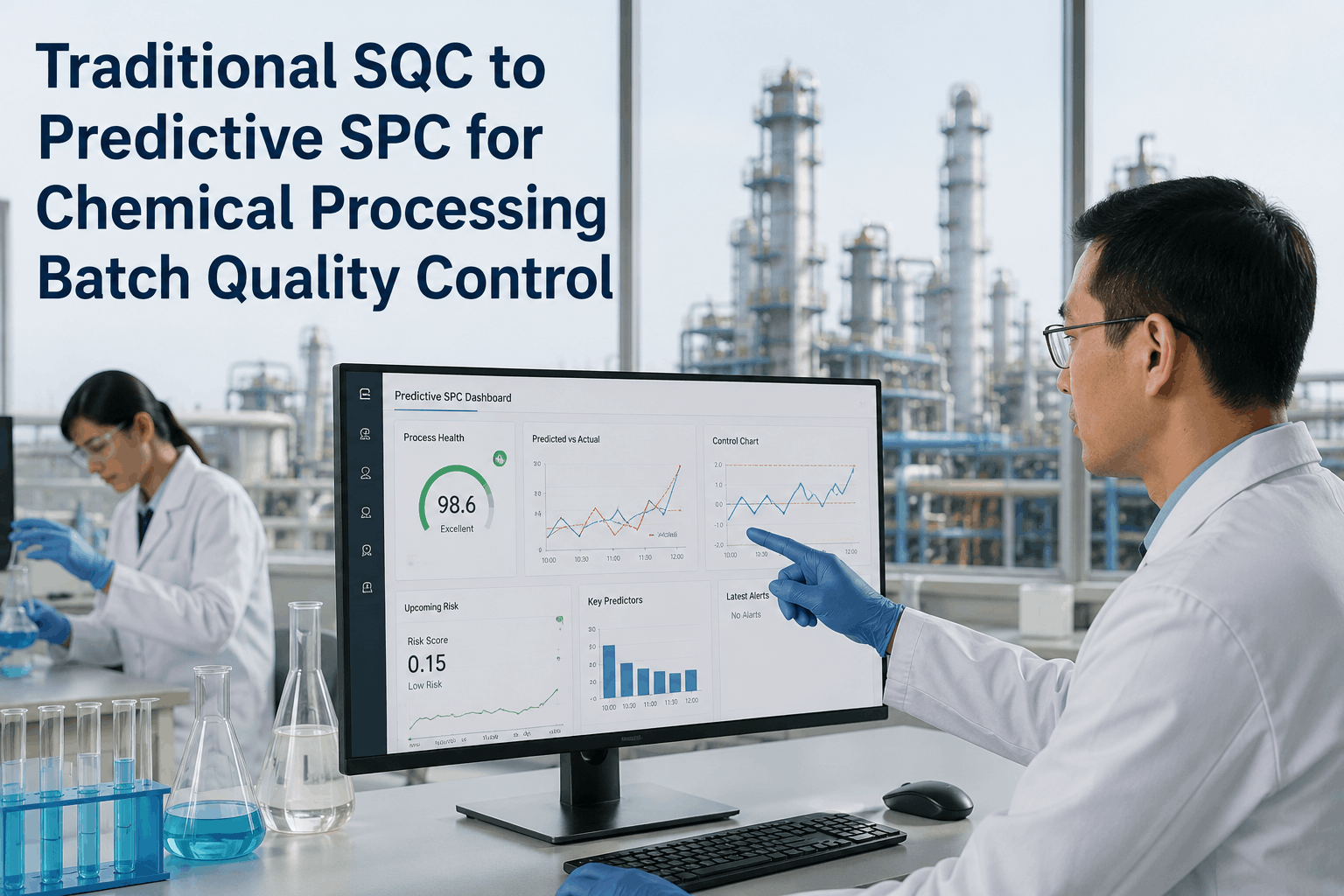
- Operator sees a live risk score per batch — green, yellow, red — updated every second
- Predictive alert fires 30–90 minutes before quality drifts out of spec
- Model learns normal variation per product recipe; false alarms drop below 5%
- Every batch trains the system — drift patterns accumulate into a plant-specific knowledge base
- Off-spec events cut by 70%+; rework cost drops by $2M+/year per plant
Why Traditional SQC Is Burning $2M+ Per Year at Your Plant
Fixed control limits don't account for catalyst aging, feed-stock variability, or ambient temperature shifts. Here's what that costs in real dollars across a typical specialty chemical batch plant.
Off-Spec Batch Write-Offs
When a batch fails final QC, the entire product is either reworked or disposed. Typical batch size: 20,000–60,000 gallons at $5–$12/gallon value. One event costs $100K–$720K.
Rework Energy & Material Waste
Reworking an off-spec batch requires additional heating, cooling, and solvent stripping. Energy costs alone add $15K–$40K per event. Material losses from reprocessing run 5–12%.
Delayed Release & Missed Shipments
An off-spec batch holds up the entire production schedule. Late delivery penalties in chemical contracts run 2–5% of order value. For a $2M order, that's $40K–$100K per delay.
Operator Time on False Alarms
Traditional SPC charts generate 10–20 false alarms per shift. Each requires a walk-down, a log entry, and a supervisor review. At 40% false alarm rate, that's $85K/year in wasted operator time.
Cumulative Yield Loss from Drift
Even batches that pass spec often drift from target, reducing yield by 2–5% across a campaign. Over 200 batches/year at $8/gallon, that's $160K–$400K in lost revenue.
Four Steps from Traditional SQC to Self-Learning Quality Systems
iFactory doesn't replace your existing sensors or DCS. It sits alongside them, ingesting the same data your SPC charts use, then builds a predictive model that learns from every batch. Here's the deployment sequence for your plant.
Connect to Existing Data Sources
iFactory connects to your DCS, PLCs, and LIMS via OPC UA or direct historian read. No new sensors. No changes to your control system. We ingest 2–4 weeks of historical batch data to seed the model.
Model Learns Normal Process Behavior
The self-learning engine identifies the statistical fingerprint of a good batch — temperature ramps, pressure profiles, catalyst feed rates, and their interdependencies. It builds a dynamic baseline that accounts for recipe changes, seasonal shifts, and equipment aging.
Real-Time Predictive Alerts
During every active batch, iFactory compares live process data against the learned model. When a variable starts to drift outside the dynamic envelope, it issues a color-coded alert 30–90 minutes before the lab would catch it. Operators see the risk on a simple dashboard.
Continuous Learning from Every Batch
Each completed batch — good or bad — trains the model further. The system accumulates a plant-specific knowledge base of drift patterns, root causes, and correction actions. Predictive accuracy improves with every cycle.
What Self-Learning Quality Systems Deliver for Chemical Batch Operations
Beyond simple SPC charting, iFactory's AI-native platform gives your operators and engineers the tools to predict quality, not just measure it.
Batch-Level Predictive Risk Score
Every active batch gets a real-time risk score from 0–100. Green (0–30) means on track. Yellow (30–70) means a variable is drifting — corrective action window open. Red (70–100) means off-spec likely within 30 minutes. Operators act before the lab confirms failure.
Recipe-Specific Dynamic Baselines
The model learns separate normal behavior for each product recipe. When you switch from Polymer A to Polymer B, the baseline shifts automatically. No manual recalibration. No false alarms from recipe transitions.
Drift Pattern Library & Root Cause Tracing
Every drift event is logged with the process variables that triggered it. Over time, iFactory builds a library of recurring drift signatures — e.g., "catalyst feed pump degradation" vs. "feed-stock viscosity shift." Operators see the most likely root cause alongside the alert.
Yield Optimization Recommendations
For batches that stay within spec, iFactory identifies opportunities to tighten process windows and increase yield. The model suggests target shifts for temperature, pressure, or feed rates that could improve output by 2–5% without risking quality.
Your SPC charts are already collecting the data. iFactory just makes them learn. Book a 30-minute walkthrough and see a live demo with chemical batch data.
End-to-End Predictive Quality — No Cloud, No Data Egress, No Integration Headaches
iFactory is an on-premise, turnkey appliance that connects to your existing plant network and starts delivering value in weeks. Here's exactly what's included.
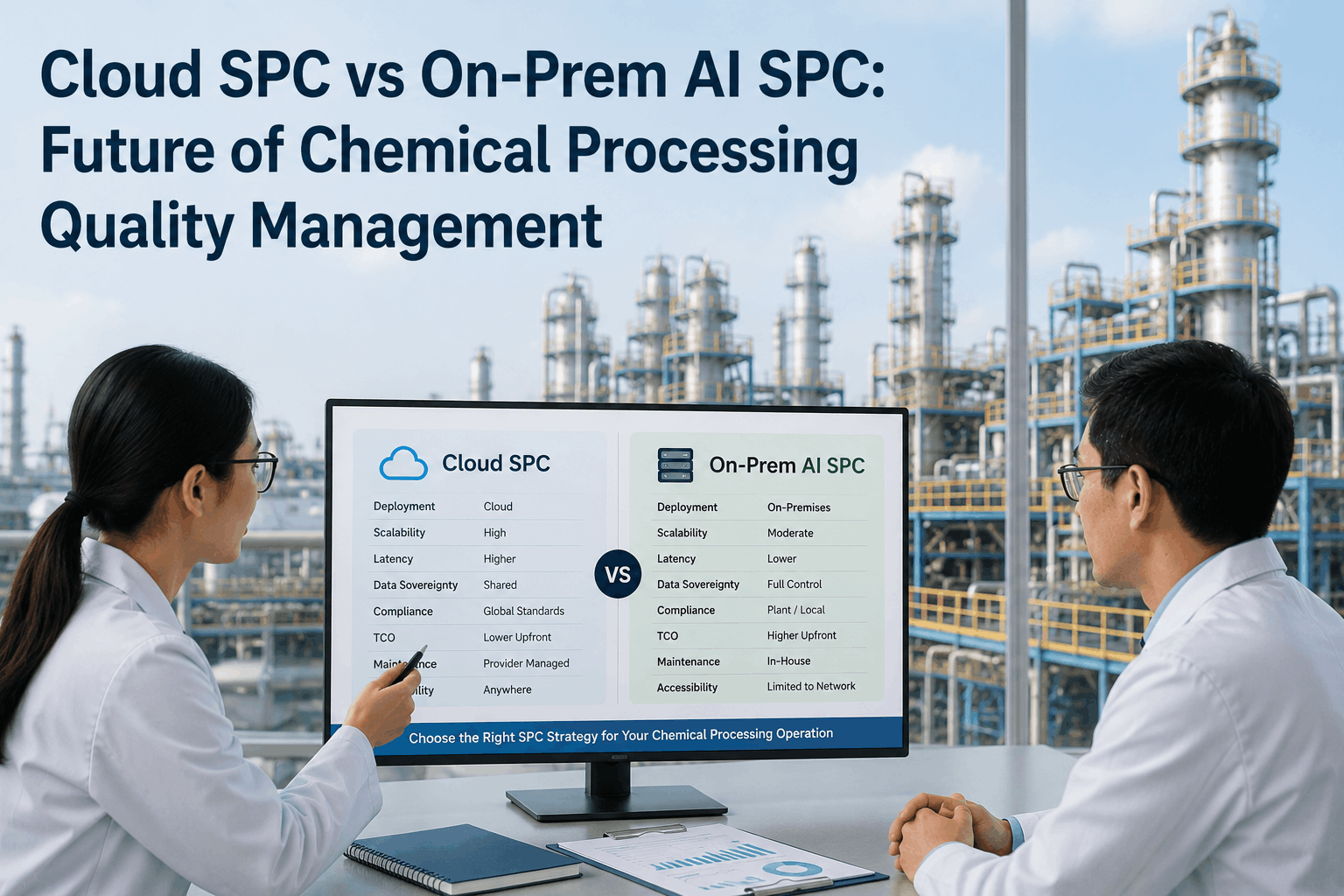
On-Premise NVIDIA Appliance
Zero cloud dependency. Zero data egress. The entire AI engine runs on your plant network behind your firewall. No IT security review for data leaving the site.
6–12 Week Pilot to First Alert
We connect to your DCS, train the model on 2–4 weeks of historical data, and deliver the first predictive alert within one quarter. No multi-year implementation.
Self-Learning Quality Engine
The core AI model that replaces traditional SPC with dynamic, recipe-aware predictive analytics. Learns from every batch. No manual tuning.
Operator Dashboard & Mobile Alerts
Simple green/yellow/red risk display on plant-floor screens and mobile devices. No training required. Operators see what matters in real time.
24x7 Managed Service
iFactory's operations team monitors your appliance, retrains models as needed, and provides monthly performance reviews. Your team focuses on operations, not AI maintenance.
Drift Pattern Reporting
Weekly and monthly reports showing drift events, root cause categories, and yield impact. Data your quality team can use for continuous improvement programs.
Common Questions About Moving from Traditional SQC to Predictive SPC
Stop discovering off-spec batches at the lab. Start predicting them.
Your SPC data is already flowing. iFactory just makes it learn. We'll show you a live demo with chemical batch data in 30 minutes. No sales pitch. Just the product.


.png)