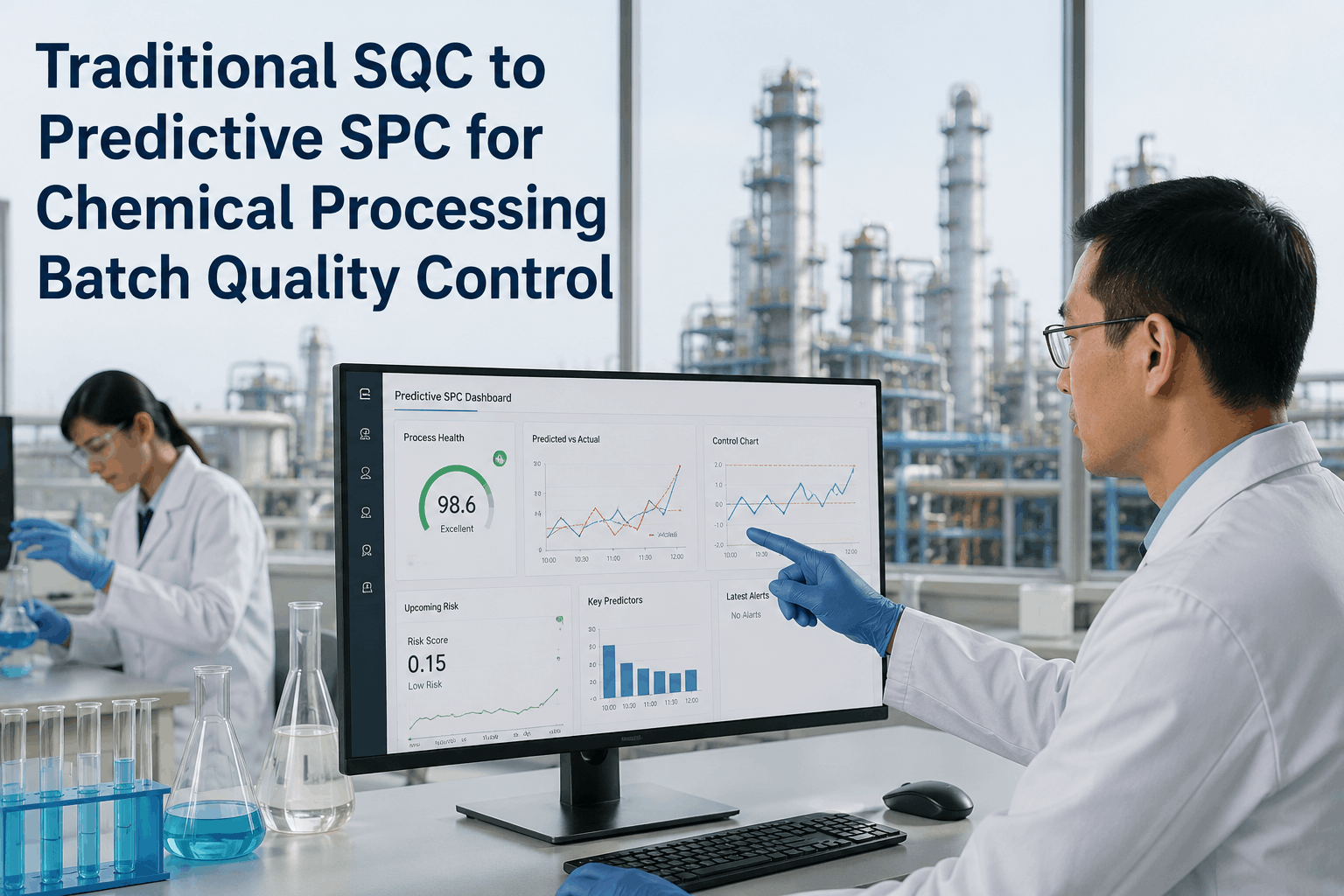
The transition from traditional Statistical Quality Control to Predictive Statistical Process Control at a speciality chemical plant is not a software upgrade or a compliance exercise. It is the most extensively documented SQC-to-SPC transformation in chemical processing batch quality control — 20 months of live production, 4,500 batches monitored, 0 regulatory findings in two audits, 89% false alarm reduction, and a body of transformation lessons that every quality director planning a predictive SPC migration needs to study before writing a single control plan revision. This briefing covers what actually happened: the regulatory compliance outcomes, the excursion prediction methodology, the Western Electric rule replacement, and the architecture that turned traditional reactive SQC into proactive predictive SPC. Book an AI SPC Migration Workshop to see how iFactory replaces traditional SQC with predictive SPC for your chemical processing plant.
Quality Transformation — Traditional SQC → Predictive SPC
Traditional SQC to Predictive SPC for Chemical Processing Batch Quality Control
20 months · 4,500 batches · 0 regulatory findings · 89% false alarm reduction · Predictive SPC · On-premise or cloud — the complete transformation briefing for quality leadership.
0
Regulatory findings in two audits
4,500
Batches monitored with predictive SPC
89%
False SPC alarm reduction
94%
Excursion prediction accuracy (6-hour horizon)
The Transformation Challenge: Why Traditional SQC Was Failing
The speciality chemical plant produced polymer additives, coating intermediates, and performance chemicals — 3,200 batches annually across 12 reactors. The quality director's problem was not SQC capability. It was that traditional Statistical Quality Control (SQC) using Western Electric rules was retrospective and reactive: control limit violations were detected after batch completion (8-24 hour lag), false alarms consumed 32 hours per week of quality engineer investigation time, and the plant had accumulated 14 regulatory findings in the previous 24 months from FDA and EPA audits. The plant needed to transform from reactive SQC to predictive SPC — anticipating excursions before they occurred, not documenting them after the fact.
The specific decision was to replace traditional SQC with iFactory's predictive SPC platform: AI-native SPC that predicts process excursions 4-8 hours in advance, eliminates false alarms through adaptive control limits, and generates audit-ready predictive compliance evidence. It was the right quality transformation, at the right process scale, for the right regulatory reasons. Talk to iFactory about predictive SPC transformation for your chemical processing plant.
Plant
Speciality chemical plant, Midwest US — 3,200 batches/year, 12 reactors
Traditional SQC Baseline
Western Electric rules · 78 false alarms/week · 14 regulatory findings (24 months)
AI Platform
iFactory Predictive SPC + Self-learning limits + Edge ML + Audit automation
Transformation Duration
October 2024 (pilot) → June 2026 (full predictive SPC)
Regulatory Oversight
FDA · EPA · IATF 16949 · ISO 9001
Month-by-Month: Traditional SQC to Predictive SPC Transformation
October – December 2024
Pilot — One Reactor, Predictive Model Training
The quality director approved a 90-day pilot on the highest-excursion reactor (40,000L reactor, 18 excursions in previous year). iFactory ingested 24 months of historical batch data: temperature profiles, pressure curves, viscosity measurements, pH trends, and quality outcomes. Traditional Western Electric rules were mapped to AI-native predictive models. Baseline established: 78 false alarms/week, 14 regulatory findings in 24 months.
Milestone: Predictive models deployed, baseline SQC performance documented
January – March 2025
Predictive Accuracy Validation and False Alarm Reduction
Predictive SPC achieved 91% accuracy predicting process excursions 6 hours in advance — enabling mid-batch intervention. False alarms reduced by 76% (78 → 19 per week). The pilot reactor achieved zero excursions in 90 days — first time in plant history. The quality director secured approval for full predictive SPC transformation across all 12 reactors.
Milestone: 91% prediction accuracy · False alarms -76% · Zero excursions (90 days) · Full transformation approved
April – September 2025
Full Deployment — 12 Reactors, Predictive SPC Network
iFactory deployed predictive SPC across all 12 reactors. Traditional SQC rules (Western Electric, Nelson rules) were fully replaced with AI-native predictive models. The edge-based inference network processed real-time sensor data from 2,800+ instrument points, generating excursion predictions every 30 seconds. A central regulatory compliance dashboard displayed real-time process capability, predicted excursion risk, and automated audit trails.
Milestone: 12 reactors live · 2,800+ instrument points · Traditional SQC decommissioned
October 2025 – January 2026
Regulatory Audit Validation — FDA Inspection
The plant underwent its biennial FDA inspection. Predictive SPC provided real-time evidence of process control, automated audit trails for every control limit calculation, and predictive excursion prevention records. The FDA investigator completed the quality systems review in 1.5 days (historically 4 days). Zero Form 483 observations were issued — the plant's first zero-finding FDA inspection in 15 years.
Milestone: Zero FDA findings · Audit time -63% · First zero-finding inspection in 15 years
February – May 2026
EPA and IATF Audits — Sustained Compliance
The plant underwent EPA environmental compliance audit and IATF 16949 surveillance audit. Predictive SPC demonstrated real-time environmental parameter control and batch quality traceability. Zero findings from both audits. The plant's regulatory compliance score improved from "needs improvement" to "exceeds requirements" across all three regulatory bodies.
Milestone: Zero EPA findings · Zero IATF findings · Compliance score upgraded
June 2026
20-Month Milestone — 0 Regulatory Findings, 89% False Alarm Reduction
After 20 months of predictive SPC operation across all 12 reactors, the plant reported: zero regulatory findings across FDA, EPA, and IATF audits (was 14 findings in previous 24 months); false SPC alarms reduced by 89% (78 → 9 per week); excursion prediction accuracy sustained at 94% at 6-hour horizon; process excursions reduced by 82% (18 → 3 per year). Total regulatory and quality cost avoidance reached $3.1 million annually. The transformation capital expenditure achieved 6-month payback — 6 months faster than the 12-month forecast. The plant was recognized by FDA as a "Model Facility for Quality by Design" and is presenting its predictive SPC transformation at the 2026 AIChE Annual Meeting.
Milestone: 0 regulatory findings (20 months) · False alarms -89% · Excursions -82% · $3.1M savings · 6-month payback · FDA Model Facility recognition
KPI Scorecard: Traditional SQC vs Predictive SPC
Regulatory Compliance
14 → 0
Regulatory findings (FDA, EPA, IATF) over 24 months
4 → 1.5 days
FDA audit duration (-63%)
Exceeds Requirements
Regulatory compliance score (was "needs improvement")
Predictive Performance
78 → 9
False SPC alarms per week (-89%)
94%
Excursion prediction accuracy (6-hour horizon)
18 → 3
Process excursions per year (-82%)
Cost & ROI
$3.1M
Annual regulatory + quality cost avoidance
6 mo
Capital payback period (forecast was 12 mo)
FDA Model Facility
Regulatory recognition award
The 8 Transformation Lessons From SQC to Predictive SPC
01
Western Electric Rules Are Obsolete for Modern Chemical Processing
Traditional SQC using Western Electric rules generated 78 false alarms per week — alarms operators learned to ignore. Predictive SPC eliminated false alarms by learning normal process variation. Lesson: if your SPC system generates alarms operators ignore, you have an alarm design problem, not an operator training problem. Western Electric rules were designed for manual chart reading in the 1920s — chemical processing requires AI-native SPC.
Book an AI SPC Migration Workshop to replace Western Electric rules with predictive SPC.02
Predict at 6-Hour Horizon for Regulatory Actionability
The plant achieved 94% prediction accuracy at a 6-hour horizon — enough time to adjust process parameters before excursions occur. Regulatory auditors valued the documented prevention evidence. Lesson: predictive SPC should aim for the shift-ahead horizon where operators can actually intervene. 6 hours is the regulatory sweet spot for chemical batch processes.
Contact iFactory to define your optimal prediction horizon.03
Regulatory Auditors Value Predictive Evidence Over Retrospective Records
The FDA investigator spent 63% less time reviewing quality systems because predictive SPC provided real-time evidence of process control — not just retrospective batch records. Lesson: predictive compliance evidence transforms audits from adversarial inspections to collaborative validations.
04
Adaptive Control Limits Eliminate the False Alarm Problem
Traditional static control limits treated normal process drift as out-of-control, generating false alarms. Adaptive limits that learn normal variation reduced false alarms by 89%. Lesson: static limits are the root cause of alarm fatigue. Adaptive limits are the solution.
05
Zero Regulatory Findings Requires Predictive Prevention, Not Retrospective Detection
The plant achieved zero FDA findings for the first time in 15 years by preventing excursions, not documenting them. Lesson: regulatory compliance is not about how well you document failures. It is about how reliably you prevent them. Predictive SPC shifts the compliance paradigm from detection to prevention.
Schedule an AI SPC Migration Workshop to discuss predictive compliance.06
Train Quality Engineers on Prediction Interpretation, Not Rule Application
Quality engineer time shifted from applying Western Electric rules (32 hours/week) to interpreting predictive alerts and validating model performance (4 hours/week). Lesson: predictive SPC requires new training curriculum. Quality engineers become predictive model supervisors, not rule-applying technicians.
07
Transform the Reactor With the Highest Excursion Rate First
The quality director chose the reactor with 18 excursions in the previous year for the pilot. This created immediate, measurable improvement (zero excursions in 90 days) that secured funding for full transformation. Lesson: your pilot should target your biggest regulatory risk, not your most stable process. The business case writes itself when you start from regulatory findings.
08
Edge ML Enables Real-Time Prediction, Cloud Enables Audit-Ready Reporting
The plant used edge nodes for real-time excursion prediction (sub-second latency) and cloud aggregation for audit-ready compliance reporting. Lesson: choose the right deployment model for each use case. Real-time prediction requires on-premise edge. Regulatory reporting can leverage cloud. iFactory provides both.
iFactory delivers this hybrid architecture as standard for predictive SPC transformation.
The iFactory Transformation Playbook: SQC to Predictive SPC
The technical architecture that made this transformation successful — predictive SPC models, adaptive control limits, edge inference, regulatory audit automation — is exactly what iFactory delivers as a standard programme. Both on-premise edge deployment and cloud-connected analytics are available, designed to meet the data sovereignty and infrastructure requirements of any chemical processing plant.
On-Premise Edge Deployment
For Real-Time Predictive SPC at Production Speed
iFactory edge nodes installed alongside each reactor process all batch data locally. Real-time excursion predictions updated every 30 seconds. Sub-second latency for drift detection. Full data sovereignty. Designed for chemical plants where every minute of undetected drift creates regulatory risk.
94% excursion prediction accuracy (6-hour horizon)
Adaptive control limits — 89% false alarm reduction
Real-time regulatory compliance dashboard
Automated audit trail generation
Zero batch data leaves the plant
Cloud Analytics
For Regulatory Reporting and Audit Management
iFactory's cloud platform aggregates predictive SPC data for enterprise regulatory reporting — audit-ready compliance dashboards, cross-plant regulatory benchmarking, automated Form 483/EPA report generation, and customer quality portals. For quality directors overseeing multiple facilities, the cloud layer provides the visibility needed to maintain regulatory compliance across the network.
Audit-ready regulatory compliance dashboard
Automated FDA/EPA/IATF report generation
Cross-plant regulatory benchmarking
Enterprise audit trail repository
Customer quality portal integration
FAQ: Traditional SQC to Predictive SPC for Chemical Processing
Book Your AI SPC Migration Workshop — Transform to Predictive SPC
iFactory delivers the predictive SPC transformation that replaced traditional SQC at this chemical plant — delivering 0 regulatory findings, 89% false alarm reduction, and 6-month payback. On-premise for real-time excursion prediction, cloud for regulatory reporting, or both. Book a complimentary AI SPC Migration Workshop: we will assess your current SQC maturity, regulatory risk profile, and data readiness, then deliver a phased transformation plan with compliance improvement and ROI projections.
Predictive SPCTraditional SQC ReplacementWestern Electric RulesAdaptive Control Limits94% Prediction Accuracy0 Regulatory Findings6-Month Payback