The batch record for lot 4027 shows a pH drift of 0.14 units starting at the 37-minute mark in reactor 3. The control chart didn't flag it — the static Shewhart limits were too wide to catch a shift that small. The operator on shift 2 saw nothing unusual. The batch passed all QC hold points. But the customer's incoming inspection rejected the entire pallet of 1,800 kg because the viscosity profile was off-spec. Rework cost: $47,000. Lost capacity on reactor 3: 14 hours. This is the hidden tax of legacy SPC — static models that miss early signals and leave your best operators blind until it's too late.
From Static Charts to AI-Native SPC — Catch Every Sub-Sigma Shift Before It Becomes a Reject
iFactory replaces fixed-limit SPC with adaptive models that learn your process, flag excursions in real time, and trace root causes across 120+ data streams — all on-premise, with zero data leaving your plant network.
AI-Native SPC Purpose-Built for Chemical Processing
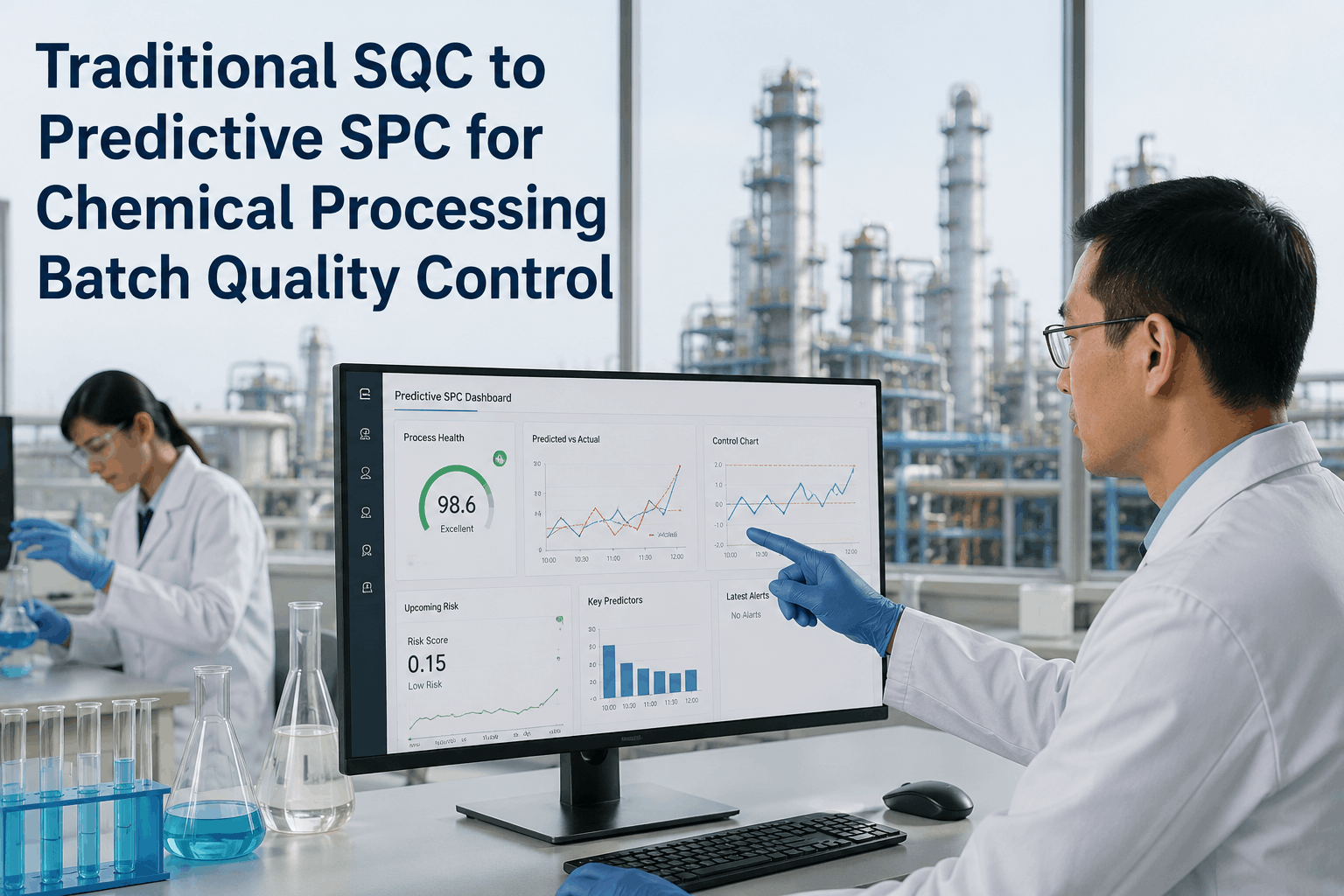
Traditional SPC relies on static control limits calculated from a single historical data set. When your process drifts — catalyst aging, raw material variation, ambient temperature shifts — those limits become useless. iFactory's AI-native SPC platform continuously recalculates control limits in real time, adapting to your process as it runs. It ingests data from DCS, LIMS, PLCs, and historians at native frequency, builds adaptive models for every critical quality attribute (CQA), and surfaces alarms only when the model detects a genuine excursion — not a false positive. The result: you catch batch-to-batch variability at the first deviation, not the final inspection.
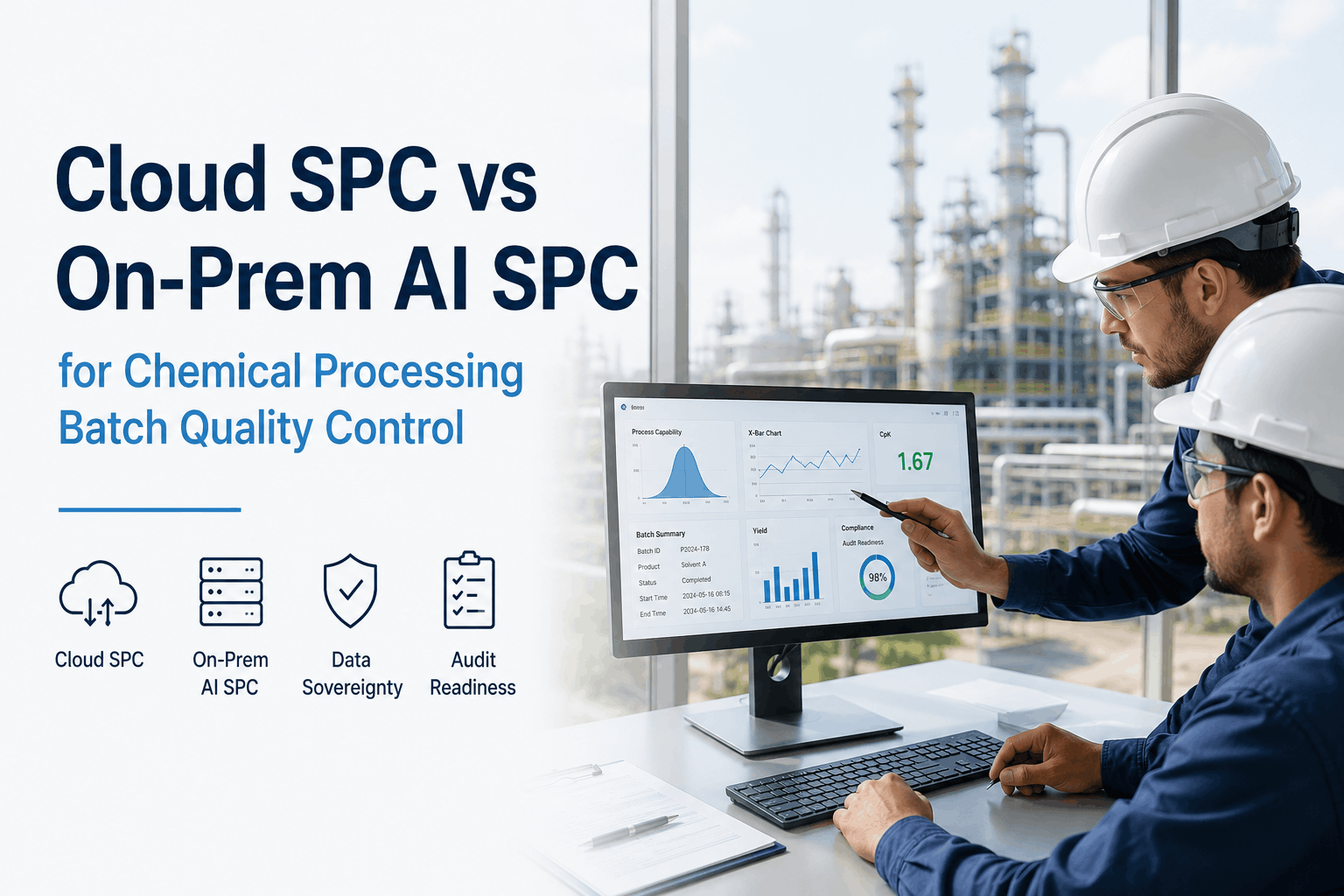
iFactory runs entirely on an NVIDIA appliance inside your plant network. No cloud dependency. No data egress. And it integrates with your existing sources in 6–12 weeks — we handle data-source mapping, model training, and operator dashboard configuration as part of the turnkey deployment.
Six Core Capabilities That Replace Static SPC
Each capability is a standalone module that works together as a unified platform. Deploy them selectively or all at once.
Self-Learning Control Limits
Models ingest 30+ days of batch data, then continuously update control limits based on real-time process behavior. No manual recalibration. No false alarms from normal process drift.
Multi-Variate Control Charts
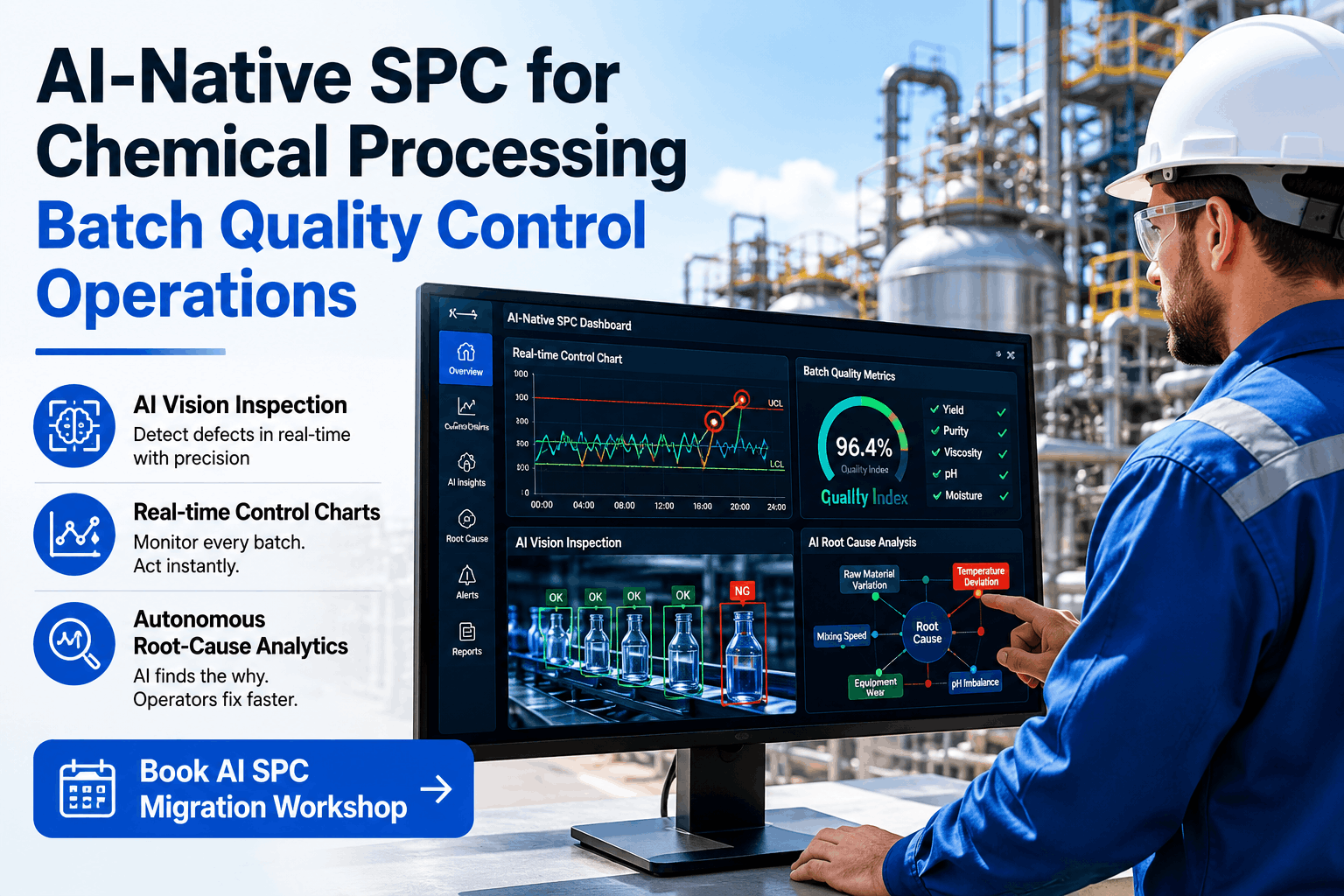
Display X-bar, R, S, and EWMA charts for every CQA simultaneously. Alarms trigger at the first sub-sigma shift — not when the batch is already out of spec.
Autonomous Traceback Engine
When an excursion is flagged, the engine automatically correlates 120+ process variables — temperature profiles, pressure ramps, feed rates — and identifies the most likely root cause in under 15 seconds.
Audit-Ready Batch Records
Every control chart, alarm, and root-cause trace is timestamped and stored in an immutable data lake. Export compliant batch records for FDA, EPA, or REACH audits with one click.
Contextual Alarms & Guidance
Alarms include the specific variable, the deviation magnitude, and a recommended corrective action. Operators don't chase false flags — they act on validated signals.
Native Connectors for DCS, LIMS, PLCs
Pre-built connectors for Emerson DeltaV, Honeywell Experion, ABB 800xA, and 40+ other systems. No custom middleware. No data engineering overhead.
From Legacy SPC to AI-Native in Four Steps
iFactory's deployment model is designed for minimal disruption and maximum speed to value.
Connect Data Sources
We connect to your DCS, LIMS, historians, and PLCs using pre-built native connectors — no middleware, no custom coding.
Train Adaptive Models
Our AI ingests 30+ days of historical batch data to build adaptive SPC models for every CQA, calibrated to your specific process.
Deploy Real-Time Dashboards
Operators get multi-variate control charts with self-updating limits, contextual alarms, and one-click root-cause traces on their existing workstations.
Automate Compliance & Reports
All data is timestamped and stored in an immutable data lake. Export batch records, control charts, and root-cause analyses for any regulatory audit.
What Legacy SPC Is Costing Your Plant Every Batch
Static control limits don't adapt to process drift. The result is a predictable pattern of waste that erodes margins and capacity.
Missed early signals
Static Shewhart limits miss sub-sigma shifts until the batch is out of spec. Average cost per missed detection: $12,000–$47,000 in rework and lost capacity.
Root-cause fire drills
Without autonomous traceback, root-cause analysis takes 4–8 hours per excursion. That's 4–8 hours of engineering time chasing variables that could be automated.
Customer rejections & lost trust
One off-spec batch can trigger a customer quality hold that costs $50,000–$200,000 in penalties and lost future orders. Static SPC can't prevent what it can't see.
Measurable ROI From AI-Native SPC
Chemical processors deploying iFactory see measurable improvements within the first quarter of operation.
Static SPC is costing your plant $200K+ per off-spec batch. Book a 30-min walkthrough and see how iFactory catches every sub-sigma shift in real time.
Questions Chemical Processors Ask About AI-Native SPC
Stop Letting Static SPC Hide Sub-Sigma Shifts
iFactory catches every excursion before it becomes a reject. On-premise. Turnkey. Live in 6–12 weeks. Schedule a demo and see adaptive SPC in action on your own batch data.