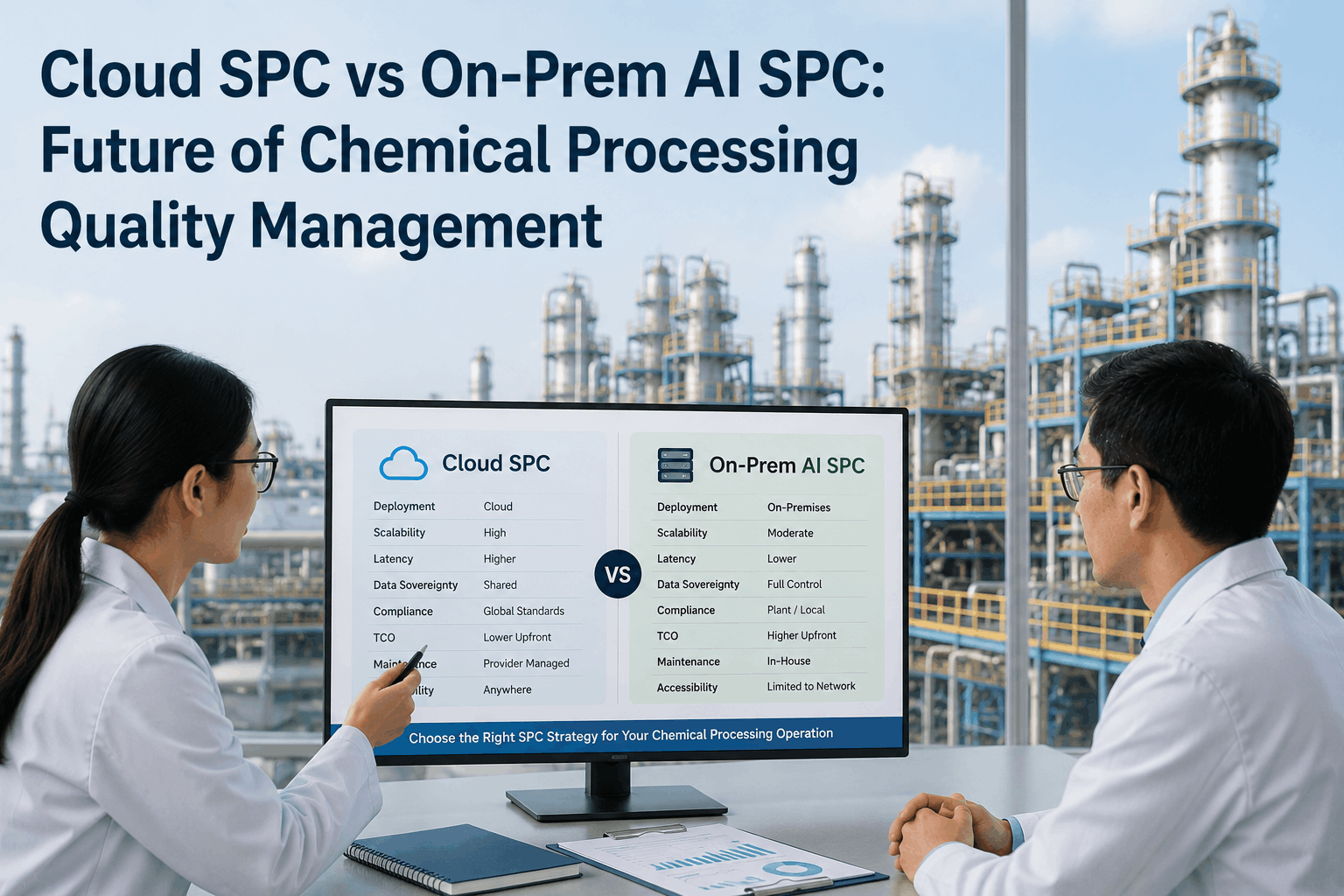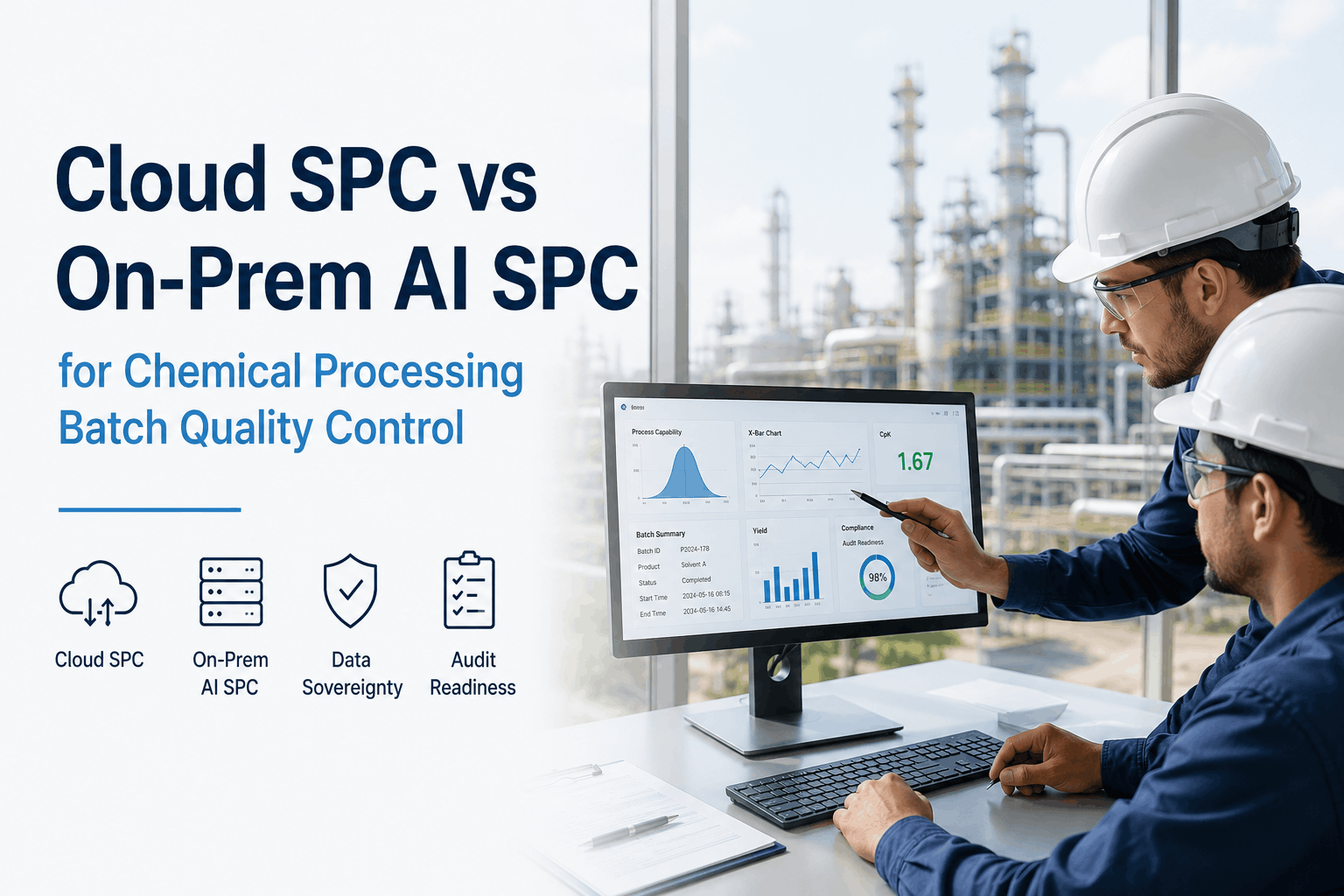
The choice between cloud SPC and on-premise AI SPC for chemical processing batch quality control is not a simple IT procurement decision. It is a strategic architecture choice that affects batch release cycles, audit readiness, data sovereignty, and total cost of ownership for the next decade. This comparison brief examines both deployment models across the dimensions that matter for chemical processors: latency, data sovereignty, audit compliance, predictive accuracy, and TCO. iFactory delivers both deployment models — on-premise edge AI SPC and cloud-native SPC analytics — so you can choose the architecture that fits your plant's specific requirements or run both in hybrid mode. Book an AI SPC Migration Workshop to evaluate the right deployment model for your chemical processing plant.
The Deployment Decision Framework for Chemical Processing Batch Quality
Chemical processing batch quality control has unique requirements that make the cloud vs on-prem decision different from other industries. Batch reactors operate on 4-48 hour cycles, but process drift can cause out-of-spec conditions in minutes. Audit requirements demand tamper-evident quality records. Data sovereignty concerns vary by customer and jurisdiction. This framework helps quality engineers and production managers evaluate which deployment model — or hybrid combination — delivers the best outcome for their specific plant.
Data transmitted from plant to cloud provider for processing and storage. SPC calculations, control limit updates, and alert generation occur in cloud infrastructure. Batch quality records stored off-site. No edge processing capability.
AI agents run on edge servers inside the plant. All SPC processing, control limit calculations, and alert generation occur locally. Batch quality records stored on-site. Cloud optional for analytics and cross-plant learning.
Edge nodes handle real-time SPC prediction and alerts. Cloud aggregates cross-plant benchmarking, trains enhanced models, and distributes learning. Quality records stay on-prem; anonymised KPIs go to cloud.
Dimension 1: Latency — Real-Time vs Retrospective Detection
Latency is the most critical differentiator for batch quality control. Chemical processes can drift from in-spec to out-of-spec in 5-15 minutes. The time between process drift and SPC alert determines whether you can intervene mid-batch or scrap the batch after completion.
Dimension 2: Data Sovereignty — Who Owns Your Batch Quality Records?
Chemical processors face increasing data sovereignty requirements from customers, regulators, and corporate IT policies. Batch quality records contain formulation intellectual property, customer-specific specifications, and process know-how that many companies consider trade secrets.
Dimension 3: Audit Readiness — Instant Evidence vs Retrospective Compilation
Chemical processors undergo IATF 16949, ISO 9001, and customer-specific quality audits. The ability to produce audit-ready SPC evidence on demand is a critical differentiator between deployment models.
| Audit Requirement | Cloud SPC | On-Prem AI SPC |
|---|---|---|
| Real-time control limit audit trail | Usually limited to 30-90 day retention in standard tier | Complete, tamper-evident history — unlimited retention |
| Batch-level SPC evidence | May require data export; latency in retrieval | Instant access; per-batch audit records |
| Control limit change history | Often not tracked or limited to cloud logs | Full audit trail with timestamp and rationale |
| Offline audit capability | Requires internet connection to access records | Full offline access; audit during network outages |
| Customer portal integration | Available but data must leave plant again | Controlled sharing; data never leaves your control |
Dimension 4: Predictive Accuracy — What Data Residency Means for Model Quality
Predictive SPC models require training on your specific batch data. The volume and granularity of that data directly affects prediction accuracy. On-prem deployment enables access to full-resolution process data. Cloud SPC often requires data aggregation or downsampling to manage transmission and storage costs.
Dimension 5: Total Cost of Ownership — 5-Year Comparison
TCO analysis must consider not just software subscription costs but also operational impacts: batch scrap savings, audit preparation time, quality engineer productivity, and unplanned downtime reduction.
Hybrid: The Best of Both Worlds
Many chemical processors choose a hybrid architecture: on-premise edge AI SPC for real-time batch quality prediction and alerting, plus cloud analytics for cross-plant benchmarking and enterprise reporting. This combination delivers sub-100ms latency for intervention, full data sovereignty for quality records, and cloud-based learning that improves all edge models simultaneously.
Decision Matrix: Which Deployment Is Right for Your Plant?
iFactory: Both Deployment Models, One Platform
Unlike vendors that force you into cloud-only or on-prem-only architectures, iFactory delivers both deployment models from a single platform. You choose the architecture that fits your plant — or run hybrid for maximum flexibility.
FAQ: Cloud SPC vs On-Prem AI SPC for Chemical Processing
Book Your AI SPC Migration Workshop — Deployment Strategy
iFactory delivers both on-premise edge AI SPC and cloud analytics from one platform — you choose the architecture that fits your plant. On-prem for real-time batch quality and data sovereignty. Cloud for enterprise benchmarking. Hybrid for both. Book a complimentary AI SPC Migration Workshop: we will assess your batch processes, data sovereignty requirements, and connectivity profile, then deliver a deployment recommendation with TCO comparison.