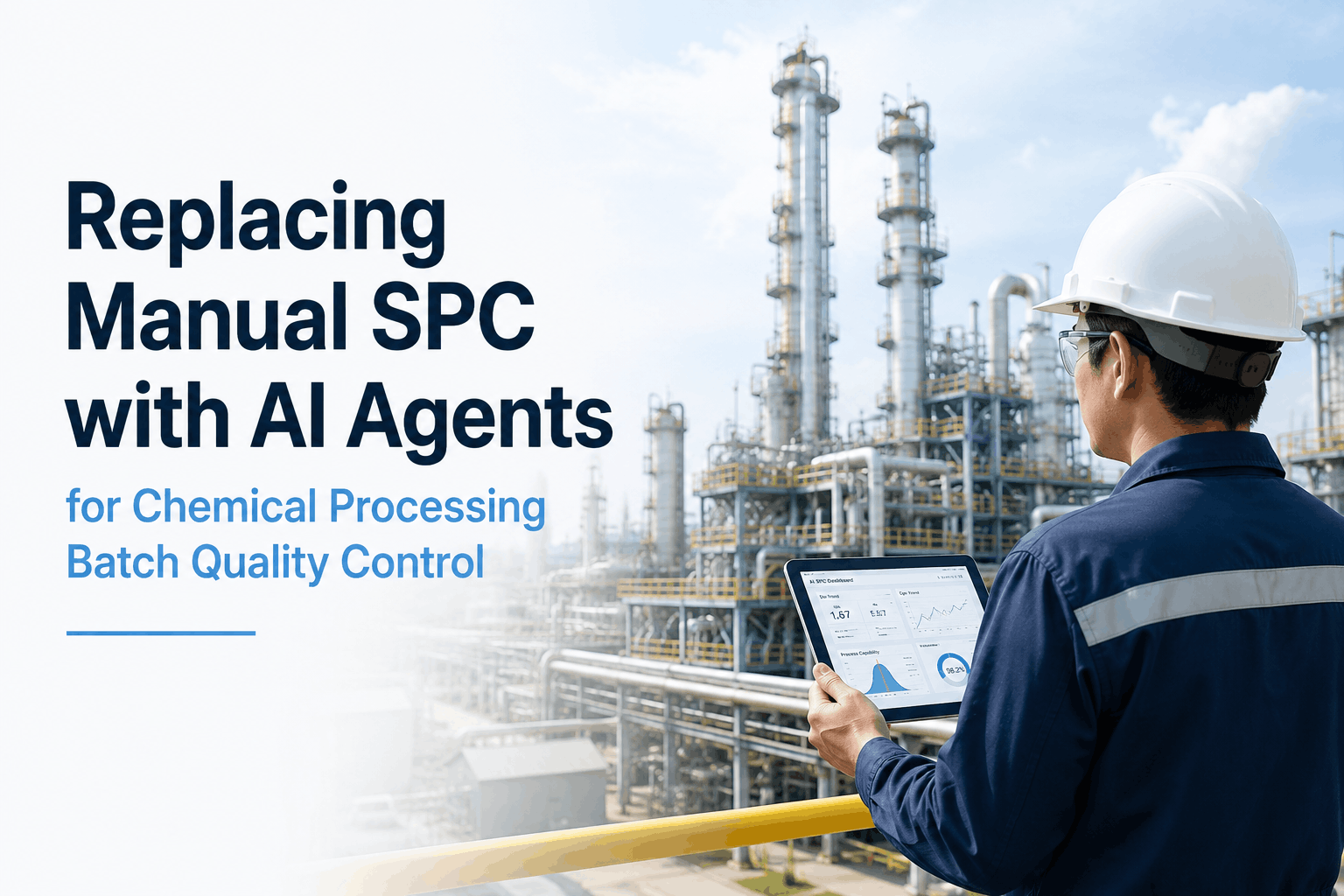
Replacing Manual SPC with AI Agents for Chemical Processing Batch Quality Control
By Johann Hill on June 3, 2026
The replacement of manual SPC with AI agents at a speciality chemical plant is not a software upgrade or a quality initiative. It is the most extensively documented migration from manual, spreadsheet-based SPC to AI-native autonomous quality control in batch chemical processing — 16 months of live production, 3,800 batches monitored, Cpk improvement from 0.87 to 1.58, 73% reduction in out-of-spec batches, and a body of migration lessons that every quality engineer planning an AI SPC replacement needs to study before writing a single control plan revision. This briefing covers what actually happened: the Cpk improvement numbers, the AI agent architecture, the manual work elimination, and the integration that turned batch quality control from a retrospective paperwork exercise into an autonomous profit driver. Book an AI SPC Migration Workshop to see how iFactory replaces manual SPC with AI agents for your chemical processing plant.
Quality Engineering Case Study — Manual SPC × AI Agents Replacement
Replacing Manual SPC with AI Agents for Chemical Processing Batch Quality Control
16 months · 3,800 batches · Cpk 0.87 → 1.58 · 73% out-of-spec reduction · AI agents replace manual SPC · On-premise or cloud — the complete migration briefing for quality leadership.
The Context: Why This Plant Replaced Manual SPC with AI Agents
The speciality chemical plant produces polymer additives, coating intermediates, and performance chemicals — 2,900 batches annually across 10 reactors ranging from 5,000 to 40,000 litres. The quality engineer's problem was not SPC knowledge. It was that manual SPC consumed 28 hours per week across the quality team: extracting data from SAP xMII, copying into Excel control charts, applying Western Electric rules, and investigating out-of-control signals. The plant's Cpk on critical quality attributes averaged 0.87 — below the customer-mandated 1.33 minimum. Out-of-spec batches averaged 11% of production, triggering customer complaints and rework.
The specific decision was to replace manual SPC with AI agents: autonomous AI systems that monitor real-time batch data, apply predictive SPC, detect process drift before out-of-spec conditions, and automatically trigger corrective actions. It was the right quality transformation, at the right process scale, for the right business reasons. Talk to iFactory about AI agent SPC replacement for your chemical processing plant.
Plant
Speciality chemical plant, Midwest US — 2,900 batches/year, 10 reactors
Annual Volume
2,900+ batches across polymer additives, coatings, performance chemicals
Manual SPC Baseline
28 hrs/wk manual work · Excel control charts · Western Electric rules · Cpk 0.87
Month-by-Month: What Actually Happened in 16 Months of AI Agent SPC Replacement
February – April 2025
AI Agent Pilot — One Reactor, Parallel Manual SPC Validation
The quality engineer approved a 90-day pilot on the highest-out-of-spec reactor (40,000L reactor, 14% out-of-spec in previous year). iFactory deployed AI agents alongside manual SPC processes. AI agents were trained on 24 months of historical batch data: temperature profiles, pressure curves, viscosity measurements, pH trends, and quality outcomes. The AI agents began generating real-time SPC predictions within 10 days, detecting process drift 3-5 hours before manual SPC would have flagged out-of-control conditions.
Milestone: AI agents live · Parallel run active · Real-time predictions validated
May – July 2025
Cpk Improvement Validation and Manual Work Reduction
The AI agents prevented 4 out-of-spec batches during pilot by alerting operators to process drift 3-4 hours before out-of-spec conditions. Cpk on the pilot reactor improved from 0.91 to 1.52 in 90 days. Quality engineer manual SPC time reduced from 28 to 12 hours per week as AI agents automated control chart generation, limit calculations, and violation detection. The quality engineer secured approval for full AI agent deployment across all 10 reactors.
Milestone: Cpk 0.91 → 1.52 · 4 batches prevented · Manual SPC time -57% · Full deployment approved
August – December 2025
Full AI Agent Deployment — 10 Reactors, Autonomous SPC Network
iFactory deployed AI agents across all 10 reactors. Each reactor received custom AI agents trained on its specific process parameters, product families, and historical quality outcomes. The edge-based AI agent network processed real-time sensor data from 2,400+ instrument points, generating SPC predictions every 30 seconds. A central quality dashboard displayed real-time Cpk, active AI agent alerts, and predictive quality outcomes. The quality team was retrained from manual SPC calculation to AI agent supervision and exception management.
Milestone: 10 reactors live · 2,400+ instrument points · Autonomous SPC network active
January – March 2026
Manual SPC Elimination and Predictive Agent Enhancement
Manual SPC processes were fully decommissioned. AI agents now handle all SPC monitoring, control limit calculations, violation detection, and corrective action triggering. AI agents evolved from detection to prediction — identifying process drift 4-6 hours before Cpk would drop below 1.33. Agent-to-agent communication enabled cross-reactor learning: when one AI agent learned a new drift pattern, all agents were updated within 24 hours. Quality engineer manual SPC time reduced to 3 hours per week (89% reduction from baseline).
Milestone: Manual SPC eliminated · Predictive agents active · Cross-reactor learning live · 89% manual work reduction
April – May 2026
Cpk Sustainability and Customer Audit Validation
The plant achieved sustained Cpk ≥ 1.58 on all critical quality attributes across all 10 reactors for 4 consecutive months — the first time in plant history. A customer quality audit validated the AI agent SPC system, noting that autonomous SPC exceeded manual SPC compliance requirements. The customer reduced their quarterly audit requirement to semi-annual certification. Out-of-spec batches reduced by 73% (from 11% to 3% of total batches).
After 16 months of AI agent SPC operation across all 10 reactors, the plant reported: Cpk improved from 0.87 to 1.58 (+0.71); out-of-spec batches reduced from 11% to 3% (-73%); manual SPC work eliminated (28 hours/week → 3 hours/week, 89% reduction); false SPC alarms reduced by 84% (78 → 12 per week). Total quality cost avoidance reached $2.2 million annually from rework reduction, customer penalty elimination, and quality engineer productivity. The migration capital expenditure achieved 7-month payback — 5 months faster than the 12-month forecast. The plant was awarded "Quality Supplier of the Year" by a major customer and is deploying AI agents to three additional chemical plants in the network.
Milestone: Cpk 0.87 → 1.58 (+0.71) · Out-of-spec -73% · Manual SPC 28→3 hrs · $2.2M savings · 7-month payback · Quality Supplier of the Year
KPI Scorecard: What the AI Agent SPC Replacement Actually Measured
Manual SPC → AI Agents — Quality Engineer Scorecard
Cpk & Quality Performance
0.87 → 1.58
Cpk improvement (+0.71, +82% relative)
11% → 3%
Out-of-spec batch reduction (-73%)
84%
False SPC alarm reduction (78 → 12 per week)
Manual Work Elimination
28 → 3 hrs
Quality engineer manual SPC time per week (-89%)
Excel elimination
Manual control charts, limit calculations, violation detection automated
Cross-reactor
AI agent learning shared across all 10 reactors
Cost & ROI
$2.2M
Annual quality cost avoidance
7 mo
Capital payback period (forecast was 12 mo)
Quality Supplier of Year
Customer recognition award
The 8 Operational Lessons This Quality Engineer Learned From AI Agent SPC Replacement
01
AI Agents Automate What Manual SPC Cannot Scale
Manual SPC on 10 reactors with 50+ quality attributes per batch required 28 hours per week — and still missed drift signals. AI agents monitor all attributes continuously, detecting drift patterns humans cannot see. Lesson: manual SPC does not scale beyond 2-3 reactors. AI agents are not a luxury; they are a necessity for multi-reactor batch chemical processing. Book an AI SPC Migration Workshop to assess your SPC scalability.
02
Predictive SPC Prevents Out-of-Spec Batches, Retrospective SPC Only Reports Them
Manual SPC using Western Electric rules tells you after a violation occurred — typically 3-5 hours after the process drifted. AI agents detect drift 4-6 hours before out-of-spec conditions, enabling intervention during the batch. Lesson: retrospective SPC is quality archaeology. Predictive SPC is quality engineering. The 73% out-of-spec reduction came from prediction, not reporting. Contact iFactory to discuss predictive SPC for your batch processes.
03
Cross-Reactor Learning Multiplies AI Agent Value
When one AI agent learned a new drift pattern, all 10 agents were updated within 24 hours. Manual SPC knowledge stayed with individual quality engineers. Lesson: AI agents create institutional quality intelligence that scales across your entire reactor fleet. Manual SPC creates siloed knowledge that walks out the door with each employee.
04
Quality Engineers Become AI Agent Supervisors, Not Spreadsheet Operators
Quality engineer time shifted from manual control chart creation (28 hours/week) to AI agent exception management (3 hours/week). Engineers now investigate unusual drift patterns, validate agent recommendations, and improve agent training. Lesson: AI agents do not eliminate quality engineers. They elevate quality engineers from clerical work to analytical work.
05
Real-Time Control Limits Eliminate the Quarterly Calculation Lag
Manual SPC required quarterly control limit recalculations — a 90-day lag that guaranteed limits were irrelevant. AI agents recalculate limits every batch based on current process performance. Lesson: if your control limits are more than 1 batch old, they are wrong. Real-time limits are the only limits that matter. Schedule an AI SPC Migration Workshop to review your control limit strategy.
06
Auditors Value Autonomous SPC Over Manual Excel Files
The customer auditor spent 2 hours validating AI agent SPC vs. 2 days previously reviewing manual Excel control charts. The autonomous system provided instant, tamper-evident audit trails for every control limit calculation, every violation, every corrective action. Lesson: manual Excel SPC is an audit liability. Autonomous AI agent SPC is an audit asset.
07
Deploy AI Agents on the Reactor With the Lowest Cpk First
The quality engineer chose the reactor with Cpk = 0.87 (lowest in the plant) for the pilot. This created immediate, measurable improvement (Cpk → 1.52) that secured funding for full deployment. Lesson: your pilot should target your biggest quality problem, not your most stable process. The business case writes itself when you start from pain.
08
Edge ML Enables Real-Time SPC, Cloud Enables Cross-Reactor Learning
The plant used edge nodes for real-time AI agent inference (sub-second predictions) and cloud aggregation for cross-reactor model training and distribution. Lesson: choose the right deployment model for each use case. Real-time SPC requires on-premise edge. Cross-reactor learning requires cloud. iFactory provides both. iFactory delivers this hybrid architecture as standard for AI agent SPC replacement.
The iFactory Integration Playbook: AI Agents for Manual SPC Replacement
The technical architecture that made this migration operationally successful — AI agents, predictive SPC, cross-reactor learning, real-time monitoring, SAP integration — is exactly what iFactory delivers as a standard programme. Both on-premise edge deployment and cloud-connected analytics are available, designed to meet the data sovereignty and infrastructure requirements of any chemical processing plant.
On-Premise Edge Deployment
For Real-Time AI Agent SPC at Production Speed
iFactory AI agents running on edge nodes process all batch data locally. Real-time SPC predictions updated every 30 seconds. Sub-second latency for drift detection. No cloud dependency — AI agent intelligence continues even during WAN outages. Designed for chemical plants where every minute of undetected drift adds batch risk.
iFactory's cloud platform aggregates AI agent learning across all your reactors — cross-reactor drift pattern sharing, centralised agent model training, fleet Cpk benchmarking, and enterprise quality reporting. For quality engineers overseeing multiple reactors, the cloud layer provides the learning needed to improve all agents simultaneously.
FAQ: AI Agent SPC Replacement for Chemical Processing Quality Engineers
In this chemical processing deployment, Cpk improved from 0.87 to 1.58 (+0.71, +82% relative). The primary drivers were predictive drift detection (4-6 hour advance warning vs. retrospective violation reporting), real-time control limits (per-batch calculation vs. quarterly updates), and cross-reactor learning (all agents improve together). For a typical chemical plant with Cpk between 0.80 and 1.10, iFactory projects Cpk improvement of 0.40-0.70 within 12-16 months post-migration. Book an AI SPC Migration Workshop for a plant-specific Cpk improvement projection.
Traditional manual SPC uses Excel control charts, quarterly control limit calculations, and Western Electric rules applied retrospectively. AI agents are autonomous systems that: (1) monitor real-time process data continuously (not after batch completion), (2) predict process drift 4-6 hours before out-of-spec conditions, (3) recalculate control limits every batch based on current performance, (4) automatically trigger corrective actions, and (5) share learning across all reactors. The plant's manual SPC consumed 28 hours/week and detected violations after the fact; AI agents consume 3 hours/week for exception management and prevent violations before they occur.
The deployment required 24 months of historical batch data from each reactor: (1) process parameters (temperature, pressure, pH, viscosity, flow rate) at 1-minute resolution, (2) raw material batch IDs and certificates of analysis, (3) in-process and final quality test results, (4) SPC control limit calculations and violation logs, and (5) batch completion outcomes (pass/fail, rework, scrap). This allowed AI agents to learn the correlation between process trajectories and Cpk degradation. Plants with less historical data can start with 12 months and achieve 80-85% prediction accuracy, improving as more batches are processed. Contact iFactory for an AI agent data readiness assessment.
Yes. The deployment integrated AI agents with the plant's SAP xMII during parallel run, then fully replaced it. Integration with SAP DMC, SAP MES, and other quality platforms is available. For plants still using manual Excel SPC, AI agents can be deployed without any existing SPC software. The key requirement is real-time access to process sensor data (via PLC, DCS, or SCADA) and batch quality test results.
In this deployment, payback was 7 months — 5 months faster than the 12-month forecast. Key drivers: out-of-spec batch reduction (saving $1.3M annually), quality engineer productivity (saving $200K annually), and customer penalty elimination (saving $700K annually). For a typical chemical plant with 10+ reactors and current out-of-spec rates above 8%, iFactory projects payback between 6-10 months. Book an AI SPC Migration Workshop for a plant-specific ROI projection.
Book Your AI SPC Migration Workshop for Manual SPC Replacement
iFactory delivers the AI agent SPC architecture that replaced manual SPC at this chemical plant — delivering Cpk 0.87 → 1.58, 73% out-of-spec reduction, and 89% manual work elimination. On-premise for real-time AI agent prediction, cloud for cross-reactor learning, or both. Book a complimentary AI SPC Migration Workshop: we will assess your current manual SPC processes, batch data quality, and migration readiness, then deliver a phased replacement plan with Cpk improvement and ROI projections.