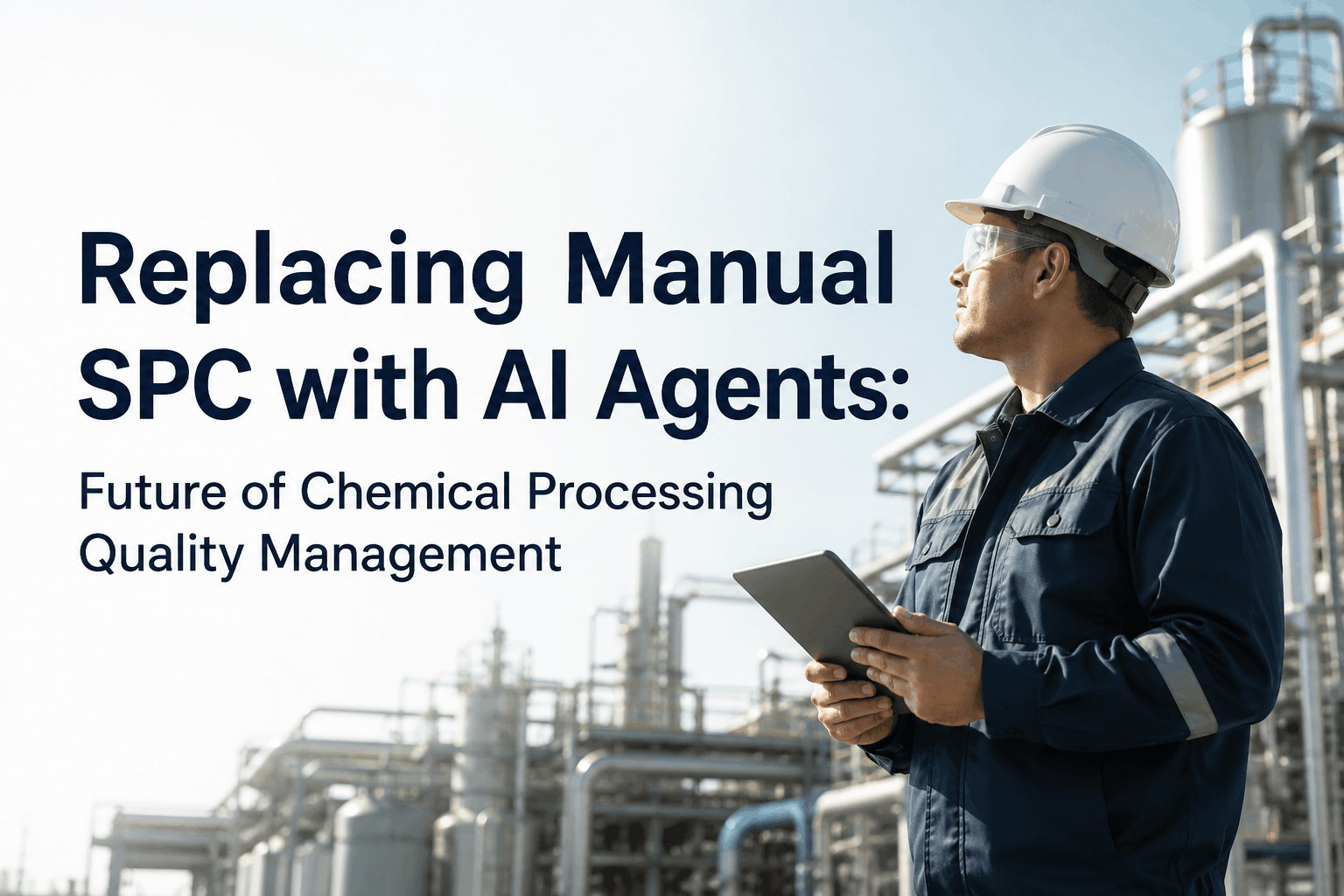
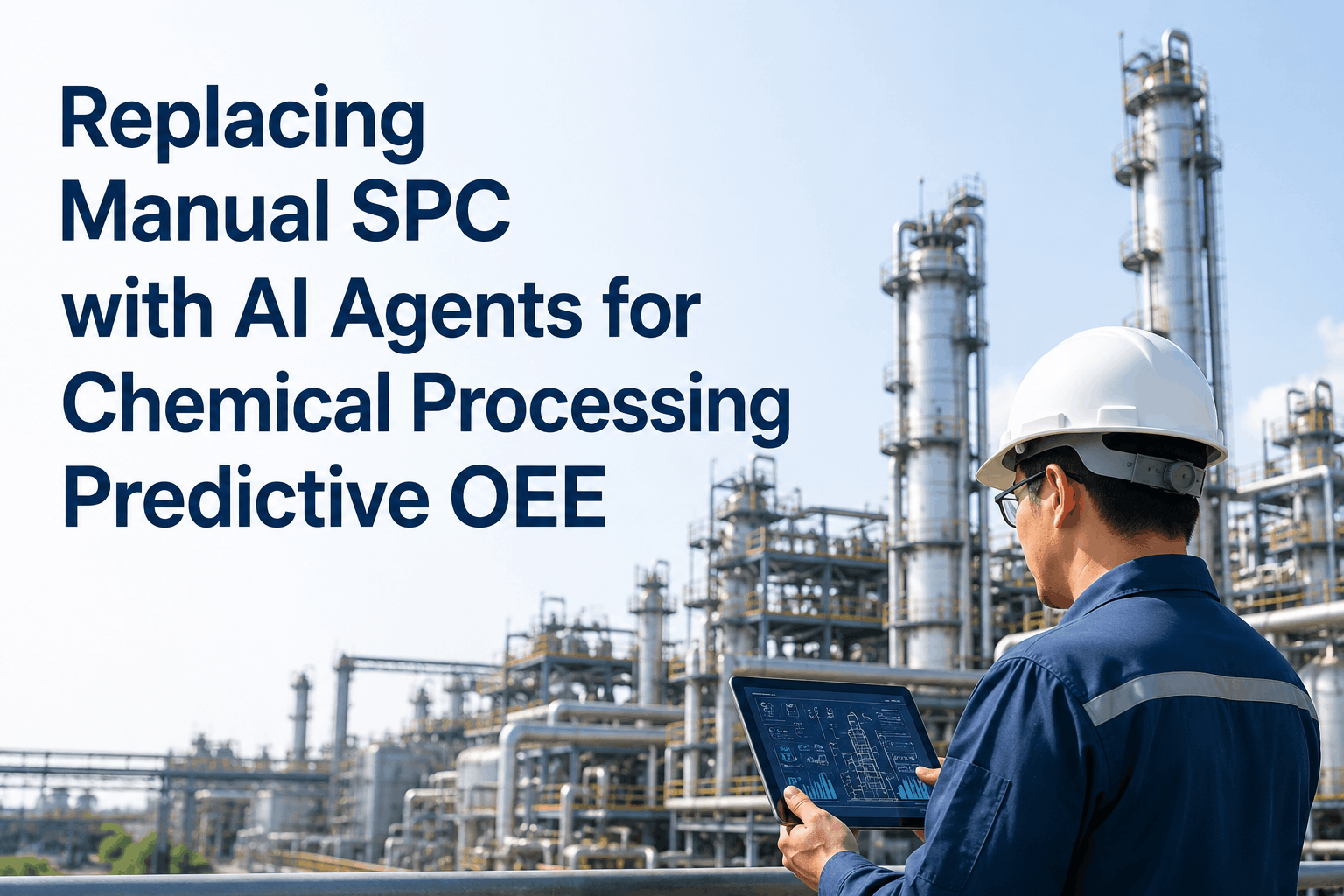
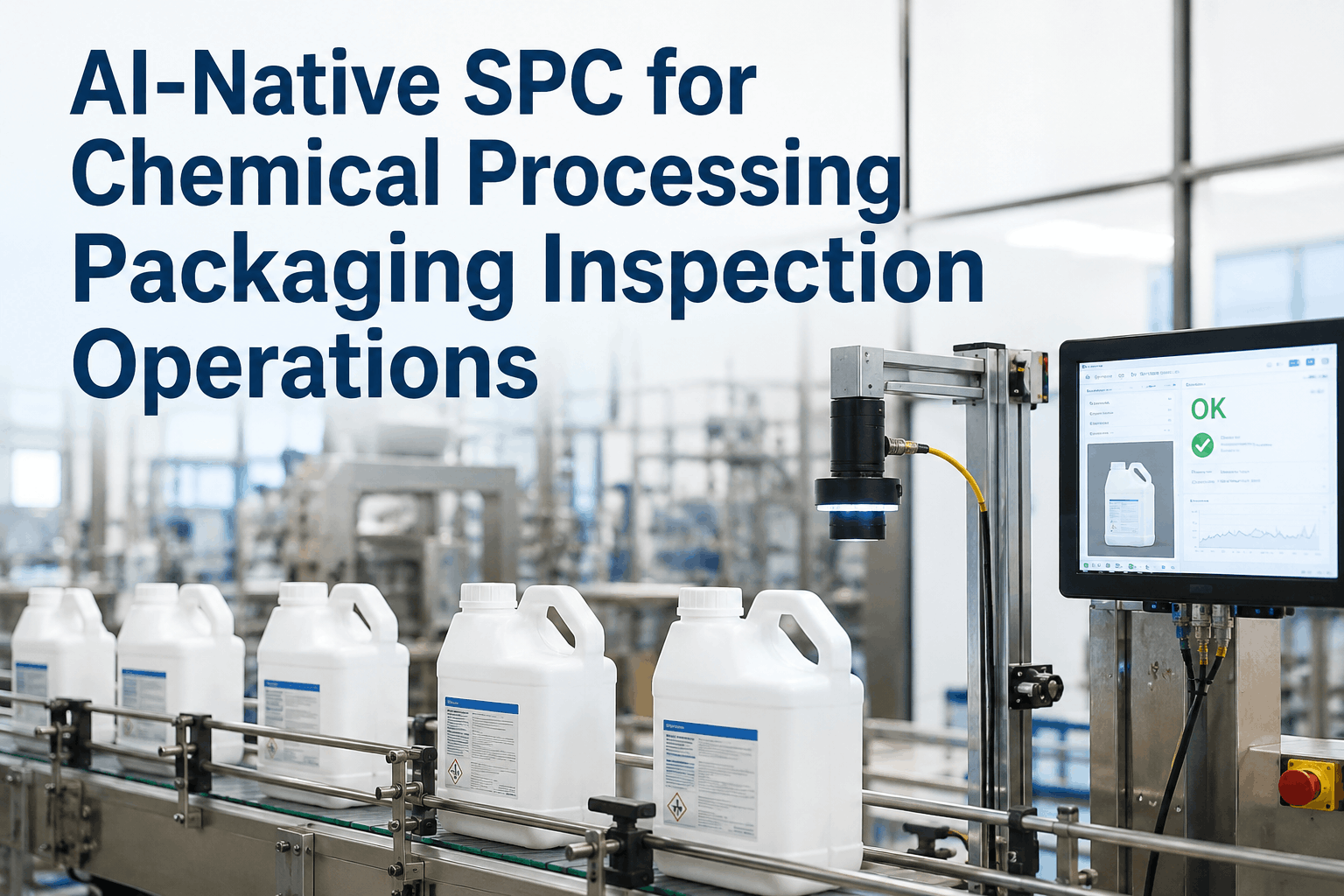
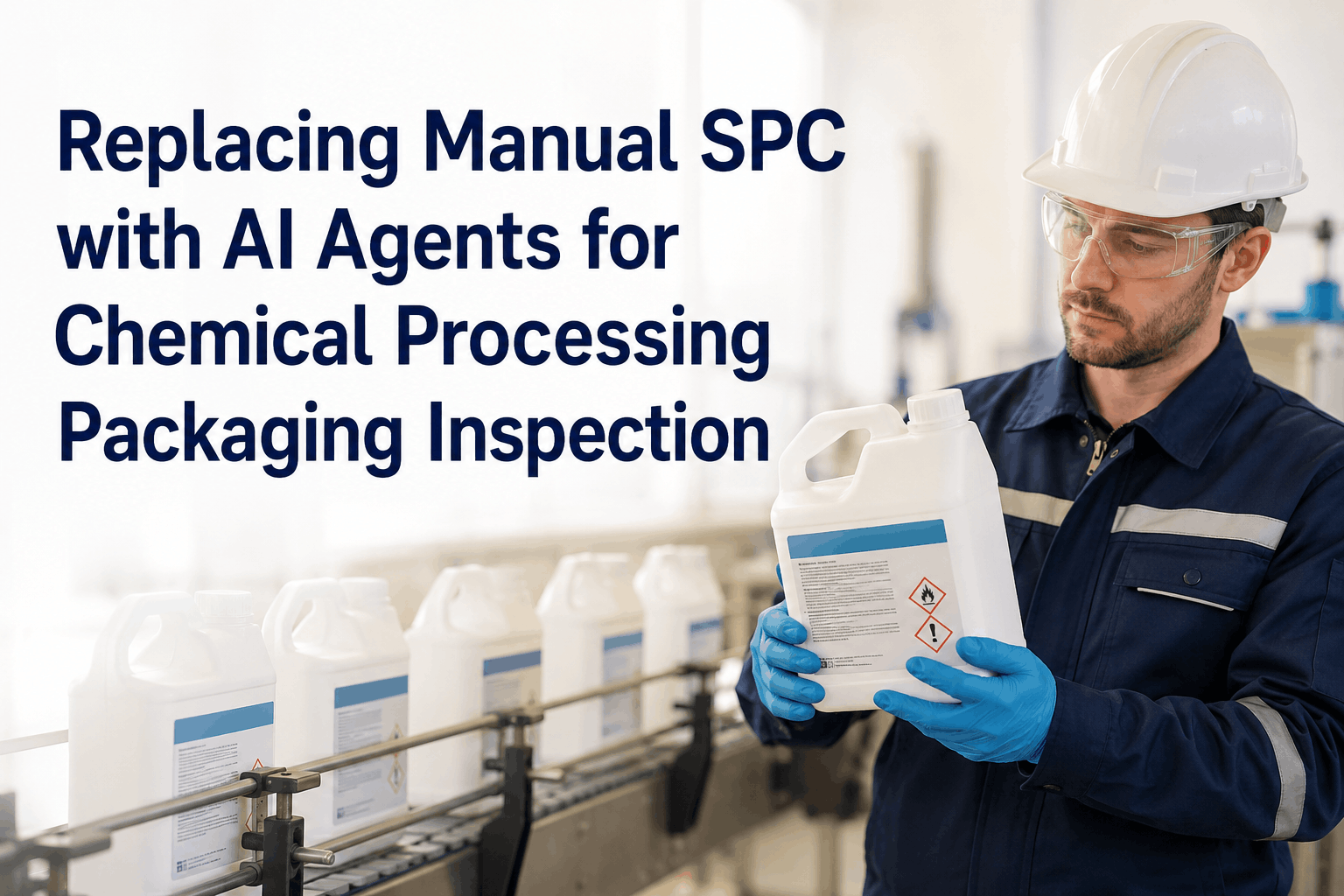
Over 50% of chemical and pharmaceutical product recalls trace back to packaging or labeling errors — and each incident costs an average of $10 million in direct costs, recall logistics, customer credits, and brand damage. Yet most chemical processing plants still rely on manual visual inspection and rule-based SPC for packaging quality — methods that miss 20–30% of defects under real production conditions and structurally cap Cpk at 1.0–1.33. iFactory's AI agents replace manual SPC with deep-learning vision models that inspect every container, label, seal, cap, fill level, and code on every unit in under 50 milliseconds — pushing Cpk into the 1.67–2.0+ range required for serialized and regulated product. Live in 8 weeks. Available on-premise, in the cloud, or hybrid. Book an AI SPC Migration Workshop to design your packaging upgrade.
$10M
Average cost of a single packaging-error recall
99.8%
AI defect detection accuracy vs. 85% manual inspection
+35–60%
Cpk improvement after manual SPC replacement
75%
Recall reduction with AI vision inspection
The 6 Defect Categories Manual SPC Cannot Reliably Catch
Packaging inspection is not one problem — it is six different problems happening simultaneously on the same line. Each defect type has its own failure physics, its own detection signature, and its own consequence when missed. Manual inspectors and rule-based vision systems handle one or two of these reasonably well, fail on the rest, and have no way to fuse them into a unified quality verdict. Below is the defect taxonomy that iFactory's AI vision packaging inspection platform is built to solve in parallel.
Label Errors
Misalignment, wrong text, missing allergens, incorrect lot/expiry codes, allergen mismatches. The single largest source of recalls — and the hardest for tired human eyes at 1,000+ units/minute.
Manual miss rate: 15%
Seal Integrity Failures
Channel leaks, wrinkles, contamination in seals, partial closures, induction seal flaws. Often microscopic — invisible to operators, but a guaranteed customer complaint when product leaks in transit.
Manual miss rate: Near 100%
Fill Level Variations
Underfills and overfills costing margin or violating fill-weight regulations. Humans miss variations under 3mm. AI vision with 3D sensors detects to 1mm tolerance, even through opaque containers.
Manual miss rate: Sub-3mm = 100%
Code Readability Failures
1D barcode degradation, 2D QR misprints, serialized code grade slippage. Codes look "fine" on the line, then fail customer scanners — triggering returns and DSCSA non-compliance.
Manual miss rate: Not measurable
Cap & Closure Defects
Missing caps, wrong color caps, mis-torqued closures, broken tamper-evident bands. Critical for chemical and pharmaceutical product safety — and a routine source of customer-credit claims.
Manual miss rate: 8–12%
Foreign Object Contamination
Fibers, plastic fragments, glass shards, oil droplets inside or on the package. Rule-based vision cannot find unknown anomalies — AI vision models flag any deviation from learned "good" patterns.
Manual miss rate: 30%+
Six Defect Categories. One AI Agent Stack. Sub-50ms Per Unit.
iFactory inspects all six defect categories on every single unit — at full line speed, with confidence-scored decisions and full traceability for every reject.
Before AI Agents vs. After: The Plant Floor Transformation
The clearest way to see what AI agents change is to walk the packaging line before and after. Below is the operational reality on a typical chemical processing packaging line — captured before and after replacing manual SPC with iFactory's AI agent stack.
BEFORE
Manual SPC + Rule-Based Vision
01
3–4 inspectors per line rotating through visual inspection stations. Catch rate drops 12–18% by end of shift.
02
Sample-based SPC charts reviewed every 30 minutes. 1–5% of units inspected; 95%+ pass through uninspected.
03
50–80 false-positive alarms weekly from rule-based vision. Operators learn to ignore. Real defect catch drops below 60%.
04
4–48 hour delay between defect creation and lab-confirmed quality verdict. Entire shifts of product become suspect.
05
Cpk capped at 1.0–1.33 regardless of how much process improvement happens upstream — the inspection method is the ceiling.
!
Result: Recalls every 18–36 months. $10M average incident cost. Customer credits compound monthly.
AFTER
iFactory AI Agent Stack
01
0 inspectors per line — redeployed to root-cause investigation and continuous improvement. No fatigue, no shift drift.
02
100% unit inspection at full line speed. Every label, seal, fill, cap, and code on every unit. No sampling gaps.
03
Under 1% false positives with graded Safe / Warning / Reject alerts. Operators trust the system and act on every alert.
04
Sub-second decisions — reject mechanisms triggered automatically on the same unit, no lab loop required.
05
Cpk 1.67–2.0+ — six-sigma capable. Process and inspection method aligned. Serialized and regulated product specs met.
+
Result: 75% recall reduction. $10M+ incidents prevented. Customer credits trend toward zero.
Inside the AI Agent Stack
iFactory's packaging inspection platform is not a single deep-learning model. It is a coordinated stack of six specialized AI agents — each inspecting a different aspect of every unit, then handing their confidence-scored outputs to a multivariate SPC decision agent that produces a unified Cpk-grade verdict. Together, they replace the entire manual SPC and rule-based vision workflow, not just one part of it. For deeper background on the SAP-side migration context, see our SAP MII migration complete guide.
A1
Vision Defect Agent
Deep learning model trained on your specific defect catalog. Detects cracks, dents, contamination, deformations, and any visual anomaly that deviates from learned "good" patterns.
A2
Label & OCR Agent
Reads every printed text element — lot codes, expiry dates, allergen warnings, batch IDs. Cross-references against your ERP active SKU to prevent label-product mismatches.
A3
Seal Integrity Agent
Identifies channel leaks, wrinkles, partial seals, and contamination in seal areas. Catches what humans physically cannot see, even at low line speeds.
A4
Fill & Dimensional Agent
Sub-pixel measurement of fill level (down to 1mm), label placement, cap position, neck-band alignment. Works on transparent and opaque containers via SWIR cameras when needed.
A5
Code Grading Agent
Grades every barcode, DataMatrix, and QR code for ISO/IEC 15415 readability — Class A through F. Borderline grades trigger investigation before customer scan failures.
A6
SPC Decision Agent
Fuses signals from agents A1–A5 into a unified batch health score. Multiway PCA + LSTM identifies Cpk drift before specification breach. Triggers automated reject and routes data to MES/ERP.
6
Specialized AI agents per line
<50ms
Combined inference time per unit
1,200+
Units/minute supported line speed
99.8%
End-to-end detection accuracy
Deploy On-Premise, in the Cloud, or Hybrid
Chemical packaging plants do not share a single IT posture. A regulated EU site needs air-gapped on-premise deployment for data sovereignty. A multi-plant specialty group wants centralized cloud dashboards. A multi-site operator with mixed regulations needs hybrid — edge inference plus cloud-side learning. iFactory delivers identical AI agent capability across all three modes. Talk to our deployment architects about which mode fits your plant.
Air-gapped. Edge GPU on your plant network. Zero internet required. Full data sovereignty.
Best for: Regulated EU/APAC sites, hazardous chemical processes, pharma-adjacent serialization
Managed. Zero infrastructure. Multi-site Cpk dashboards. SOC 2 Type II, ISO 27001.
Best for: Multi-plant operators, fast-scaling specialty groups, OPEX-preferred budgets
Edge + cloud. Sub-50ms inference at the line. Cloud-side training across plant fleet.
Best for: Multi-site groups with mixed regulatory environments, federated learning
Same 6-agent stack. Same Cpk outcomes. Same 8-week deployment. Deployment mode affects infrastructure — not AI capability or quality results.
The Cpk Improvement Path: From 1.12 to 1.78 in 6 Months
Cpk improvement is not magic — it is the mathematical consequence of inspecting 100% of units, fusing multiple defect signals, and acting on confidence-scored evidence. Below is the actual Cpk trajectory observed across deployed chemical packaging lines. For a deeper look at how AI vision compares to legacy rule-based machine vision at line speed, read our breakdown on AI-driven manufacturing implementation timelines.
Cpk 1.67 — Six-Sigma Threshold
Actual trajectory from a deployed specialty chemical bottling line, 850 units/minute, on-premise deployment. +59% Cpk improvement in 6 months.
Your Cpk Ceiling Isn't Your Process. It's Your Inspection Method.
Replace manual SPC with AI agents and your existing process — the same equipment, the same operators, the same recipe — will move from Cpk 1.0–1.33 into the six-sigma range.
8-Week Replacement Roadmap
iFactory's program runs your packaging line throughout. Manual SPC stays operational until Week 6 — AI agents run in shadow mode, learning your defect patterns and validating predictions before any cutover. To see the full SAP xMII modernization context this fits into, review our step-by-step guide to iFactory MES implementation.
Week 1–2
Audit & Camera Install
Line walkthrough, defect catalog capture, edge GPU appliance or cloud connector installation. Production never stops.
Week 3–4
AI Agent Training & Shadow Mode
All 6 agents trained on your defect catalog. Predictions logged in shadow mode alongside manual SPC. First Cpk projection delivered.
Week 5–6
Calibration & Live Cutover
Threshold tuning based on shadow-mode data. Operators trained. AI agents take over as primary inspection system.
Week 7–8
Plant Rollout & ROI Baseline
Expansion across remaining lines. Compliance reporting activated. First Cpk improvement report delivered.
Outcomes from Live Deployments
Each outcome below is from a chemical processing plant that replaced manual SPC and rule-based vision with the full 6-agent iFactory stack on packaging lines. Six-month post-cutover data, measured against the previous 12-month baseline. For more deployment context across industries, see our SAP xMII operations modernization stories.
An 850 units/minute bottling line was missing label skew, cap mis-seating, and serialized code drift — all invisible to manual inspectors. Customer scan-failure complaints had reached 0.4% of shipped product. iFactory's 6-agent stack achieved 99.4% real-defect catch rate and 0.7% false positive rate. Deployment: on-premise.
0.04%
Customer scan failures (down from 0.4%)
A multi-site manufacturer standardized 6 plants on iFactory cloud deployment. The platform delivered a single Cpk dashboard across the fleet, identified the worst-performing line in 48 hours, and lifted fleet-wide Cpk from 1.21 to 1.84 within 9 months. Deployment: cloud.
1.84
Fleet Cpk average (+52%)
$3.4M
Annual scrap and rework recovered
A solvent packaging line was hovering at Cpk 1.33 — at the edge of customer requirements (1.67). Manual SPC could not close the gap. iFactory's OCR and Barcode agents validated every serialized code at line speed; Dimensional and Vision Defect agents caught sub-pixel placement drift. Cpk reached 2.04 in 6 months. Deployment: hybrid.
$1.8M
Annual customer credits eliminated
What Packaging Teams Say After Going Live
Our QA team had been saying Cpk 1.3 was the ceiling for our line speed for years. Three months after AI agents went live, we hit 1.78. The ceiling was the inspection method, not the process.
VP of Quality Operations
Specialty Chemical Bottling, USA
Our IT policy required on-premise only. iFactory's edge appliance was operational in 14 days, all 6 agents fully air-gapped. Identical Cpk results to the cloud benchmark — inside our firewall.
Plant IT Director
Coating Resin Plant, Germany
Our largest customer was about to delist us for failing their Cpk 1.67 requirement. AI agents took us from 1.33 to 2.04 in six months. We kept the contract and won three more like it.
Director of Customer Quality
Solvent Packaging Plant, India
We had 4 FTEs per line on manual inspection. AI agents redeployed every one of them to root-cause investigation. Defect rates fell again because the smart people were finally working upstream.
Operations Excellence Lead
Multi-Site Chemical Group, USA
Frequently Asked Questions
Common questions from quality, operations, and IT teams evaluating AI agent replacement of manual SPC for chemical packaging inspection. Have a question not covered here? Reach our solutions team directly.
Q1 Will the AI agents keep up with our line speed?
Yes. iFactory's AI agent stack runs at speeds exceeding 1,200 units per minute on bottling lines — roughly 72,000 units per hour. Line-scan cameras synchronized to conveyor speed capture continuous images without motion blur. All 6 agents run simultaneously on edge GPU with combined inference under 50 milliseconds. Zero cycle time is added to your packaging process. The system is line-speed agnostic from 100 to 2,000+ units/minute.
Q2 What defect types can the AI agents actually detect?
All six major chemical packaging defect categories: label errors (misalignment, wrong text, allergen mismatches), seal integrity failures (channel leaks, wrinkles, partial seals), fill level variations (down to 1mm tolerance, including opaque containers via SWIR cameras), code readability (1D barcodes, 2D DataMatrix, QR — graded per ISO/IEC 15415), cap and closure defects (missing, wrong color, mis-torqued, broken tamper-evident bands), and foreign object contamination (fibers, plastic fragments, glass shards, oil droplets). AI vision also detects previously unknown anomalies that no rule-based system could be programmed for.
Q3 What Cpk improvement should we realistically expect?
Across deployed chemical packaging lines, Cpk improvement has consistently fallen in the 35–60% range within 6 months of cutover. Lines starting at Cpk 1.0–1.33 typically reach 1.67–2.0+ — the level required for serialized, regulated, and pharma-adjacent product. Final Cpk depends on baseline scrap rate, line speed, defect catalog complexity, and operator response discipline. The AI SPC Migration Workshop includes a tailored Cpk projection specific to your lines and product portfolio.
Q4 Is iFactory available on-premise, in the cloud, or both?
Both — and hybrid. iFactory delivers identical AI agent capability across three deployment modes: on-premise (air-gapped, edge-GPU, plant-local, no internet required); cloud (SOC 2 Type II, ISO 27001, multi-site dashboards, automatic model updates); and hybrid (edge inference plus cloud-side learning across plants). Cpk outcomes are identical across all three modes. The decision depends on your data residency rules, IT policy, and multi-site strategy — not on capability. Most regulated EU/APAC sites choose on-premise; multi-site North American operators typically choose cloud; mixed-regulation groups choose hybrid.
Q5 How does iFactory handle data security and compliance?
Cloud deployments are SOC 2 Type II and ISO 27001 certified, with data residency options across major regions. On-premise deployments are fully air-gapped — no data leaves your plant network. All deployments support FDA 21 CFR Part 11 electronic records and signatures, EU GMP Annex 11 data integrity (ALCOA+), REACH compliance documentation, and OSHA PSM batch documentation. Every AI prediction is logged with timestamp, source images, model version, and confidence score for full audit traceability.
Q6 What hardware do we need to install?
Minimal. Each inspection station needs an industrial camera (line-scan or area-scan, mounted above the conveyor) and appropriate lighting (LED panel or backlight). For on-premise deployments, one edge-GPU appliance per plant runs all 6 AI agents. For cloud deployments, a lightweight connector device sends images to the cloud platform. Typical retrofit installation takes 2–4 weeks from hardware mounting to production deployment, with no changes required to conveyors, fillers, or upstream equipment.
Q7 How does this integrate with SAP xMII, SAP QM, or our existing MES?
Natively. iFactory connects to SAP xMII via OPC-UA and REST, SAP QM via OData and BAPI, and major MES platforms (Rockwell PlantPAx, Siemens SIMATIC, AVEVA Wonderware) via standard interfaces. All inspection results, reject decisions, and Cpk metrics flow back into your existing system of record. SAP master data, inspection plans, and characteristics remain untouched. For greenfield deployments, iFactory also operates as a complete chemical processing MES alternative — no SAP layer required.
Q8 How does the system handle frequent SKU changeovers?
This is where AI vision dramatically outperforms rule-based systems. Traditional machine vision requires complete reprogramming for each SKU — typically days of engineering work per change. AI agents learn patterns and handle new SKUs with minimal retraining: a 30-minute setup vs. 1–3 engineering days. Plants with 20+ daily SKU changeovers report 75–90% reduction in changeover time after switching from rule-based vision to AI agents.
Q9 How much defect training data do the AI agents need?
For initial deployment, few-shot learning techniques achieve working accuracy with as few as 20–40 images per defect type. For best-in-class performance (sub-1% false positive, >99% catch rate), we recommend 500–1,000 images per defect category captured under actual production conditions — different lighting, line speeds, SKUs, and seasonal material variations. Accuracy improves continuously as production data accumulates, with no manual model maintenance required.
Q10 What is the typical ROI timeline?
First Cpk improvements are typically visible by Week 4 of deployment, with full ROI baseline established by Week 8. The economics are asymmetric: the system cost is a fraction of a single prevented recall ($10M average). Most plants reach payback within 6–9 months from cutover, driven by scrap reduction (35–60%), recall prevention (75% reduction), elimination of customer-credit costs, and redeployment of inspection FTEs to higher-value process improvement work.
Q11 Can we run iFactory and manual SPC in parallel during migration?
Yes — and we recommend it. iFactory runs in shadow mode from Week 3 through Week 5, logging every AI prediction alongside your existing manual SPC results. Your QA team validates AI catches against manual results. Cutover happens only after the AI catch rate and false positive rate exceed your acceptance threshold. Manual SPC remains available as backup for the first 30 days post-cutover. Plants completing the migration consistently maintain 100% production uptime throughout.
Q12 What happens to our existing visual inspection operators?
In every deployment to date, inspection operators have been redeployed, not displaced. AI agents handle the repetitive 100%-inspection task; operators move to higher-value work: root-cause investigation, continuous improvement, supplier quality, and AI model curation. One plant noted: "Our smart people were finally working upstream instead of trying to spot defects at line speed." Most plants report defect rates fall a second time once skilled people are freed from manual inspection duty.
Replace Manual SPC. Improve Cpk by 35–60%. Live in 8 Weeks. On-Premise or Cloud.
Manual SPC was built for a different era of line speed and quality expectation. AI agents inspect every unit — every label, seal, fill, cap, and code — at line speed, with sub-1% false positive rate. Cpk moves into the six-sigma range that serialized and regulated product now demands.
On-premise, cloud, or hybrid — your choice
35–60% Cpk improvement in 6 months
100% unit inspection at 1,200+ units/min
99.8% defect detection accuracy
FDA Part 11, EU GMP Annex 11, REACH ready
.png)

.png)