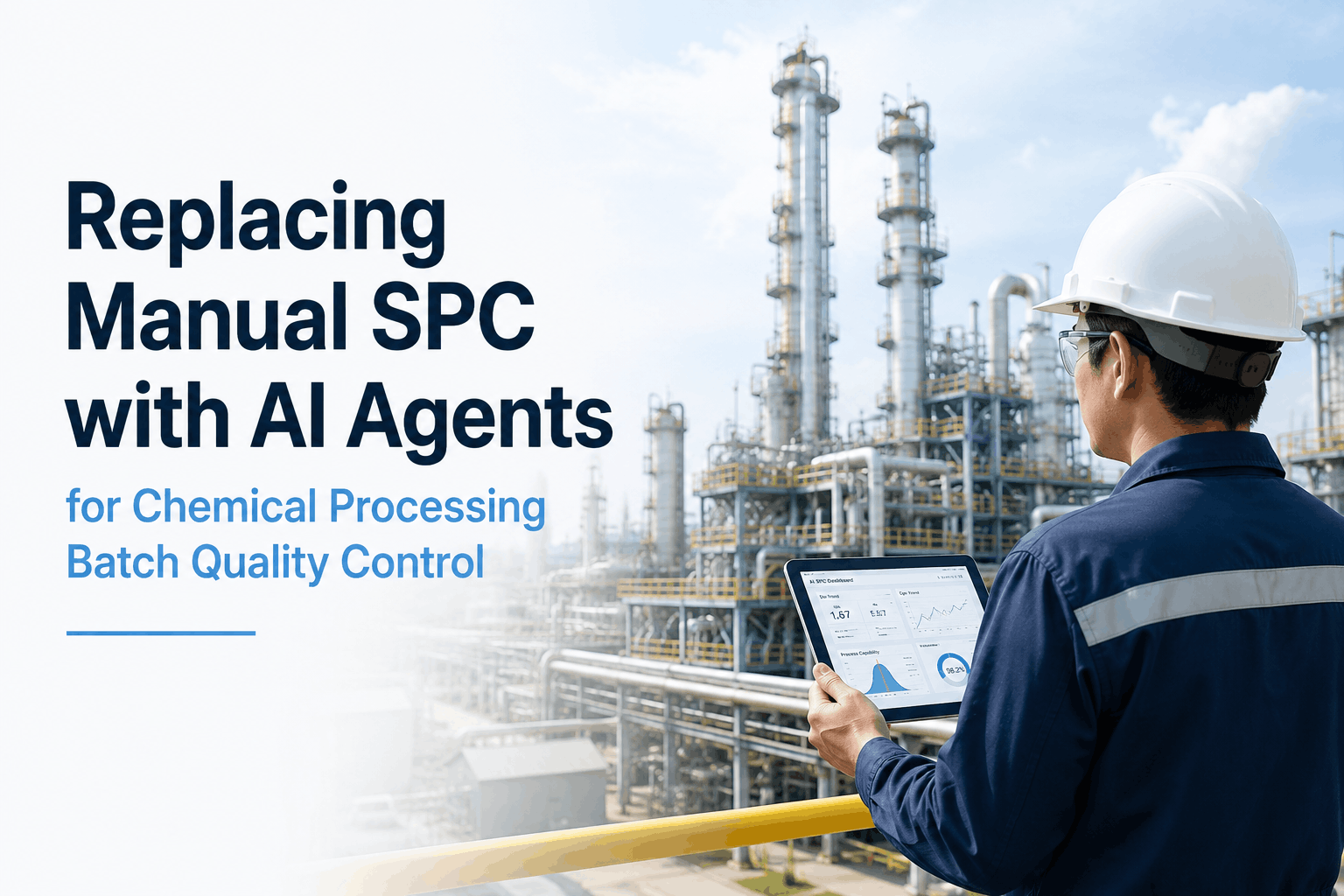
Manual SPC in chemical processing is a human-speed solution to a machine-speed problem. A quality engineer reviewing control charts every 30 minutes cannot outpace a reactor parameter that drifts to failure in 22. A supervisor reading a shift-end OEE report cannot prevent the unplanned downtime that already occurred at 14:00. AI agents replace this model entirely — monitoring every parameter, every second, across every unit operation, and firing targeted interventions before the drift becomes a failure. For quality directors, this is not a quality improvement story. It is a downtime prevention story: every hour of unplanned downtime that AI catches before it happens is a direct OEE recovery that manual SPC structurally cannot deliver. iFactory deploys AI agents for chemical processing SPC on-premise, in the cloud, or both. Book an AI SPC Migration Workshop — see the downtime prevention case for your plant.
AI Agents · Chemical SPC · Predictive OEE · Downtime Prevention
Manual SPC Watches the Process.
AI Agents Protect It.
iFactory replaces manual SPC rules with AI agents that monitor every chemical process parameter in real time — predicting OEE losses and preventing downtime before it happens. On-premise or cloud.
30%
Reduction in unplanned downtime when AI agents replace manual SPC monitoring in chemical plants
22 min
Average window AI agents provide before a manual SPC alarm would fire — the intervention window that prevents downtime
On-Prem & Cloud
iFactory deploys both — full data sovereignty or multi-site fleet intelligence, your choice
Why Manual SPC Cannot Prevent Downtime in Chemical Processing
Manual SPC was not designed for downtime prevention. It was designed for quality documentation — recording that a process was in control during the period reviewed. The gap between "reviewed every 30 minutes" and "drifts to failure in 22 minutes" is not a training problem or a staffing problem. It is a structural limitation of human-reviewed static control charts. No quality director can hire their way out of this gap. Only AI agents — monitoring at machine speed, across all parameters simultaneously — can close it.
The Structural Gap Between Manual SPC and Downtime Prevention
Review Cycle
Manual SPC: 30–60 min review cycle
AI Agent: <2 sec
Parameters Monitored Simultaneously
Manual: 3–6
AI Agent: All parameters — 50–200+ simultaneously
Detection Before Limit Breach
Manual: 0 min
AI Agent: 20–40 min early warning
Downtime Events Prevented Per Month
Manual: 0
AI Agent: 3–7 events per plant per month
How AI Agents Work in Chemical Processing SPC
An AI agent in the context of chemical SPC is not a chatbot or an automation script. It is a continuously running ML model with a specific role: monitor a defined set of process parameters, maintain a multivariate model of normal process behaviour, detect deviations from that model before they breach any individual limit, and trigger a targeted intervention recommendation to the relevant operator or supervisor. Multiple AI agents run in parallel — one per reactor, one per unit operation, one per product grade — each learning from the batch history of its assigned process.
AI Agent Architecture for Chemical Processing SPC
Temperature + Pressure correlation
Residence time distribution
Feed composition ratio
Reaction rate vs. setpoint
Fires: Batch health score + intervention recommendation to Reactor Operator
Prevents: Runaway reactions, yield loss, unplanned reactor shutdown
Pump vibration signature
Heat exchanger thermal efficiency
Compressor current draw
Valve actuator response time
Fires: Predictive maintenance alert to Maintenance Supervisor + CMMS work order
Prevents: Unplanned mechanical downtime 6–14 days in advance
Multivariate process signature
LIMS lab result correlation
Raw material lot properties
Historical failure signatures
Fires: Off-spec prediction alert to Quality Director + SAP QM notification
Prevents: Batch failures, rework costs, customer quality complaints
Real-time availability rate
Throughput vs. nameplate capacity
First-pass quality rate trajectory
Shift-level OEE forecast
Fires: OEE forecast + contributing factor analysis to Shift Supervisor dashboard
Prevents: Undetected OEE drift, missed production targets, end-of-shift surprises
The Downtime Prevention Playbook: AI Agent vs. Manual SPC
Same Plant. Same Event. Two Very Different Outcomes.
Scenario: Heat exchanger fouling developing over 3 days — Reactor 2, Chemical Plant
Manual SPC Response
Day 1
Heat exchanger efficiency drops 3%. Historian records it. No SPC rule fires. No alert generated.
Day 2
Efficiency at 89% — still above SPC lower control limit of 85%. Operator sees nothing actionable on manual chart review.
Day 3 — 06:00
Efficiency at 82%. Outlet temperature rising. Still no breach. Operator notes it — adds to log.
Day 3 — 14:30
Temperature breach — SPC alarm fires. Reactor 2 taken offline for emergency cleaning.
Day 3 — Cost
8 hours unplanned downtime. 2 batches lost. Emergency maintenance at premium rate. Total: $180K–$320K.
iFactory AI Agent Response
Day 1
AI Equipment Health Agent detects 3% efficiency drop. Cross-references with vibration and flow data. "Watch" flag raised on Reactor 2 heat exchanger.
Day 2
Trend confirmed. Agent fires alert to Maintenance Supervisor: "Reactor 2 heat exchanger — fouling signature detected. Schedule cleaning in next 48–72 hrs to avoid unplanned shutdown."
Day 3 — 06:00
Planned maintenance window scheduled for Day 3 night shift. Reactor 2 continues production at reduced rate during day.
Day 3 — Night
Planned cleaning completed in 4-hour scheduled window. Reactor 2 restored to full capacity. No production batches lost.
Day 3 — Cost
Planned maintenance: $12K–$18K. Zero unplanned downtime. Zero lost batches. OEE protected.
What Quality Directors Measure After AI Agent Deployment
30%
Reduction in unplanned downtime — chemical plants replacing manual SPC with AI agents
vs. manual SPC baseline
22–35%
OEE improvement within 6 months of AI agent deployment
Predictive OEE uplift
6–14 days
Equipment failure prediction window — time to plan maintenance before breakdown
Predictive maintenance
87–94%
Batch failure prediction accuracy at mid-batch using AI quality excursion agents
Quality excursion agent
On-Premise or Cloud: iFactory AI Agents Deploy Both Ways
Chemical processing plants managing proprietary formulations, regulated substances, or multi-territory IP cannot accept cloud-only deployments for SPC and quality data. iFactory is built from the ground up to deliver full AI agent capability in both architectures — no feature compromise, no performance penalty. Talk to our team about the right deployment for your plant's IT and compliance requirements.
On-Premise Deployment
Full Data Sovereignty
All AI agent processing, SPC computation, OEE forecasting, and quality data stays inside your plant network. Zero batch or process parameter data transmitted externally. Sub-20ms agent inference latency. FDA 21 CFR Part 11 and GMP compliant. Air-gap compatible for highest-security environments.
Best for: regulated chemical, pharma-chem, proprietary process IP protection
Discuss On-Premise
OR
Cloud Deployment
Multi-Site Agent Fleet
AI agents deployed across all chemical processing facilities with centralised Quality Director dashboards. Cross-site downtime benchmarking, fleet-wide learning (agent insights from Plant A improve predictions at Plant B), automatic model updates. Mobile alert delivery for quality directors and plant managers anywhere.
Best for: multi-site chemical groups, centralised quality and OEE management
Discuss Cloud Setup
Integration: How AI Agents Connect to SAP, LIMS, and DCS
iFactory AI Agent — Integration Map
Data Source
What AI Agents Read
Agent Output Destination
Downtime Prevention Value
Process Historian
PI, PHD, IP21
Real-time temperature, pressure, flow, composition — every tag, every second
Reactor Agent
Detects drift 20–40 min before limit breach
DCS / PLC
OPC-UA / REST
Equipment status, actuator response, alarm history, setpoint deviations
Equipment Agent
Predicts mechanical failure 6–14 days ahead
LIMS
LabVantage, STARLIMS
Lab results, raw material lot properties, in-process quality measurements
Quality Agent
Correlates lab data with process — predicts batch outcome
SAP QM / xMII
OData / BAPI
Production orders, batch records, inspection lots, historical quality notifications
OEE Agent
Routes quality decisions back to SAP QM automatically
CMMS
SAP PM / Maximo
Maintenance history, equipment age, last service dates, failure records
Equipment Agent
Auto-creates PM work orders on equipment degradation alerts
FAQ: Replacing Manual SPC with AI Agents in Chemical Processing
What is the difference between an AI agent and a traditional SPC rule in chemical processing?
A traditional SPC rule is a static condition: "fire an alarm when parameter X exceeds value Y." It monitors one parameter at a time, uses limits that were set months ago, and has no memory of what happened in previous batches. An AI agent is a continuously learning model that monitors multivariate parameter combinations, adapts its sensitivity based on current process conditions, and fires intervention recommendations — not just alarms — when it detects the trajectory patterns that historically precede specific failure modes. The agent knows which parameter combinations matter, in what order they drift, and what intervention has the highest success rate for this specific signature.
How does iFactory prevent downtime specifically — not just detect quality failures?
Downtime prevention requires three things traditional SPC cannot provide: early enough detection (before the failure is inevitable), specific enough guidance (which component, which parameter, what action), and automatic routing to the right person (maintenance, not quality). iFactory's Equipment Health Agent detects mechanical degradation signatures 6–14 days before failure, generates a maintenance recommendation with the specific component and urgency window, and routes it automatically to the CMMS as a planned work order. The downtime event that would have occurred becomes a scheduled maintenance window — at a fraction of the cost.
Book a workshop to model the downtime prevention ROI for your plant.
Does replacing manual SPC with AI agents require dismantling SAP xMII or SAP QM?
No. iFactory runs alongside xMII during migration and replaces it after a parallel validation period of 2–4 weeks. SAP QM is never touched — it remains the system of record for batch disposition, inspection lots, and quality notifications. iFactory routes its AI agent outputs (quality alerts, OEE predictions, maintenance flags) into SAP QM via standard OData interfaces. Quality directors and supervisors see AI agent recommendations in both iFactory dashboards and as SAP QM notifications — whichever workflow they prefer to action from.
Can AI agents be deployed on-premise to protect proprietary chemical formulation data?
Yes — on-premise is a core iFactory deployment model, not a premium add-on. All AI agent processing, model inference, and SPC data remains entirely within your plant network. No process parameters, formulation signatures, or batch quality data are transmitted externally. The on-premise deployment meets FDA 21 CFR Part 11 electronic records requirements and GMP data governance standards. For multi-site operations requiring both sovereignty and cross-plant intelligence, iFactory supports a hybrid model — on-premise agents per site with aggregated, anonymised benchmarking in cloud.
How long does it take for AI agents to become accurate enough to prevent real downtime events?
AI agents begin generating predictions from the first batch run — using physics-informed initial models where historical data is limited. For plants with 6+ months of historian data, agents reach production-grade accuracy within the first 4–6 weeks of parallel running. For equipment health agents specifically, accuracy is highest when 12–18 months of maintenance history is available for training. Most chemical plants see their first AI-predicted-and-prevented downtime event within 60–90 days of deployment — earlier for plants with rich historian archives and frequent historical failure events to train against.
iFactory · AI Agents · Chemical Processing SPC
Replace Manual SPC Rules With AI Agents.
Turn Downtime Events Into Planned Maintenance.
iFactory deploys AI agents for chemical processing SPC — monitoring every parameter, predicting every failure, and routing interventions to the right person before the line stops. On-premise or cloud. SAP xMII and QM compatible. Downtime prevention from day 60.
AI Agents for SPC
Downtime Prevention
On-Premise Available
Cloud Available
SAP QM + xMII Bridge
Predictive OEE
.png)

.png)