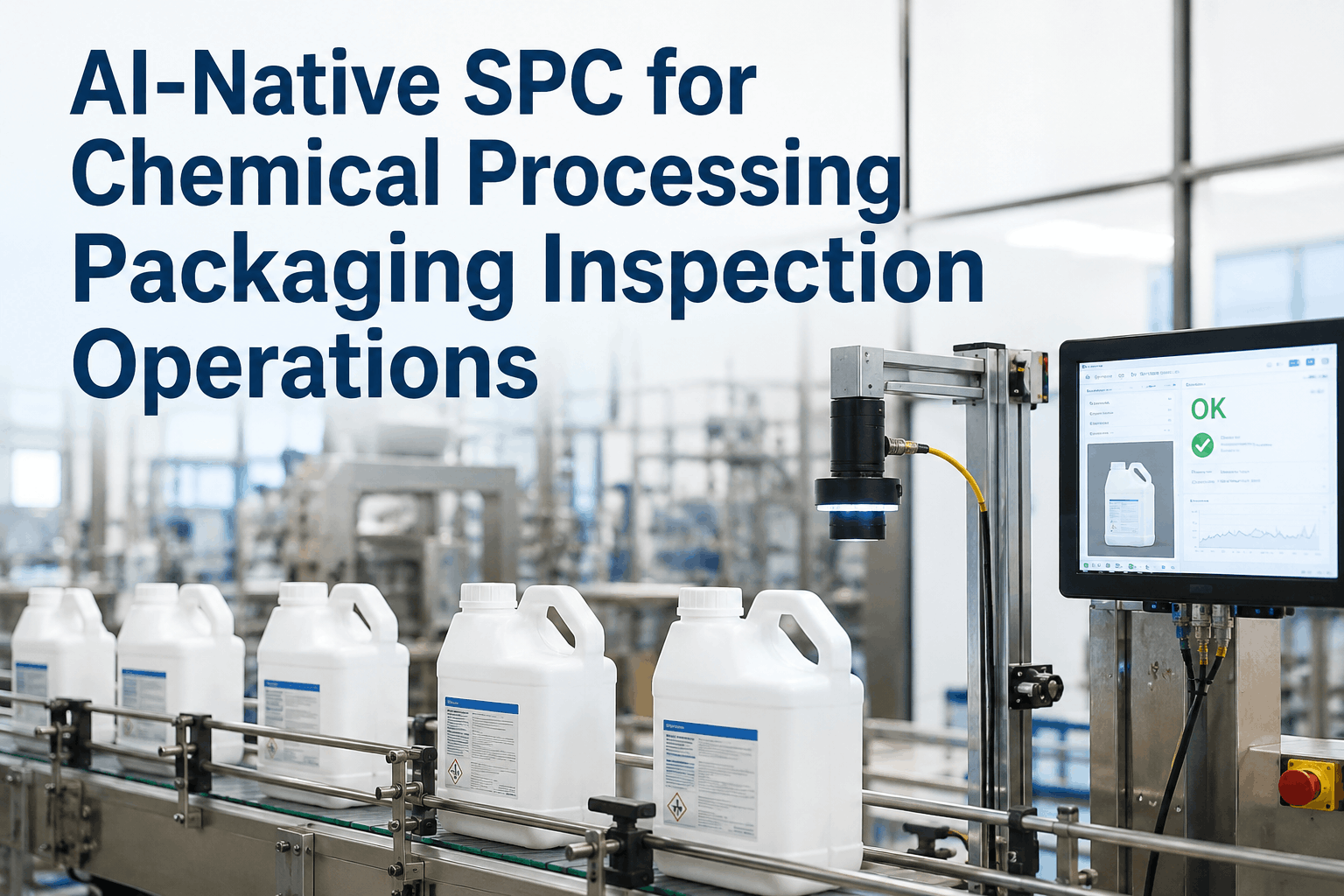
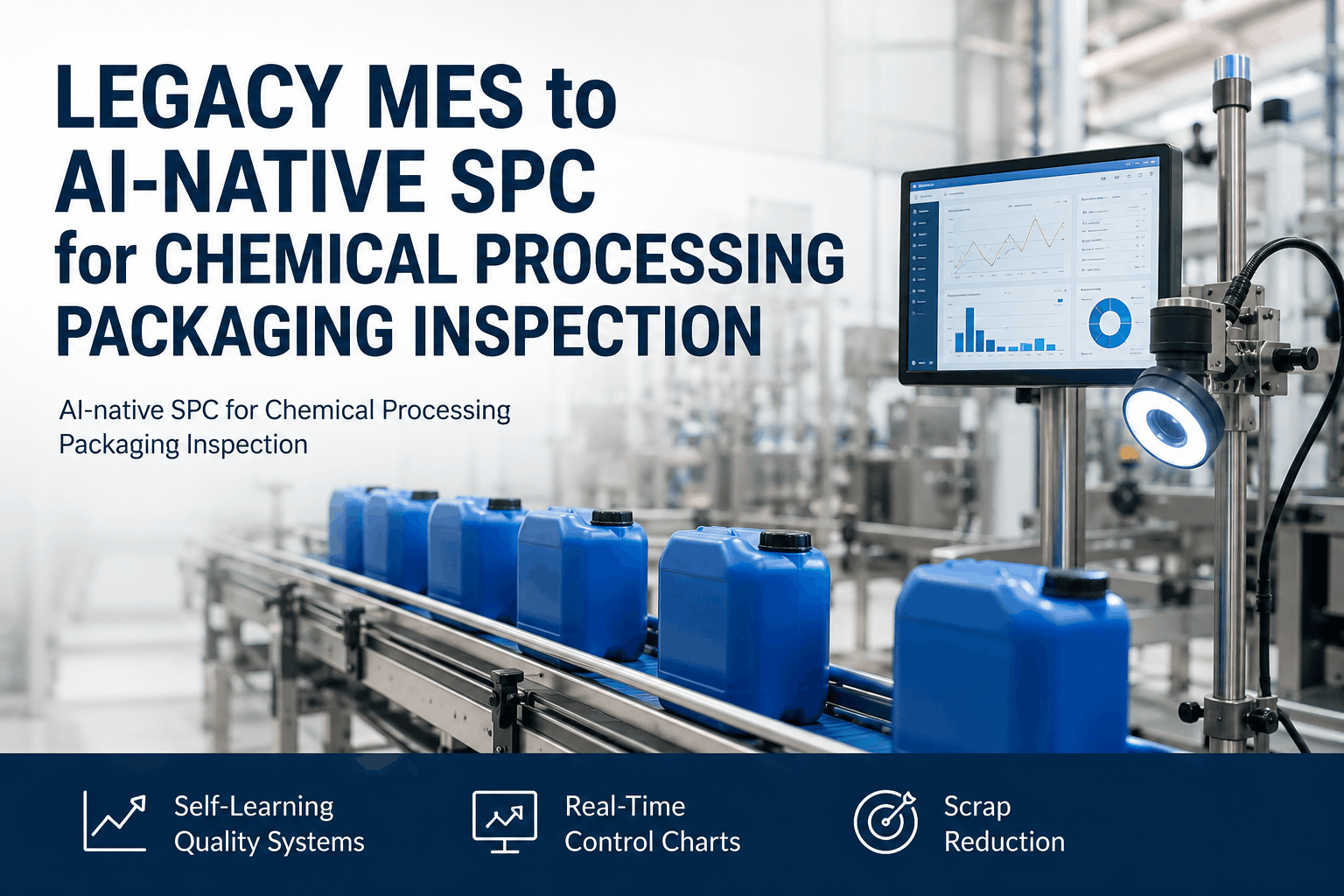
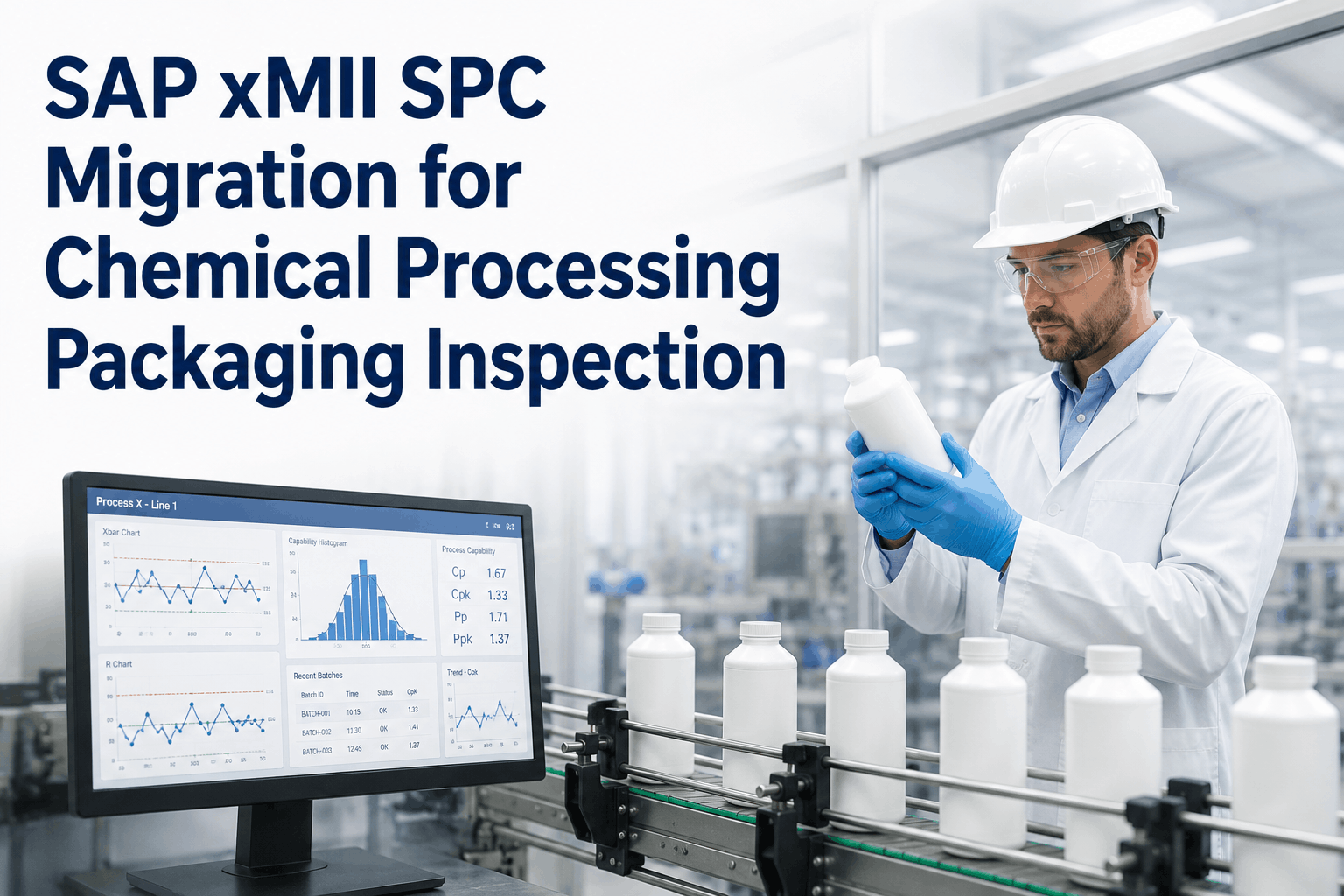
Chemical processing plants moving to SAP Digital Manufacturing Cloud (SAP DMC) are discovering the same gap their xMII deployments had: SAP's strategic successor delivers strong shop-floor execution and a generic predictive quality module — but the SPC engine itself remains threshold-based, single-variable, and reactive. For packaging inspection at modern line speeds, this is not enough. Manual visual inspection misses 20–30% of defects, generic SPC charts cap Cpk at 1.0–1.33, and the cost of a single packaging-error recall now averages $10 million. iFactory's AI-native SPC sits as a specialized analytics layer alongside SAP DMC — replacing reactive control-chart logic with predictive multivariate intelligence, AI vision inspection, and autonomous root-cause analytics. Plants typically lift Cpk into the 1.67–2.0+ range within six months, available on-premise, cloud, or hybrid, live in 8 weeks. Book an AI SPC Migration Workshop to design your packaging analytics layer.
$10M
Average cost of a single packaging-error recall incident
99.8%
AI defect detection accuracy vs. 85% manual inspection
+35–60%
Cpk improvement after AI-native SPC deployment
8 wks
Deployment timeline, on-premise or cloud
Why SAP DMC Alone Is Not Enough for Packaging Quality
SAP Digital Manufacturing Cloud is a strong execution platform — it connects shop floor to ERP, handles work orders, and provides a unified data layer. But its native SPC and quality modules were built for generalized manufacturing, not for chemical packaging lines running at 1,200+ units/minute with multivariate defect signatures. Below are the three structural gaps every plant on SAP DMC eventually encounters. Read more about the broader context in our SAP MII migration complete guide.
01
Univariate SPC Limits
DMC's SPC module monitors one variable per chart. Modern packaging lines have 40+ correlated inspection signals — label position, seal integrity, fill level, code grade, cap torque — that interact in ways no single chart can capture.
02
Reactive Detection
Generic SPC fires alarms after a threshold has already been breached. Predictive forecasting — knowing what Cpk will be 1–8 hours from now — requires specialized time-series ML that DMC's analytics layer does not provide.
03
No Native Vision Intelligence
DMC ingests inspection results but does not generate them. Without a dedicated AI vision layer, packaging lines still depend on manual inspection or rule-based vision — the bottleneck that caps Cpk in the first place.
SAP themselves recommend a hybrid coexistence model — SAP DMC for execution, best-of-breed analytics for predictive quality and SPC. iFactory is built for exactly that architecture.
Keep SAP DMC. Add AI-Native SPC. Lift Cpk Into the Six-Sigma Range.
iFactory plugs into SAP DMC as the specialized analytics layer SAP's own architecture recommends — preserving every execution workflow while replacing the reactive SPC engine with predictive AI.
What AI-Native SPC Actually Does
AI-native SPC is not a faster control chart. It is a fundamentally different mathematical model for understanding packaging quality — built from the ground up around multivariate, time-series, vision-fused data. Here is what changes when you deploy it on a chemical packaging line. Background reading: our AI vision packaging inspection overview.
PILLAR 1
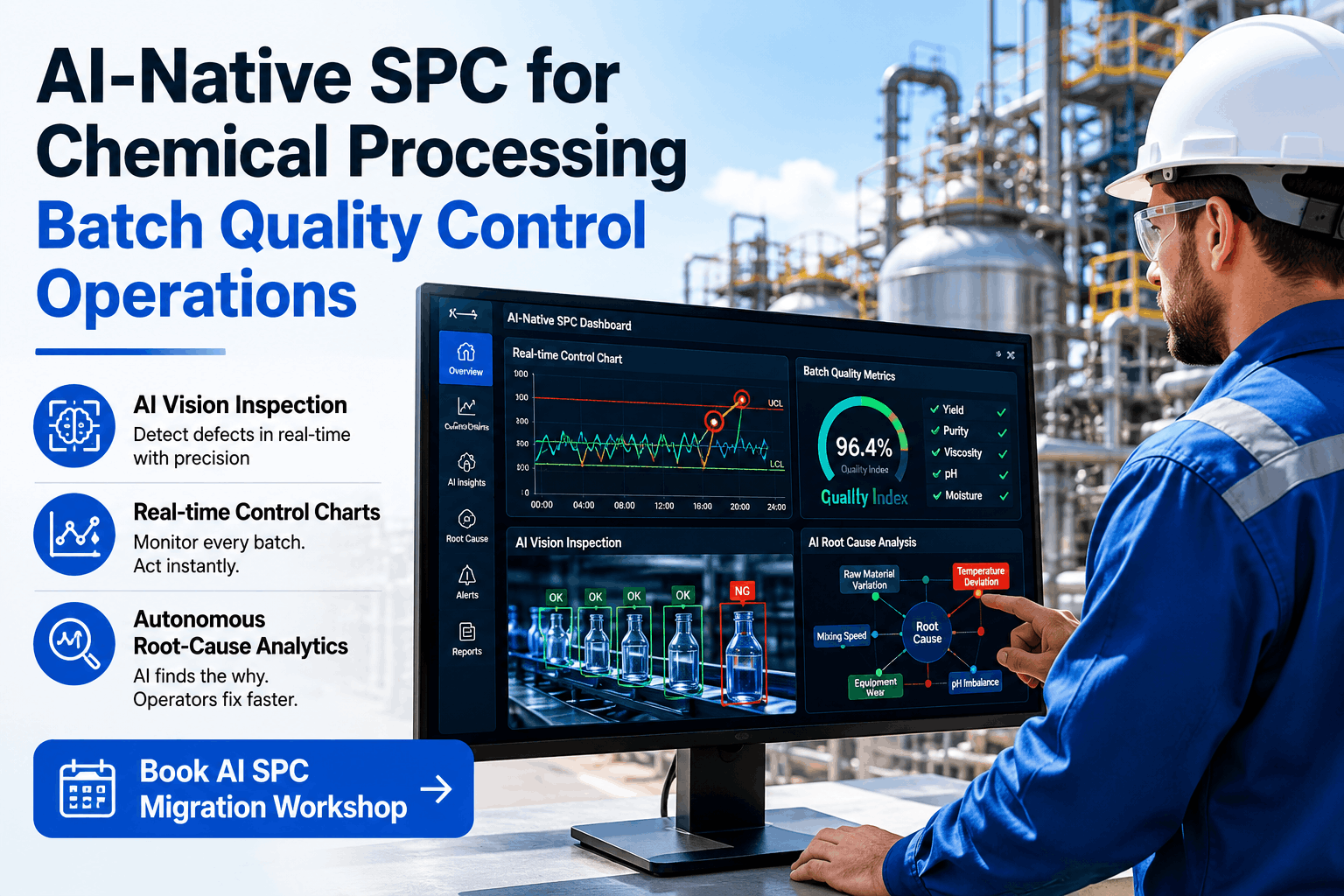
100% Vision Inspection
Edge-GPU AI vision inspects every container, label, seal, cap, fill level, and printed code on every unit at line speed. No sampling. No human fatigue. Sub-50ms per unit.
100%
Unit inspection coverage
PILLAR 2
Multivariate Predictive SPC
Multiway PCA + LSTM forecasting models fuse all inspection signals into a unified batch trajectory. Predicts Cpk drift 1–8 hours before specification breach — time enough to correct upstream.
1–8 hrs
Predictive horizon
PILLAR 3
Autonomous Root-Cause
When a defect cluster forms, the AI traces backward through correlated process variables to identify the most probable root cause. No 4-hour Pareto analysis. No multi-day cross-functional war room.
<30 min
Time to root-cause
The Three-Layer SAP DMC + iFactory Architecture
Most chemical plants moving to SAP DMC do not want a full replacement architecture — they want SAP DMC for execution and orchestration, and a specialized AI layer for predictive quality. iFactory delivers exactly that pattern. Here is how the layers connect.
LAYER 1 — ENTERPRISE
SAP S/4HANA + SAP DMC
Work Orders
Master Data
Execution Logic
Compliance Records
Preserved — SAP remains the system of record for production orders, master data, and regulatory documentation.
LAYER 2 — iFACTORY AI-NATIVE SPC
Predictive Quality & Vision Analytics
AI Vision Inspection
Multivariate SPC Models
LSTM Forecasting
Autonomous Root-Cause
New — adds specialized AI intelligence that DMC's generic SPC module cannot deliver.
LAYER 3 — PLANT FLOOR
Packaging Lines & Inspection Hardware
Line-Scan Cameras
Edge GPU Appliance
DCS / PLC Systems
LIMS Connectors
Existing infrastructure preserved — cameras retrofit in 2–4 weeks per line.
Deploy On-Premise, in the Cloud, or Hybrid
Chemical plants do not share a single deployment posture. A regulated EU site needs air-gapped on-premise for data sovereignty. A multi-plant specialty group prefers centralized cloud dashboards. A site with mixed regulations wants edge inference plus cloud-side learning. iFactory delivers identical AI-native SPC capability across all three modes — the choice is yours; the Cpk improvement is the same. Talk to our deployment architects about which mode fits your plant.
Air-gapped. Edge GPU on your plant network. Zero internet required. Full data sovereignty.
Best for: Regulated EU/APAC sites, hazardous chemical processes, pharma-adjacent serialization
Managed. Zero infrastructure. Multi-site Cpk dashboards. SOC 2 Type II, ISO 27001.
Best for: Multi-plant operators, fast-scaling specialty groups, OPEX-preferred budgets
Edge + cloud. Sub-50ms inference at the line. Cloud-side training across plant fleet.
Best for: Multi-site groups with mixed regulatory environments, federated learning
Same AI models. Same SAP DMC integration. Same Cpk outcomes. Deployment mode affects infrastructure and IT alignment — not capability or quality results.
The Cpk Improvement Trajectory
Cpk improvement is measurable, predictable, and consistent across chemical packaging plants. Below is the typical six-month trajectory observed after iFactory AI-native SPC goes live alongside SAP DMC. For deeper migration context, see our step-by-step iFactory MES implementation guide.
Cpk 1.67 — Six-Sigma Threshold for Serialized Product
Trajectory from a deployed specialty chemical bottling line — 850 units/minute, SAP DMC + iFactory AI-native SPC, on-premise deployment. +59% Cpk improvement in 6 months.
Your Cpk Ceiling Isn't Your Process. It's Your SPC Engine.
Add AI-native SPC alongside SAP DMC and your existing process — same equipment, same recipes, same operators — will move from Cpk 1.0–1.33 into the six-sigma range.
8-Week Deployment Roadmap
iFactory's program runs your packaging lines and SAP DMC throughout the deployment. The AI-native SPC layer is built in shadow mode, validated against your historical batches, then promoted to live in measured, reversible stages.
Week 1–2
DMC Audit & Camera Install
Map SAP DMC quality workflows, inspection plans, and tag inventory. Mount line-scan cameras at packaging stations. Edge GPU appliance or cloud connector installed.
Week 3–4
AI Model Training & Shadow Mode
Multiway PCA + LSTM models trained on 60–90 days of historical inspection and batch data. AI predictions logged alongside DMC's native SPC. First Cpk projection delivered.
Week 5–6
Calibration & Operator Training
Tune alert thresholds based on shadow-mode precision and recall. Train QA and operators on Safe / Warning / Critical workflow. Bidirectional DMC integration validated.
Week 7–8
Live Cutover & ROI Baseline
AI-native SPC promoted to primary quality engine. SAP DMC continues to handle execution and compliance records. First Cpk improvement report delivered.
Outcomes from Live Deployments
Each outcome below is from a chemical packaging operation running SAP DMC (or migrating from SAP xMII to DMC) with iFactory AI-native SPC layered on top. Six-month post-cutover data, measured against the previous baseline. See more context in our SAP xMII operations modernization writeup.
An 850 units/minute bottling line was running SAP DMC for execution but relying on manual visual inspection for packaging quality. Label skew, cap mis-seating, and serialized code drift were invisible to operators. Customer scan-failure complaints had reached 0.4% of shipped product. iFactory's 6-agent AI vision stack plus multivariate SPC achieved 99.4% real-defect catch rate and 0.7% false positive rate. Deployment: on-premise.
0.04%
Customer scan failures (down from 0.4%)
A 6-plant coating resin manufacturer standardized on SAP DMC for execution and iFactory AI-native SPC for packaging quality. Cloud deployment delivered a single Cpk dashboard across the fleet, identified the worst-performing line within 48 hours, and lifted fleet-wide Cpk from 1.21 to 1.84 in 9 months. Deployment: cloud.
1.84
Fleet Cpk average (+52%)
$3.4M
Annual scrap and rework recovered
A solvent packaging line hovering at Cpk 1.33 was at the edge of customer specification (1.67 required). SAP DMC's native SPC could not close the gap. iFactory's OCR/OCV and Barcode agents validated every serialized code at line speed; Dimensional and Vision Defect agents caught sub-pixel placement drift. Cpk reached 2.04 in 6 months. Deployment: hybrid.
$1.8M
Annual customer credits eliminated
What Packaging Teams Say After Going Live
SAP DMC handled our execution well, but Cpk was stuck at 1.3 because the SPC module was univariate and reactive. iFactory's AI-native layer fixed exactly that gap. Cpk 1.78 within six months.
VP of Quality Operations
Specialty Chemical Bottling, USA
Our IT mandate required on-premise only. iFactory's edge appliance was operational in 14 days, fully air-gapped, with bidirectional SAP DMC integration. Same Cpk results we would have gotten in the cloud.
Plant IT Director
Coating Resin Plant, Germany
Our largest customer required Cpk 1.67 on serialized solvent packs. We were at 1.33 with DMC native SPC. AI-native SPC lifted us to 2.04 in six months. We kept the contract and won three more.
Director of Customer Quality
Solvent Packaging Plant, India
The hybrid architecture made our auditors comfortable — execution data flows through SAP DMC for compliance, AI predictions stay traceable. ALCOA+ audit passed first time.
Quality Assurance Lead
Biotech Manufacturing, Japan
FAQ: AI-Native SPC in Chemical Packaging Inspection
Common questions from quality, operations, and IT teams evaluating AI-native SPC alongside SAP DMC for chemical packaging inspection. Question not covered here? Reach our solutions team directly.
Does AI-native SPC require us to replace SAP DMC?
No. iFactory is designed for hybrid coexistence — SAP recommends this exact pattern. SAP DMC remains the system of record for execution, work orders, master data, and compliance records. iFactory connects via OData, REST, and RFC interfaces to add the specialized AI-native SPC layer (multivariate models, predictive forecasting, AI vision inspection, autonomous root-cause). No SAP customization is required. Integration is complete in under 2 weeks for standard DMC environments.
How does AI-native SPC differ from SAP DMC's built-in SPC module?
SAP DMC's native SPC is univariate and reactive — it monitors one variable per chart against fixed control limits, alerting only after a threshold breach. iFactory AI-native SPC is multivariate and predictive — fusing 40+ inspection signals into a single batch trajectory using multiway PCA, then applying LSTM time-series forecasting to predict Cpk drift 1–8 hours before specification breach. The mathematical foundation is multivariate statistical process control extended with deep learning forecasting, a well-published approach in chemical engineering literature.
Is iFactory available on-premise, in the cloud, or both?
Both — and hybrid. iFactory delivers identical AI-native SPC capability across three modes: on-premise (air-gapped, edge-GPU, plant-local, zero internet required); cloud (SOC 2 Type II, ISO 27001, multi-site Cpk dashboards, automatic model updates); and hybrid (edge inference plus cloud-side training across plants). Cpk outcomes are identical across all three modes. The choice depends on your data residency rules, IT policy, and multi-site strategy — not capability.
Will AI vision keep up with packaging line speed?
Yes. iFactory's AI vision agents inspect every unit at speeds exceeding 1,200 units per minute. Line-scan cameras synchronized to conveyor speed capture continuous images without motion blur. All inspection agents run simultaneously on edge GPU with combined inference under 50 milliseconds. The system adds zero cycle time to your packaging line and is line-speed agnostic from 100 to 2,000+ units/minute.
What Cpk improvement should we realistically expect?
Across deployed chemical packaging lines, Cpk improvement has consistently fallen in the 35–60% range within 6 months of cutover. Lines starting at Cpk 1.0–1.33 typically reach 1.67–2.0+ — the level required for serialized, regulated, and pharma-adjacent product. The exact gain depends on baseline scrap rate, line speed, defect catalog complexity, and operator response discipline. The AI SPC Migration Workshop includes a tailored Cpk projection for your specific lines.
Will AI-native SPC break our FDA Part 11 or EU GMP Annex 11 compliance?
No — it strengthens it. iFactory auto-generates structured batch reports formatted for FDA 21 CFR Part 11, EU GMP Annex 11, ICH Q7, REACH, and OSHA PSM. All SAP DMC compliance records remain intact and audit-traceable. The AI layer adds enriched quality data with full provenance — every prediction linked to source images, process tags, model version, and confidence score, satisfying ALCOA+ data integrity requirements.
How much historical batch and inspection data do we need?
Typically 60–90 days of plant operating history — including SAP DMC inspection records, DCS process tag data, and LIMS analytical results. Model baseline training completes in 5–7 days. First live detections are validated during the Week 3–4 pilot phase. Full model calibration with false positive rate under 6% is reached within 6 weeks of deployment for standard chemical packaging environments.
Can we run iFactory and SAP DMC native SPC in parallel during migration?
Yes — and we recommend it. iFactory runs in shadow mode from Week 3 through Week 5, logging every AI prediction alongside DMC's native SPC results. Your QA team validates AI catches against existing decisions. Cutover to AI-native SPC as primary happens only after catch rate and false positive rate exceed your acceptance threshold. DMC native SPC remains available as backup for the first 30 days post-cutover. Plants consistently maintain 100% production uptime throughout migration.
Add AI-Native SPC to SAP DMC. Lift Cpk by 35–60%. Live in 8 Weeks.
SAP DMC handles execution. iFactory adds the predictive AI quality intelligence DMC's native SPC module does not deliver — multivariate forecasting, 100% AI vision inspection, autonomous root-cause analytics — fully integrated with your existing SAP layer, available on-premise, in the cloud, or hybrid.
On-premise, cloud, or hybrid — your choice
35–60% Cpk improvement in 6 months
100% AI vision inspection at 1,200+ units/min
SAP DMC bidirectional integration in 2 weeks
FDA Part 11, EU GMP Annex 11, REACH ready