SAP Quality Management has been the backbone of batch quality control in chemical processing for over two decades. It handles inspection lots, sampling plans, quality notifications, and batch records with a reliability that most plant quality teams depend on. But the version of SAP QM most chemical plants are running today was designed before real-time IoT sensor data existed, before AI could forecast batch outcomes from in-process parameters, and before a predictive SPC model could flag a viscosity drift five hours before the batch fails specification. The SAP mandatory migration deadline to S/4HANA — extended to 2030 — is the forcing function. Every chemical processor running legacy SAP QM or SAP xMII is planning a modernization. The question is whether that modernization just moves the same quality logic to a new platform, or whether it becomes the catalyst for AI-native SPC that transforms batch quality from reactive to predictive. Book an AI SPC Migration Workshop and see what predictive quality looks like for your chemical plant.
SAP QM Modernization · Chemical Processing
Your SAP Migration Deadline
Is Your Quality Transformation Window.
iFactory AI-native SPC deploys alongside your S/4HANA migration — adding predictive batch quality control, real-time deviation detection, and automated compliance records to the SAP QM foundation you already have. On-premise or cloud.
The SAP QM Modernization Imperative: What Chemical Processors Need to Know
SAP has set a mandatory migration deadline for customers to move from legacy ECC systems to S/4HANA — recently extended from 2027 to 2030. The surrounding market is enormous: analysts peg the broader S/4HANA opportunity at more than $89 billion when implementation, upgrades, and ongoing support are included. For chemical processors, the migration creates a decision point that goes beyond technical infrastructure.
The SAP Modernization Landscape for Chemical Processors
Now
Legacy SAP QM / xMII
Inspection lots, sampling, batch records. Rule-based. Reactive to deviations already occurred.
2025–2027
S/4HANA Migration Window
Technical migration of QM processes. The decision point: migrate and replicate, or migrate and modernize?
2027–2030
AI-Native SPC Layer Active
iFactory AI SPC running alongside S/4HANA QM — real-time batch monitoring, predictive deviation alerts, automated compliance records.
2030 Deadline
ECC End of Support
Plants that only migrated: same reactive quality on a new platform. Plants that modernized: predictive QC compounding value for 3+ years.
The migration window is the once-in-a-decade opportunity to upgrade quality intelligence — not just move it to a new database.
What Legacy SAP QM Cannot Do for Chemical Batch Quality
What SAP QM Does Well
Manages inspection lots and sampling plans
Records test results and usage decisions
Links batch records to production orders
Generates quality notifications for deviations
Supports GMP and ISO audit trail requirements
What SAP QM Cannot Do
Monitor in-process sensor parameters in real time
Predict batch outcome 4–6 hours before end-of-batch lab test
Detect multivariate drift patterns across 50+ process variables
Flag deviation before it produces an off-spec batch
Correlate raw material variability to downstream quality outcomes
The gap is structural: SAP QM is a records system, not a real-time intelligence system. It knows what quality was. iFactory AI SPC knows what quality will be. Book an AI SPC Migration Workshop to see how iFactory layers onto your existing SAP QM environment.
The AI-Native SPC Difference: From Reactive to Predictive
Batch Quality Control: Reactive vs. Predictive
Batch starts production
↓
8–16 hours of production
↓
End-of-batch lab sample taken
↓
Lab result: OUT OF SPEC
↓
Entire batch scrapped or reworked. SAP QM notification created. Root cause investigation begins.
vs.
Batch starts production
↓
AI monitors 50+ process parameters in real time — every minute
↓
Hour 3: AI detects multivariate drift — temperature + agitation speed correlation trending off-model
↓
Operator alerted — process adjustment made. Batch continues within spec.
↓
End-of-batch lab: PASS. SAP QM record created automatically with full in-process trace.
5 AI-Native SPC Capabilities That Transform Chemical Batch Quality
01
Real-Time Multivariate Batch Monitoring
Chemical batches are influenced by dozens of parameters simultaneously — reactor temperature, agitation speed, pH, feed rates, pressures, and raw material attributes. Legacy SPC monitors each univariately — missing the interaction effects that cause most off-spec batches. AI multivariate monitoring correlates all parameters simultaneously, detecting drift patterns invisible to single-variable control charts. Off-spec batches reduced 36% in chemical manufacturing deployments using AI multivariate monitoring (iFactory platform data, 2026).
36% reduction in off-spec batches — iFactory chemical plant data 2026
02
Predictive End-of-Batch Quality Forecasting
AI models trained on historical batch data — process parameters, raw material specs, equipment state — forecast end-of-batch quality 4–6 hours before the batch completes. Operators receive a predicted quality outcome and a confidence interval against the product specification. When the prediction indicates a risk of non-conformance, corrective adjustments can be made while the batch is still in process — before the lab sample is needed and before product is committed to packaging.
Predicts batch outcome 4–6 hours in advance — before end-of-batch lab sample
03
Raw Material Variability Correlation
Most chemical plants manage raw material quality through incoming inspection in SAP QM — COA review, sample testing, usage decision. What SAP QM does not do is correlate raw material property variation to downstream batch quality outcomes across dozens of batches. AI builds this model automatically from historical data — identifying which raw material attributes (moisture content, particle size, impurity profile) have the highest predictive impact on batch quality, enabling procurement decisions based on quality risk, not just price.
Product consistency improved 44% in chemical plants with AI raw material correlation
04
AI-Driven SPC Control Charts — Real-Time, Per-Batch
Traditional SPC in chemical batch processing uses fixed control limits calculated from historical averages — which may not account for product grade changes, seasonal raw material variation, or equipment ageing. AI-native SPC adapts control limits dynamically to the specific batch context — product grade, incoming material lot, equipment state — reducing false alarm rates by 40%+ while detecting true process shifts faster than static-limit charts. Laboratory testing efficiency improved 28% in chemical AI SPC deployments through reduced false-positive investigations.
40%+ false alarm reduction · 28% lab testing efficiency improvement
05
Automated GMP / ISO Compliance Record Generation
GMP batch record requirements — every process parameter, every deviation, every operator action, every in-process test result — represent hours of documentation effort per batch in legacy SAP QM environments. iFactory AI captures every parameter automatically from DCS and IoT sensors, structures it as a batch record, and posts it to SAP QM in near real time. Deviation records, corrective actions, and review-by-exception workflows in SAP QM are pre-populated from AI monitoring data — reducing batch record closure time from days to hours.
Batch record closure: days → hours · Zero manual parameter transcription
Chemical Processing Quality KPIs: AI-Native SPC Impact
36%
Reduction in off-spec batches — iFactory AI chemical plant deployments (2026)
44%
Product consistency improvement — AI multivariate batch monitoring
5.3 mo
Typical payback period — chemical AI quality platform deployments
28%
Lab testing efficiency improvement through reduced false-positive investigations
The Migration Approach: SAP QM + iFactory AI SPC — Not Either/Or
The strongest migration outcome for chemical processors is not replacing SAP QM — it is making it intelligent. SAP QM remains the system of record for inspection lots, usage decisions, quality notifications, and compliance documentation. iFactory AI SPC adds the real-time intelligence layer that SAP QM was never designed to provide. Ask our team about the iFactory SAP QM integration architecture for chemical batch operations.
iFactory AI SPC + SAP QM Integration Architecture
SAP S/4HANA QM
Inspection Lots
Usage Decisions
Quality Notifications
Batch Records
GMP Compliance
System of record — compliance documentation, audit trails, supplier quality, CAPA management. Modernized in S/4HANA migration.
Bidirectional via OData · REST · BAPI — real-time, no batch uploads
iFactory AI SPC Layer
Multivariate Monitoring
Predictive Batch Quality
Real-Time SPC Charts
Deviation Detection
Root Cause AI
Real-time intelligence — monitors every in-process parameter, predicts outcomes, detects deviations before they produce off-spec batches. Feeds SAP QM automatically.
OPC-UA · MQTT · DCS APIs · IoT sensors — real-time streaming
Plant Data Sources
DCS / SCADA
IoT Sensors
Lab Systems (LIMS)
Reactor / Vessel Data
Raw Material CoA
Source of truth for batch process data. iFactory reads all sources simultaneously — no manual data extraction or spreadsheet correlation required.
The Migration Workshop: What iFactory Delivers in 4 Weeks
Week 1
Current State Assessment
Map existing SAP QM configuration — inspection types, sampling plans, quality notifications, custom code. Identify SAP xMII / legacy integration touchpoints. Assess data quality and availability from DCS, LIMS, and IoT systems.
Week 2
Batch Quality Root Cause Analysis
Analyse 12–24 months of historical batch data to identify the parameters and patterns that predict off-spec outcomes. Quantify the scrap and rework cost addressable by predictive SPC. Identify the top 3–5 use cases by ROI.
Week 3
AI Model Prototype
Build a prototype AI SPC model on your historical batch data — demonstrating predictive accuracy against known off-spec events. Show operators what real-time monitoring would have looked like on three recent problematic batches.
Week 4
Migration Roadmap & Business Case
Deliver the full migration roadmap: SAP QM S/4HANA migration track + iFactory AI SPC deployment track. Documented ROI case with your data. Deployment timeline, resource requirements, and on-premise vs. cloud recommendation.
Ready to start? The workshop uses your historical batch data — no live system access required in week 1.
Book AI SPC Workshop
iFactory Deployment: On-Premise & Cloud for Chemical Processing
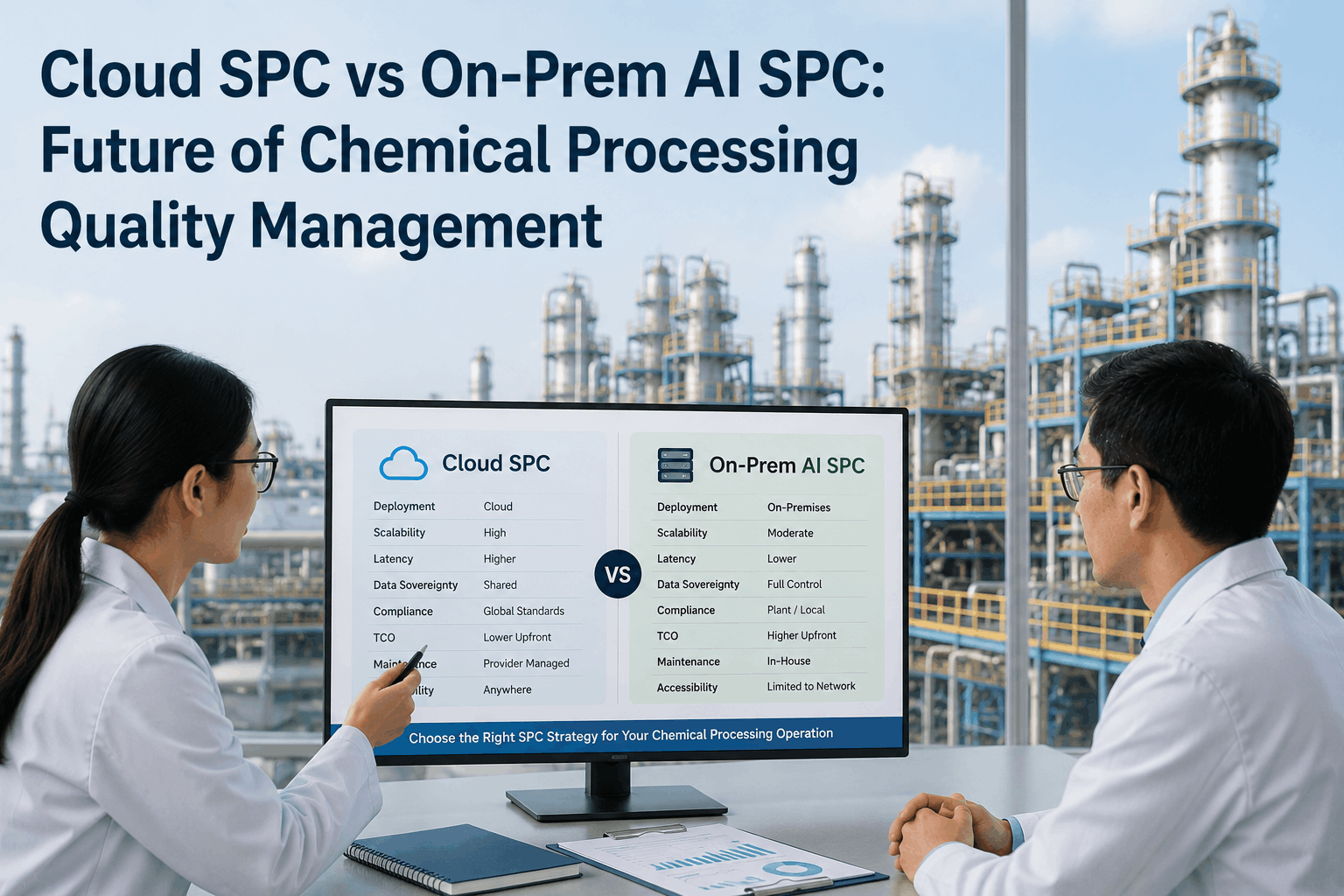
Chemical batch data — formulations, process parameters, yield outcomes — is some of the most competitively sensitive production data in any plant. iFactory provides both deployment models so your data stays where your governance requirements dictate. Discuss your deployment requirements with our team before the migration workshop.
On-Premise
Plant-Level Data Sovereignty
All batch data, AI models, and compliance records inside plant network
No transmission of formulation or process parameter data externally
Real-time DCS integration — sub-second parameter monitoring without cloud latency
GMP audit trail integrity — tamper-evident on-premise log storage
Meets REACH, FDA 21 CFR Part 11, and ISO audit requirements
Discuss On-Premise Setup
Cloud
Multi-Plant Quality Analytics
Cross-plant batch quality benchmarking and consistency comparison
Enterprise quality KPI dashboards accessible to QA leadership globally
AI model improvement from multi-plant batch data — broader training set
Regulatory submission data packages generated automatically
Ideal for specialty chemical groups with multiple production sites
Discuss Cloud Setup
FAQ: SAP QM Modernization and AI SPC for Chemical Processing
Should we wait until the S/4HANA migration is complete before adding AI SPC?
No — and waiting is the most common mistake in SAP modernization programmes. iFactory AI SPC connects to your existing SAP ECC QM environment today via standard OData and BAPI interfaces. Deploying AI SPC before S/4HANA migration means you build 1–3 years of AI model training data, demonstrate ROI before the migration investment, and arrive at S/4HANA with a proven AI quality layer already integrated. The migration then migrates the SAP QM records system — the AI SPC layer is already calibrated to your process and simply reconnects to the new S/4HANA QM interface. Starting with S/4HANA means starting AI SPC with no historical model — you lose the compounding advantage of early deployment.
What is the difference between SAP QM modernization and SAP xMII replacement?
SAP xMII (Manufacturing Integration and Intelligence) was SAP's shop floor connectivity and manufacturing intelligence platform, now approaching end of strategic development as SAP consolidates its manufacturing portfolio. SAP xMII replacement typically involves moving shop floor integration to SAP Digital Manufacturing (SAP DM) or SAP Manufacturing Execution (SAP ME) within S/4HANA. SAP QM modernization is broader: it covers the entire quality management architecture — inspection planning, in-process control, lab integration, compliance documentation, and supplier quality. iFactory AI SPC addresses both dimensions: it replaces xMII's real-time process monitoring capability with AI-native multivariate monitoring, while feeding the modernized SAP QM layer with structured quality data and deviation records automatically.
How does iFactory AI SPC handle GMP and FDA 21 CFR Part 11 compliance requirements?
iFactory's on-premise deployment generates a tamper-evident audit log of every process parameter reading, AI model output, alert generated, and operator action — with timestamps and user IDs. This log satisfies FDA 21 CFR Part 11 electronic records requirements and EU GMP Annex 11 for computerised systems in regulated manufacturing. AI-generated deviation records are posted to SAP QM as quality notifications with full provenance: the sensor data that triggered the alert, the AI model version that detected it, and the timestamp of operator acknowledgement. Batch record packages — combining process data, QM inspection results, and deviation records — are generated automatically for GMP batch release review, reducing review time from days to hours.
How long does it take for AI SPC to start improving batch quality in a chemical plant?
iFactory's phased deployment approach delivers value at multiple milestones: Phase 1 (weeks 1–6) establishes data integration, historical baseline analysis, and initial monitoring — operators see real-time process dashboards and first anomaly detections. Phase 2 (weeks 6–10) deploys predictive batch quality forecasting and root-cause analytics — first measurable improvements in off-spec detection speed. Phase 3 (months 4–6) scales to multi-unit deployment and advanced compliance reporting. Chemical manufacturers typically achieve positive ROI within 5.3 months. The workshop delivers the prototype model in week 3 — your team can see AI SPC predictions against your own historical batch data before any production deployment.
What data does iFactory need from a chemical plant to build the predictive SPC model?
The baseline dataset for model training is: 12–24 months of batch process parameter data from DCS (temperature, pressure, flow rates, agitation speed, pH — whatever your process captures), corresponding end-of-batch lab results (the quality outcome the model learns to predict), and raw material CoA data for the same period if available. Most chemical plants have this data already — the gap is that it sits in separate systems (DCS historian, LIMS, SAP QM) without a unified correlation layer. The migration workshop's week 2 analysis connects these systems and quantifies the predictive signal. Batch count matters: 50+ historical batches per product grade provides sufficient training data for most chemical processes. Complex multi-product operations with fewer batches per grade can use transfer learning from similar product chemistries.
What ROI should a chemical processor expect from AI-native SPC?
iFactory chemical plant deployments report off-spec batch reduction of 36%, product consistency improvement of 44%, and lab testing efficiency improvement of 28% — with positive ROI typically within 5.3 months. The financial case: in a plant producing 200 batches per month with a 4% off-spec rate, a 36% reduction eliminates approximately 2.9 off-spec batches per month. At typical specialty chemical batch values of $50,000–$500,000 per batch, that is $145,000–$1.45M in monthly avoided scrap and rework costs. Most deployments achieve payback in scrap avoidance alone within 3–6 months — compliance documentation efficiency and lab cost savings add further ROI on top.
Book the AI SPC Migration Workshop to model the ROI for your specific batch operations.
SAP QM Modernization + AI SPC
Book the AI SPC Migration Workshop.
See Predictive Quality on Your Batch Data.
iFactory's 4-week workshop delivers a prototype AI SPC model on your historical batch data, a documented ROI case, and a migration roadmap that works alongside your S/4HANA programme — not after it. On-premise or cloud.
SAP QM S/4HANA Integration
Predictive Batch Quality
On-Premise & Cloud
GMP / FDA 21 CFR Part 11
5.3-Month ROI Payback

.png)