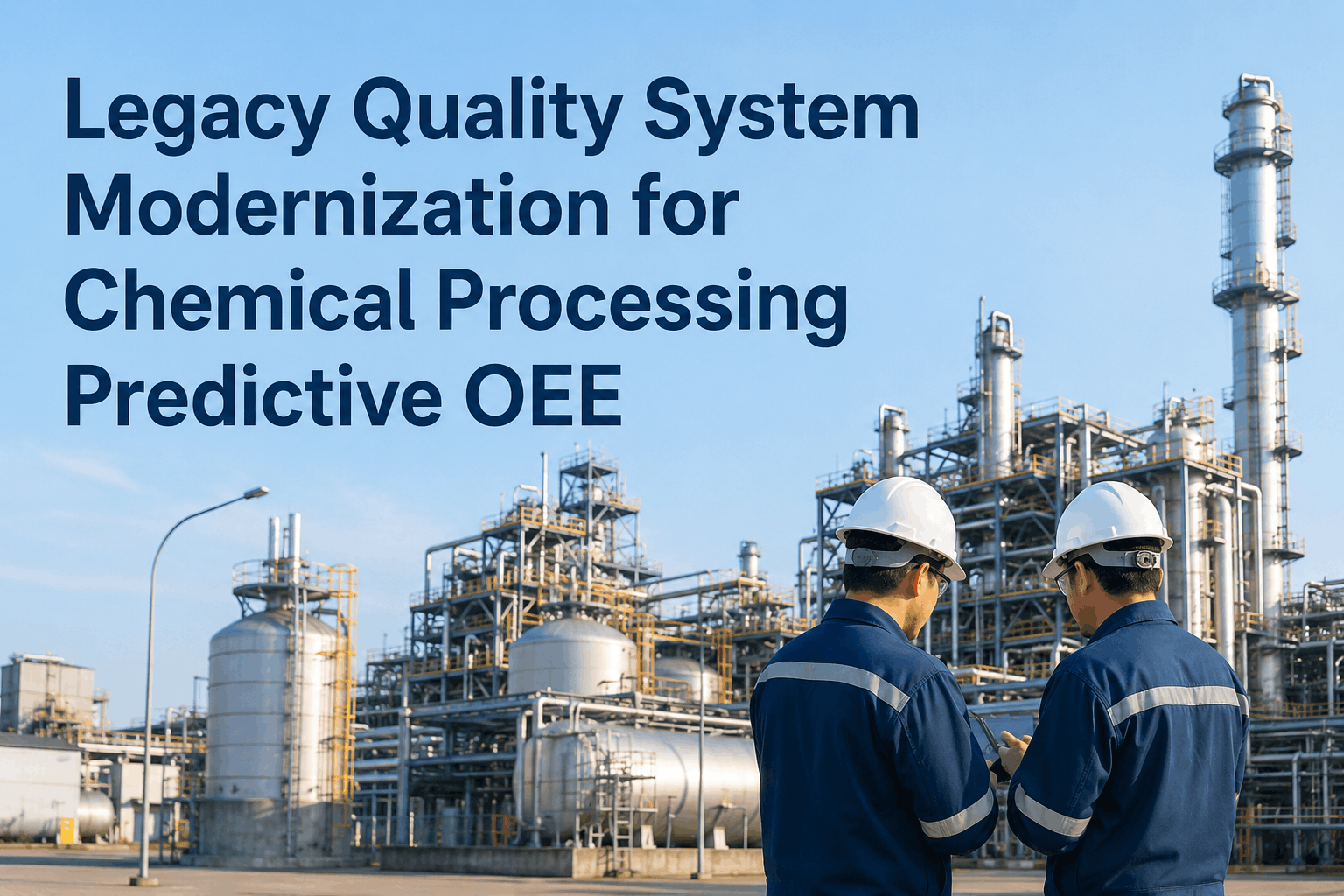
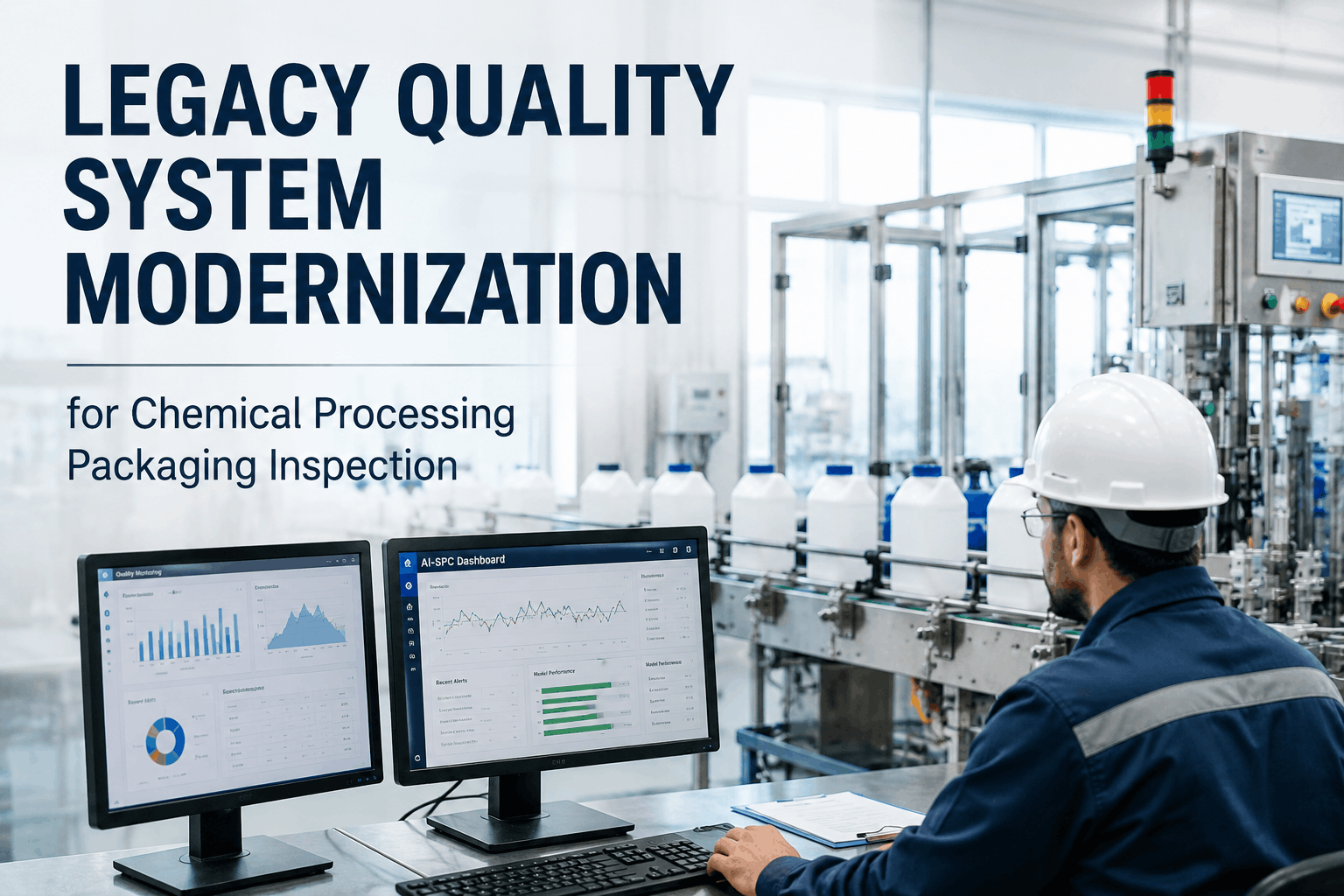
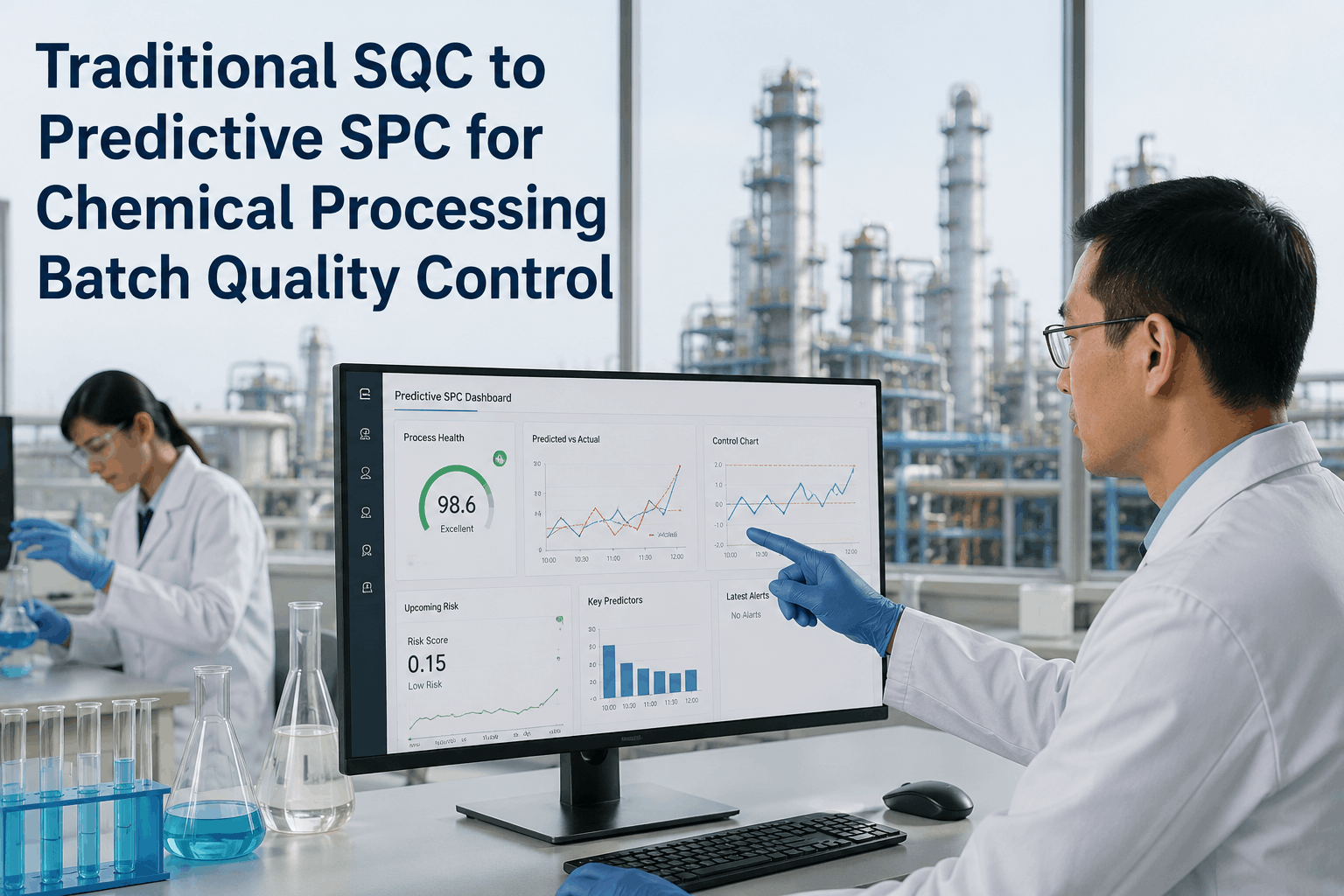
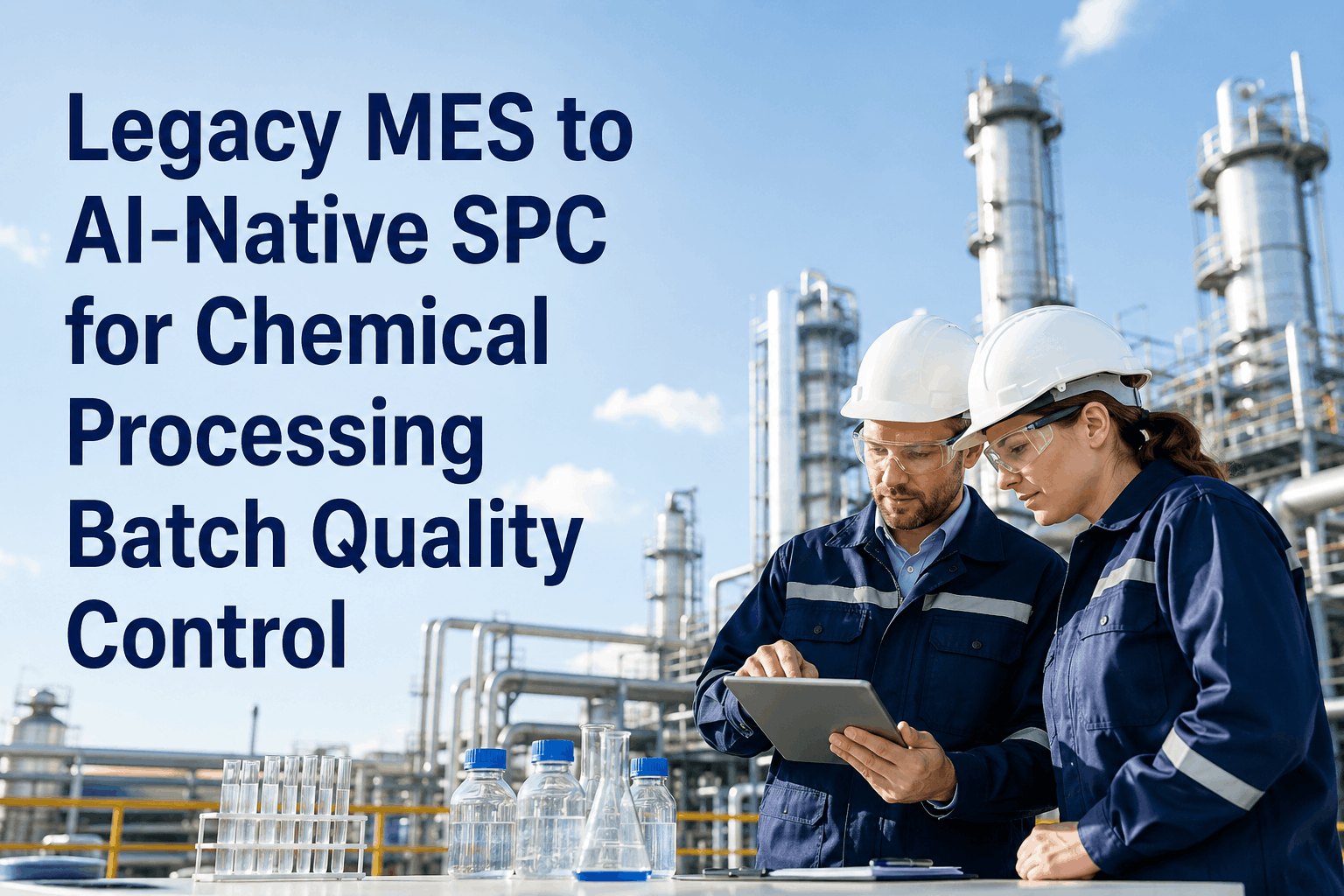
The SAP QM and SAP xMII systems running in most chemical processing plants today were not designed for predictive OEE. They were designed for compliance documentation, batch record generation, and quality notification routing — functions they still perform adequately. But OEE in chemical processing is not a compliance metric. It is a real-time operational signal: reactor uptime, yield rate, and quality performance combined into a single number that shifts minute by minute. Legacy quality systems report OEE after the shift. Self-learning AI quality systems predict OEE degradation before it happens — giving operators the 20–40 minute window they need to intervene. iFactory delivers this modernization on-premise, in the cloud, or both — without dismantling the SAP infrastructure already in place. Book an AI SPC Migration Workshop to see how iFactory modernizes your quality stack.
SAP QM Modernization · Predictive OEE · Chemical Processing
Legacy Quality Systems Report OEE.
Self-Learning AI Predicts It.
iFactory replaces static SAP QM and xMII quality logic with self-learning AI — delivering predictive OEE, real-time operator intelligence, and continuous quality improvement for chemical processing plants.
22–35%
OEE improvement in chemical plants after AI-native quality modernization
3x Faster
Operator response to quality deviations with AI-powered real-time alerts vs. shift-end reports
On-Prem & Cloud
iFactory deploys both — full data sovereignty or multi-site intelligence, your choice
What "Legacy Quality System" Really Means in Chemical Processing
When chemical plant managers talk about legacy quality systems, they mean a specific combination: SAP QM handling inspection lots, quality notifications, and batch disposition; SAP xMII or a historian middleware aggregating process data; and manual or semi-automated SPC charts reviewed by quality engineers — usually an hour or more after the data was generated. This architecture has three structural problems that modernization must solve.
01
Data Arrives After Decisions Are Made
Batch parameters reaching SAP QM via xMII are already 15–60 minutes old by the time a quality engineer reviews them. OEE calculations based on this data reflect what already happened — not what is about to happen. Operators make shift decisions without the information they need.
OEE impact: planned interventions become reactive firefighting
02
Quality Systems Don't Learn From History
SAP QM stores quality notifications. It does not learn from them. The same failure mode that produced 12 quality notifications last year will produce the same alerts again this year — because the system has no mechanism for encoding what those failures had in common and detecting their early signatures.
OEE impact: repeat failures consume the same unplanned downtime year after year
03
Operator Dashboards Show Data, Not Decisions
Legacy operator screens display historian data — temperature trends, pressure readings, quality flags. They do not tell operators what to do next, which parameter combination matters most right now, or what probability the current batch will meet specification. Operators must interpret raw data under time pressure, on every shift.
OEE impact: operator response time is limited by human data processing speed
What Self-Learning Quality Systems Actually Do
Self-learning quality systems are not a marketing term — they describe a specific technical architecture. Every batch that runs trains the AI model further. Every quality notification updates the failure signature library. Every operator intervention that succeeds or fails is encoded into future predictions. The system gets measurably more accurate with every production cycle — something that static SAP QM configuration never achieves.
How iFactory Self-Learning Quality Works — Continuous Improvement Loop
1
Batch Runs
Process historian data, DCS parameters, LIMS results, and OEE actuals ingested in real time
→
2
AI Monitors & Predicts
Multivariate drift detected, batch health scored, OEE degradation probability calculated
→
3
Operator Acts
Role-specific alert tells operator exactly what to check and what intervention to consider
→
4
Outcome Recorded
Batch closes — outcome (on-spec / off-spec) and intervention logged against the alert signature
→
5
Model Updates
AI retrains on the new batch — detection accuracy improves, false alarm rate decreases
Every batch makes the system smarter. SAP QM stores records. iFactory learns from them.
Predictive OEE: The 3 Components That Legacy Systems Miss
OEE = Availability × Performance × Quality
Availability
Legacy Approach
Downtime recorded after it occurs. SAP PM work orders created reactively. No prediction of next failure event.
iFactory AI
Vibration, temperature, and current signatures predict equipment failure 6–14 days ahead. Planned maintenance replaces unplanned downtime.
Availability gain: 8–14%
Performance
Legacy Approach
Speed losses reported in shift logs. Cycle time deviations visible in historian but not correlated to process quality or equipment state.
iFactory AI
AI correlates real-time throughput with process parameters — identifying which parameter combinations drive speed loss before they cascade into batch quality failures.
Performance gain: 5–10%
Quality
Legacy Approach
First-pass yield tracked per batch. Off-spec batches flagged after lab result. Quality rate calculated retrospectively — never predicted.
iFactory AI
Predictive batch scoring predicts final quality at mid-batch with 87–94% accuracy. Defect patterns detected 20–40 min before specification breach — enabling correction while the batch is still recoverable.
Quality rate gain: 6–12%
Operator Productivity: From Data Interpreter to Decision Maker
The most direct route to OEE improvement in chemical processing is operator productivity — not more automation, but better-informed operators acting faster on higher-quality information. Legacy systems give operators data. iFactory gives operators decisions: what is happening right now, why it matters, what to do next, and how confident the AI is in that recommendation. Talk to our team about role-specific AI dashboards for your operator and supervisor team.
Operator Experience: Legacy vs. AI-Modernized
Legacy System Experience
06:00 — Shift Start
Operator reviews historian trends for last 8 hrs. No anomalies visible yet. SAP QM shows no open notifications.
08:30 — Temperature Drift
Temperature trending up. Still within SPC limits. No alert. Operator doesn't notice — monitoring 12 other parameters.
10:15 — Limit Breach
SPC alarm fires. Operator investigates. 1.5 hrs of drift already in the batch. Correction attempted but batch trajectory too far off.
14:00 — Lab Result
Lab confirms batch off-spec. SAP QM notification created. Batch written off. Root cause investigation assigned.
iFactory AI Experience
06:00 — Shift Start
AI dashboard shows batch health scores for all active reactors. One reactor flagged: "Watch — heat exchanger efficiency trending down from 3 batches ago."
08:32 — Drift Detected
AI alert fires: "Reactor 4 — temperature-pressure correlation drifting. Batch failure probability 61%. Recommended: check cooling water flow rate."
08:38 — Operator Acts
Operator adjusts cooling water. Drift corrects within 12 minutes. Batch health score recovers to 94%. Alert closed.
14:00 — Lab Result
Lab confirms on-spec batch. SAP QM updated automatically. Intervention outcome logged — AI model updated for next shift.
iFactory Deployment: On-Premise and Cloud — Both Available, No Compromise
On-Premise
Full Data Sovereignty
All batch, process, and quality data stays within your plant network
Zero proprietary formulation data transmitted externally
Sub-20ms AI inference — edge processing, no cloud dependency
FDA 21 CFR Part 11 and GMP data residency compliant
Air-gap compatible for high-security regulated environments
Direct DCS, PI historian, LIMS, and SAP QM integration
Best for: regulated chemical, pharma-chem, proprietary process IP
Discuss On-Premise
Cloud
Multi-Site Intelligence
Real-time predictive OEE across all chemical processing facilities
Cross-site operator productivity benchmarking and best-practice sharing
Mobile dashboards for supervisors and quality managers anywhere
Automatic AI model updates — continuous improvement without IT effort
Fleet-wide learning: insights from one plant improve predictions at all
SOC 2 Type II compliant — encrypted, regionally configurable
Best for: multi-site chemical groups, centralised quality operations
Discuss Cloud Setup
Modernization Outcomes: What Chemical Plants Measure After Deployment
22–35%
Predictive OEE improvement within 6 months of AI quality modernization
Chemical processing plants
3x
Faster operator response to quality deviations with AI role-specific alerts
vs. legacy SPC monitoring
45%
Reduction in time operators spend interpreting raw data vs. acting on decisions
Operator productivity gain
60%
Faster lab-to-quality-decision with LIMS-AI integration replacing manual review
Quality cycle acceleration
FAQ: Legacy Quality System Modernization for Chemical Processing
Does modernizing our quality system require replacing SAP QM entirely?
No — and this is the most important point of the modernization design. SAP QM remains the system of record for inspection lots, quality notifications, batch disposition decisions, and compliance documentation. iFactory replaces the intelligence layer — the SPC logic, the OEE calculation, the quality prediction — while writing its outputs back to SAP QM via standard OData interfaces. Your SAP QM configuration, quality notification workflows, and ERP integration stay intact. The change is invisible to SAP.
Contact our team to review your specific SAP QM configuration.
How does iFactory calculate predictive OEE differently from our current system?
Current OEE systems calculate availability, performance, and quality from recorded data after the event — downtime already occurred, speed losses already happened, quality failures already confirmed by the lab. iFactory calculates predictive OEE by modelling the probability of each OEE component degrading within the next production window based on real-time process signatures. Availability prediction uses equipment vibration and thermal trends. Performance prediction uses real-time throughput correlated against process parameters. Quality prediction uses multivariate batch trajectory scoring. The result is an OEE forecast, not a history report.
What does "self-learning" mean in practical terms for a chemical processing plant?
Self-learning means the AI model updates after every batch. When a batch closes on-spec, the process trajectory that produced that outcome is reinforced in the model. When a batch closes off-spec, the parameter signatures that preceded the failure are added to the failure pattern library. When an operator intervention succeeds, the intervention type and timing are encoded as a recommended action for similar future signatures. After 3–6 months of operation, iFactory's prediction accuracy is measurably higher than at deployment — something that static SAP QM configuration never achieves regardless of how long it runs.
How does on-premise iFactory deployment differ from cloud in terms of operator experience?
The operator dashboard experience is identical in both deployments — the same real-time batch health scores, the same role-specific alerts, the same predictive OEE displays. The difference is where the AI processing happens (local edge server vs. cloud inference), how AI model updates are delivered (IT-scheduled on-premise vs. automatic cloud), and whether cross-site benchmarking is available (not available on-premise, available cloud). For operators on the floor, both deployments feel the same. For quality managers across multiple sites, cloud adds the cross-plant visibility layer that on-premise cannot provide.
What is the typical modernization timeline from legacy SAP xMII to iFactory AI?
The standard migration timeline is 10–12 weeks from project kickoff to full production cutover, with a 2–4 week parallel running period where iFactory and xMII run simultaneously for validation. AI model training on historical batch data typically requires 4–6 weeks running in parallel. Production is never disrupted — iFactory runs in shadow mode until quality team validation is complete. iFactory's SAP QM integration goes live in the same deployment window, adding 1–2 weeks of configuration that runs in parallel with AI training.
Book a migration workshop for a timeline specific to your plant and SAP configuration.
iFactory · Legacy Quality Modernization · Chemical Processing
Stop Reporting OEE After the Shift.
Start Predicting It During the Batch.
iFactory modernizes SAP QM and xMII with self-learning AI quality systems that deliver predictive OEE, real-time operator intelligence, and continuous improvement — on-premise or cloud, without disrupting your SAP infrastructure.
Self-Learning Quality AI
Predictive OEE
On-Premise Available
Cloud Available
SAP QM Integration
90-Day Modernization