Chemical processing plants face a compliance paradox in 2026. Regulators — FDA, EPA, REACH, TSCA — are demanding more: real-time batch traceability, automated audit trails, continuous quality monitoring, and documented AI governance. Yet the systems most chemical plants rely on for quality management — SAP xMII, legacy SPC software, manual batch logs — were designed for a world where periodic sampling and end-of-batch testing were acceptable proof of compliance. That world is ending. Edge AI SPC processes quality data directly on your plant floor — no cloud transmission delays, no external data sovereignty risk, no latency gap between a compliance event and its documentation. Book an AI SPC Migration Workshop to see how iFactory's edge AI platform meets your compliance requirements.
Edge AI · Chemical Processing Compliance
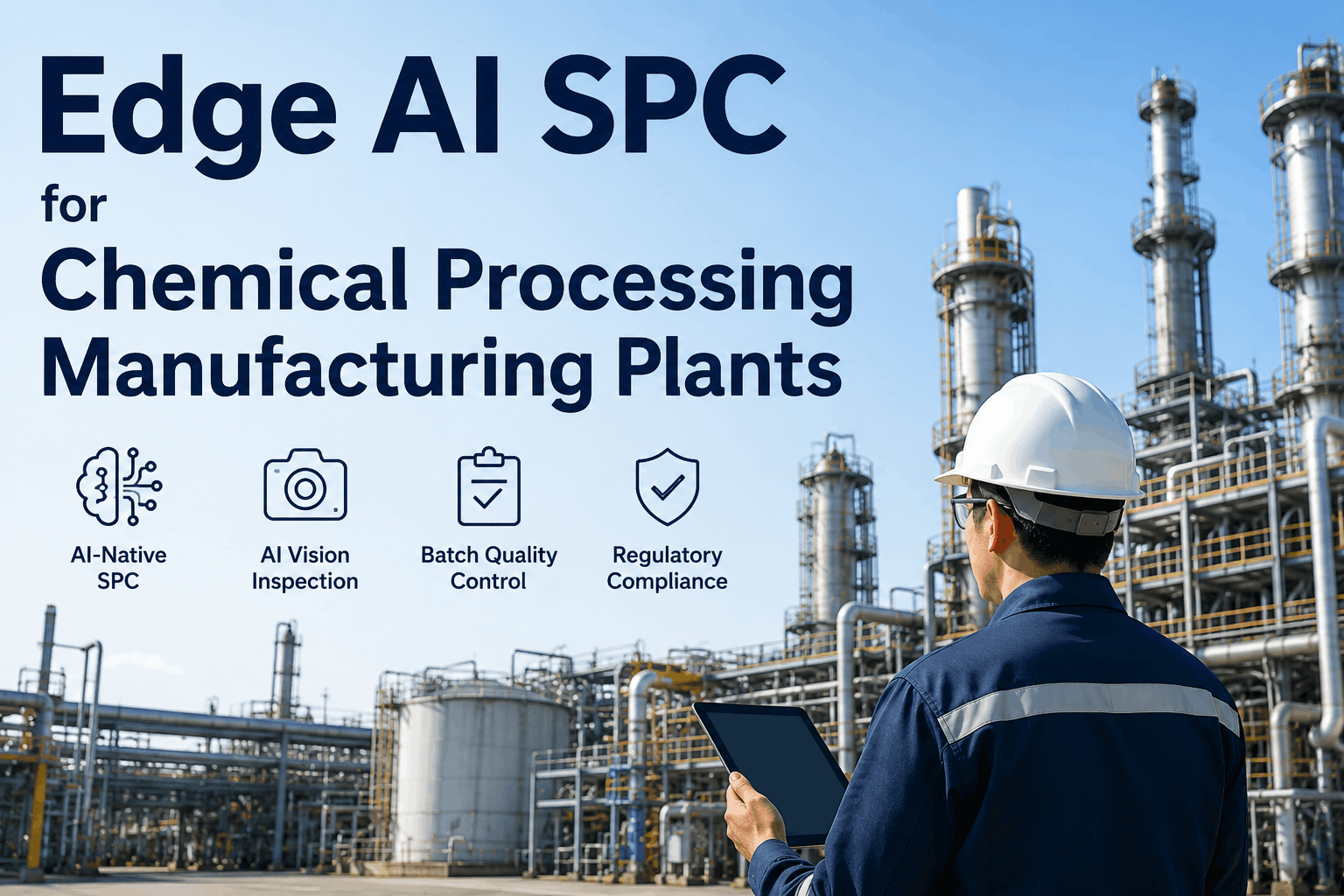
Edge AI SPC for Chemical Processing Manufacturing Plants
Process AI inference at the plant floor edge — millisecond quality decisions, tamper-evident audit trails, and regulatory documentation that builds itself. Available on-premise and cloud.
Regulatory Frameworks Supported
FDA 21 CFR Part 11
EPA TSCA 2025
EU REACH
ISO 9001
GMP
IATF 16949
All compliance documentation generated automatically — no manual assembly
<10ms
Edge AI quality decision latency vs 2–6s cloud
0%
Data transmitted externally (on-premise mode)
36%
Off-spec batch reduction from AI-native SPC
90%
Reduction in audit preparation time
Why "Edge" Matters for Chemical Processing Compliance
Cloud-based AI quality analytics introduce three compliance risks that chemical plants cannot accept: transmission latency (2–6 seconds for a round-trip to a cloud inference endpoint), external data exposure (batch formulations and process parameters transmitted outside the facility), and connectivity dependency (a network outage creates compliance record gaps). Edge AI eliminates all three by running AI inference locally — on hardware at or near the production equipment — so quality decisions happen in under 10 milliseconds with zero external data transmission. Talk to our compliance team about edge AI deployment requirements for your regulatory framework.
Cloud AI vs Edge AI — Why It Matters for Compliance
Cloud AI (Legacy)
Plant Sensor
Upload to cloud
2–6 sec latency
Cloud Server
Return result
more latency
Quality Decision
Data leaves facility — sovereignty risk
Network outage = compliance gap
2–6 second latency = missed events
Cloud costs scale with data volume
Edge AI (iFactory)
Plant Sensor
Local inference
<10ms latency
Edge AI Node
Quality Decision
All data stays in facility — full sovereignty
Air-gap capable — works offline
<10ms latency — catches fast events
Fixed cost — no per-GB cloud fees
The 2026 Regulatory Compliance Landscape for Chemical Plants
The regulatory environment facing chemical processing plants has shifted fundamentally between 2024 and 2026. Three changes are driving AI adoption as a compliance necessity — not just an efficiency option. Understanding each is critical for any plant operator making platform decisions today.
FDA
FDA · 21 CFR Part 11 & AI Governance
In April 2026, the FDA issued warning letters citing facilities that used AI without documented human oversight workflows. The FDA's stance is clear: AI influencing manufacturing, batch release, or quality decisions must have verifiable audit trails, explainable outputs, and documented model governance. Edge AI SPC with full audit logging satisfies this — black-box cloud AI does not.
Implication: Every AI quality decision needs a timestamped, tamper-evident record with the data that drove it.
EPA
EPA · TSCA Section 5 Updates 2025
TSCA Section 5 updates in 2025 significantly expanded data submission and reporting requirements for chemical manufacturers. Enhanced traceability — tracking batch-level process conditions through to final product specifications — is now expected as part of compliance submissions. Manual batch logs and SAP xMII's report-based records are insufficient for the depth of data now required.
Implication: Batch process data must be automatically captured and structured for EPA reporting — not manually assembled.
REACH
EU REACH & UK REACH · Chemical Traceability
EU and UK REACH regulations require documented evidence that chemical substances were produced within validated process conditions. AI-native SPC provides continuous, automated evidence of process control — replacing the selective sampling records that REACH auditors are increasingly challenging as insufficient proof of systematic process monitoring.
Implication: Continuous process monitoring records are stronger REACH compliance evidence than periodic sampling reports.
What Edge AI SPC Delivers for Compliance — Feature by Feature
A
Automated Audit Trail Generation
Every AI quality decision — SPC alert fired, vision inspection result, process parameter deviation — is written to a tamper-evident, timestamped audit log stored locally on-premise. Records include the sensor data that triggered the decision, the AI model version, and the operator action taken. FDA 21 CFR Part 11 compliant by design.
Compliance coverage: FDA 21 CFR Part 11, ISO 9001, GMP batch records
B
Continuous Batch Traceability — No Sampling Gaps
Edge AI monitors every batch continuously — not at 30-minute manual check intervals. Every process parameter deviation, every vision inspection result, and every quality gate outcome is recorded for the full duration of the batch. Auditors receive a complete, uninterrupted data record rather than sampled snapshots.
Compliance coverage: EPA TSCA traceability, EU/UK REACH, IATF 16949 quality records
C
Explainable AI — Auditor-Ready Decision Rationale
Every AI quality alert includes the specific sensor readings, process variables, and statistical thresholds that triggered it. Auditors can trace any quality decision back to the exact data that caused it. "AI said reject" is not a compliance record. "AI rejected due to viscosity exceeding 3σ upper control limit at 14:32:07, confirmed by vision inspection score 0.42 below threshold 0.65" is.
Compliance coverage: FDA AI governance guidance 2025–2026, ISO 9001 quality decision documentation
D
Automatic Certificate of Analysis Population
AI SPC results and vision inspection scores feed directly into Certificate of Analysis templates — populated automatically at batch completion. Quality engineers review and approve rather than manually assemble data from DCS exports, lab results, and SAP QM records. CoA generation time drops from 2–4 hours to under 10 minutes.
Compliance coverage: GMP CoA requirements, customer quality agreements, third-party audit submissions
E
Offline-Capable Compliance Record Storage
Edge AI deployments store all quality records locally — on-premise hardware within the facility network. In air-gap mode (OT network isolated from internet), all AI inference and record generation continues without interruption. Compliance documentation cannot have a connectivity-dependent gap when a network outage occurs during a regulated production run.
Compliance coverage: All regulatory frameworks — continuous record availability regardless of network state
On-Premise vs Cloud: iFactory Supports Both — With Full Compliance Capability
Not every chemical plant has the same compliance architecture. Some plants require full on-premise deployment because their regulatory frameworks prohibit batch data leaving the facility. Others operate multi-site quality networks where cloud consolidation is the only viable architecture for cross-site compliance benchmarking. iFactory delivers both — with identical AI quality intelligence and compliance record generation in each deployment model. Schedule a compliance architecture discussion with our deployment team.
On-Premise
For data sovereignty & air-gap requirements
All AI inference runs on local edge hardware
Batch data never leaves facility network
Air-gap compatible — no internet required
Full audit trail stored locally — Part 11 compliant
Offline capable during connectivity failures
or
Both deliver: real-time SPC · vision inspection · audit trails · SAP QM integration
Cloud
For multi-site compliance consolidation
Compliance data unified across all plants
Cross-site audit trail access for corporate QA
Regulatory submission packages generated centrally
Mobile access for remote compliance review
Auto-updates — always current with latest standards
Compliance Questions Plant Operators Ask Most
Does edge AI SPC qualify as a validated computer system under FDA 21 CFR Part 11?
iFactory's edge AI SPC platform is designed with Part 11 compliance as a foundational requirement — not an afterthought. The system generates electronic records with user identification, timestamping, tamper-evidence, and audit trail completeness that Part 11 requires. Validation documentation (IQ/OQ/PQ protocols) is provided. The April 2026 FDA warning letter about AI governance highlighted the need for human oversight — iFactory's operator approval workflow ensures every AI quality decision has a documented human review step for regulated actions.
Talk to our compliance team about validation package options for your site.
How does edge AI SPC help with EPA TSCA traceability requirements?
EPA TSCA's 2025 updates require detailed process condition data tied to batch production records. iFactory's edge AI captures and timestamps every process parameter deviation, control action, and quality outcome — creating the continuous batch-level traceability record that TSCA submissions now require. Data is exportable in structured formats directly aligned with EPA's CDX platform reporting requirements.
Can edge AI SPC replace manual batch records entirely, or do operators still need to enter data?
For process parameter data — yes, entirely automated. Edge AI captures all DCS process data, vision inspection results, and SPC alert outcomes without operator data entry. Operators still provide approval signatures for batch release decisions, CAPA approvals, and exception documentation. This is intentional: regulatory frameworks require human oversight for release decisions, even when AI provides the quality evidence. The goal is eliminating data entry — not eliminating human judgment.
How does iFactory handle model drift and AI governance documentation?
iFactory tracks model performance metrics continuously — monitoring prediction accuracy, false alarm rates, and detection sensitivity against rolling production data. When model drift is detected (model performance degrades as process conditions evolve), the system flags retraining and documents the model version change in the audit trail. Every batch record shows which AI model version made each quality decision — satisfying the model lifecycle management requirements now expected by FDA and ISO 9001 auditors.
Book a workshop to review AI governance documentation standards for your regulatory framework.
Compliance Impact: Before and After Edge AI SPC
2–4 hrs
↓
<10 min
Certificate of Analysis generation time
Periodic sampling
↓
100% continuous
Batch quality coverage for audit trail
Days of prep
↓
Same-day export
Regulatory audit documentation preparation
Manual entry
↓
Automated
Batch record population in SAP QM
iFactory · Edge AI SPC Platform
Your Compliance Documentation Should Build Itself. Edge AI SPC Makes That Real.
iFactory's edge AI SPC platform delivers real-time quality intelligence, automated audit trails, and regulator-ready batch documentation — on-premise for full data sovereignty or cloud for multi-site consolidation. Designed for FDA 21 CFR Part 11, EPA TSCA, EU/UK REACH, and GMP compliance from day one.
On-Premise Available
Cloud Available
FDA Part 11 Compliant
Air-Gap Capable
Automated Audit Trails