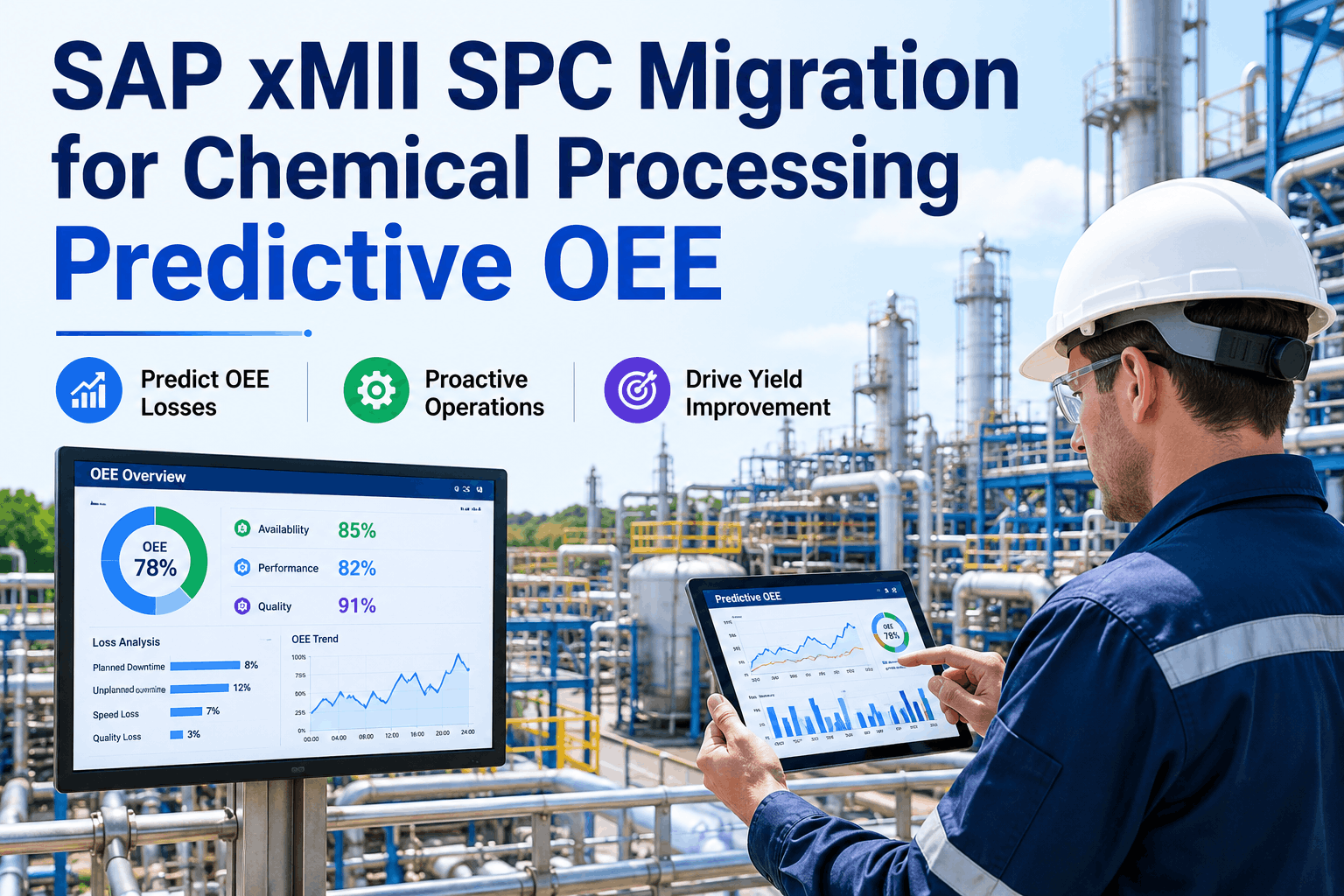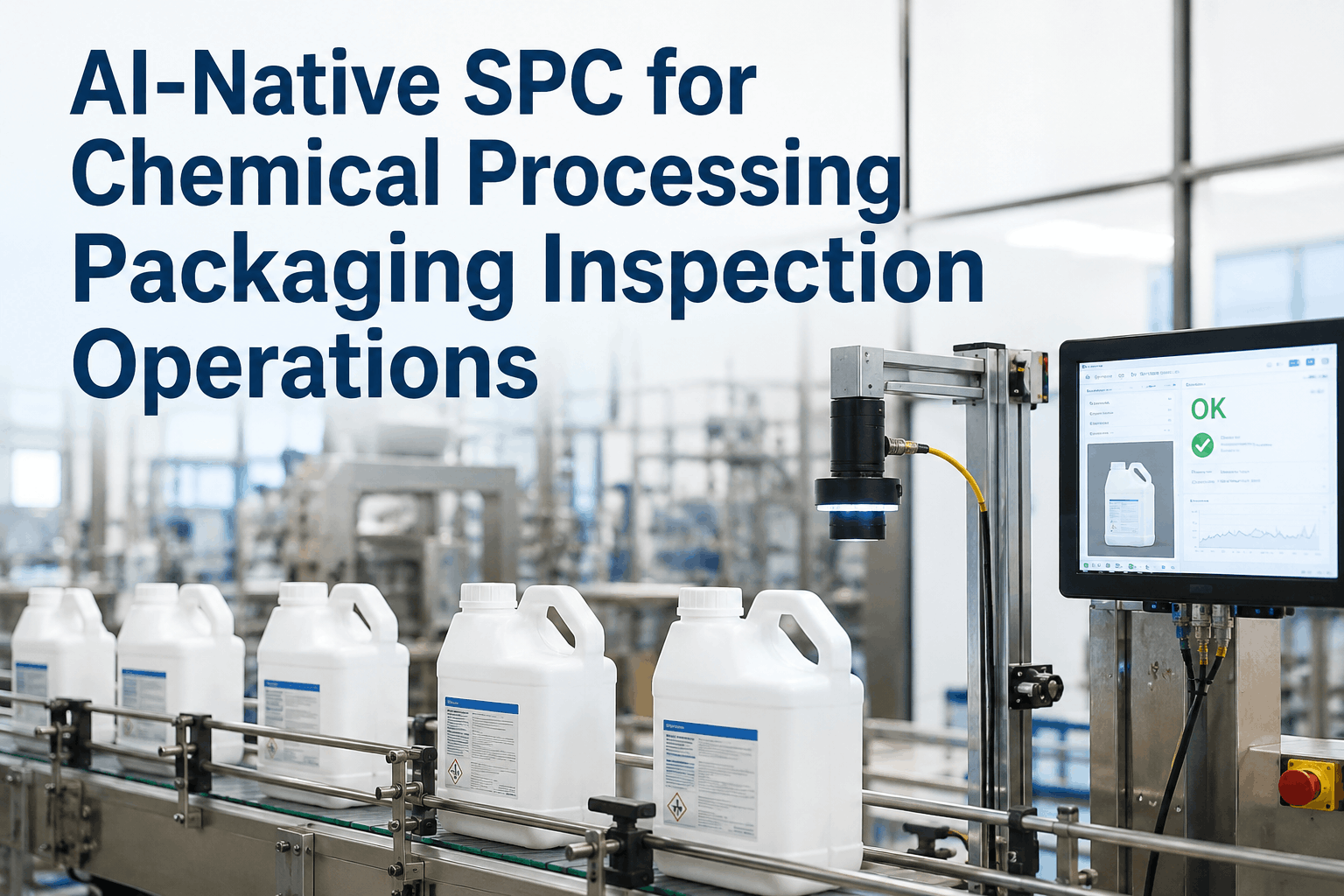
SAP Quality Management has been the workhorse of batch quality control in chemical processing for decades. It handles inspection lots, sampling plans, usage decision workflows, and quality notifications with enterprise-grade rigour. But SAP QM — and particularly SAP xMII, the manufacturing intelligence layer that sits beneath it — was designed for a world where quality control meant checking samples against fixed specifications after the fact. The chemical processing industry now needs something different. It needs quality control that predicts batch yield before the batch completes, detects process drift before out-of-spec material is produced, and closes the loop to DCS and SCADA automatically — without a quality engineer manually reviewing SPC charts that are already hours old. That is what AI-native SPC delivers. And the migration path from SAP QM/xMII to an AI-native quality platform is shorter and less disruptive than most plant managers expect. Book an AI SPC Migration Workshop to map your SAP QM environment to an AI-native replacement path.
The SAP QM / xMII Gap in Chemical Processing Quality
SAP QM is not a broken system. For what it was designed to do — manage inspection lots, record test results, issue quality notifications, and enforce usage decisions — it works. The problem is the gap between what SAP QM records and what modern chemical processing operations need from a quality platform.
Why SAP xMII Is No Longer the Right Foundation
SAP Manufacturing Integration and Intelligence (xMII) has been the data broker between SAP ERP and the plant floor for over two decades. For chemical processing plants, it has served as the bridge between DCS historian data and SAP QM inspection records. But the platform is approaching an inflection point that cannot be ignored. Book a migration workshop to assess your specific xMII inventory and replacement path.
What AI-Native SPC Looks Like in a Chemical Processing Plant
The shift from SAP QM's reactive quality recording to AI-native SPC is most clearly illustrated by what changes for operators and quality engineers at the shift level.
The iFactory Migration Path: SAP QM / xMII to AI-Native in 10 Weeks
iFactory's migration approach begins with rationalization — not replacement. A structured inventory of your xMII transactions identifies what to retire, what standard iFactory capabilities replace without custom work, and what genuinely needs rebuild. The result is a dramatically smaller migration scope than the full SAP DM path. Book an AI SPC Migration Workshop and receive your personalized xMII inventory assessment.
On-Premise or Cloud: iFactory Deploys Both Ways
KPI Impact: AI-Native SPC vs. SAP QM / xMII
FAQ: SAP QM Modernization for Chemical Processing
No — and this is the most important distinction. iFactory replaces SAP xMII (the manufacturing intelligence and data broker layer) while integrating bi-directionally with SAP QM (the quality management record system). Batch records, inspection results, and usage decisions sync between iFactory and SAP QM automatically. Your quality records remain in SAP QM for compliance and audit purposes — iFactory adds the AI intelligence layer on top. Many chemical plants maintain SAP QM for its ERP-level quality record management while replacing xMII with iFactory's AI platform for real-time process monitoring and predictive quality. Book a workshop to map your specific SAP QM integration requirements.
iFactory connects to all major chemical plant historian and DCS systems via standard OPC-UA, Modbus, MQTT, EtherNet/IP, and PROFINET interfaces. Supported historians include OSIsoft PI (AVEVA PI System), AspenTech IP.21, Honeywell PHD, Yokogawa Exaquantum, and InfluxDB. DCS connectivity covers Honeywell Experion, Emerson DeltaV, ABB 800xA, Siemens PCS 7/PCS Neo, and Yokogawa Centum. Most chemical plant integrations complete in 2–4 weeks — iFactory reads from your existing instrumentation without replacing any field hardware. Contact support to confirm compatibility with your specific DCS and historian.
Every batch record, process measurement, AI recommendation, operator action, and quality decision in iFactory is logged with immutable, timestamped audit trails compliant with FDA 21 CFR Part 11 electronic records requirements (for pharmaceutical-adjacent chemical processing) and ISO 9001 quality records management. Pre-built compliance templates support OSHA Process Safety Management, EPA Risk Management Program, ISO 9001, and REACH documentation requirements. AI-assisted compliance reporting is 60% faster than manual processes. For GxP-validated plants migrating from xMII with validated batch record workflows, iFactory's migration team provides a qualification approach that preserves critical validation status through the transition.
Traditional univariate SPC monitors each process parameter independently — temperature has a control chart, pH has a control chart, viscosity has a control chart. In chemical processing, these parameters are highly correlated — a simultaneous shift in temperature and viscosity that is individually within control limits can indicate a reaction anomaly that no single-parameter chart would detect. Multivariate SPC methods — Hotelling's T² control charts, MEWMA (Multivariate EWMA), and Principal Component Analysis-based monitoring — detect these correlated deviation patterns across all monitored parameters simultaneously. AI-native SPC applies these methods automatically, without requiring quality engineers to manually build and maintain multivariate models. The result is earlier detection of batch problems that univariate SAP QM SPC charts routinely miss. See multivariate SPC demonstrated on chemical process data — book a demo.
iFactory's AI SPC Migration Workshop is a structured 2-day engagement (remote or on-site) that produces four concrete deliverables: (1) a complete inventory and classification of your xMII transactions (RETIRE / REPLACE / TRANSFORM / KEEP), (2) a DCS and historian connectivity assessment confirming integration readiness, (3) a migration scope and timeline estimate with cost comparison vs. SAP DM migration path, and (4) a prioritised AI SPC use case list ranked by batch yield improvement potential and migration complexity. The workshop is the fastest way to understand exactly what modernizing your SAP QM environment means for your specific plant — without committing to a deployment. Most plants that complete the workshop proceed to deployment within 60 days.