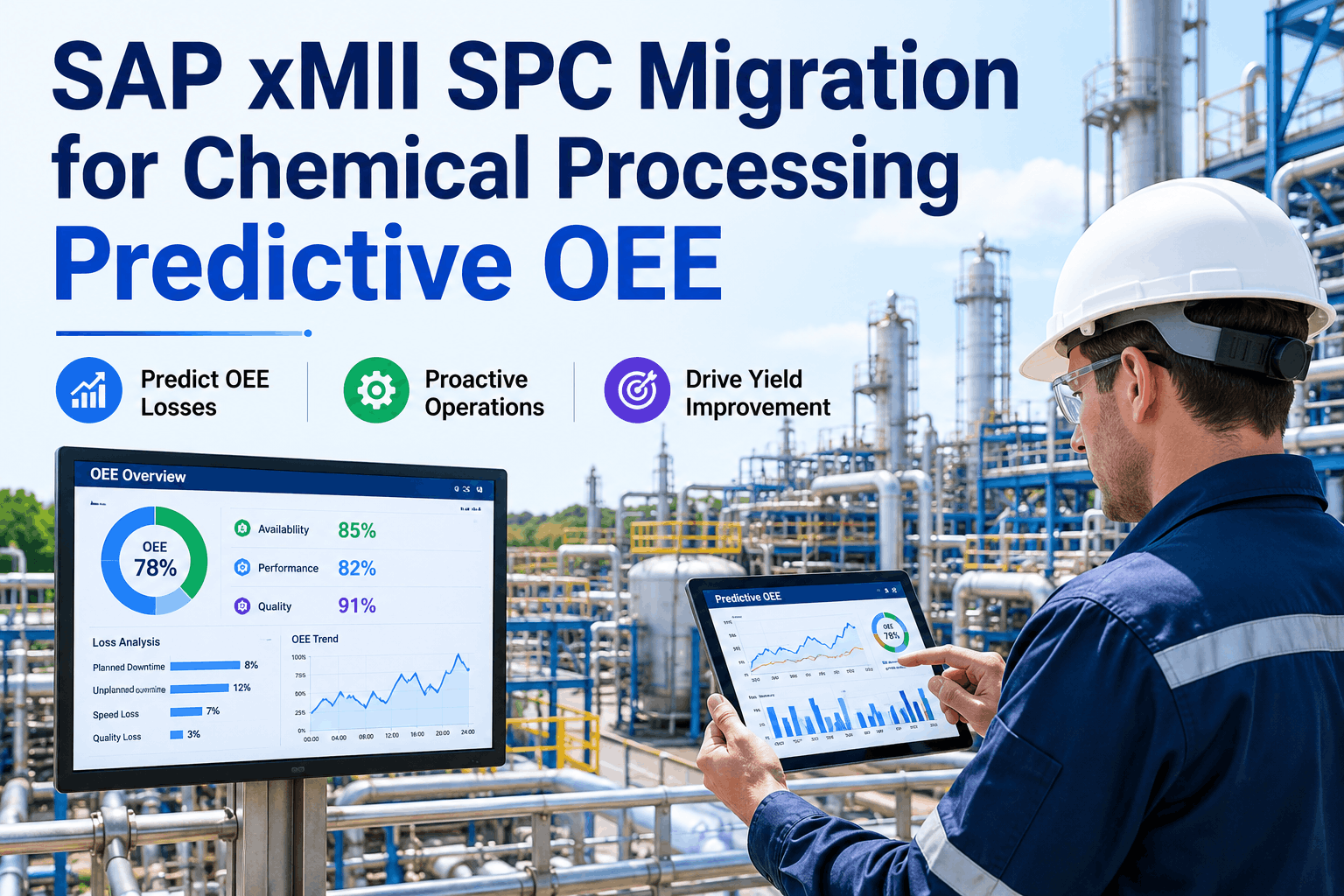
The math behind Overall Equipment Effectiveness is unforgiving: OEE = Availability × Performance × Quality. Three numbers, each capped at 100%, multiplied together. A chemical plant running 90% across all three lands at 72.9% OEE — well below world-class. Yet most chemical plants are still trying to improve OEE with legacy SAP xMII SPC modules built for reactive, univariate threshold monitoring. The result: first-pass yield stuck between 60% and 85% in specialty chemical plants, unplanned downtime costing the industry up to $20 billion annually, and quality signals that arrive 4–48 hours after the off-spec batch has already been produced. iFactory's AI-native SPC migration replaces the xMII SPC engine with predictive multivariate intelligence — lifting all three OEE factors simultaneously through closed-loop yield optimization, predictive quality forecasting, and AI vision inspection. Book an AI SPC Migration Workshop to scope your xMII-to-predictive-OEE transition.
The OEE Math Problem — and Why Legacy xMII SPC Cannot Solve It
Most plant supervisors know the OEE formula intuitively. Fewer know how punishing the multiplication actually is. Improving one factor while the others lag yields almost nothing — but improving all three together produces compounding gains. Legacy SAP xMII SPC was designed to support one factor: Quality. And even there, its univariate, reactive nature limits what is achievable. To break through, you need predictive analytics across all three OEE pillars.
How AI-Native SPC Lifts Each OEE Pillar
Legacy xMII SPC contributes mostly to the Quality pillar — and only after a defect has already been produced. AI-native SPC contributes to all three pillars simultaneously by predicting issues before they occur, fusing multivariate signals, and triggering closed-loop corrective action. Here is exactly how each pillar moves. Read more about the broader OEE measurement framework in our OEE calculation and benchmarking guide.
The SAP xMII to AI-Native SPC Migration Playbook
SAP confirmed xMII end-of-mainstream support on December 31, 2030. The countdown is real, but so is the operational risk of migrating without a methodical playbook. iFactory's migration approach is built around the three principles that separate successful xMII migrations from disrupted ones: data mapping, parallel run, and controlled cutover. For the wider migration context, see our SAP MII migration complete guide.
Deploy On-Premise, in the Cloud, or Hybrid
Chemical plants do not all operate under the same IT posture. Regulated EU/APAC sites typically require air-gapped on-premise. Multi-site North American operators prefer cloud for centralized OEE dashboards. Sites with mixed regulations choose hybrid — edge inference plus cloud-side learning. iFactory delivers identical predictive OEE capability across all three. Talk to our deployment architects about which mode fits your plant.
8-Week SAP xMII SPC Migration Timeline
The migration runs alongside production. xMII stays live through Week 6. AI-native SPC builds in shadow mode, validates against your historical data, and cuts over in measured, reversible stages. Detailed implementation walkthrough in our step-by-step iFactory MES implementation guide.
OEE Trajectory After Migration
OEE improvement is measurable, predictable, and consistent across deployed chemical plants. Below is the typical six-month trajectory observed after iFactory predictive OEE replaces legacy SAP xMII SPC. See similar context in our custom OEE solutions writeup.
Outcomes from Deployed Chemical Plants
Each outcome below is from a chemical processing facility that migrated from SAP xMII SPC to iFactory AI-native SPC and predictive OEE. Six-month post-cutover data, measured against the previous 12-month xMII baseline.
What Chemical Plant Supervisors Say After Migration
FAQ: SAP xMII SPC Migration for Predictive OEE
Common questions from supervisors, operations leaders, and IT teams scoping SAP xMII SPC migration to predictive OEE. Question not covered here? Reach our solutions team directly.