Overall Equipment Effectiveness is the single most powerful number in manufacturing operations, and also the most frequently misunderstood and misapplied. A plant reporting 75 percent OEE may be calculating it correctly and performing acceptably, or it may be hiding 35 percent of available production capacity in calculation gaps, planned downtime exclusions, and quality loss categories that never make it into the formula. iFactory monitors OEE in real time across every production asset, automatically calculating Availability, Performance, and Quality from PLC and SCADA data without manual time-recording, and identifying the specific loss category, machine, and shift pattern that is pulling each component below the world-class 85 percent threshold. Manufacturing plants running iFactory have improved average OEE by 12 to 18 percentage points within 12 months of deployment. Book a free OEE assessment for your plant today.
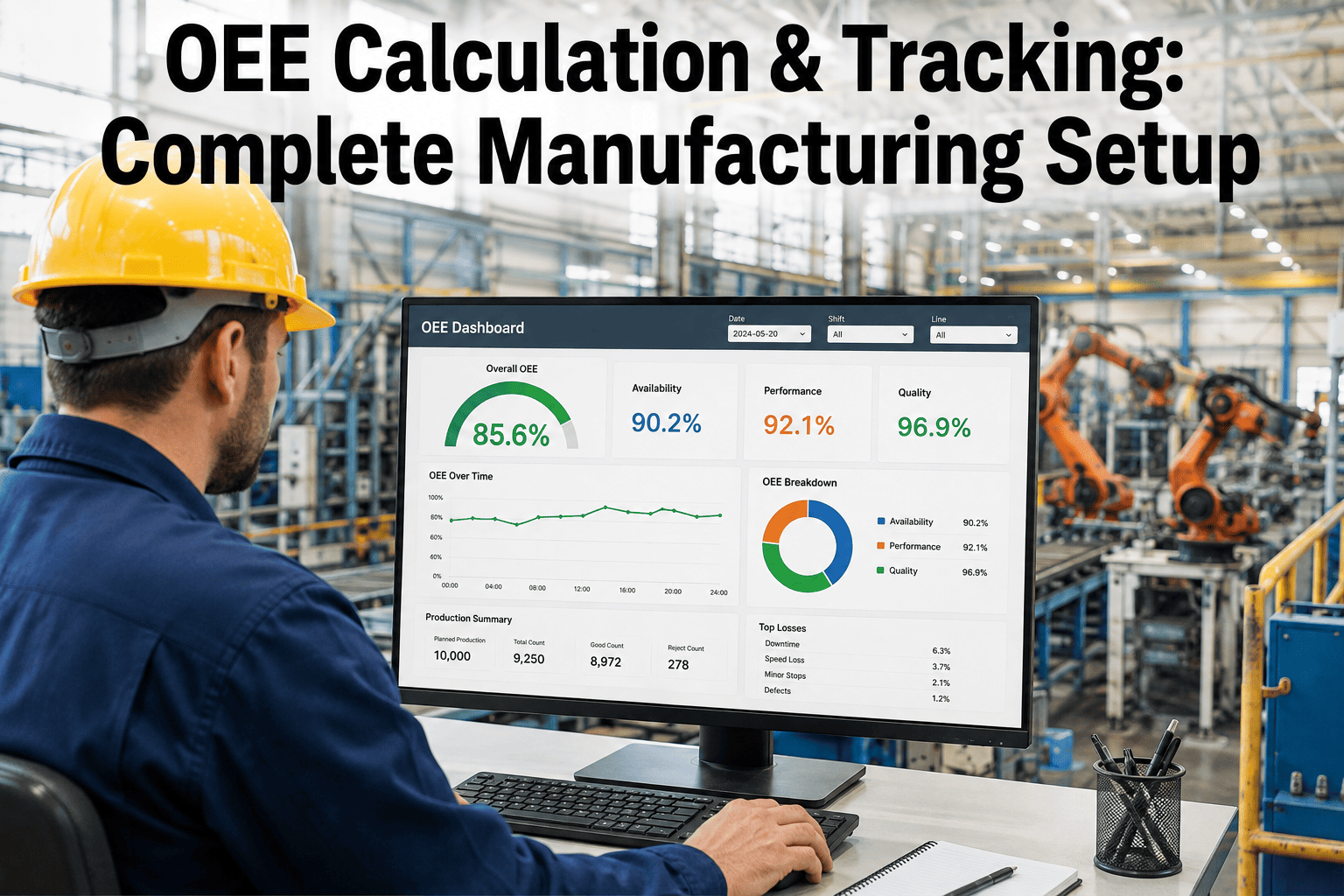
OEE = Availability x Performance x Quality. Availability = (Operating Time / Planned Production Time). Performance = (Ideal Cycle Time x Total Count / Operating Time). Quality = (Good Count / Total Count). World-class OEE is defined as 85 percent or above. Industry average across manufacturing sectors is 60 percent. The gap between industry average and world-class represents 25 percent of planned production capacity that is being lost to the Six Big Losses: equipment failures, setups and adjustments, minor stoppages, reduced speed, production defects, and startup yield loss.
The OEE Formula: Availability, Performance, and Quality Calculated
Each OEE component has a precise calculation, a specific data source, and a different set of underlying loss categories that drive it below the world-class threshold. Understanding what each component measures, and what it does NOT measure, is the foundation for using OEE as an improvement driver rather than a reporting metric. Book a demo to see iFactory's OEE calculation configured for your production line.
The Six Big Losses: Where OEE Points Are Being Destroyed
Every OEE gap traces back to one of the Six Big Losses defined by the Total Productive Maintenance (TPM) framework. iFactory categorizes every production loss event in real time, populating the Six Big Loss breakdown automatically from PLC data so your engineering team can see exactly which loss category is the highest priority improvement target at each machine.
Unplanned stoppages caused by equipment malfunction requiring repair before production can restart. Typically the single largest loss category for equipment with no predictive maintenance program. iFactory's predictive monitoring eliminates most L1 losses by detecting developing faults before they cause an unplanned stoppage, converting breakdown losses to planned maintenance intervals. Target: under 2 percent of planned production time.
Time lost between production runs for tooling changes, product changeovers, and equipment setup. iFactory tracks changeover duration per product code and shift, benchmarking actual changeover against the SMED target for each changeover type. Changeover analytics identify the specific steps driving overrun and quantify the OEE impact of changeover time reduction for prioritization.
Stoppages under 5 minutes that reset automatically without maintenance intervention, including jams, blocked sensors, and transfer faults. Minor stoppages are the most under-counted OEE loss: operators often reset them without logging, making them invisible to manual recording systems. iFactory captures every PLC fault signal above zero duration, automatically classifying it by fault code and building a Pareto of minor stoppage causes by machine and shift.
The machine is running but at a speed below its rated ideal cycle time. Caused by worn tooling, material variation, operator adjustment from quality concerns, or protective speed reduction from process parameter drift. iFactory detects reduced speed by comparing actual encoder feedback and production counter rates against the programmed ideal cycle time for the current product and tool, flagging speed reduction events and correlating them with process conditions.
Parts produced during normal production that do not meet specification. iFactory integrates with quality inspection systems, CMMs, and vision inspection outputs to capture defect counts at each stage automatically. Statistical process control (SPC) charts track key dimensions trending toward out-of-specification, providing a predictive quality signal before defect rate rises. The Quality component of OEE updates in real time as parts are inspected.
Non-conforming parts produced during machine warm-up, after changeover, or at shift start before the process has stabilized. iFactory timestamps the first good part after each startup or changeover event, measuring startup yield loss duration and defect count per event. Trending startup yield loss across shifts and operators identifies best-practice startup sequences and quantifies the OEE impact of standardizing them across all operators.
No paper-based downtime recording. No manually entered stoppage reasons. iFactory reads PLC fault signals, encoder speed data, and production counters in real time, categorizing every loss event into the Six Big Losses automatically and building the Pareto that shows your engineering team exactly where OEE points are being destroyed.
OEE Industry Benchmarks: Where Does Your Plant Stand?
World-class OEE of 85 percent is the widely cited target, but the distribution of OEE across manufacturing sectors varies significantly based on process complexity, product variety, and changeover frequency. The benchmarks below represent median industry OEE from published manufacturing productivity studies and iFactory deployment data. Book a demo to see your plant's OEE benchmarked against sector peers in the iFactory dataset.
Benchmarks represent published median OEE from industry productivity studies and iFactory deployment dataset. Individual plant OEE varies based on product mix, shift pattern, equipment age, and changeover frequency. Chemical processing naturally achieves higher OEE due to continuous process operation with rare changeovers.
iFactory vs Competing OEE Monitoring Platforms
OEE tracking accuracy is only as good as the data capture method. Manual OEE entry understates downtime by 30 to 60 percent, because operators rarely log stoppages under 5 minutes. iFactory's automatic PLC data capture eliminates the manual recording gap and provides the only source of accurate Six Big Loss data in a manufacturing plant. Book a demo to see iFactory's OEE accuracy versus your current manual or semi-automated tracking method.
| OEE Capability | iFactory | QAD Redzone | Evocon | L2L (Leading2Lean) | MaintainX | Siemens Insights Hub | Tulip | SafetyCulture |
|---|---|---|---|---|---|---|---|---|
| OEE Data Capture | ||||||||
| Automatic PLC data capture (no manual entry) | Full PLC, SCADA, encoder integration | Sensor + manual hybrid | Sensor-based, limited PLC | Manual-first, some automation | Manual entry primary | Full Siemens PLC integration | Manual + sensor hybrid | Manual inspection forms |
| Minor stoppage capture (under 5 minutes) | Every PLC fault signal captured | Sensor-based threshold | Signal-based, configurable | Operator-reported only | Not captured | Via SIMATIC integration | Configurable sensors | Not captured |
| Six Big Loss automatic categorization | Auto-classified from PLC fault codes | Partial, requires configuration | Partial | Manual categorization | No OEE-specific categories | Via MindApp configuration | Manual categorization | No |
| OEE Intelligence and Action | ||||||||
| Real-time OEE display per machine | Per machine, per shift, per product | Yes | Yes | Yes | No OEE calculation | Yes | Yes | No |
| Predictive maintenance integrated with OEE | L1 losses predicted before they occur | No predictive layer | No predictive layer | No predictive layer | No predictive layer | Siemens APM integration | No predictive layer | No predictive layer |
| On-premise: no cloud dependency | Full on-premise AI | Cloud SaaS | Cloud SaaS | Cloud SaaS | Cloud SaaS | Cloud or hybrid | Cloud SaaS | Cloud SaaS |
Based on publicly available documentation as of Q1 2025. Verify capabilities with each vendor before procurement decisions.
Regional Compliance: OEE Data and Production Records
OEE data forms the core of production performance records required by ISO 9001, IATF 16949, and several regulatory frameworks. iFactory's OEE audit trail provides the machine performance, downtime, and quality records required by each major regional standard.
| Region | Key Standards | OEE and Production Record Requirement | iFactory Coverage |
|---|---|---|---|
| USA | IATF 16949 (automotive) / ISO 9001 / FDA 21 CFR Part 11 (pharmaceutical production records) / OSHA 1910 (production safety) / ISO 50001 (energy efficiency linked to OEE) | IATF 16949 OEE and process capability records, FDA 21 CFR Part 11 compliant production batch records with electronic signatures, ISO 9001 equipment effectiveness evidence, OSHA machine safeguarding records integrated with OEE downtime data | IATF 16949 OEE records, FDA 21 CFR Part 11 compliant electronic records, ISO 9001 equipment performance evidence, machine safety integration, ISO 50001 energy-OEE correlation reports |
| UAE | UAE Make It in the Emirates / ADNOC Production Standards / ISO 9001 / ISO 50001 / UAE Industrial Strategy (manufacturing productivity targets) / ICV reporting | Production effectiveness evidence for UAE Industrial Strategy compliance, ISO 9001 quality management records, ICV manufacturing productivity reporting, ADNOC-aligned production performance records for energy sector manufacturers | UAE Industrial Strategy OEE reporting, ICV productivity records, ISO 9001 and ISO 50001 documentation, Arabic platform support, ADNOC-aligned production performance records |
| UK | IATF 16949 (automotive supply chain) / ISO 9001 / UK Made Smarter initiative / MHRA (pharma GMP) / Health and Safety at Work Act (machine safety records) / ISO 50001 | IATF 16949 OEE and PPAP records for UK automotive supply chain, MHRA GMP equipment qualification and performance records, Made Smarter digital manufacturing evidence, ISO 50001 production energy efficiency records | IATF 16949 and PPAP OEE records, MHRA GMP equipment performance documentation, Made Smarter productivity evidence, Health and Safety machine records, ISO 50001 energy-OEE reports |
| Canada | IATF 16949 (automotive: Ontario, Quebec) / ISO 9001 / Health Canada (pharmaceutical GMP) / CSA Z1000 / Canada 2030 Advanced Manufacturing / bilingual record requirements | IATF 16949 OEE records for Ontario and Quebec automotive supply chains, Health Canada GMP equipment performance records, ISO 9001 production effectiveness evidence, bilingual (EN/FR) documentation requirements in Quebec facilities | IATF 16949 OEE and PPAP records, Health Canada GMP documentation, ISO 9001 evidence, bilingual (EN/FR) platform for Quebec compliance, CSA Z1000 maintenance records linked to OEE data |
| Germany / EU | IATF 16949 / ISO 9001 / EU Machinery Directive / EMA GMP (pharmaceutical) / EU EED (energy efficiency reporting) / GDPR / Industrie 4.0 framework / VDA standards | IATF 16949 and VDA OEE records for German automotive tier suppliers, EMA GMP pharmaceutical equipment performance records, EU EED production energy efficiency evidence, GDPR-compliant OEE data handling, Industrie 4.0 digital manufacturing KPI records | EU data residency available, GDPR-compliant OEE data, IATF 16949 and VDA records, EMA GMP equipment records, EU EED energy-OEE reports, Industrie 4.0 KPI documentation |
| Australia | ISO 9001 / TGA (pharmaceutical GMP) / NGER Act (energy and emissions, production-linked) / WHS Act (machine safety records) / AS/NZS standards / AMP (Australian Manufacturing Policy) | ISO 9001 equipment effectiveness records, TGA pharmaceutical equipment performance and qualification documentation, NGER Act production and energy consumption records, WHS Act machine safety and incident records linked to OEE downtime data | ISO 9001 OEE records, TGA GMP equipment documentation, NGER production and energy records, WHS machine safety documentation linked to OEE, ISO 50001 energy-OEE reports |
iFactory's OEE audit trail generates the machine performance records, downtime logs, and quality data required by IATF 16949, ISO 9001, FDA 21 CFR Part 11, and VDA standards automatically. Every shift's OEE data is permanently archived and retrievable for any customer, regulatory, or certification audit.
Results: Manufacturing Plants Improving OEE with iFactory
Average OEE improvement achieved within 12 months of iFactory deployment, measured from baseline OEE at deployment to trailing 3-month average at the 12-month mark across the monitored equipment population.
Plants that switch from manual downtime recording to iFactory's automatic PLC data capture typically find 3 to 4 times more loss events, particularly minor stoppages under 5 minutes that were never logged in the manual system.
iFactory's combination of predictive maintenance eliminating L1 breakdown losses, minor stoppage Pareto driving focused improvement, and SPC integrating quality signal upstream delivers world-class OEE across most manufacturing equipment categories within 18 months.
iFactory eliminates the paper-based or spreadsheet-based manual downtime log for all machines connected to the platform. PLC data capture replaces operator entry entirely, improving both accuracy and engineering time available for improvement activities.
Within 24 hours of connecting iFactory to your plant's PLC and production control systems, the first automated OEE baseline report is generated for every connected machine, showing Availability, Performance, Quality, and the Six Big Loss Pareto for the previous production period.
Every production shift's OEE data, downtime event, and quality record permanently archived in iFactory's immutable audit trail for IATF 16949, ISO 9001, FDA, and VDA certification evidence without manual data compilation before audits.
Frequently Asked Questions
Continue Reading
Automatic Six Big Loss capture from PLC data. Real-time OEE per machine, per shift, per product. Predictive maintenance integrated to eliminate Availability losses before they happen. IATF 16949, ISO 9001, and FDA 21 CFR Part 11 production records generated without manual compilation. First accurate OEE report within 24 hours of connection.