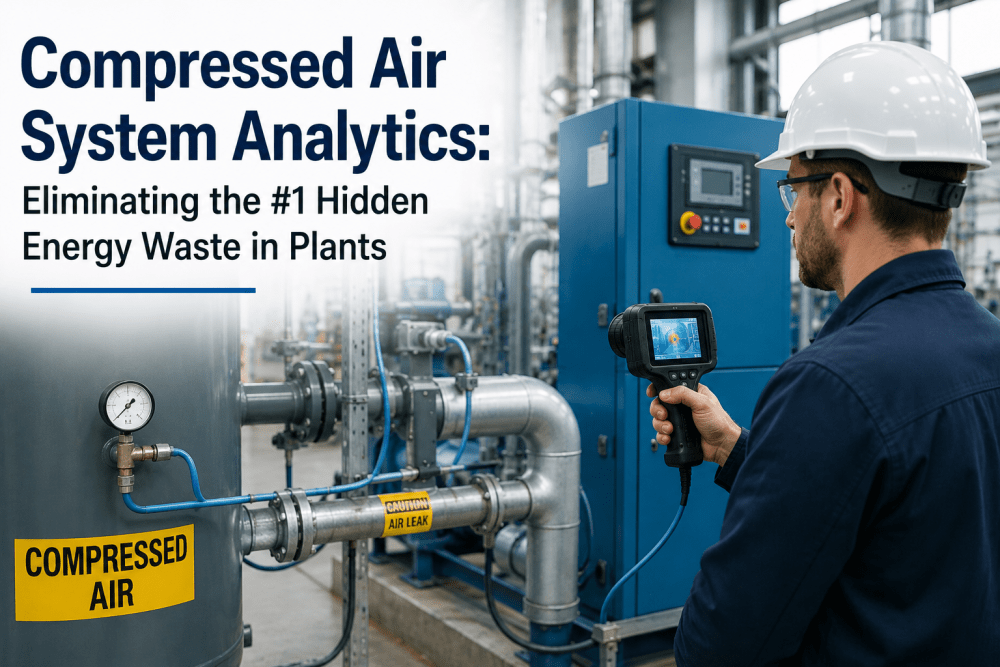
Compressed air is the fourth utility in manufacturing, after electricity, gas, and water, and it is the most expensive to generate and the most wasteful to manage without real-time monitoring. In a typical manufacturing plant, 25 to 35 percent of all compressed air generated is lost before it reaches any production tool, primarily through pipe leaks, pressure mismatches, and compressor inefficiency. iFactory's AI platform addresses all three waste sources simultaneously: ultrasonic and pressure differential leak detection that identifies every leak point automatically, AI-driven compressor scheduling that matches supply to real demand, and pressure optimization analytics that eliminate the energy cost of over-pressurization. Manufacturing plants running iFactory have reduced compressed air energy costs by 30 to 45 percent within 12 months of deployment. Book a free compressed air assessment for your plant today.
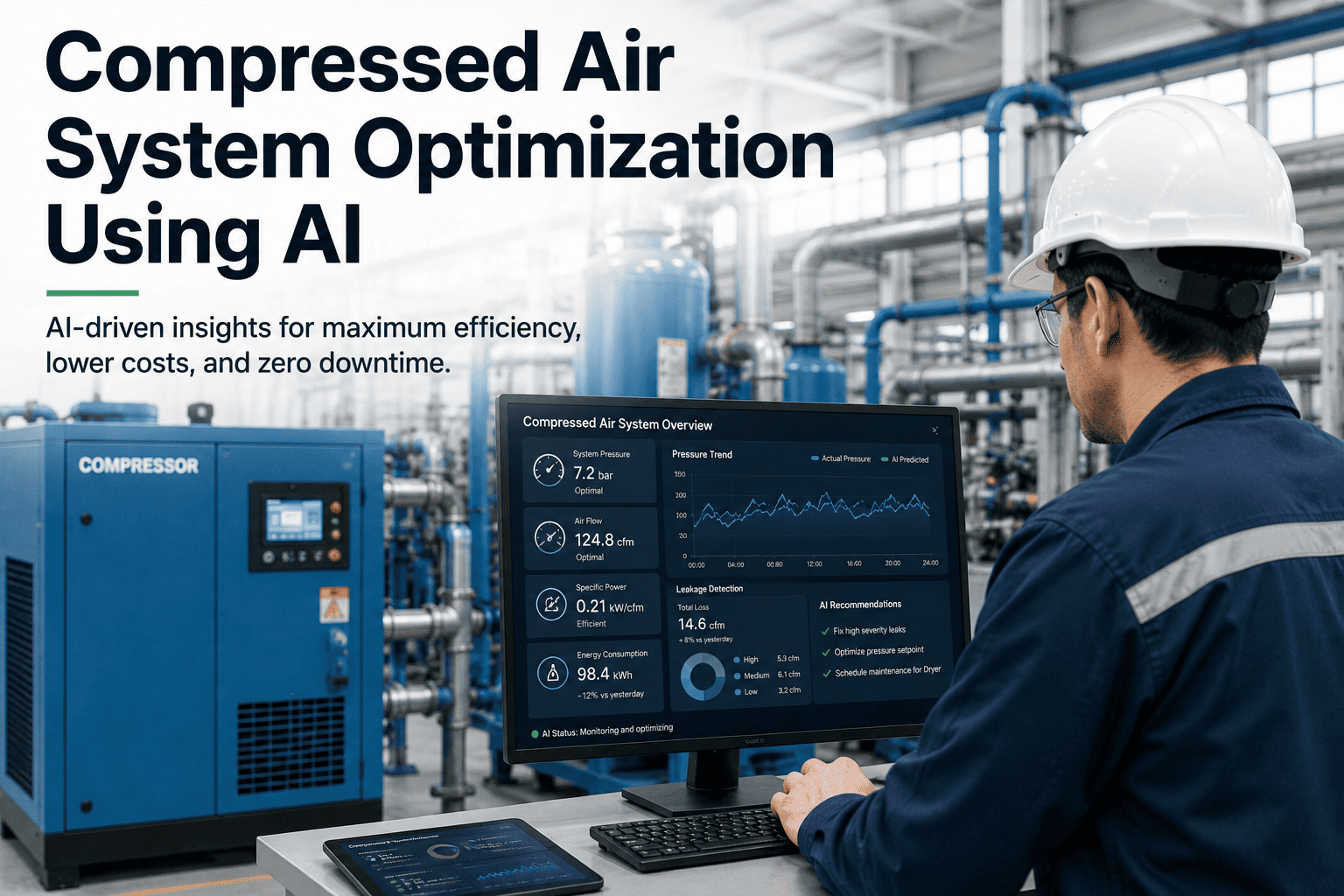
iFactory reduces compressed air energy costs through three integrated monitoring streams: continuous ultrasonic and pressure differential leak detection that locates every active leak in real time; AI-powered compressor scheduling that staggers compressor starts and stops to match actual production demand; and system pressure analytics that identify zones where over-pressurization is wasting energy without improving tool performance. All three streams feed one AI model that generates work orders for leak repairs and optimization actions automatically.
Where Your Compressed Air Energy Goes: The Four Waste Sources
Most compressed air energy audits reveal the same pattern: four categories of waste, each requiring a different monitoring and optimization approach. iFactory addresses all four simultaneously from day one of deployment. Book a demo to see all four monitoring streams configured for your compressed air system.
Pipe joints, valve packing, quick-disconnect fittings, and condensate drains that leak continuously 24 hours a day, 7 days a week, regardless of production activity. A 3mm leak at 7 bar costs approximately $800 per year in energy. A plant with 20 such leaks loses $16,000 per year from leaks alone, before considering the compressor energy required to maintain system pressure against continuous leak demand.
Compressors running in unloaded mode consume 25 to 40 percent of full-load energy while delivering zero air. This happens when compressors are started and stopped on a simple timer rather than on actual system pressure demand. Plants with poor compressor scheduling often run two or three compressors partially loaded when one compressor at full load would serve the same demand more efficiently.
Every 1 bar reduction in system pressure reduces compressor energy consumption by approximately 7 percent. Many plants run their entire compressed air system at the pressure required by the highest-demand tool, when 80 percent of the system only needs 4 to 5 bar. Pressure zoning with local boosters for high-demand points can reduce system pressure by 1 to 2 bar, cutting energy consumption by 7 to 14 percent with no change to tool performance.
Open blow-off nozzles, air-operated equipment running when production is stopped, non-optimized air tools, and inappropriate use of compressed air for cooling or cleaning where lower-cost alternatives exist. iFactory monitors total flow demand patterns against production schedules, identifying periods when compressed air is consumed but no production is occurring, and flagging specific high-consumption zones for end-use audit.
iFactory Compressed Air Monitoring: Three Technical Pillars
Three monitoring techniques, each targeting a specific category of compressed air waste. iFactory integrates all three into a single platform with unified dashboards, shared alert management, and one AI model that correlates data across all three streams.
Compressed air leaks generate ultrasonic sound at frequencies of 35 to 45 kHz, well above the audible range but detectable by ultrasonic sensors. iFactory deploys fixed ultrasonic sensors at pipe manifolds, valve stations, and high-density fitting areas, continuously scanning for leak signatures. When a leak is detected, the system estimates leak flow rate from signal amplitude, calculates annual energy cost, and generates a maintenance work order with the leak location, estimated size, and repair priority based on cost impact.
iFactory's AI model learns the plant's compressed air demand pattern over 7 to 21 days, building a demand curve that correlates system pressure and flow against the production schedule, shift pattern, and seasonal variation. The AI then generates a compressor scheduling recommendation that staggers start and stop times, selects the most efficient compressor for each load range, and minimizes unloaded running time. On plants with multiple compressors, iFactory typically identifies 15 to 25 percent energy savings from scheduling optimization alone, before any leak repairs.
iFactory monitors pressure at multiple points across the compressed air distribution system, detecting pressure differentials that indicate flow restriction, excessive pressure drop, or zone isolation opportunities. The analytics identify specific pressure zones where system pressure can be reduced without affecting tool performance, quantify the energy saving per bar reduction per zone, and flag high-pressure-drop sections where pipe sizing or filtration improvements would reduce compressor energy consumption.
iFactory's leak detection, compressor scheduling, and pressure optimization work on your existing compressed air infrastructure. No new compressors. No pipe replacement. First energy savings visible within 30 days of sensor deployment.
Compressed Air Energy Audit: Investment vs Return with iFactory
The financial case for compressed air optimization is among the clearest in any manufacturing maintenance program. The numbers below are based on a typical 200 to 500 kW compressor plant running two shifts per day, 250 days per year at $0.12 per kWh. Book a demo to model the ROI for your specific compressor configuration.
| Optimization Source | Typical Waste | iFactory Reduction | Annual Energy Saving | Payback Period |
|---|---|---|---|---|
| Leak repairs (compressed air distribution) | 25-35% of generation | 60-80% of identified leaks repaired within 90 days | $18,000 to $45,000 per year (typical 300kW plant) | Under 60 days |
| Compressor scheduling optimization | 15-25% unloaded running | Unloaded running reduced to under 5% of operating time | $12,000 to $30,000 per year (typical 300kW plant) | Under 30 days |
| System pressure reduction (1 bar reduction) | Over-pressurization by 1-2 bar | 7% energy reduction per bar pressure reduction | $8,000 to $20,000 per year per bar reduced | Immediate |
| End-use monitoring and non-productive consumption | 5-10% consumed during non-production | Non-productive consumption identified and eliminated | $4,000 to $12,000 per year (typical 300kW plant) | Under 90 days |
| Combined iFactory platform | 30-45% total waste | 30-45% compressed air energy cost reduction | $42,000 to $107,000 per year (typical 300kW plant) | 30-60 days |
iFactory vs Competing Compressed Air Monitoring Platforms
Most compressed air solutions focus on either leak detection hardware or compressor control, but not both in a unified AI model with automatic work order generation. iFactory delivers all three optimization pillars in one on-premise deployable system. Book a demo to compare iFactory against your current compressed air monitoring approach.
| Capability | iFactory | TRACTIAN | Siemens Insights Hub | MaintainX | Fiix (Rockwell) | SafetyCulture | Limble CMMS | C3 AI Mfg |
|---|---|---|---|---|---|---|---|---|
| Compressed Air Monitoring | ||||||||
| Continuous ultrasonic leak detection | Fixed sensors + real-time mapping | Periodic route-based | Via partner sensors | No sensor layer | No sensor layer | No sensor layer | No sensor layer | Via connectors |
| AI compressor scheduling optimization | Demand curve AI, multi-compressor | No | Via Siemens drives | No | No | No | No | Via models |
| System pressure zone analytics | Multi-zone pressure mapping + savings model | No | Via SCADA integration | No | No | No | No | Via models |
| Annual energy cost per leak point | Calculated automatically per leak | Manual estimate | No | No | No | No | No | Via models |
| Maintenance Operations and Deployment | ||||||||
| Auto work order per leak point | Full WO: location, size, cost, priority | Alert only | Via SAP PM | Yes (manual trigger) | Yes | Yes | Yes | Via CMMS |
| On-premise: no cloud dependency | Full on-premise AI | Cloud primary | Cloud or hybrid | Cloud SaaS | Cloud SaaS | Cloud SaaS | Cloud SaaS | Cloud primary |
| Deployment to first results | Leak report within 24 hours of sensor install | Route-based, periodic | Weeks to months | Days (CMMS) | Days | Days | Days | Months |
Based on publicly available documentation as of Q1 2025. Verify capabilities with each vendor before procurement decisions.
Regional Compliance: Compressed Air and Energy Reporting
iFactory's compressed air monitoring audit trail provides the energy management and maintenance documentation required by every major manufacturing compliance framework across your operating regions.
| Region | Key Standards | Compressed Air Requirement | iFactory Coverage |
|---|---|---|---|
| USA | DOE Compressed Air Challenge / EPA Energy Star / OSHA 1910 (pressure systems) / SEC climate disclosure / ISO 50001 energy management | Energy management documentation for EPA Energy Star certification, DOE Compressed Air Challenge best practice compliance, compressed air system audit records for SEC climate reporting | DOE best practice compliance records, EPA Energy Star energy data, SEC climate reporting integration, ISO 50001 energy management audit trail, OSHA pressure system maintenance records |
| UAE | UAE Energy Rationalization / ICV reporting / Abu Dhabi Department of Energy / Dubai Carbon Centre / ISO 50001 / UAE Net Zero 2050 | Energy consumption reporting for UAE ICV and Net Zero compliance, compressed air energy efficiency evidence for Abu Dhabi and Dubai energy authority reporting, ISO 50001 energy management documentation | UAE energy rationalization records, ICV energy efficiency data, Net Zero reporting, ISO 50001 documentation, Arabic platform support, DEWA energy reporting integration |
| UK | ESOS (Energy Savings Opportunity Scheme) / UK ETS / Climate Change Levy / PSSR 2000 (pressure vessels) / ISO 50001 / PAS 11000 | ESOS phase 3 energy audit evidence for compressed air systems, UK ETS carbon reporting data, PSSR Written Scheme of Examination for pressure vessels, ISO 50001 energy management records | ESOS energy audit evidence, UK ETS carbon data, PSSR pressure vessel inspection records, ISO 50001 energy management documentation, Climate Change Levy reporting |
| Canada | NRCan Energy Efficiency Act / CSA B51 (pressure vessels) / Provincial OHS pressure system Acts / ISO 50001 / Clean Fuel Regulations | NRCan energy efficiency reporting for manufacturing facilities, CSA B51 pressure vessel maintenance records, provincial OHS pressure system inspection documentation | NRCan energy efficiency records, CSA B51 pressure vessel documentation, provincial OHS compliance, bilingual (EN/FR) platform, ISO 50001 audit trail |
| Germany / EU | EU EED (Energy Efficiency Directive) / EU ETS / BetrSichV / PED (Pressure Equipment Directive) / ISO 50001 / GDPR / ISO 11011 (compressed air energy efficiency) | EU EED energy audit evidence for compressed air systems, PED pressure equipment maintenance records, ISO 11011 compressed air efficiency documentation, GDPR-compliant energy data handling | EU EED audit evidence, EU ETS carbon reporting, PED pressure equipment records, ISO 50001 and ISO 11011 documentation, GDPR-compliant architecture, EU data residency available |
| Australia | EEPROM (Energy Efficiency Opportunities Act legacy) / NGER Act (greenhouse gas) / AS 3788 (pressure equipment) / WHS Act / ISO 50001 | NGER greenhouse gas and energy reporting for manufacturing facilities, AS 3788 pressure equipment inspection records, WHS-compliant compressed air system maintenance documentation | NGER energy and emissions reporting, AS 3788 pressure equipment inspection records, WHS maintenance documentation, ISO 50001 audit trail, Safe Work records |
iFactory's compressed air monitoring generates the ISO 50001, ESOS, UAE ICV, NGER, and EU EED energy documentation your compliance team needs automatically. Every compressor runtime, leak repair, and optimization action permanently recorded and retrievable for any audit or regulatory submission.
Results: Manufacturing Plants Running iFactory Compressed Air Analytics
Average energy cost reduction achieved across iFactory compressed air deployments within 12 months, combining leak repair, compressor scheduling, and pressure optimization savings.
iFactory continuous ultrasonic monitoring identifies over 80 percent of all active leaks within 48 hours of sensor deployment, versus 20 to 30 percent typically found in a manual annual walkdown.
AI compressor scheduling optimization reduces unloaded running time from a typical 20 to 30 percent of operating hours to under 5 percent, delivering 15 to 25 percent compressor energy savings immediately.
Within 24 hours of sensor deployment, iFactory delivers a complete compressed air leak map with location, estimated size, annual energy cost, and repair priority for every identified leak point in the plant.
Most manufacturing plants recover the full cost of iFactory compressed air monitoring deployment within 60 days from compressor scheduling optimization and initial leak repair energy savings alone.
Every compressor runtime, pressure reading, leak detection event, and repair work order permanently timestamped in iFactory's audit trail for ISO 50001, ESOS, NGER, and EU EED compliance documentation.
Implementation Roadmap: From Sensor Deployment to Energy Savings
Four structured deployment phases, delivering measurable energy savings from week one. No compressed air system shutdown at any stage. Book a demo to receive your plant-specific compressed air deployment plan.
Ultrasonic sensors deploy at pipe manifolds, valve stations, and condensate drains. Pressure transmitters connect to existing monitoring points or new taps. Compressor integration reads runtime, pressure, and power data from existing controls via OPC-UA or Modbus. No system shutdown required.
iFactory delivers the plant's first complete leak map: every leak point detected, estimated flow rate, annual energy cost at your local electricity tariff, and repair priority score. Work orders are generated for the highest-cost leaks and scheduled into the next available maintenance window. First repair results are visible in compressor power consumption within days.
iFactory's AI learns the plant's compressed air demand pattern across shifts, production modes, and days of the week. The compressor scheduling optimization model generates the first scheduling recommendation after 7 to 21 days of baseline data. First energy savings from scheduling are typically visible in the compressor energy dashboard within the third week.
Ongoing leak detection catches new leaks as they develop. Pressure zone analytics identify further optimization opportunities. Monthly energy reports quantify savings from each optimization source. ROI dashboard tracks cumulative savings against deployment cost. Compliance reports generate automatically for ISO 50001 and regional energy regulatory requirements.
Frequently Asked Questions
Continue Reading
Continuous ultrasonic monitoring, AI compressor scheduling, and pressure zone analytics working together to eliminate the four categories of compressed air waste that inflate your energy bill every month. First leak report within 24 hours of deployment. First compressor scheduling savings within 21 days.


.png)