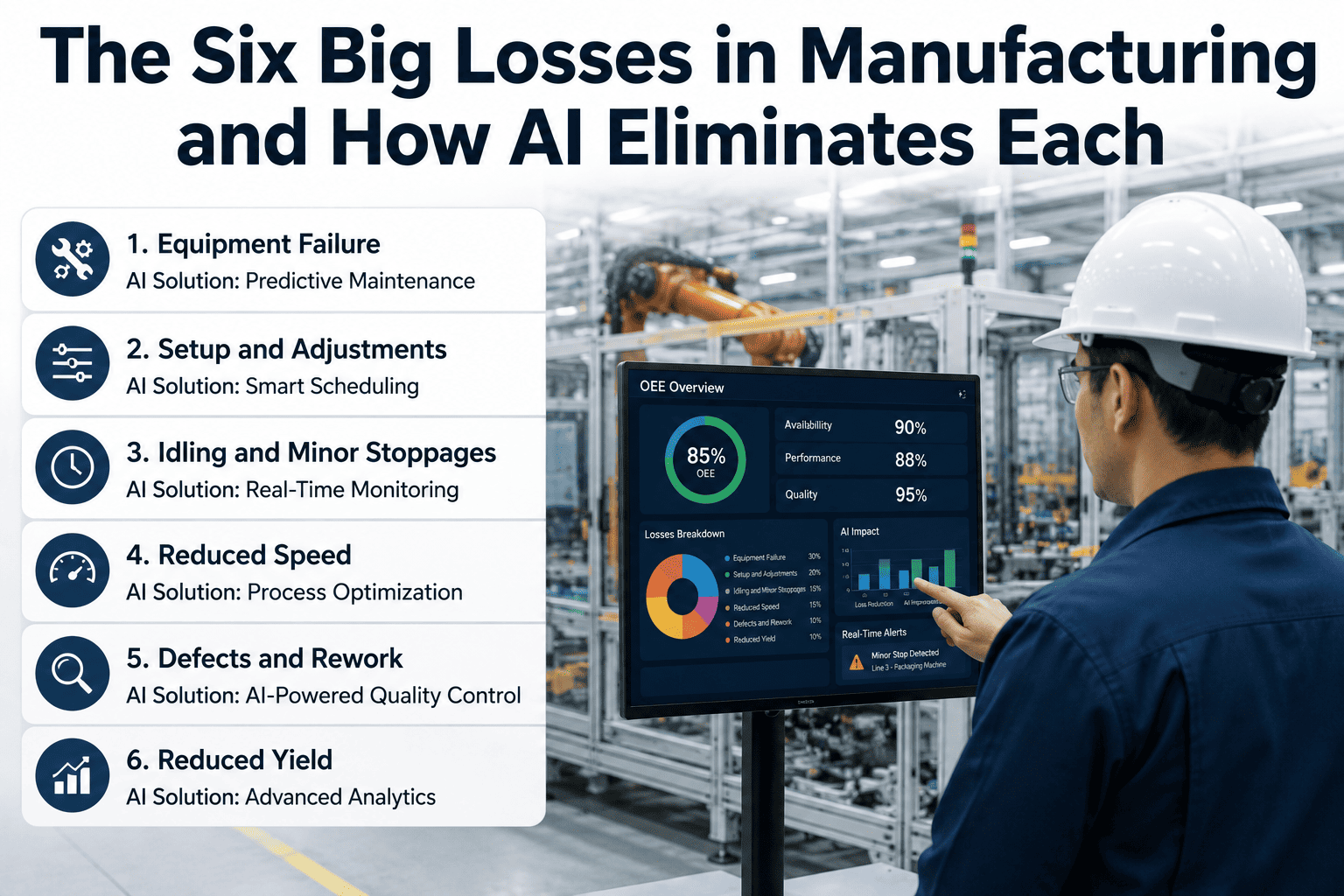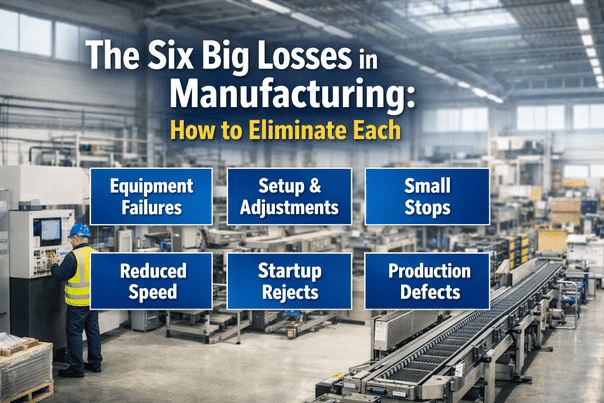
The Six Big Losses framework from Total Productive Maintenance theory remains the most precise diagnostic tool available for understanding why a manufacturing plant is not producing at its full potential. Six categories account for virtually all OEE loss in every manufacturing sector: equipment failures, setup and adjustment time, minor stoppages, reduced speed, process defects, and startup rejects. Eliminating them requires a different capability: the ability to detect the conditions that cause each loss category before they produce the loss event itself. This guide documents what each of the six losses actually costs, which conditions precede each one, and how iFactory's AI platform detects and eliminates each category through automated monitoring, predictive alerts, and condition-based work orders generated directly from your PLC and SCADA data. Book a free Six Big Loss analysis for your production lines.
The Six Big Losses (Equipment Failures, Setups, Minor Stoppages, Reduced Speed, Process Defects, and Startup Rejects) account for all OEE loss in manufacturing. iFactory eliminates each category through a different mechanism: predictive AI for L1, changeover analytics for L2, automatic PLC micro-stop capture for L3, cycle time deviation monitoring for L4, SPC and process correlation for L5, and startup parameter tracking for L6. All six mechanisms operate simultaneously from your existing PLC data with no manual entry required.
How the Six Losses Distribute Across Manufacturing Plants
Industry research from MESA International and the Lean Enterprise Institute shows a consistent distribution of OEE losses across manufacturing sectors. The most important insight from this data is that L3 (Minor Stoppages) and L4 (Reduced Speed) together account for more OEE loss than L1 (Equipment Failures), yet they are the two categories most commonly ignored because manual downtime systems almost never capture them accurately.
Eliminating Each of the Six Big Losses with iFactory
Each loss category has a different elimination strategy because each has a different root cause mechanism. The common thread across all six is that iFactory addresses each from your existing PLC and SCADA data, without requiring operator input, manual logging, or replacement of your current maintenance management system. Book a demo to see each elimination mechanism applied to your production lines.
Equipment failures develop from progressive degradation: bearing wear, seal deterioration, electrical insulation failure, lubrication breakdown. The failure event is the end of a process that began days or weeks earlier with measurable precursor signals in vibration, temperature, current, and process parameters.
Multi-sensor AI monitors vibration FFT, bearing temperature, motor current signature, and hydraulic pressure simultaneously. Deviation from baseline triggers a graded alert: advisory (7+ days), warning (48-96 hours), critical (under 48 hours). Each alert auto-generates a condition-based work order with pre-diagnosed fault type.
Setup and adjustment time accumulates from: unoptimized changeover sequences, time to first good part after a setup, trial-and-error parameter adjustments, tooling retrieval delays, and undocumented setup procedures. The largest component is usually the time from setup completion to first good part, not the mechanical changeover itself.
Changeover duration tracked automatically from last good part on the prior production order to first good part on the new order, sourced from PLC counter and ERP order data. Changeover Pareto by product transition, machine, and shift identifies the specific sequences with the highest improvement opportunity. Digital work instructions deployed via mobile for high-loss changeovers.
Minor stoppages under 10 minutes are caused by: part jams at transfer points, sensor false trips, material feeding issues, interlocks triggered by marginal part geometry, and equipment hesitation from borderline fault conditions. They are resolved by operators without maintenance involvement and are almost never recorded in manual downtime systems.
Every PLC fault signal with auto-reset, regardless of duration, is captured automatically. Minor stoppages of under 5 seconds are counted and categorized by fault code. The L3 Pareto is built in real time, revealing patterns invisible to manual logging: typically 3 to 5 fault codes account for 60 to 80 percent of all minor stoppages on any given line, and all are fixable with a single maintenance intervention.
Reduced speed loss is caused by: operators running below design rate due to quality concerns, equipment degradation causing cycle time extension, machine parameters set conservatively for stability, and feed system issues that slow the overall line cycle. It is the most difficult loss to detect without automated monitoring because the machine is running and producing: it just is not running at the rate it should be.
Actual cycle time derived from PLC encoder or production counter is compared against the ideal cycle time from the iFactory product master in real time. Speed loss is calculated continuously per machine per product. When actual cycle time exceeds ideal by more than the configured threshold, an alert fires with the specific machine, product, and duration of the speed loss event to enable targeted investigation.
Process defects during steady-state production are caused by: equipment wear that degrades process consistency (tooling, dies, spindles), process parameter drift that moves the process outside specification, fixturing wear that changes part positioning, and cooling, lubrication, or utility quality events that temporarily alter process conditions. Most L5 events have a traceable equipment or process cause that preceded the defect.
SPC control charts per quality characteristic updated in real time from CMM, vision system, or gauge data via OPC-UA. Every defect event is correlated with the process parameter and equipment state data from the preceding production window to identify the causal equipment or process event. Defect alerts fire when SPC trending indicates approaching out-of-control conditions, before defects start appearing in the physical count.
Startup reject losses are caused by: unstable process parameters during equipment warmup, setup adjustments that require trial production to dial in, tooling that has not reached thermal equilibrium, and material feeding systems that require priming after a changeover. The cost per rejected unit during startup is typically the highest in the production run because full material cost has been consumed with no sellable output.
Startup quality records are automatically segregated from steady-state production records in iFactory using the machine restart event timestamp from the PLC. Startup reject rate, time to first good part, and number of trial pieces per changeover are tracked per product, machine, and operator. Parameter stability monitoring alerts when process parameters have not stabilized to steady-state range before production counting begins.
One deployment. One PLC data connection. All six loss categories tracked automatically, categorized accurately, and linked to work orders and alerts. First Six Big Loss Pareto available within 24 hours of connection.
Implementation Roadmap: Six Loss Visibility to Full Elimination in 8 Weeks
Eliminating the Six Big Losses is a sequential process: you need accurate data before you can identify root causes, and identified root causes before you can implement targeted corrective actions. iFactory structures this sequence into four defined phases with measurable milestones. Book a demo to see the roadmap configured for your production lines and asset types.
PLC connected read-only. Fault codes mapped to Six Big Loss categories. Ideal cycle times set per product. First 48-hour automated Pareto validated against floor observations. Baseline OEE established per machine.
AI models calibrated against historical failure data. L1 equipment failure prediction active for priority assets. First condition-based work orders generated from predictive alerts. L3 minor stoppage elimination actions begin from Pareto data.
Quality system integrated for L5 and L6 tracking. SPC control charts active per key characteristic. Changeover analytics live for L2 Pareto. Digital work instructions deployed for high-priority changeover sequences. CMMS connected for work order loop closure.
All six loss categories in active elimination cycle. Weekly Six Loss review replaces manual downtime report preparation. Predictive AI prevents new L1 events. OEE trend tracking shows measurable improvement from each loss category action. Management dashboard shows live Six Loss contribution and trend.
Client Results: Six Big Loss Elimination with iFactory
Average OEE improvement across all six loss categories combined within 12 months of full iFactory deployment, measured from the pre-deployment baseline established during PLC mapping week.
Average ratio of loss events captured by iFactory versus prior manual downtime logging systems, driven primarily by L3 minor stoppage events previously unrecorded and L4 speed loss events previously invisible.
Time from PLC connection to first valid automated Six Big Loss Pareto for all connected machines, including Six Loss categorization, shift attribution, and OEE contribution calculation.
Average reduction in L3 minor stoppage frequency within 6 months of iFactory deployment, once the Pareto reveals the top causes for the first time and targeted interventions are implemented.
Average reduction in L1 equipment failure events within 12 months, driven by predictive maintenance AI converting unplanned stops to planned maintenance interventions across the monitored asset population.
All six loss categories are tracked automatically from PLC data. Manual downtime logging forms, paper shift reports, and end-of-shift downtime entry are eliminated from the first day of iFactory deployment.
L3 minor stoppages and L4 reduced speed together account for more OEE loss than L1 equipment failures in most plants, yet manual systems capture neither reliably. The Six Big Loss Pareto that iFactory generates in 24 hours often changes a plant's entire improvement priority sequence.
iFactory vs Competing Six Big Loss Tracking Platforms
Most OEE platforms track some of the six loss categories. The differentiation is in how accurately each category is captured, whether the system requires operator input for the underlying data, and whether the platform connects loss events to predictive alerts that prevent future recurrence. Book a demo to see iFactory's Six Loss tracking compared to your current OEE system.
| Six Loss Capability | iFactory | QAD Redzone | Evocon | Mingo Smart Factory | VersaCall | WorkClout | Tulip | Epicor Mfg ERP |
|---|---|---|---|---|---|---|---|---|
| Data Collection and Accuracy | ||||||||
| L1 to L6 auto-capture from PLC (no operator entry) | Full automatic all 6 categories | Operator tablet entry | PLC integration, auto-capture | PLC integration, auto-capture | Andon system, operator-triggered | Mobile operator entry | Configurable, manual or sensor | ERP data only |
| L3 minor stoppages captured (under 10 minutes) | All micro-stops, any duration | Operator-reported only | Configurable threshold | Configurable threshold | Andon triggers only | Not typically captured | Configurable | No |
| L4 reduced speed auto-calculated from cycle time | Real-time vs ideal cycle time | Count-based calculation | Yes, from PLC counter | Yes, from PLC counter | Not available | Not available | Configurable | No |
| Elimination and Prevention Capability | ||||||||
| Predictive AI prevents future L1 events | Full predictive AI, 48-96 hr warning | Reactive tracking only | Reactive tracking only | Reactive tracking only | Reactive tracking only | Reactive tracking only | Reactive tracking only | Reactive tracking only |
| Process parameter correlation for L5 root cause | 200+ parameters correlated per defect event | No process data correlation | Limited | Limited | No | No | Via integrations | Via quality module |
| On-premise deployment (no cloud data transfer) | Full on-premise | Cloud SaaS | Cloud SaaS | Cloud SaaS | Cloud SaaS | Cloud SaaS | Cloud SaaS | Cloud SaaS |
Based on publicly available product documentation as of Q1 2025. Verify capabilities with each vendor before procurement decisions.
Regional Compliance: Six Loss Data and OEE Reporting Requirements
Six Big Loss data underpins OEE reporting, which is increasingly mandated for quality system certification, customer audits, and regional regulatory frameworks across all major manufacturing regions. iFactory's on-premise architecture ensures all production performance data remains within your facility and jurisdiction.
| Region | OEE and Production Loss Reporting Standards | Key Requirement | iFactory Coverage |
|---|---|---|---|
| USA | IATF 16949 requires production monitoring and OEE analysis for automotive tier suppliers. FDA 21 CFR Part 11 requires electronic production records with audit trail for pharma and food. ISO 9001 requires monitoring and measurement of production processes. OSHA PSM requires mechanical integrity evidence for hazardous chemical plants. | IATF 16949 customer-specific requirements from GM, Ford, and Stellantis mandate OEE tracking and Six Loss analysis as part of APQP. FDA 21 CFR Part 11 requires immutable electronic production records for regulated manufacturers. | IATF 16949 OEE and Six Loss records with full audit trail. FDA 21 CFR Part 11 electronic production records. OSHA PSM mechanical integrity evidence from auto-generated work orders. All data on-premise within US jurisdiction. |
| UAE | ADNOC HSEMS requires production performance and equipment condition monitoring records. UAE ESMA industrial product certification requires production quality evidence. MOHAP GMP requires batch production records with equipment status for pharmaceutical plants. UAE Industrial Strategy mandates productivity KPI reporting for Make It in the Emirates program participants. | UAE Industrial Strategy productivity evidence requires OEE measurement and improvement documentation. ADNOC HSEMS equipment performance records must include downtime categorization and root cause evidence. MOHAP GMP batch production records require equipment state documentation. | UAE Industrial Strategy productivity KPI evidence. ADNOC HSEMS equipment performance records. MOHAP GMP batch records with equipment state. UAE ESMA production quality documentation. Arabic platform support. All data on-premise within UAE. |
| UK | IATF 16949 and Ford Q1, JLR MMOG standards for automotive. MHRA GMP batch production records for pharmaceutical. PUWER 1998 equipment maintenance records. Made Smarter UK manufacturing productivity program requires digital OEE evidence for grant applications. UK GDPR for production data processing. | Ford Q1 and JLR MMOG supplier quality standards require OEE measurement and Six Loss analysis as supplier qualification evidence. MHRA GMP batch production records require equipment downtime documentation. Made Smarter grants require OEE baseline and improvement evidence. | Ford Q1 and JLR MMOG OEE records. MHRA GMP batch production and equipment records. PUWER maintenance work records. Made Smarter OEE baseline and improvement evidence. UK GDPR compliant on-premise processing. |
| Canada | IATF 16949 for Ontario and Quebec automotive suppliers. Health Canada GMP batch production records for pharmaceutical. CMMC cybersecurity evidence for defense manufacturing suppliers. Provincial OHSA equipment maintenance records. Statistics Canada manufacturing productivity reporting. | IATF 16949 customer-specific requirements from Toyota CDMS and GM require OEE and Six Loss tracking. Health Canada GMP batch production records require equipment state and maintenance documentation. CMMC Level 2 cybersecurity controls for US defense manufacturing suppliers in Canada. | IATF 16949 OEE and Six Loss records. Health Canada GMP production and equipment records. CMMC cybersecurity control evidence. OHSA maintenance records. Bilingual EN/FR reporting for Quebec. All data on-premise within Canada. |
| Germany / EU | IATF 16949 and VDA standards for automotive tier suppliers. EMA GMP for pharmaceutical production records. EU CSRD sustainability reporting requires production energy intensity and productivity metrics. GDPR requires all production data processing to comply with data minimization and residency. EU NIS2 OT cybersecurity for critical manufacturing. | VDA 6.3 process audit and IATF 16949 require OEE measurement and Six Loss Pareto analysis as part of process capability evidence. EU CSRD requires energy intensity per unit of production which requires OEE data to normalize. GDPR mandates that production data stays within EU jurisdiction. | VDA and IATF 16949 OEE and Six Loss records. EMA GMP production records. EU CSRD energy and productivity intensity data. GDPR-compliant on-premise data processing. EU data residency guaranteed. NIS2 OT security controls. |
| Australia | ISO 9001 and IATF 16949 for automotive and general manufacturing. TGA GMP for pharmaceutical batch production records. WHS Regulations for equipment maintenance records. AMP Advanced Manufacturing Fund requires productivity evidence including OEE measurement for grant applications. | AMP Advanced Manufacturing Fund grants require OEE baseline measurement and improvement evidence as condition of funding. TGA GMP pharmaceutical batch production records require equipment state and maintenance documentation. WHS equipment maintenance records must be maintained. | AMP OEE baseline and improvement evidence. TGA GMP batch production and equipment records. WHS maintenance records from work order system. ISO 9001 and IATF 16949 OEE and Six Loss records. All data on-premise within Australia. |
Frequently Asked Questions
Continue Reading
L1 through L6 tracked automatically from PLC data. Six Loss Pareto built in real time with no manual entry. Predictive AI prevents future L1 events. CMMS work orders auto-generated for every identified loss cause. On-premise deployment with zero cloud data transfer.