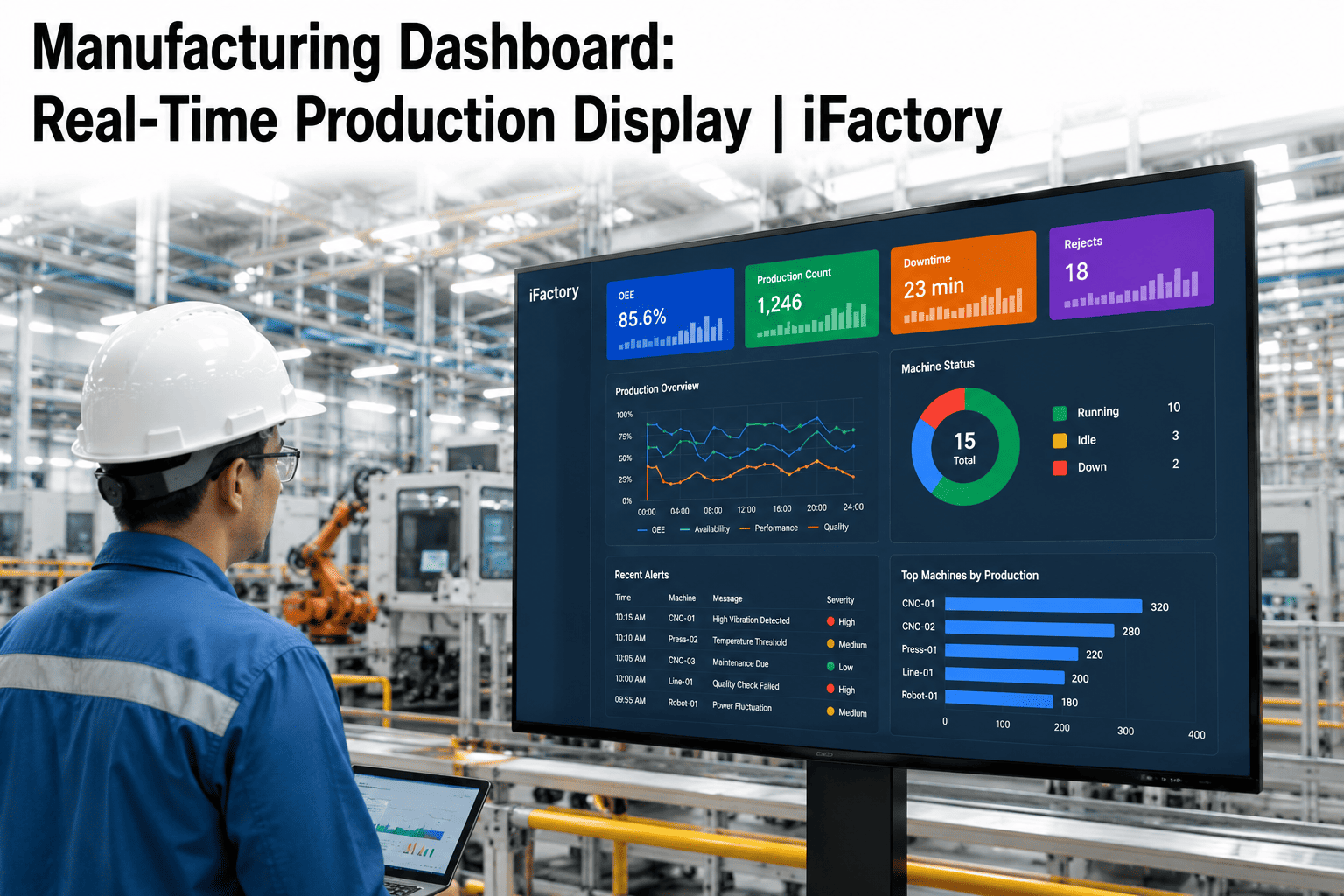
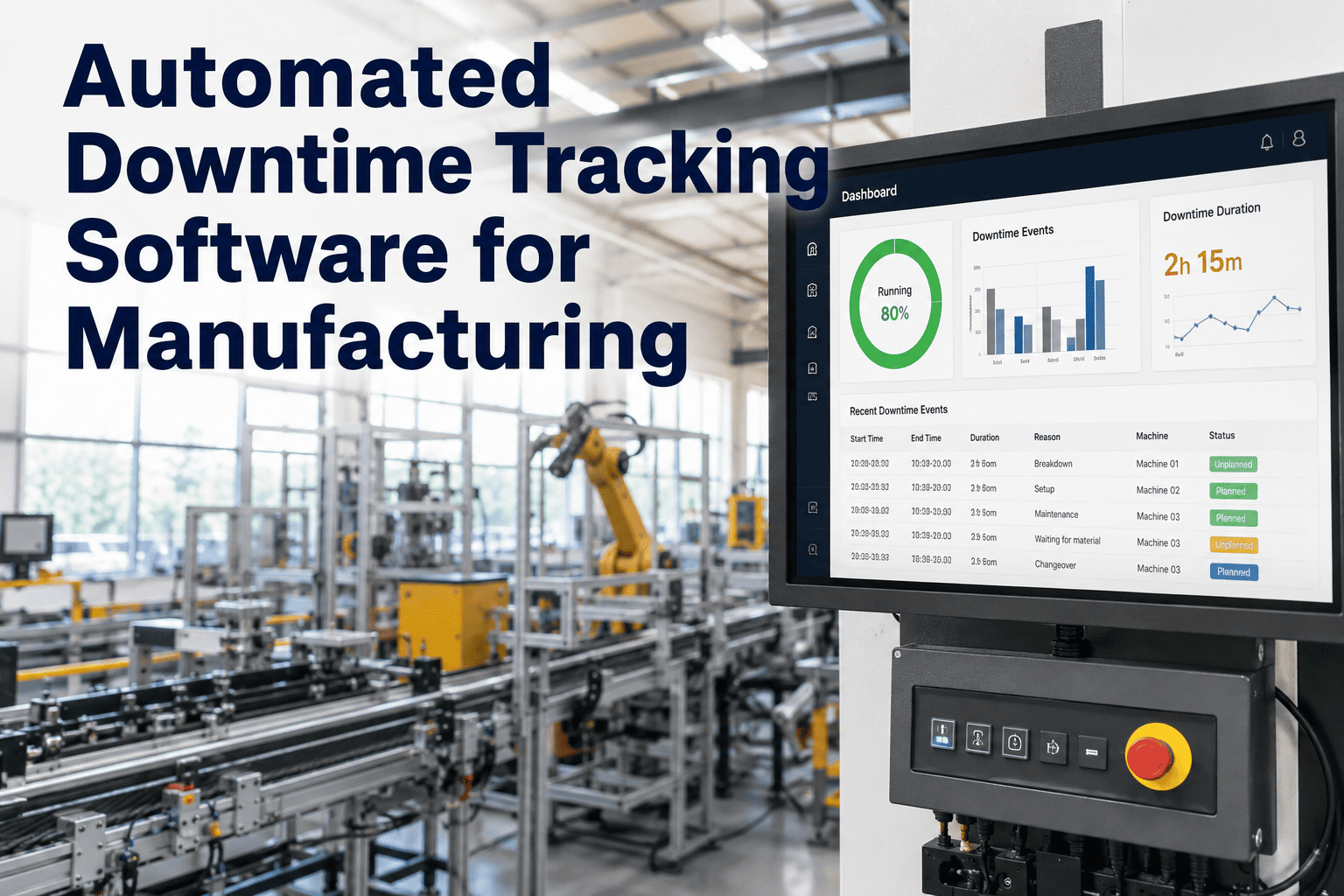
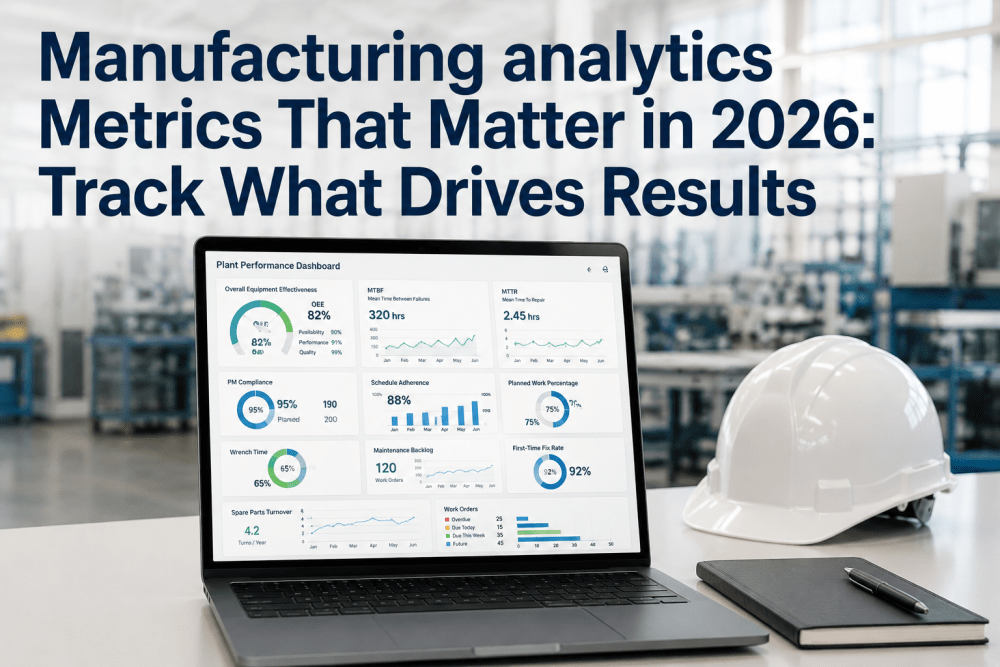
A manufacturing plant dashboard showing 40 metrics is showing nothing. The operations teams that consistently improve plant profitability track fewer than 20 KPIs, but they track the right ones with the right frequency from the right data sources, and they can explain the causal chain between each metric and the financial outcome it drives. This reference covers the 20 most operationally critical manufacturing plant KPIs across five categories: equipment reliability, production performance, quality, maintenance effectiveness, and energy and cost. For each KPI, the page documents the correct formula, the world-class benchmark, and how iFactory calculates it automatically from PLC, SCADA, and sensor data without manual entry. Book a free KPI dashboard assessment for your plant today.
Blog
Top 20 Manufacturing Plant KPIs and Metrics to Track
11 min read
Quick Answer
The 20 most critical manufacturing plant KPIs span five categories: equipment reliability (MTBF, MTTR, Availability, EFOR), production performance (OEE, Throughput, Cycle Time, Capacity Utilization), quality (First Pass Yield, Scrap Rate, Rework Rate, CpK/Process Capability), maintenance effectiveness (PM Compliance, Planned vs Unplanned %, Maintenance Cost Intensity, Work Order Backlog), and energy and cost (Energy Intensity, Cost per Unit, Schedule Adherence, On-Time Delivery). iFactory tracks all 20 automatically from your existing PLC, SCADA, and ERP data with no manual entry required.
Category 1: Equipment Reliability KPIs
Equipment reliability KPIs measure how frequently equipment fails, how long it takes to restore when it does, and what proportion of planned time is actually available for production. These four metrics form the foundation of any maintenance improvement program. Book a demo to see all four tracked automatically from your PLC downtime data.
FormulaOperating Time / Number of Failures
World ClassSector-dependent: high-speed presses 500-2,000 hrs. CNC machining centers 1,000-5,000 hrs. Continuous process 5,000+ hrs between unplanned stops.
iFactory SourcePLC run/fault signal. Every failure event timestamped automatically. MTBF calculated per machine, per shift, per product.
FormulaTotal Repair Time / Number of Failures Repaired
World ClassUnder 2 hours for production-critical equipment. Under 30 minutes for high-OEE lines. iFactory reduces MTTR by 40-70% through pre-diagnosed fault type and pre-staged parts.
iFactory SourceWork order timestamps from fault detection to return-to-run. Includes response time, diagnostic time, and repair time separately tracked.
Formula(Planned Production Time - Unplanned Downtime) / Planned Production Time x 100%
World Class95%+ for production-critical equipment. 90-95% acceptable for general industry. Below 85% indicates serious reliability program gap.
iFactory SourceDirect PLC signal. Feeds the Availability component of OEE. Updated in real time per machine. Distinguishes unplanned downtime from planned downtime automatically.
FormulaNumber of Unplanned Stoppages per Period (shift/week/month)
World ClassUnder 2 unplanned stoppages per machine per week for non-continuous processes. Zero unplanned stoppages from predictable failure modes (bearings, seals, lubrication) is achievable with iFactory.
iFactory SourcePLC fault signal count per period. Categorized by fault code into Six Big Loss Category 1 (equipment failures). Trending shows rate of improvement from predictive maintenance program.
Category 2: Production Performance KPIs
Production performance KPIs measure how much product the plant is producing, how efficiently it is using available capacity, and how close actual production rates are to the designed ideal. These metrics connect directly to revenue capacity and capital utilization.
FormulaAvailability x Performance x Quality
World Class85%+ considered world class. Industry average 60%. Every 1 percentage point of OEE improvement on a $50M revenue line is worth approximately $300,000 to $500,000 in additional output capacity.
iFactory SourceThree-component calculation from PLC encoder, counter, and fault signals. Per machine, per shift, per product. No manual entry. Six Big Loss Pareto generated automatically.
FormulaTotal Good Units Produced / Time Period
World ClassBenchmark is product-specific. Track actual throughput against designed line rate, against the best achieved throughput (demonstrated capacity), and against customer demand requirement (takt-aligned).
iFactory SourcePLC production counter minus quality reject count from quality system integration. Real-time good parts per hour, shift, and day. Displayed on shopfloor dashboard and in management reporting.
Formula(Actual Output / Maximum Possible Output) x 100%
World ClassTarget depends on strategy. High-volume lines: 80-90%+ to justify capital. Job shops: 70-75% typical to maintain flexibility. Under 60% signals OEE or demand problem requiring investigation.
iFactory SourceActual output from PLC counter against theoretical maximum calculated from ideal cycle time and calendar hours. Differentiates loss to OEE from loss to planned non-production time.
FormulaTakt Time = Available Production Time / Customer Demand. Cycle Time = Actual time per unit. Gap = Takt - Cycle Time.
World ClassCycle time should equal 85-90% of takt time to build buffer for variation. Cycle time exceeding takt time indicates the line cannot meet customer demand without overtime or additional shifts.
iFactory SourceCycle time from PLC timestamp per unit. Takt time from ERP demand and shift schedule. Gap displayed in real time on shopfloor dashboard with alert when cycle time threatens takt.
iFactory Calculates All 20 KPIs Automatically from Your PLC and SCADA Data
No spreadsheets. No manual data entry. No end-of-shift downtime logging. iFactory reads from your existing PLCs and production systems to calculate every reliability, performance, quality, maintenance, and energy KPI in real time, displayed on role-specific dashboards accessible from any device.
Category 3: Quality KPIs
Quality KPIs measure how much of what the plant produces meets specification on the first attempt. Quality losses are often the most expensive loss category because they represent materials, labor, and machine time that produced no sellable output. Book a demo to see quality KPIs tracked with SPC integration for your production process.
Formula(Units Passing Inspection First Time / Total Units Inspected) x 100%
World Class98%+ for most discrete manufacturing. 99.5%+ for automotive tier 1 IATF 16949 suppliers. Pharmaceutical GMP: 99%+ expected. FPY below 95% indicates systemic process control issues.
iFactory SourceQuality system integration: CMM, vision inspection, test stand pass/fail signals via OPC-UA. FPY calculated per operation, per line, per shift. SPC trending flags drift before FPY falls.
Formula(Scrapped Units / Total Units Produced) x 100%
World ClassUnder 0.5% for world-class discrete manufacturing. Under 2% acceptable for most processes. Automotive OEM supply chain target: under 50 PPM (0.005%) for safety-critical parts.
iFactory SourceQuality system or manual scrap entry integration. Scrap Pareto by defect code, machine, and shift auto-generated. Correlated with process parameters to identify root causes.
Formula(Units Requiring Rework / Total Units Produced) x 100%
World ClassUnder 1% for most manufacturing. Rework is more insidious than scrap: it consumes additional labor, machine time, and inspection resources while appearing in FPY as a pass. Track rework cost separately from scrap cost.
iFactory SourceWork order system integration: rework work orders per part number and operation. Rework hours and cost tracked against production order. Trending identifies processes with chronic rework accumulation.
FormulaCpK = min[(USL - Mean) / (3 x StdDev), (Mean - LSL) / (3 x StdDev)]
World ClassCpK 1.67+ for safety-critical characteristics. CpK 1.33+ for general manufacturing. CpK under 1.0 means the process is producing out-of-spec parts as a predictable statistical outcome.
iFactory SourceCMM or gauge data via OPC-UA or CSV import. SPC control charts per characteristic per machine. CpK trending identifies processes drifting toward incapability before defects start appearing.
Category 4: Maintenance Effectiveness KPIs
Maintenance effectiveness KPIs measure whether the maintenance program is structured correctly, whether resources are being used efficiently, and whether the balance between planned and unplanned work is improving or deteriorating over time.
Formula(PM Work Orders Completed On Schedule / PM Work Orders Due) x 100%
World Class90%+ completion rate on schedule. Under 80% indicates the maintenance team is spending too much time on reactive work to complete planned work, creating a self-reinforcing downtime cycle.
iFactory SourceCMMS work order system integration. PM schedule compliance tracked per asset class and maintenance technician. Trend alert when compliance drops below threshold in consecutive weeks.
Formula(Planned Maintenance Hours / Total Maintenance Hours) x 100%
World Class80%+ planned is the threshold for a functional maintenance program. Below 60% planned indicates a reactive maintenance culture. iFactory plants typically reach 74%+ planned within 12 months.
iFactory SourceWork order type classification (planned/unplanned) from CMMS. iFactory's condition-based work orders are classified as planned regardless of urgency. Trend shows progressive improvement month-over-month.
Formula(Total Maintenance Cost / Replacement Asset Value) x 100%
World ClassUnder 2% of RAV annually for world class. Industry average 4-8% of RAV. Above 10% of RAV indicates systemic maintenance effectiveness failure or asset end-of-life requiring capital planning.
iFactory SourceWork order cost from CMMS (labor + parts). Asset RAV from asset register. Tracked per asset class, production line, and plant total. iFactory plants reduce maintenance cost intensity by 22-35% on average.
FormulaTotal Open Work Order Hours / Average Weekly Maintenance Workforce Capacity (hours)
World Class2-4 weeks backlog is healthy: enough to plan efficiently but not so much that urgent work is delayed. Under 1 week means the maintenance team is understaffed or under-planning. Over 6 weeks signals resource or priority problem.
iFactory SourceOpen work order count and estimated hours from CMMS. Backlog trend tracked weekly. iFactory automatically prioritizes backlog by asset criticality and fault severity to ensure the most important work is scheduled first.
Category 5: Energy, Cost, and Delivery KPIs
The final four KPIs connect plant operations to the financial and customer outcomes that determine plant profitability and competitive position. These metrics are the ones most visible to senior leadership and customers, but they are downstream consequences of the 16 operational KPIs above. Book a demo to see the complete 20-KPI dashboard configured for your plant operations.
FormulaTotal Energy Consumed (kWh or GJ) / Units Produced (or revenue, or hours run)
World ClassSector-specific. Track against own historical baseline and normalize for production mix. iFactory identifies the primary drivers of energy intensity variation: OEE (idle running), compressed air leaks, and process temperature drift.
iFactory SourceEnergy meter and sub-meter data via Modbus or OPC-UA. Production count from PLC. Energy intensity per unit calculated in real time. Alerts when intensity drifts above baseline for the current production mix.
Formula(Total Production Cost: Labor + Material + Energy + Maintenance) / Good Units Produced
World ClassProduct and sector-specific. Track trending not absolute level. iFactory plants achieve 15-25% cost per unit reduction within 18 months through OEE improvement, energy optimization, and maintenance cost reduction simultaneously.
iFactory SourceCost components from ERP integration (labor, material) combined with iFactory energy data and CMMS maintenance cost. Total cost per good unit calculated per production order. Variance analysis by line and product.
Formula(Production Orders Completed on Schedule / Total Production Orders Scheduled) x 100%
World Class95%+ for lean manufacturing operations. Under 85% indicates equipment reliability or capacity planning issues that are propagating into delivery performance. Track root causes of schedule miss separately from the metric itself.
iFactory SourceProduction order completion times from ERP vs scheduled completion. iFactory identifies whether schedule misses are caused by equipment downtime (OEE), quality rework, material shortages, or changeover overruns.
Formula(Deliveries Made On or Before Promised Date / Total Deliveries) x 100%
World Class98%+ for automotive tier 1. 95%+ for most manufacturing. OTD is the final downstream consequence of OEE, maintenance effectiveness, and quality performance. Improving the upstream KPIs (1-19) is the only sustainable way to improve OTD.
iFactory SourceERP shipping data vs committed delivery date. iFactory connects OTD misses back to the equipment downtime or quality events that caused them, enabling root cause improvement rather than symptom management.
iFactory vs Competing KPI Dashboard Platforms
Most manufacturing KPI tools aggregate data from manual entries or extract from a single source (ERP or CMMS only). iFactory is the only on-premise platform that automatically calculates all 20 KPIs across all five categories from PLC, SCADA, sensor, quality system, and ERP data simultaneously in one unified dashboard. Book a demo to see iFactory's 20-KPI dashboard configured for your plant layout.
| KPI Category |
iFactory |
QAD Redzone |
L2L (Leading2Lean) |
MaintainX |
Siemens Insights Hub |
Epicor Mfg ERP |
SafetyCulture |
Limble CMMS |
| Equipment Reliability KPIs (from PLC data, automatic) |
| MTBF, MTTR, Availability (auto from PLC) |
Fully automatic, PLC-sourced |
Sensor-based, limited PLC depth |
Operator-reported, semi-auto |
Manual work order entry |
Full PLC integration |
ERP data only |
Manual entry |
CMMS-derived, manual-sourced |
| Production and Quality KPIs |
| OEE with Six Big Loss auto-categorization |
Full automatic PLC-sourced OEE |
Yes |
Yes |
No OEE calculation |
Yes |
Via MES module |
No |
No |
| Quality KPIs with SPC integration (FPY, CpK) |
CMM, vision system, test stand integration |
Partial |
Partial |
No quality integration |
Via MES |
Via quality module |
Inspection checklists only |
No |
| Maintenance and Energy KPIs |
| Maintenance cost intensity (from CMMS + asset register) |
CMMS + iFactory asset register integrated |
No maintenance focus |
Basic maintenance tracking |
Yes |
Via SAP PM integration |
Via ERP |
No |
Yes |
| Energy intensity per unit (from energy meters) |
Sub-meter + production count = unit intensity |
No energy tracking |
No energy tracking |
No energy tracking |
Via Siemens energy mgmt |
Via ERP cost module |
No |
No |
| On-premise: no cloud dependency for KPI data |
Full on-premise AI and KPI calculation |
Cloud SaaS |
Cloud SaaS |
Cloud SaaS |
Cloud or hybrid |
Cloud SaaS |
Cloud SaaS |
Cloud SaaS |
Based on publicly available documentation as of Q1 2025. Verify capabilities with each vendor before procurement decisions.
Regional Compliance: KPI Reporting Requirements by Region
Manufacturing KPI reporting is increasingly subject to regulatory requirements across all major operating regions, particularly for energy consumption, emissions intensity, and production quality in regulated industries. iFactory's 20-KPI tracking system provides the underlying data for all major regional reporting frameworks.
| Region |
Key KPI Reporting Standards |
Mandatory Reporting Requirement |
iFactory KPI Coverage |
| USA |
ISO 9001 / IATF 16949 (automotive) / FDA 21 CFR Part 11 (pharma) / EPA Energy Star (energy intensity) / OSHA recordkeeping (safety KPIs) / SEC climate disclosure (emissions per unit) |
IATF 16949 PPAP process capability records, FDA 21 CFR Part 11 production batch quality records, EPA Energy Star energy intensity reporting, SEC Scope 3 emissions intensity per unit of production for public companies |
All 20 KPIs tracked. IATF 16949 capability records auto-generated. FDA 21 CFR Part 11 electronic records with audit trail. EPA Energy Star energy intensity calculated per unit. SEC climate emissions per unit data from energy metering. |
| UAE |
ISO 9001 / ADNOC production performance standards / UAE Industrial Strategy KPIs / ICV performance reporting / UAE Net Zero 2050 (energy and emissions intensity) / ISO 50001 energy management |
UAE Industrial Strategy production efficiency KPIs for Make It in the Emirates incentives, ICV reporting requiring manufacturing productivity evidence, ISO 50001 energy management KPIs for ADNOC and government suppliers, Net Zero 2050 energy intensity tracking |
UAE Industrial Strategy KPI reporting, ICV productivity evidence, ISO 50001 energy intensity per unit, Net Zero emissions and energy data, Arabic platform support, ADNOC-aligned production performance records. |
| UK |
ISO 9001 / IATF 16949 / MHRA GMP (pharma quality KPIs) / ESOS energy audits / UK SECR (energy and carbon reporting) / Made Smarter digital manufacturing KPIs |
UK SECR (Streamlined Energy and Carbon Reporting) energy intensity per unit for large manufacturers, ESOS energy audit evidence including equipment efficiency KPIs, MHRA GMP batch quality records for pharmaceutical manufacturers |
UK SECR energy and carbon intensity data, ESOS energy audit evidence, MHRA GMP quality KPI records, IATF 16949 OEE and capability evidence, Made Smarter productivity KPI demonstration. |
| Canada |
ISO 9001 / IATF 16949 (Ontario and Quebec automotive) / Health Canada GMP / OBPS (Output-Based Pricing System, carbon intensity) / NRCan energy intensity reporting / bilingual record requirements |
OBPS carbon intensity per unit of production for large emitters, NRCan energy efficiency reporting, Health Canada GMP pharmaceutical production quality records, IATF 16949 supplier quality KPIs for automotive OEM supply chains |
OBPS carbon intensity per unit from energy and production data, NRCan energy intensity reporting, Health Canada GMP quality records, IATF 16949 OEE and capability records, bilingual (EN/FR) platform for Quebec. |
| Germany / EU |
IATF 16949 / VDA standards / EU CSRD (Corporate Sustainability Reporting) / EU EED energy intensity reporting / EU ETS emissions per unit / ISO 50001 / EMA GMP / GDPR |
EU CSRD energy and emissions intensity per unit for sustainability reporting, EU ETS emissions per unit for covered manufacturers, EU EED energy efficiency improvement KPIs, VDA quality standards including OEE evidence for automotive tier suppliers |
EU CSRD and ETS emissions intensity per unit, EU EED energy intensity KPIs, VDA and IATF 16949 OEE and quality records, EMA GMP pharmaceutical production records, GDPR-compliant on-premise data, EU data residency available. |
| Australia |
ISO 9001 / TGA GMP (pharma) / NGER Act (energy and emissions intensity) / AMP manufacturing productivity program / WHS Act (safety performance KPIs) / ISO 50001 |
NGER Act energy and greenhouse gas intensity per unit for facilities above thresholds, TGA pharmaceutical GMP production quality records, WHS Act safety performance reporting including maintenance and equipment safety KPIs |
NGER energy and emissions intensity per unit, TGA GMP quality records, WHS safety performance data, ISO 9001 and 50001 KPI evidence, AMP manufacturing productivity demonstration. |
Your Region Has Mandatory KPI Reporting Requirements. iFactory Generates That Data Automatically.
From EU CSRD sustainability KPIs to IATF 16949 process capability records to UAE ICV productivity evidence, iFactory's 20-KPI tracking system provides the underlying data for every major regional mandatory reporting framework without additional data collection effort from your team.
Results: Manufacturing Plants Improving KPIs with iFactory
12-18 pts
OEE Improvement (KPI 05)
Average OEE improvement within 12 months of iFactory deployment measured from baseline, driven by L1 breakdown elimination through predictive maintenance and minor stoppage Pareto identification.
40-70%
MTTR Reduction (KPI 02)
Pre-diagnosed fault type, pre-staged parts, and guided repair procedures from iFactory work orders reduce average repair time by 40 to 70 percent compared to reactive fault investigation from first principles.
22-35%
Maintenance Cost Reduction (KPI 15)
Shift from reactive to planned condition-based maintenance reduces total maintenance labor and parts cost by 22 to 35 percent across the monitored asset population within the first 12 months.
30-45%
Energy Intensity Reduction (KPI 17)
Combined compressed air leak detection, compressor scheduling, motor efficiency monitoring, and boiler combustion optimization delivers 30 to 45 percent energy intensity reduction in the majority of manufacturing plants.
24 hrs
Time to First 20-KPI Dashboard
Within 24 hours of iFactory PLC and SCADA connection, the first automated 20-KPI dashboard is available for all connected machines, eliminating the manual data collection that previously delayed weekly performance review cycles.
Zero
Manual Data Entry Required
All 20 KPIs are calculated automatically from plant data sources. Manual shift downtime logs, paper scrap records, and spreadsheet maintenance tracking are eliminated from the first day of iFactory deployment.
"We had 47 metrics on our monthly management dashboard. No one could explain what caused any of them to move, because the data came from too many different manual sources to be reliable. iFactory automated 20 core KPIs from our PLC and SCADA data. Three months in, our engineering team understood why OEE was moving because they could see the Six Big Loss data in real time. The monthly review went from 2 hours of argument about data quality to 45 minutes of improvement decisions."
Director of Manufacturing Operations
Specialty Packaging Manufacturer, Rotterdam, Netherlands
Frequently Asked Questions
How does iFactory handle KPIs for plants with multiple product types and changeovers?
iFactory tracks all 20 KPIs per production order, not just per shift or per period, so each product variant gets its own KPI performance profile. Ideal cycle time, quality specification limits, and energy intensity benchmarks are all set per product code from the ERP or iFactory product master. Multi-product OEE, FPY, and energy intensity all reflect the actual product mix running at any given time.
Book a demo to see multi-product KPI tracking for your production mix.
Which of the 20 KPIs is most commonly the biggest improvement opportunity?
In plants with no prior predictive maintenance program, KPI 04 (Unplanned Downtime Frequency) and KPI 14 (Planned vs Unplanned Maintenance Ratio) show the most dramatic initial improvement because eliminating even 2 to 3 unplanned stoppages per month cascades into OEE, MTBF, Availability, Schedule Adherence, and On-Time Delivery improvements simultaneously. Energy intensity (KPI 17) typically delivers the fastest measurable return.
Book a free assessment to identify your plant's highest-priority KPI improvement opportunity.
Can iFactory track KPIs for equipment that does not have a PLC?
Yes. For non-PLC equipment, iFactory deploys wireless sensors (vibration, temperature, current, and ultrasonic) to capture the key signals needed for reliability KPIs. Production counting can use optical or proximity sensors rather than PLC integration. Manual quality entry is supported via the mobile app for operations where automated quality data collection is not feasible. iFactory prioritizes automated data capture but handles manual data entry gracefully for legacy equipment.
Book a demo to discuss KPI tracking options for legacy non-PLC equipment in your plant.
How does iFactory present KPIs to different levels of the organization?
iFactory provides role-specific KPI views: shopfloor operators see real-time OEE, cycle time vs takt, and active fault alerts on the shopfloor dashboard. Maintenance supervisors see MTBF, MTTR, work order backlog, and PM compliance on the maintenance dashboard. Plant managers see the complete 20-KPI summary with trend lines. All views are available on any device, on-premise, without cloud access.
Book a demo to see all three KPI dashboard views configured for your plant roles.
How long does it take to set up the 20-KPI dashboard for a new plant?
The first 12 KPIs (reliability, production, and quality) are available within 24 to 48 hours of PLC and SCADA connection, because they calculate directly from production data. Maintenance KPIs (13-16) are available within 3 to 7 days once CMMS integration is configured. Energy KPIs (17-18) are available within 24 hours of energy meter connection. Delivery KPIs (19-20) require ERP integration, typically completed within the first week of deployment.
Book a demo to review the KPI setup timeline for your specific system landscape.
Does iFactory replace our existing CMMS, ERP, or MES systems for KPI tracking?
No. iFactory integrates with your existing CMMS, ERP, and MES via standard APIs and reads data from all of them to calculate the 20 KPIs in a unified dashboard. Your CMMS continues to manage work orders. Your ERP continues to manage production orders and costs. iFactory adds the predictive layer, the sensor data layer, and the unified KPI calculation that your existing systems cannot provide individually.
Book a demo to review integration with your specific CMMS and ERP.
Continue Reading
20 Manufacturing KPIs. One Dashboard. Calculated Automatically from Your PLC, SCADA, and ERP Data.
Reliability, production performance, quality, maintenance effectiveness, and energy KPIs in one unified view. No manual data entry. No spreadsheet aggregation. No end-of-shift downtime logging. First 20-KPI dashboard available within 24 to 48 hours of iFactory deployment for connected machines.
20 KPIs Tracked Automatically
PLC and SCADA Sourced
IATF 16949 and ISO 9001 Records
EU CSRD and NGER Energy KPIs
First Dashboard in 24 Hours
On-Premise: Zero Cloud