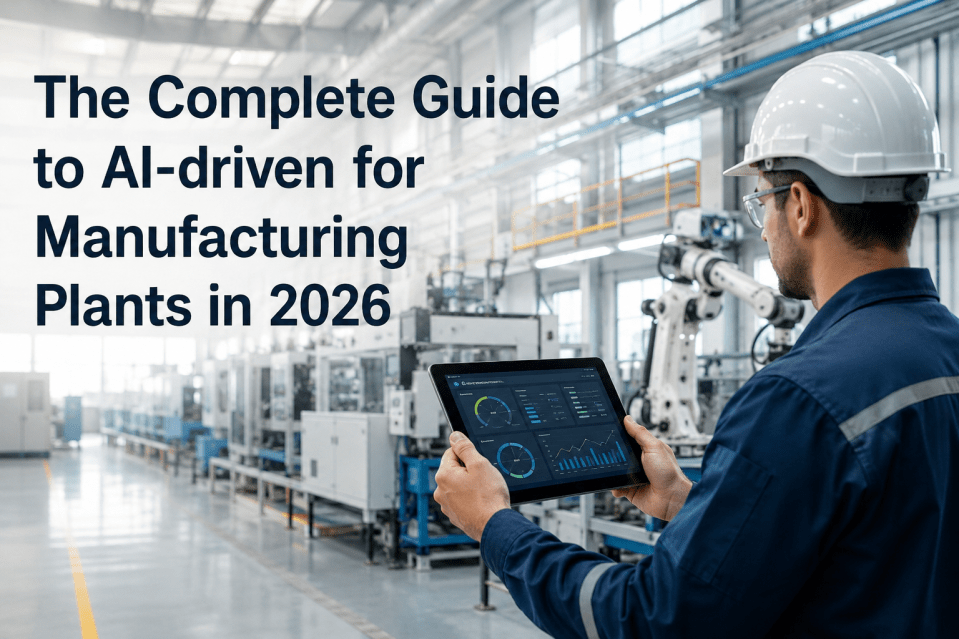
The manufacturing floor of 2026 looks fundamentally different from the one that existed five years ago — and the gap is widening every quarter. Plants that have embedded AI-driven decision systems into their operations are outperforming legacy facilities on every measurable dimension: OEE, scrap rate, energy consumption, maintenance cost, and labor productivity. Those still running on manual inspection cycles, reactive maintenance schedules, and disconnected ERP data are not just falling behind — they are structurally unable to compete at the contract terms, delivery windows, and quality tolerances that modern industrial customers now require as baseline. This guide gives U.S. manufacturing leaders the complete operational picture of what AI-driven manufacturing actually means in practice, what it costs, what it returns and how to implement it without disrupting the production floor that pays for it.
Where AI Manufacturing Stands in 2026: The Numbers That Define the Shift
The smart manufacturing transition is no longer a future-state planning exercise. It is happening now, at scale, across aerospace, automotive, food and beverage, pharmaceutical, and discrete manufacturing. The performance data from plants that have completed their AI integration reveals a consistent pattern: the gap between AI-enabled and traditional operations compounds over time rather than stabilizing.
These numbers are not projections from analyst reports. They represent documented outcomes from plants that have moved through full deployment cycles. The range of benefit depends heavily on which AI capabilities are activated, in what sequence, and whether they are integrated into a unified platform or deployed as disconnected point solutions. The integration question is where most implementations succeed or fail — and it is where platform architecture decisions made early determine whether the investment compounds or stalls.
Ready to See What AI-Driven Operations Looks Like in Your Plant?
iFactory's unified AI manufacturing platform connects predictive maintenance, production analytics, quality control, and asset management in a single system built for industrial scale.
The Five AI Capability Layers That Define a Modern Manufacturing Plant
AI-driven manufacturing is not a single technology — it is a layered capability stack. Each layer builds on the one below it, and the compounding performance gains only materialize when the layers are integrated rather than siloed. Here is how each capability layer operates and what it delivers independently and in combination.
Layer 1: Connected Asset Intelligence
FoundationEvery AI capability in a manufacturing plant depends on real-time machine data. Connected asset intelligence aggregates sensor readings, PLC outputs, SCADA data, and manual inspection records into a unified asset health model. Without this layer, AI models operate on incomplete information and produce recommendations that maintenance technicians cannot trust — the primary reason early AI pilots fail. The data integration layer must cover every asset class: CNC machines, conveyors, compressors, HVAC, electrical distribution, and process equipment.
Layer 2: Predictive Maintenance Engine
High ROIPredictive maintenance translates asset health data into forward-looking failure probability scores. Machine learning models trained on historical failure events, vibration signatures, thermal patterns, and production load data identify degradation trajectories 30–90 days before equipment failure occurs. The output is a prioritized maintenance work queue with estimated remaining useful life (RUL) for each asset — replacing calendar-based PM schedules with condition-based interventions that are performed exactly when needed, not before or after. For plants running 24/7 production schedules, this is typically the highest-ROI capability in the AI stack.
Layer 3: AI Quality Control and Inspection
Defect EliminationComputer vision systems integrated with production lines perform 100% inspection at line speed — replacing sampling-based quality control with continuous, objective defect detection. AI vision models trained on historical defect images achieve detection accuracies exceeding 99.2% on surface defects, dimensional non-conformances, and assembly errors that human inspectors miss at production rates. The downstream benefit is not just defect detection — it is root cause correlation. When quality data is connected to process parameters, the AI system identifies which machine settings, material batches, or environmental conditions are generating defects, enabling process corrections rather than inspection-based containment.
Layer 4: Production Analytics and OEE Optimization
ThroughputReal-time OEE dashboards built on AI-aggregated production data give operations leaders a continuous view of availability, performance, and quality losses across every line and shift. The AI layer goes beyond reporting — it identifies the specific micro-stops, speed losses, and changeover inefficiencies that aggregate dashboards mask. Shift-by-shift comparison, machine-by-machine benchmarking, and bottleneck identification at the process level give plant managers the granular data needed to prioritize improvement initiatives with measurable output impact rather than gut-feel prioritization.
Layer 5: Energy and Sustainability Intelligence
Cost + ComplianceAI-driven energy management monitors consumption at the equipment and process level, identifies waste patterns that fixed-schedule energy audits miss, and optimizes power demand during peak tariff windows. For plants subject to scope 1 and scope 2 emissions reporting requirements, the AI energy layer provides the granular consumption data needed for verified carbon accounting — a compliance requirement that is becoming a customer RFQ criterion in aerospace, automotive, and consumer goods supply chains.
How to Implement AI Manufacturing Without Disrupting Production: A Phased Approach
The single biggest implementation failure mode in AI manufacturing is attempting to deploy everything simultaneously. Full-stack AI transformations that try to go live across all five capability layers at once consistently overrun timelines, exceed budgets, and create organizational resistance that derails the initiative entirely. The plants that succeed follow a structured phased approach that generates visible ROI early, builds internal confidence, and funds subsequent phases from demonstrated savings rather than speculative projections.
The sequence below reflects deployment patterns from plants that have successfully completed full AI integration. It is not a generic consulting framework — it is the actual order of operations that generates the fastest payback while maintaining production continuity throughout. If your operations team is evaluating where to start, a platform scoping session can map this sequence to your specific asset mix and production environment.
Data Foundation and Asset Connectivity
- Sensor audit across all critical production assets
- Edge hardware deployment for data capture on legacy equipment
- Integration with existing ERP, CMMS, and historian systems
- Data quality baseline measurement and gap remediation
- Initial asset health dashboard deployment for maintenance teams
- Complete asset visibility across monitored equipment pool
- Maintenance teams shift from reactive to condition-aware operations
- First failure predictions begin within 60 days of sensor coverage
- Baseline OEE measurement established per line and shift
Predictive Maintenance and Quality Analytics Activation
- ML failure prediction models trained on historical maintenance data
- Automated work order generation from AI-generated failure alerts
- AI vision inspection pilot on highest-scrap production line
- SPC and defect correlation analytics connected to process parameters
- Maintenance cost tracking integrated with asset performance data
- 30–40% reduction in unplanned downtime on monitored assets
- First documented ROI case studies available for internal reporting
- Quality inspection scope expanded from sampled to 100% coverage
- Scrap rate reduction measurable within 90 days of vision system go-live
Full OEE Optimization and Energy Intelligence
- Production analytics expanded across all lines with shift benchmarking
- Bottleneck identification and micro-stop analysis deployed plant-wide
- Energy monitoring at equipment level with demand optimization active
- Digital twin models calibrated for production scenario planning
- Cross-site performance benchmarking for multi-plant operations
- OEE improvement of 15–25% measurable vs. pre-deployment baseline
- Energy cost reduction of 12–22% against prior 12-month benchmark
- Full AI stack operating as integrated system rather than point solutions
- Plant positioned for customer audit readiness on digital quality documentation
Point Solutions vs. Unified AI Platform: The Architectural Decision That Determines ROI
The most consequential technology decision manufacturing leaders make when beginning an AI initiative is not which vendor to choose — it is whether to build from point solutions or deploy a unified platform. This choice determines whether AI capabilities compound over time or remain siloed tools that require manual integration effort to generate actionable insights.
| Capability Area | Point Solution Approach | Unified AI Platform | Business Impact |
|---|---|---|---|
| Data Integration | Custom API bridges between each system; breaks on updates | Native data layer; all capabilities share one data model | 60% lower integration cost |
| Cross-Capability Insights | Manual data export and reconciliation required | Automatic correlation between maintenance, quality, and production data | Root cause visibility in minutes |
| Time to Value | 6–18 months per tool; sequential deployment only | Phased rollout with value at each stage; parallel activation possible | 3–6 months faster to first ROI |
| Total Cost of Ownership | Multiple vendor contracts; integration maintenance overhead | Single vendor relationship; no integration maintenance burden | 40% lower 5-year TCO |
| Scalability | Each tool scaled independently; governance complexity grows | New sites and assets onboarded to existing platform architecture | Linear scaling without complexity growth |
| Workforce Adoption | Multiple UIs; separate training per tool; context switching | Single interface for maintenance, quality, and operations teams | Higher adoption, lower training cost |
| AI Model Performance | Models operate on partial data; accuracy limited by silos | Models trained on complete cross-functional data; higher accuracy | 15–20% better prediction accuracy |
The financial case for a unified platform approach becomes clearer when you factor in the hidden costs of point solution integration: the engineering hours spent maintaining API connections, the data reconciliation work that prevents insights from being acted on in real time, and the delayed value realization that comes from sequential rather than parallel deployment. For plants evaluating platform options, a structured platform comparison session maps your specific use cases to the right architecture before any purchase decision is made.
How to Build the Business Case for AI Manufacturing: ROI Categories and Calculation Framework
The ROI case for AI manufacturing investment does not rest on a single benefit category. It is built across six measurable value streams that, when calculated against your plant's specific cost structure, typically produce a business case that clears standard capital authorization hurdles within the first 12 months of deployment. Here is how to quantify each category for your facility.
Downtime Elimination Value
Formula: (Annual unplanned downtime hours × Hourly production value) × 0.35
A plant producing $2,400 per hour of output with 480 hours of annual unplanned downtime carries $1.15M in avoidable downtime cost. A 35% reduction from predictive maintenance delivers $403K in annual recovered production value — before accounting for avoided emergency repair premiums, which typically add 60–80% to the base maintenance labor cost.
Quality and Scrap Reduction Value
Formula: (Annual scrap + rework cost) × 0.30 + (Warranty cost) × 0.20
AI quality inspection and SPC correlation typically reduces scrap and rework by 25–35% within the first production year. For a plant carrying $600K in annual quality costs, this represents $150–$210K in direct material and labor savings. Warranty cost reduction from reduced field escapes adds a further recovery that varies significantly by product type and customer contract structure.
Maintenance Labor Efficiency
Formula: (Annual maintenance labor cost) × 0.20 + (Emergency repair premium) × 0.60
Predictive maintenance shifts technician time from reactive firefighting to planned, efficient interventions. A maintenance team spending 40% of hours on emergency response and reactive work — a common baseline — typically recovers 15–20% of total maintenance labor cost through condition-based scheduling. Emergency repair premiums (overtime, expedited parts) are eliminated at an even higher rate as failure rates decline.
OEE Throughput Gain Value
Formula: (Current output × OEE improvement %) × Net margin per unit
A 5-point OEE improvement on a line producing $8M annually at 12% margin delivers $48K in incremental margin per point of improvement. Plants consistently achieving 15–23% OEE gains from AI production analytics are adding $720K to $1.1M in annual margin from existing assets — without capital expenditure on new equipment.
Energy Cost Reduction
Formula: (Annual energy spend) × 0.15 to 0.22
AI energy management delivers 15–22% reductions in energy spend for most manufacturing facility types. For a plant spending $1.8M annually on electricity, this represents $270K–$396K in annual savings — a benefit that compounds as energy costs rise and carbon pricing mechanisms expand across U.S. industrial markets through 2027–2028.
Labor Productivity and Redeployment Value
Formula: (Hours freed by automation × Fully-loaded labor rate) × Redeployment multiplier
AI automation of manual inspection, reporting, and data reconciliation tasks frees skilled labor for higher-value activities. Plants report 15–25% of quality and operations technician hours redirected from monitoring and recording to root cause analysis and process improvement — converting fixed labor cost into measurable output improvement rather than simple headcount reduction.
Build Your AI Manufacturing Business Case With Real Platform Data
iFactory's AI manufacturing platform gives plant leaders the unified capability stack — predictive maintenance, quality intelligence, production analytics, and energy management — in a single system designed for industrial deployment at any scale.
What Operations Leaders Say After Full AI Platform Deployment
The most reliable signal on AI manufacturing outcomes comes not from vendor case studies but from operations leaders who have completed full deployment cycles and can speak to both the implementation challenges and the measurable results. The following perspectives reflect documented deployment experiences across mid-size U.S. manufacturing operations.
We spent three years trying to make point solutions work — a separate predictive maintenance tool, a standalone SPC system, a quality dashboard that nobody used because the data was always 24 hours stale. The turning point was moving to a unified platform where maintenance alerts, quality data, and production metrics all live in the same system. Our maintenance supervisor now sees a quality deviation trend on the same screen as the bearing health alert for the machine causing it. That correlation took us 20 minutes to identify manually before. Now it surfaces automatically. Our OEE went from 67% to 81% in fourteen months, and we have documented $2.3M in avoided downtime costs in year one alone.
The energy ROI surprised us most. We expected to recover $200K in energy costs annually. We hit $380K in the first year because the AI system identified consumption patterns in our HVAC and compressed air systems that no audit had ever caught — equipment running at full load during periods when production demand didn't justify it. That alone paid for a significant portion of the platform. The predictive maintenance value is real too, but the energy story is the one I lead with now when I talk to peer plant managers considering the investment.
Our quality team resisted AI inspection initially — they were convinced the system would flag good parts as defects and create more work, not less. Twelve months in, our false positive rate is under 0.3%, our field escape rate has dropped 44%, and three of our five quality inspectors have been redeployed into process improvement roles where they are generating far more value than manual inspection ever could. The system handles the 100% inspection coverage and the team handles the root cause analysis. That division of labor is what we should have had years ago.
These outcomes share a common thread: the value compounded when AI capabilities operated as an integrated system rather than isolated tools. Manufacturers evaluating where to start should note that the operations leaders above all cite the integration layer — not any individual feature — as the decision that determined their results. If you want to see how an integrated AI platform performs against your current operation, the fastest path is a structured capability demonstration against your actual production data.
The Bottom Line: AI Manufacturing Is a Competitive Necessity, Not a Technology Experiment
The window for treating AI manufacturing as a pilot program or future-state initiative has closed. The plants that will compete for premium industrial contracts in 2026 and beyond are those that have already built the data foundation, activated the predictive maintenance and quality layers, and are now using AI-generated insights to drive continuous improvement decisions that their competitors cannot replicate with manual processes.
The implementation barriers that dominated the conversation three years ago — data quality, workforce resistance, integration complexity — are solvable problems with a structured approach and the right platform partner. The business case, when built correctly against your plant's specific cost structure, consistently supports the investment decision. The 14-month median payback period documented across deployments is not an optimistic scenario — it is the central outcome for plants that follow a phased implementation sequence and deploy capabilities in the order that generates the fastest early returns.
The risk is no longer in moving too fast toward AI manufacturing. It is in moving too slowly while competitors extend their operational advantage to a point where the gap becomes a structural disadvantage in contract negotiations, customer audits, and talent recruitment. If your operations team is ready to move from evaluation to planning, the fastest next step is a platform capability session that maps your specific asset mix, production environment, and performance gaps to the deployment sequence most likely to generate measurable ROI within your first 90 days.
AI-Driven Manufacturing Plants — Frequently Asked Questions
Most plants document first measurable ROI within 60–90 days of sensor coverage deployment — typically from one or two prevented equipment failures that the predictive system flagged before the maintenance team would have detected them through conventional inspection. The 14-month median payback period cited across documented deployments reflects cumulative returns across downtime elimination, quality improvement, and energy savings. Plants in high-volume discrete manufacturing with significant unplanned downtime history often see payback within 8–10 months. Process industries with lower failure frequency but higher failure cost per event typically see payback in the 16–20 month range.
Yes. The majority of U.S. manufacturing plants run a mixed equipment fleet that spans multiple generations — and modern AI platforms are specifically designed to accommodate this reality. Retrofit sensor packages including accelerometers, temperature sensors, current transducers, and ultrasonic monitors can be mounted on any mechanical equipment without modifying the machine or its control system. Edge computing hardware captures and transmits data from these sensors to the AI platform without requiring PLC connectivity. For equipment with older PLCs that do support network communication, protocol translators handle Modbus, Profibus, and RS-232 data without custom programming. The effective coverage threshold — the minimum percentage of assets under monitoring needed for AI models to produce reliable outputs — is typically 70% of your critical asset pool, not 100%.
Traditional CMMS systems are record-keeping tools — they store work order history, maintenance schedules, and parts inventory but do not analyze data to predict when maintenance is needed or why quality is degrading. Traditional MES systems track production execution but do not learn from historical patterns or generate forward-looking operational recommendations. AI manufacturing platforms add the analytical and predictive layer on top of this record-keeping foundation: they ingest real-time sensor data, apply machine learning models to identify failure trajectories and quality patterns, and surface actionable recommendations before problems occur. Many AI platforms also include integrated CMMS and MES capabilities, allowing plants to consolidate from multiple systems to a single unified platform — eliminating the integration overhead that prevents insights from being acted on in real time.
Cloud-native AI manufacturing platforms scale to any number of production sites without architectural changes. Each new site is onboarded to the existing platform infrastructure — adding its assets, sensors, and production data to the shared data model without requiring a separate deployment or integration project. Multi-site deployments unlock cross-site benchmarking capabilities that single-site operations cannot access: the ability to compare OEE, maintenance cost per asset class, quality performance, and energy intensity across facilities identifies which site practices are generating the best results and enables structured knowledge transfer between operations. For companies with 3 or more manufacturing sites, the cross-site analytics capability frequently generates the highest-value insights in the entire AI platform deployment.
Modern AI manufacturing platforms are designed for operation by existing plant personnel — maintenance supervisors, quality engineers, and operations managers — without requiring dedicated data science staff or IT resources for day-to-day operation. The initial deployment requires a project team that typically includes a maintenance lead, an operations lead, and an IT integration contact for a period of 8–16 weeks. After go-live, the system is maintained by platform vendor support for the AI model layer, while plant personnel use the dashboards and work order interfaces as part of their standard daily workflow. The most successful deployments assign a platform champion — typically a maintenance supervisor or operations analyst — who owns user adoption and translates AI-generated insights into operational decisions. This role typically adds 2–4 hours per week to an existing position, not a new headcount requirement.
See iFactory's Unified AI Platform in Action Across Your Production Environment
Join the U.S. manufacturers already running predictive maintenance, AI quality inspection, OEE analytics, and energy intelligence from a single platform — and closing the performance gap with a 14-month payback period.