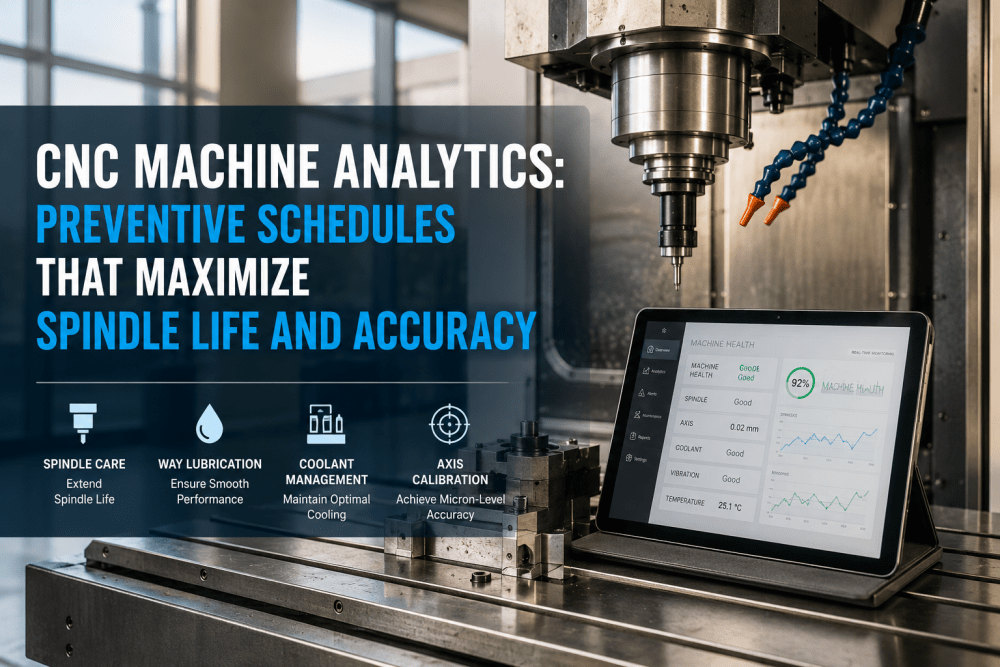
CNC machines are the backbone of precision manufacturing — and every lost spindle hour, misaligned axis, or neglected lubrication point is money walking out the door. Most manufacturers track downtime after it happens. The ones winning on shop floor efficiency are tracking it before it does. That is the difference a properly configured analytics platform makes: turning reactive repair cycles into scheduled, data-driven precision maintenance programs that protect spindle life, axis accuracy, and coolant integrity simultaneously.
Is Your CNC PM Program Protecting Spindle Life?
Deploy iFactory's CNC analytics engine to build preventive schedules that maximize uptime, accuracy, and machine longevity across every spindle and axis on your floor.
The Hidden Cost of Running CNC Machines Without Analytics
A CNC machining center running without telemetry-backed preventive scheduling is operating on assumption. Spindle bearings degrade quietly. Axis backlash accumulates over thousands of cycles. Coolant concentration drifts from specification. Way lubrication intervals based on calendar time rather than actual cutting hours create both over-lubrication waste and dangerous dry-run periods. By the time these issues surface as a part rejection or unplanned downtime, the damage is already done — and in tight-tolerance environments, the rework cost often exceeds the original job margin.
The shift to analytics-driven CNC maintenance is not about adding complexity. It is about replacing guesswork with measurable, scheduled actions tied directly to machine behavior data. Shops that implement structured preventive maintenance scheduling for their CNC assets consistently report lower scrap rates, extended spindle intervals, and faster regulatory or customer audit readiness.
Spindle Life Maximization: What the Data Actually Tracks
The spindle is the most expensive serviceable component on any machining center — and the most poorly tracked in most PM programs. Effective spindle analytics goes beyond runtime hours. A data-driven spindle maintenance program monitors multiple interdependent parameters and uses them to trigger scheduled interventions before bearing wear reaches critical thresholds.
Vibration Signature Trending
Accelerometers mounted on spindle housings capture FFT signatures at defined intervals. Baseline signatures are recorded at commissioning. As bearing surfaces wear, specific frequency bands amplify — and analytics platforms flag these deviations before catastrophic failure. Scheduling bearing inspections at 85% of the baseline drift threshold eliminates surprise failures.
Spindle Load Current Monitoring
Drive current draw during standard cutting cycles serves as a proxy for cutting tool condition and spindle resistance. When average load current rises more than 12–15% above the established baseline for a given operation, the analytics engine triggers a tooling inspection work order before dimensional drift affects part quality.
Thermal Gradient Tracking
Spindle bearing temperature logged against ambient shop temperature and RPM gives a precise thermal gradient. Tracking this gradient over thousands of spindle hours reveals lubrication degradation patterns that fixed calendar-based grease intervals miss entirely. Most shops over-grease by 30–40% — a problem that damages seals and accelerates the very bearing wear they are trying to prevent.
Cutting Hour Accumulation vs. Speed Profile
A spindle running predominantly at high RPM ages faster than one operating in a mixed-speed profile. Analytics platforms weight spindle hours by speed band — calculating an effective spindle age that is more accurate than calendar hours alone. This metric drives grease interval scheduling that actually reflects mechanical reality.
For high-volume shops running lights-out operations, spindle monitoring integrated into your PM platform eliminates the need for technicians to estimate service intervals — the data schedules the work order automatically.
Way Lubrication Analytics: Getting the Interval Right the First Time
Linear way systems — whether box way, linear rail, or hybrid — depend on precisely timed lubrication to maintain the film thickness that separates sliding surfaces. Too little lubricant and you get fretting wear that degrades positioning repeatability. Too much and you introduce contamination risks, attract swarf, and waste consumables. Analytics-driven way lubrication scheduling replaces fixed intervals with consumption-based triggers.
| Lubrication Parameter | Fixed Schedule Approach | Analytics-Driven Approach | Result |
|---|---|---|---|
| Interval Trigger | Calendar time (e.g., weekly) | Axis travel distance accumulation | Precision scheduling |
| Volume Dispensed | Fixed pump stroke count | Adaptive to measured film resistance | 30% less consumption |
| Failure Detection | Visual inspection only | Pressure sensor feedback on lube lines | Blockage alerts |
| Contamination Risk | High — excess pooling on ways | Controlled — metered delivery only | Reduced swarf adhesion |
| Positioning Accuracy | Drifts between service visits | Maintained within spec continuously | Micron-level consistency |
| Audit Trail | Paper log or memory | Timestamped digital PM record | Audit-ready documentation |
The most effective CNC way lubrication programs track axis travel in meters rather than calendar days, then trigger lubrication events at manufacturer-specified intervals adjusted for actual shop temperature and cutting load. When a lube line blockage occurs, the analytics platform flags it as a maintenance work order within the same shift — not at the next scheduled inspection.
Coolant Analytics: Concentration, pH, and Microbial Control on Schedule
Coolant management is the most frequently neglected subsystem in CNC preventive maintenance — and one of the highest-impact variables for tool life, surface finish, and machine corrosion. A coolant management analytics program monitors three critical parameters on a scheduled basis and triggers corrective actions before parts are affected.
Refractometer readings taken on a scheduled frequency and logged digitally detect concentration drift caused by evaporation, drag-out, and makeup water additions. Analytics platforms flag out-of-spec readings automatically and trigger top-up work orders before cutting performance degrades.
pH outside the 8.8–9.4 range for most semi-synthetic coolants accelerates machine corrosion and microbial growth simultaneously. Scheduled pH readings logged in the analytics system reveal drift trends before the coolant reaches rejection criteria, allowing corrective chemistry additions rather than full sump dumps.
Bacterial and fungal contamination in coolant sumps reduces lubricating properties, creates tramp oil emulsification, and generates hydrogen sulfide odor that signals dangerously high microbial counts. Analytics-scheduled dip slide testing at defined intervals — typically weekly for high-volume sumps — catches contamination 10–14 days before it reaches critical rejection levels.
Analytics platforms tracking concentration, pH, and microbial counts simultaneously can calculate the optimal sump change interval based on actual coolant condition rather than calendar weeks. Most shops change coolant 20–30% more frequently than necessary — a direct cost reduction opportunity that analytics data quantifies and justifies to management.
Axis Calibration Scheduling: Maintaining Micron-Level Accuracy Over Machine Life
Positioning accuracy in a CNC machining center degrades through three primary mechanisms: ballscrew wear, thermal growth, and geometric error accumulation in the linear guide system. Analytics-driven calibration scheduling identifies when each axis requires intervention — before the deviation exceeds the tolerance stack allowed by your workpiece drawings.
Establish Baseline Volumetric Accuracy
Laser interferometer measurements at machine commissioning create the reference dataset for all future calibration comparisons. This baseline captures positional accuracy, repeatability, and pitch/yaw errors across the full travel range of each axis. Without this baseline, you have no objective reference to measure against.
Track Ballscrew Wear via Positioning Error Trending
Scheduled ballbar testing at defined machine hour intervals — typically every 2,000 cutting hours — reveals ballscrew pitch error and backlash accumulation. Analytics platforms plot these results against the baseline and flag when error growth exceeds 30% of the original specification, triggering a compensation parameter update or mechanical inspection work order.
Thermal Error Compensation Verification
Machines equipped with thermal compensation systems require periodic verification that compensation models remain accurate as machine structure ages. Analytics-scheduled warm-up cycle measurements — conducted seasonally or after shop HVAC changes — confirm compensation table accuracy and flag when recalibration is needed to maintain part quality across temperature shifts.
Geometric Error Accumulation Monitoring
Squareness between axes, spindle tilt, and headstock alignment drift over years of use. Scheduled precision level and square measurements — documented in the analytics platform — create a longitudinal record of machine geometry health that predicts when structural alignment work will be required, allowing it to be planned during scheduled downtime rather than discovered during a customer audit.
Shops running tight-tolerance aerospace or medical parts should schedule calibration verification after every 500 spindle hours minimum. An integrated PM scheduling platform automates these work order triggers so calibration never gets pushed back due to production pressure — one of the most common and costly maintenance deferrals in precision machining environments.
Building Your CNC Analytics PM Program: A Practical Implementation Sequence
Deploying analytics-driven preventive maintenance across a CNC floor does not require replacing every machine controller or installing expensive sensor arrays on day one. A phased implementation approach gets the highest-value machines under data coverage first, builds institutional knowledge, and delivers measurable ROI within the first quarter.
Asset Criticality Ranking
- Rank CNC assets by revenue contribution and replacement cost
- Identify machines with highest unplanned downtime history
- Select top 20% of assets for initial analytics coverage
- Document current PM intervals and their basis (calendar vs. usage)
Baseline Data Collection
- Conduct spindle vibration baseline measurements on priority machines
- Record ballbar test results for each axis on selected assets
- Log current coolant concentration, pH, and microbial counts
- Document way lubrication system condition and last service dates
PM Schedule Conversion
- Convert calendar-based intervals to usage-based triggers in the platform
- Set vibration and temperature alert thresholds per machine specification
- Configure automated work order generation for threshold breaches
- Assign technician roles and response time SLAs per task category
Continuous Improvement Loop
- Review PM completion rates and backlog trends monthly
- Adjust alert thresholds based on actual fault event data
- Expand analytics coverage to next asset tier on 90-day cycle
- Generate quarterly spindle health and axis accuracy reports for QA
Replace Calendar PM with a CNC Analytics Program That Actually Works
iFactory's Preventive Maintenance Scheduling platform gives CNC-intensive operations a single system to track spindle health, way lubrication cycles, coolant condition, and axis calibration status — all with usage-based triggers and automated work order generation.
What Manufacturing Engineers Say About Analytics-Driven CNC PM
The shift from fixed-interval to analytics-driven CNC preventive maintenance is well-documented in precision manufacturing literature and operational case studies across aerospace, defense, medical device, and automotive tier-1 suppliers.
The single biggest change in our CNC PM program was switching spindle service intervals from 6-month calendar cycles to vibration-threshold triggers. We extended average spindle service life by 40% in the first year and eliminated three surprise failures that would have each cost us roughly $30,000 in parts, labor, and lost production. The analytics data also gave us the documentation needed to negotiate better spindle warranty terms with our machine builder.
Coolant management was costing us approximately $4,200 per machine annually in unnecessary sump changes driven by a rigid 8-week calendar schedule. After implementing analytics-tracked concentration and pH monitoring, we extended average sump life to 14 weeks and reduced our coolant consumption by 28%. The data also let us identify one machine with a persistent pH drop caused by a water quality issue we had been chasing for two years.
These outcomes are not exceptional — they represent the consistent results manufacturing operations achieve when CNC preventive maintenance is driven by actual machine data rather than manufacturer-recommended intervals that assume average operating conditions your shop may never actually experience.
The Bottom Line on CNC Machine Analytics and Preventive Scheduling
CNC machine analytics is not a technology investment — it is a business decision with a measurable payback period. Spindle failures that analytics could have predicted cost American manufacturers an estimated $4.8 billion annually in unplanned downtime, emergency repair costs, and scrapped work-in-process. The gap between shops winning precision machining contracts and those losing them on quality and delivery reliability increasingly comes down to how well their maintenance programs leverage the data their machines are already generating.
A structured CNC analytics PM program — covering spindle vibration, way lubrication cycles, coolant condition, and axis calibration intervals — does not require a full digital transformation initiative. It requires a disciplined approach to baseline measurement, threshold-based scheduling, and digital documentation of every maintenance action. The result is a CNC floor that runs closer to design accuracy, longer between failures, and with the audit trail that quality-conscious customers increasingly require before awarding contracts.
If your current CNC PM program is built on calendar intervals, clipboard logs, and technician memory, the path to better spindle life and part accuracy starts with replacing assumption with measurement. Your machines are already telling you when they need service. A purpose-built analytics platform makes sure you hear it before production does.
CNC Machine Analytics and Preventive Scheduling — Frequently Asked Questions
The most reliable indicator is a combination of vibration signature drift and thermal gradient trending rather than calendar time alone. Spindles running predominantly at high RPM on aggressive materials age faster than manufacturer interval tables assume. When vibration amplitude in the bearing frequency bands increases more than 25% above your commissioned baseline, or when operating temperature rises more than 8–10°C above the established baseline at equivalent RPM, a bearing inspection is warranted regardless of hours elapsed. Analytics platforms automate this comparison continuously.
For a two-shift operation accumulating approximately 3,500–4,000 cutting hours annually, ballbar testing every 2,000 cutting hours is a practical starting point — typically landing at twice per year. After collision events or major tooling crashes, an immediate ballbar test should be performed before the machine returns to production on tolerance-critical work. For machines running aerospace or medical tolerances tighter than ±0.001 inch, quarterly testing is advisable. The key is logging results in a platform that tracks the trend, not just the pass/fail at each interval.
On active machining cells running one to three shifts, concentration should be checked at minimum three times per week — daily is better. Concentration can drift 1.5–2 percentage points in a single shift on cells with high coolant throughput or significant evaporation from open chip conveyors. pH should be measured weekly, and dip slide microbial testing conducted weekly in sumps over 50 gallons. The critical discipline is logging each reading with timestamp and technician ID in the PM platform so drift trends are visible over weeks, not just individual readings.
Yes. Most CNC analytics implementations begin with retrofit sensor packages — accelerometers, temperature sensors, and spindle load current monitoring — connected via edge hardware that reads machine outputs without modifying the CNC control. MTConnect and OPC-UA protocols allow modern analytics platforms to read axis position data, spindle speed, and feed rate directly from controllers on Fanuc, Siemens, Mitsubishi, and Heidenhain platforms without custom programming. For older machines without network interfaces, USB or RS-232 data capture hardware bridges the gap. The most valuable analytics — spindle vibration, thermal trending, and coolant condition — can be deployed on machines from any era.
First-year ROI varies by fleet size, machine age, and current PM maturity, but shops with 10 or more CNC machining centers typically see measurable returns within 90 days. Common first-year outcomes include: one to two prevented spindle failures worth $15,000–$35,000 each, coolant management cost reductions of $800–$2,400 per machine annually, 15–25% reduction in emergency maintenance labor costs, and measurable improvement in first-part accuracy that reduces setup scrap on tolerance-critical jobs. The documentation value — digital PM records that satisfy customer quality audits and AS9100 or ISO 13485 requirements — is a secondary benefit that becomes primary during customer visits or certification audits.
Start Tracking Spindle Health and Axis Accuracy With iFactory Today
Join precision manufacturers who have replaced calendar-based CNC maintenance with usage-driven, analytics-backed preventive schedules that protect spindle life, maintain micron-level accuracy, and generate audit-ready PM documentation automatically.