Every year, manufacturing facilities lose millions in productivity and face regulatory penalties not because their equipment fails—but because their compliance systems do. OSHA non-conformance is the silent operational drain costing manufacturing leaders market access, worker compensation claims, and operational credibility across their facilities. The cost of inaction is not a fine. It is downtime, liability exposure and an unsafe workforce.
Is Your Manufacturing Plant Audit-Ready Across Every Department?
iFactory's Compliance Platform harmonizes OSHA safety protocols, equipment inspections, and hazard documentation across all manufacturing locations—in one unified dashboard.
Why Manual OSHA Compliance Fails Modern Manufacturing Operations
The OSHA regulatory framework imposes a complex, multi-layered compliance structure on manufacturing operations. Plants must track machine guarding standards, lockout/tagout (LOTO) certifications, electrical safety protocols, personal protective equipment (PPE) requirements, hazardous material handling procedures and worker training completion across every department and shift. For facilities managing 75+ pieces of equipment, 150+ staff members, and dynamic work assignments, the compliance burden becomes operationally unmanageable through manual spreadsheets and paper records.
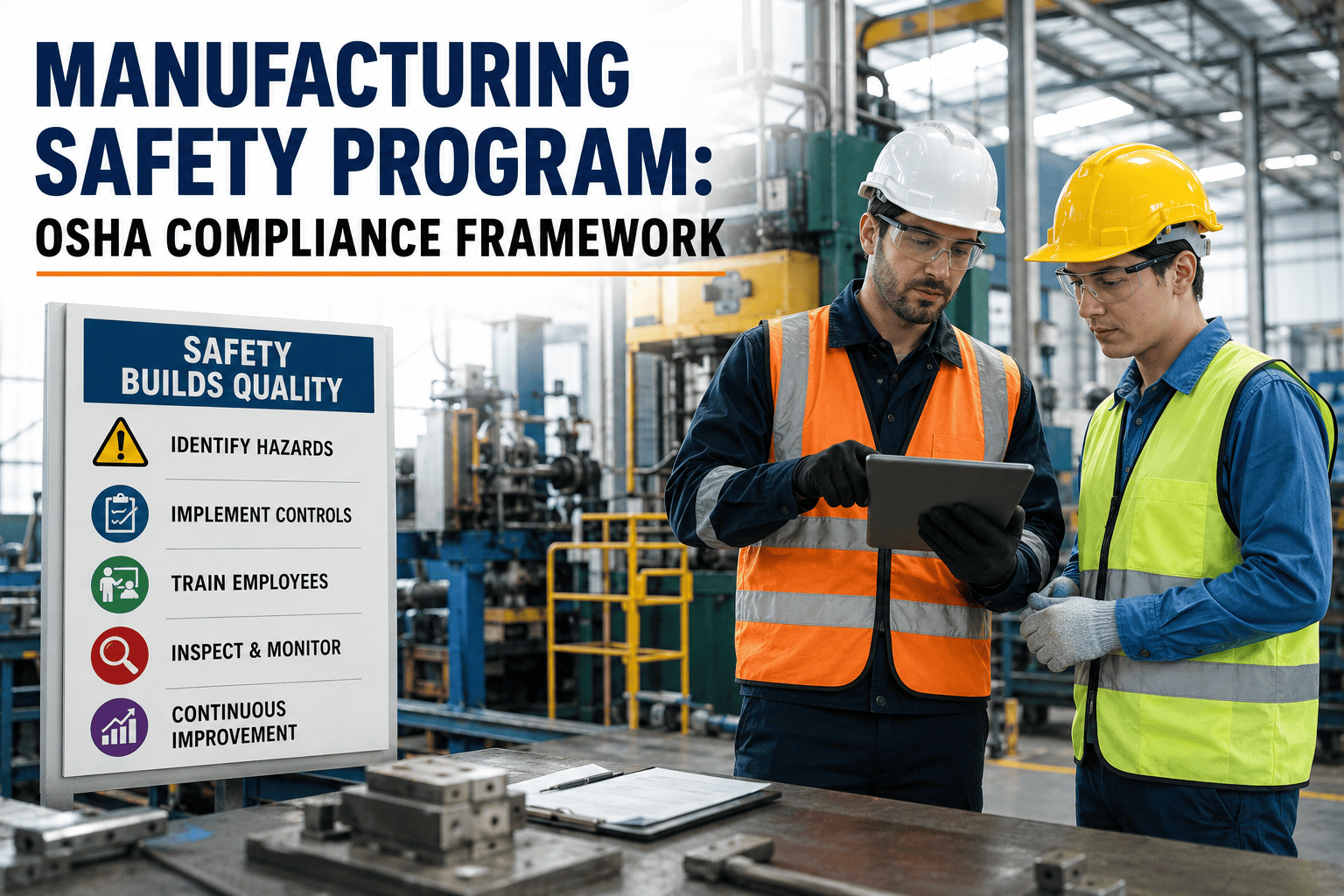
A single lapsed equipment inspection, missed LOTO certification, or undocumented machine guarding modification creates an immediate safety risk in manufacturing: invisible until an OSHA inspector arrives or a worker is injured. Organizations that have migrated to integrated safety management systems report inspection findings reduced by 60%, near-miss incident reporting increased by 45% and audit preparation time slashed by 70%. The pathway is clear: automated safety compliance and maintenance coordination eliminates the administrative friction that allows safety lapses to accumulate. You can book a demo to explore real-time safety dashboards and compliance verification tools.
OSHA Compliance Areas Tracked
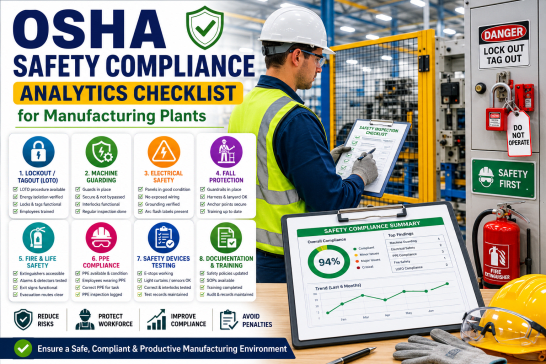
- Machine Guarding & Protective Devices (29 CFR 1910.212)
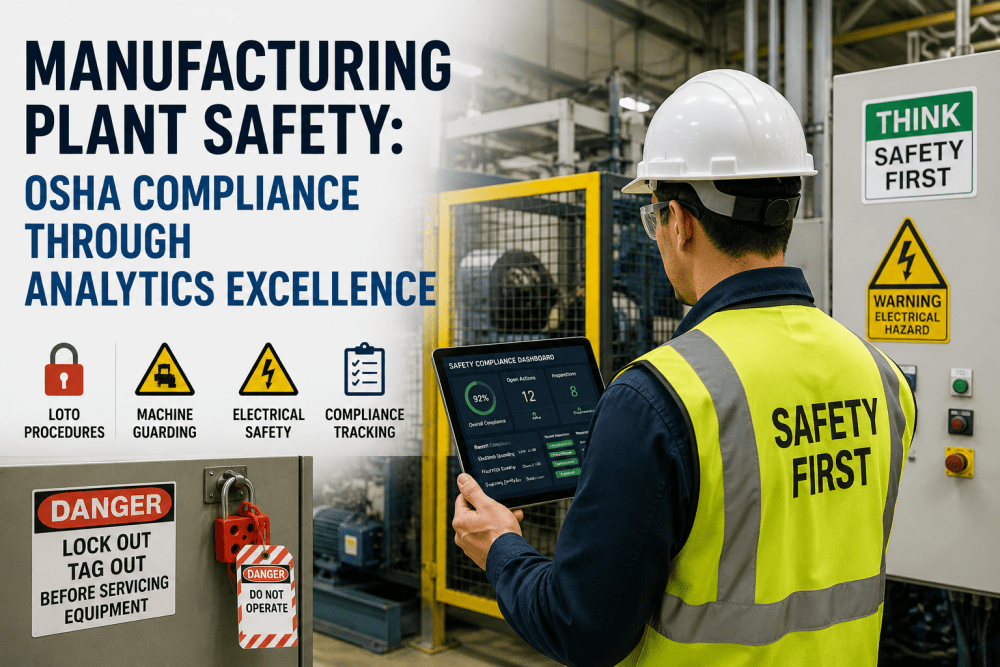
- Lockout/Tagout (LOTO) Procedures & Certifications (29 CFR 1910.147)
- Electrical Safety Standards (29 CFR 1910.303–307)
- Personal Protective Equipment (PPE) Compliance (29 CFR 1910.132–138)
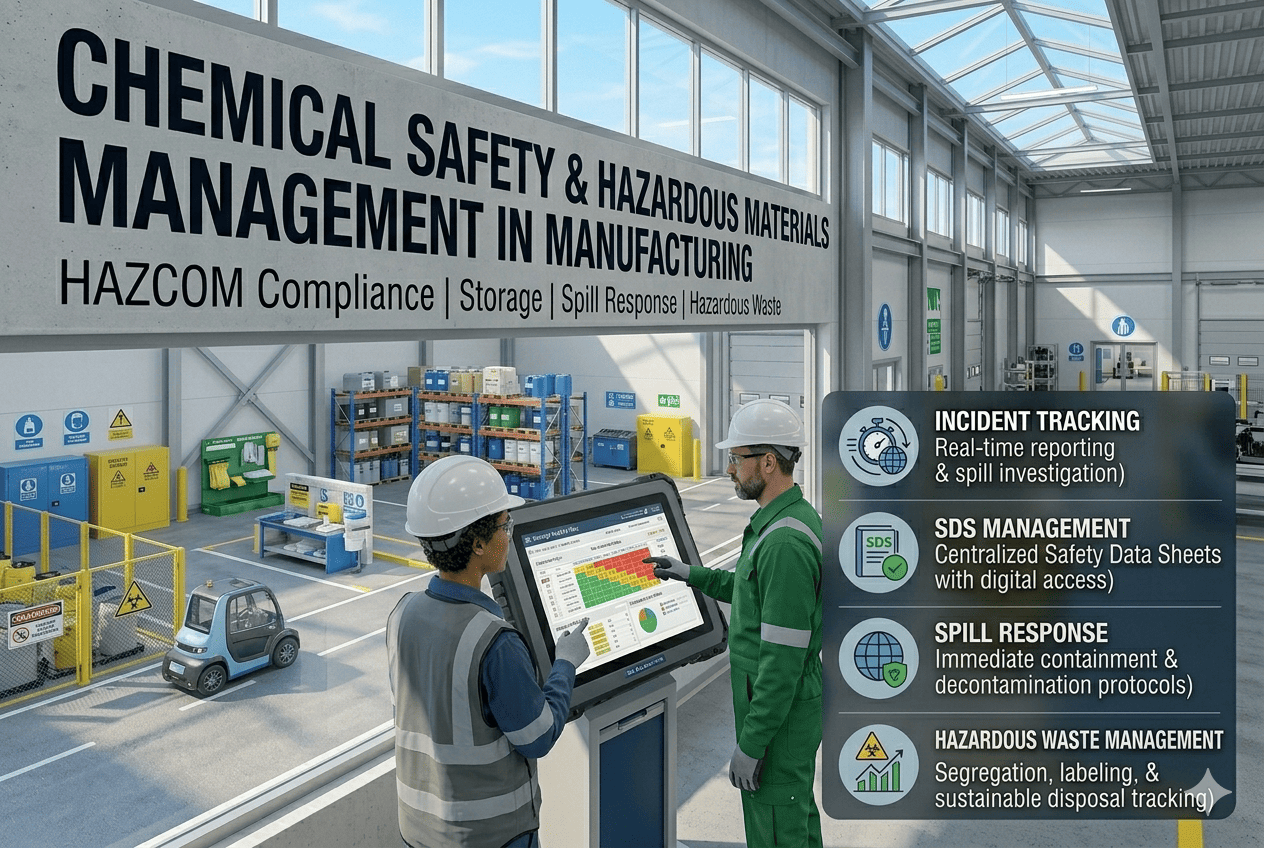
- Hazard Communication & Safety Data Sheets (29 CFR 1910.1200)
- Equipment Inspection & Maintenance Records
- Worker Safety Training Completion & Currency
- Incident Reporting & Near-Miss Documentation (OSHA 301)
Automation & Monitoring Features
- Real-Time Equipment Status & Hazard Alerts
- Automated Inspection Due Dates & Escalations
- LOTO Certification Tracking & Renewal Workflows
- Non-Conformance & Corrective Action Management
- Audit-Ready Compliance Package Generation
- Multi-Shift Safety Incident Dashboard
- Immutable Compliance Audit Trail with Timestamps
- Worker Competency & Safety Training Verification
Manual vs. Integrated Safety Management: Compliance Performance Comparison
The operational difference between manual compliance checklists and an integrated safety management system is categorical. The table below compares critical OSHA compliance functions across both approaches, illustrating the risk profile and audit readiness of each method for a mid-size manufacturing facility.
| Compliance Function | Manual / Spreadsheet | Integrated Safety Platform | Inspection Risk Reduction | Compliance Impact |
|---|---|---|---|---|
| Equipment Inspection Tracking | Monthly manual review sheets | Real-time automated alerts with PLC integration | Elimination of missed inspections | Critical |
| LOTO Certification Status | HR spreadsheet, no expiry tracking | Individual certification profiles with cascade alerts | Removes expired authorization risk | Critical |
| Hazard Identification & Documentation | Reactive incident response only | Proactive hazard scans and near-miss logging | 60% fewer OSHA findings | Critical |
| Audit Documentation Readiness | Days of manual file assembly | Auto-generated compliance packages in minutes | 70% time reduction | Critical |
| Worker Training Record Integrity | Editable records, no audit trail | Immutable timestamped training logs | Regulator-grade traceability | High |
| Multi-Shift Safety Visibility | Per-shift silos, no facility-wide view | Unified cross-shift hazard dashboard | Fleet-wide incident prevention | High |
Six Critical OSHA Standards Impacting Manufacturing Safety Compliance
Understanding the specific OSHA standards that apply to your manufacturing environment is the first step toward building a compliance-focused safety strategy. The standards below represent the regulatory foundation for most general industry manufacturing facilities. Each standard carries distinct equipment, documentation, and training requirements that must be reflected in your safety program and compliance workflows.
Requires written LOTO procedures, authorized employee training and certification, and documented lock/tag practices for all equipment maintenance. Violations typically result in $10,000+ penalties per occurrence.
Mandates protective guards on all rotating equipment, reciprocating parts, and pinch points. Applies to drill presses, saws, conveyors, and stamping machines. Inspection records must be current and available.
Covers electrical equipment installation, grounding, circuit protection, and worker training. Requires documented electrical maintenance and annual inspection of power distribution systems.
Requires written respiratory protection programs, fit testing documentation, and ongoing training. Applies to facilities using dust collection, spray finishing, or chemical exposure processes.
Mandates chemical safety data sheets (SDS), proper labeling, and employee training on hazardous material handling. Maintenance staff must have immediate access to SDS for all chemicals on-site.
Requires regular inspection of all walkways, platforms, and emergency egress routes. Safety staff must track repair completions and ensure hazards are remediated within compliance timeframes.
Five-Step Framework: Building an OSHA-Compliant Safety Program
Transitioning from fragmented safety record-keeping to an integrated safety compliance and maintenance system requires a structured deployment approach. The following implementation sequence ensures minimal disruption while establishing a fully compliant, auditable safety infrastructure. Organizations ready to begin can book a demo to receive a tailored compliance assessment for their facility's current safety posture.
Current State Safety Audit & Gap Analysis
Conduct a comprehensive audit of existing safety records, inspection documentation, LOTO certifications, and worker training completions. Identify compliance gaps—missing inspection records, expired certifications, undocumented equipment hazards—before system migration begins. Document the baseline risk profile.
OSHA Standards Configuration & Risk Mapping
Configure the platform to reflect your facility's specific OSHA regulatory environment—include all applicable standards (1910.147, 1910.212, 1910.303–307, etc.), equipment guarding requirements, electrical maintenance cycles, and LOTO authorization limits tailored to your process.
Equipment Hazard Profiling & Inspection Scheduling
Map every piece of equipment in your facility to its applicable OSHA standards and create individual equipment hazard profiles. Establish inspection frequencies, guarding verification checklists, and maintenance-to-safety workflows. AI gap analysis flags equipment with expired or missing inspection records immediately.
Worker Certification & Training Workflow Activation
Enroll all workers in the platform's safety training and certification tracking system. Set renewal cascade parameters—90, 60, and 30-day alert thresholds for LOTO, electrical safety, and hazmat certifications. Link training completions directly to equipment authorization profiles.
OSHA Inspection Readiness Validation
Run a simulated OSHA inspection using the platform's auto-generated compliance package. Verify that every piece of equipment has current inspection records, every certified worker has verified credentials, and every hazard has documented mitigation actions—then activate live operations with full audit confidence. Book a demo to see the inspection simulation process.
Top Six OSHA Violation Patterns & Prevention Strategies
OSHA inspection findings follow predictable patterns. Understanding the most common violation categories is essential for safety directors building a proactive compliance strategy. The citations below represent the regulatory findings that lead to operational shutdown, worker injuries, and enforcement action. For a detailed assessment of how your facility compares against these violation patterns, you can book a demo to review a compliance risk assessment with our safety engineers.
Equipment guarding inspections are not documented or current. Missing guards on rotating shafts, insufficient barrier height, or damaged protective devices remain unaddressed—creating direct worker injury risk and willful violation citations.
Workers perform maintenance without verified lockout/tagout authorization, documented procedures are absent or outdated, or certification records cannot be produced during inspection. Single serious violation penalties: $10,000+.
Electrical equipment lacks proper grounding documentation, circuit protection is inadequate, or maintenance records for power distribution systems are missing. Inspection and repair records must be current and accessible.
Worker safety training records are incomplete, certifications have expired, or training documentation cannot be correlated to job assignments. Lack of training evidence is treated as non-compliance by OSHA inspectors.
Chemical safety data sheets (SDS) are not accessible in work areas, hazmat labels are missing or incomplete, or worker training on hazardous material handling is not documented. Applies to all chemicals on-site including maintenance solvents.
OSHA 301 incident forms are not completed, injury records are not maintained or accessible, or near-miss reporting is not encouraged. This is among the most frequently cited violations across all industries.
Expert Review: OSHA Compliance as a Maintenance Strategy
"OSHA compliance is not a regulatory obligation—it is a maintenance obligation. When your maintenance program fails to track equipment inspections, verify worker certifications, and document hazard mitigation, you are not managing risk; you are managing invisible liability. Manufacturing directors who have integrated safety compliance into their maintenance workflow report three measurable outcomes: first, audit findings drop 60% within the first year; second, worker confidence in safety protocols increases dramatically; and third, unplanned downtime due to safety-related production stops virtually disappears. The transformation is not incremental—it is categorical. Safety becomes your competitive advantage."
Transform Your Manufacturing Plant Into an OSHA Compliance Leader
Automate equipment inspection tracking, worker certification management, and compliance documentation to achieve OSHA excellence and protect your workforce through continuous monitoring and real-time alerts.
Frequently Asked Questions: OSHA Compliance in Manufacturing
What is the difference between machine guarding inspection and maintenance?
Machine guarding inspection is a verification activity—you visually confirm that guards are in place, undamaged, and functional. Maintenance is the repair or replacement activity that follows if guarding is found to be deficient. Both must be documented and tracked. OSHA citations typically cite inadequate documentation of either activity, not the discovery itself. An integrated system tracks both in a single workflow and produces documentation automatically.
How often must LOTO certifications be renewed?
OSHA does not mandate a specific renewal interval for LOTO certification, but 29 CFR 1910.147 requires that authorized employees understand the purpose and function of the energy control program. Best practice calls for refresher training every 3 years, and many facilities implement annual recertification. Your facility's authorized lockout procedures document should specify your renewal cycle. An integrated compliance platform automates tracking and alerts.
Can OSHA inspect my facility without advance notice?
Yes. OSHA has authority to conduct unannounced inspections under 29 USC §657. Inspectors can walk through your facility and immediately request safety-related documentation—equipment inspection records, worker training files, hazard assessments. Your ability to produce complete, current, timestamped records in real-time is a critical competitive advantage during these inspections. An automated compliance system ensures documentation is always ready. You can book a demo to see how quickly audit packages are generated.
What documentation must I keep for electrical equipment maintenance?
29 CFR 1910.303–307 requires documentation of electrical equipment inspections, testing results, and any repairs performed. For switchgear, transformers, and main distribution systems, annual inspections are industry standard. Records must include the date of inspection, equipment tested, results, and corrective actions taken. Documentation must be retained and made available to OSHA inspectors upon request. Integrated systems timestamp all electrical maintenance activities and correlate them to equipment asset records.
How do I prepare my facility for an unannounced OSHA inspection?
Continuous compliance is the only effective preparation. Maintain current equipment inspection records, verify worker certifications, ensure machine guarding is in place and documented, and keep all safety training files complete with signatures and dates. When an inspector arrives, immediately request a walk-around with your plant safety manager and site supervisor—this gives you the opportunity to provide context and documentation in real-time. An automated system produces ready-to-present compliance dossiers for any equipment or process within seconds. You can book a demo to see a sample inspection-readiness package in action.
OSHA Compliance as Your Competitive Advantage
Manufacturing facilities that view OSHA compliance as a regulatory checkbox never outperform those that embed safety into the operational core of their maintenance programs. The transformation begins with a simple decision: move from reactive, manual compliance tracking to proactive, automated safety management integrated with every maintenance activity. When your equipment inspection schedule, worker certification tracking, hazard identification, and audit documentation flow through a single system that timestamps every action and produces immutable records, you eliminate the administrative friction that allows safety lapses to accumulate.
The competitive advantage compounds: your audit preparation time collapses from days to minutes; your OSHA findings drop by 60% within the first year; your worker confidence in safety protocols increases visibly; and your unplanned production stops due to safety-related shutdowns virtually disappear. The regulatory requirement becomes a business differentiator. Facilities that have made this transition report not just compliance success, but operational resilience that translates directly to uptime, talent retention, and customer confidence.
The pathway is clear, proven, and ready to deploy. If you are ready to move beyond manual compliance spreadsheets and into a fully integrated safety management program, book a demo with our safety compliance engineers today. Review live dashboards from active manufacturing deployments and see how integrated safety management transforms OSHA compliance from a burden into a business asset that protects your workforce and strengthens your operational foundation.