.png)
Three months ago, the night shift supervisor at a Gulf Coast specialty chemical plant watched the same batch of polymer intermediate drift out of spec for the third consecutive run — viscosity climbing while the control chart showed nothing but green. The lab result came back 12 hours later, too late to save the 45,000-gallon vessel. That single off-spec batch cost $187,000 in rework and lost production time. Today, that same plant runs every batch through an AI-native SPC system that catches the drift in real time, correlates it to a 0.4°C temperature deviation in reactor three, and adjusts the feed rate autonomously — before the first alarm would have fired on the old system. The shift supervisor now spends her time on process improvements, not firefighting. This is what happens when you move from legacy MES to AI-native SPC for chemical processing batch quality control.
From Lab Results to Live Control: AI-Native SPC That Eliminates Off-Spec Batches
Replace reactive batch quality control with adaptive SPC models that detect drift in real time, pinpoint root causes autonomously, and lift first-pass yield above 98% — without cloud dependency or data egress.
What AI-Native SPC Means for Your Batch Quality
These are the results from chemical plants that replaced their legacy MES-driven quality systems with iFactory's adaptive SPC models — measured within one quarter of deployment.
Adaptive SPC Models That Learn Your Process
iFactory's AI-native SPC platform doesn't just monitor control limits — it builds dynamic models of every batch, every reactor, every recipe variant, and adapts as your process evolves.
Adaptive Control Limits
Traditional SPC uses fixed limits that become obsolete as catalysts age, feedstocks change, or ambient conditions shift. iFactory's models recalculate limits every batch, incorporating process drift before it becomes an excursion. One plant reduced false alarms by 83% while catching every true deviation.
Real-Time Batch Inference
Stop waiting for lab results. iFactory correlates inline process data — temperature, pressure, viscosity, pH, flow — to final quality attributes with 94% accuracy. You know a batch is good or bad the moment the reaction completes, not 12 hours later when the lab calls.
Autonomous Root-Cause Analytics
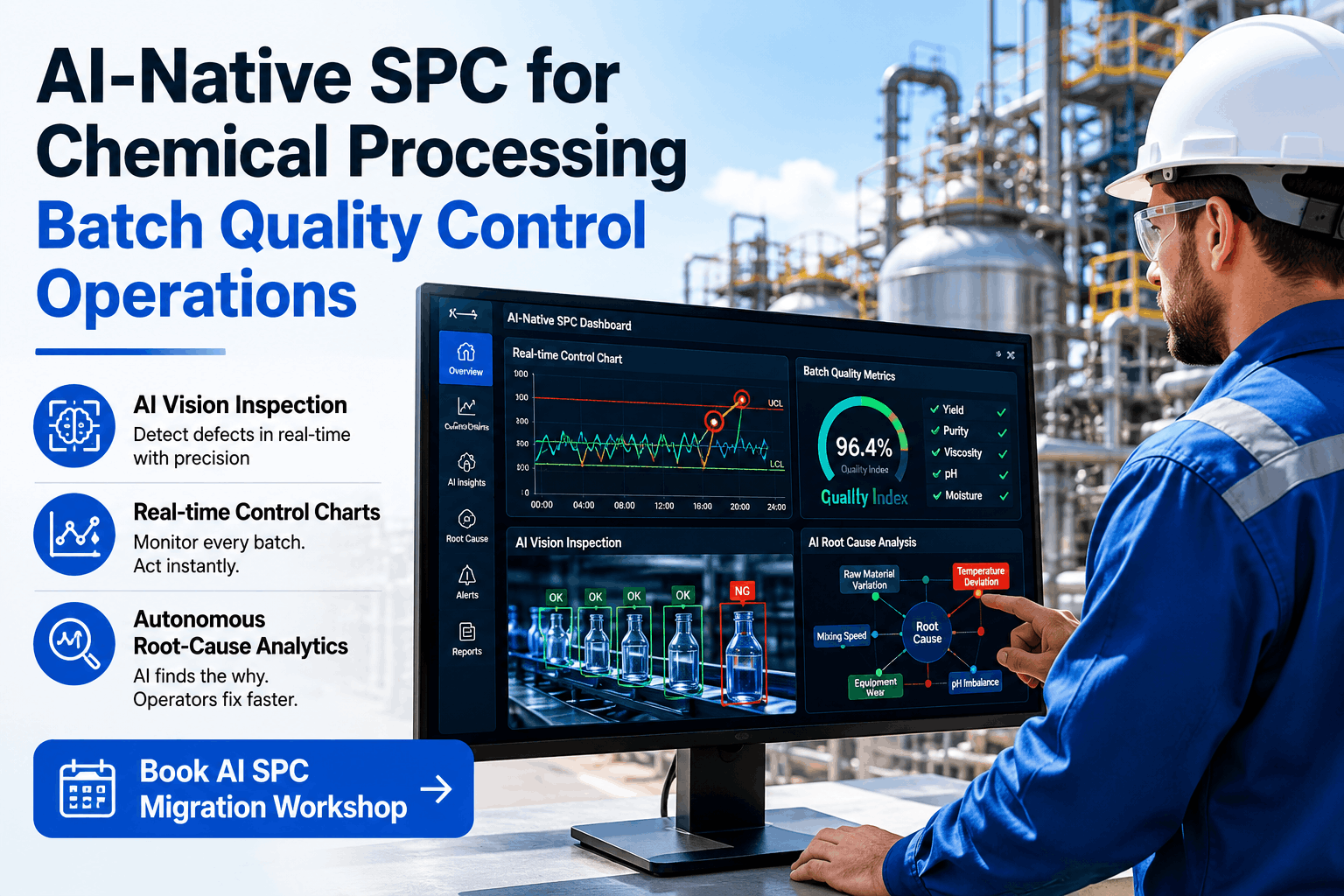
When a batch starts drifting, iFactory doesn't just flag the control chart. It traces the deviation back to the specific sensor, valve position, or feed-rate change that caused it — and surfaces the correlation in plain language. No more engineers spending hours sifting through historian data.
Multi-Variate SPC Fusion
Single-variable control charts miss interactions that cause 60% of off-spec events. iFactory fuses 12–20 process variables into a single composite quality score for each batch, giving operators a single number that tells them — with statistical confidence — whether the batch is on track.
Recipe-Aware Model Switching
Running five different polymer grades on the same reactor train? iFactory automatically detects which recipe is active and loads the correct SPC model — including recipe-specific limits, variable weights, and quality targets. No manual model switching, no configuration errors.
Legacy MES to AI-Native SPC Migration
iFactory sits directly on your plant data sources — no dependency on SAP MII, ME, or PCo. We ingest historian data, DCS streams, and LIMS results in parallel, building your adaptive SPC models in 6–12 weeks. The legacy MES can be decommissioned on your timeline, not ours.
The Cost of Waiting for Lab Results
Every hour between a process drift and its detection costs your plant real money. Here's what the old approach — fixed SPC limits, batch-level lab sampling, manual root-cause analysis — is costing you right now.
The 12-Hour Blind Spot
Your lab runs QC on every batch, but the result arrives 8–12 hours after the reaction ends. In that window, your downstream equipment is already processing the material — or worse, you've committed the batch to a customer tank. A single off-spec batch at a 50,000-gallon reactor costs $150,000–$250,000 in rework, blending, or disposal.
Static Control Charts That Miss the Drift
Your current SPC system uses control limits calculated six months ago — before the feedstock supplier changed, before the catalyst activity shifted, before summer ambient temperatures started affecting cooling tower performance. Those fixed limits generate 40–60 false alarms per shift, so operators learn to ignore them. Real drifts slip through.
The Root-Cause Rabbit Hole
When a batch goes out of spec, your process engineer spends 4–6 hours pulling historian data, cross-referencing shift logs, and running manual correlations. By the time they find the cause — a sticking valve on reactor 7's cooling jacket — three more batches have been affected. That's $500,000+ in cumulative losses per incident.
Stop chasing off-spec batches after the fact. Book a 30-min walkthrough and see iFactory catch a drift in live data — before it becomes a $200,000 problem.
From Legacy MES to AI-Native SPC in Four Steps
iFactory deploys on your plant network with no cloud dependency. Here's how we get from data-source access to adaptive batch quality control in 6–12 weeks.
Connect to Your Plant Data Sources
iFactory ingests DCS historian data, LIMS results, recipe definitions, and batch records — all on-premise via an NVIDIA appliance. No data leaves your network.
Train Adaptive SPC Models on Your Batch History
We feed 6–24 months of historical batch data into our AI engine, which learns the normal operating envelope for every reactor, grade, and recipe variant — including your acceptable quality ranges.
Deploy Real-Time Inference and Control
iFactory runs live, fusing inline process data into real-time quality predictions. Operators see control charts that adapt to every batch, with autonomous root-cause alerts when drift is detected.
Decommission Legacy MES on Your Timeline
Once iFactory is proven — typically within one quarter — you can retire your SAP MII, ME, or PCo systems. iFactory absorbs the operational role with no data migration, no cloud, no disruption.
Everything You Need to Eliminate Off-Spec Batches
iFactory delivers a complete, turnkey solution for AI-native SPC — from the hardware to the models to the ongoing support.
End-to-End Deployment, 6–12 Weeks
We bring the NVIDIA appliance, install it on your plant floor, connect to your data sources, and deliver a working pilot within a single quarter. No cloud, no data egress, no IT project.
On-Premise, Zero Cloud Dependency
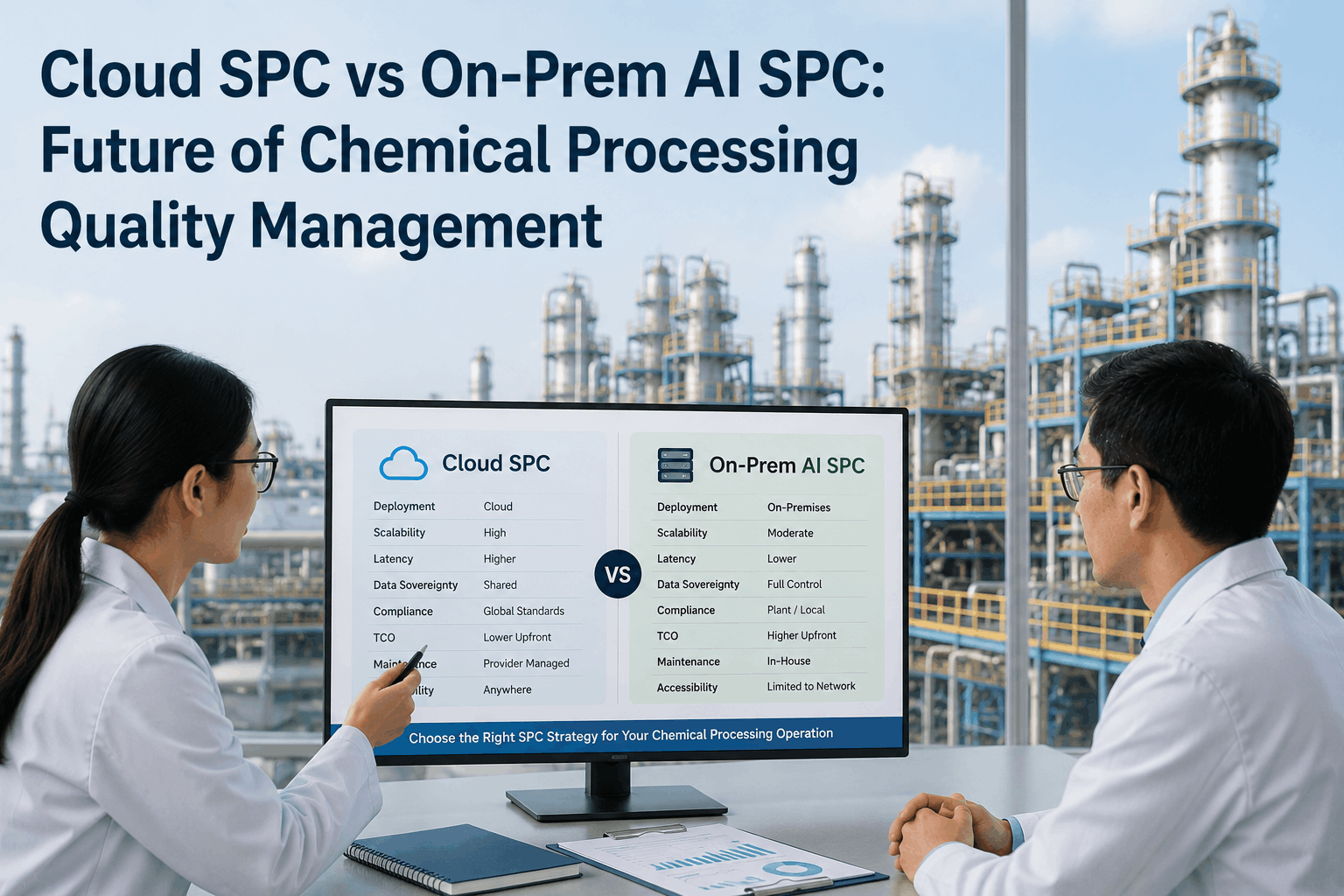
iFactory runs entirely on your plant network. Your batch quality data stays inside your firewall. No internet connection required for real-time operation.
24×7 Managed Service
Our operations team monitors your iFactory instance around the clock, updating models as your process evolves, tuning alerts, and ensuring uptime. You get the capability without the headcount.
Pilot-to-ROI in One Quarter
We measure first-pass yield, off-spec reduction, and root-cause speed within 90 days of go-live. If the metrics aren't there, we fix the models — no long-term commitment required.
Questions About AI-Native SPC for Chemical Processing
Stop Reacting to Lab Results. Start Controlling Batch Quality in Real Time.
Your next off-spec batch is preventable. iFactory's AI-native SPC deploys on your plant network in 6–12 weeks and delivers measurable results within the first quarter. Book a demo and we'll show you live — on your data, on your timeline.

.png)