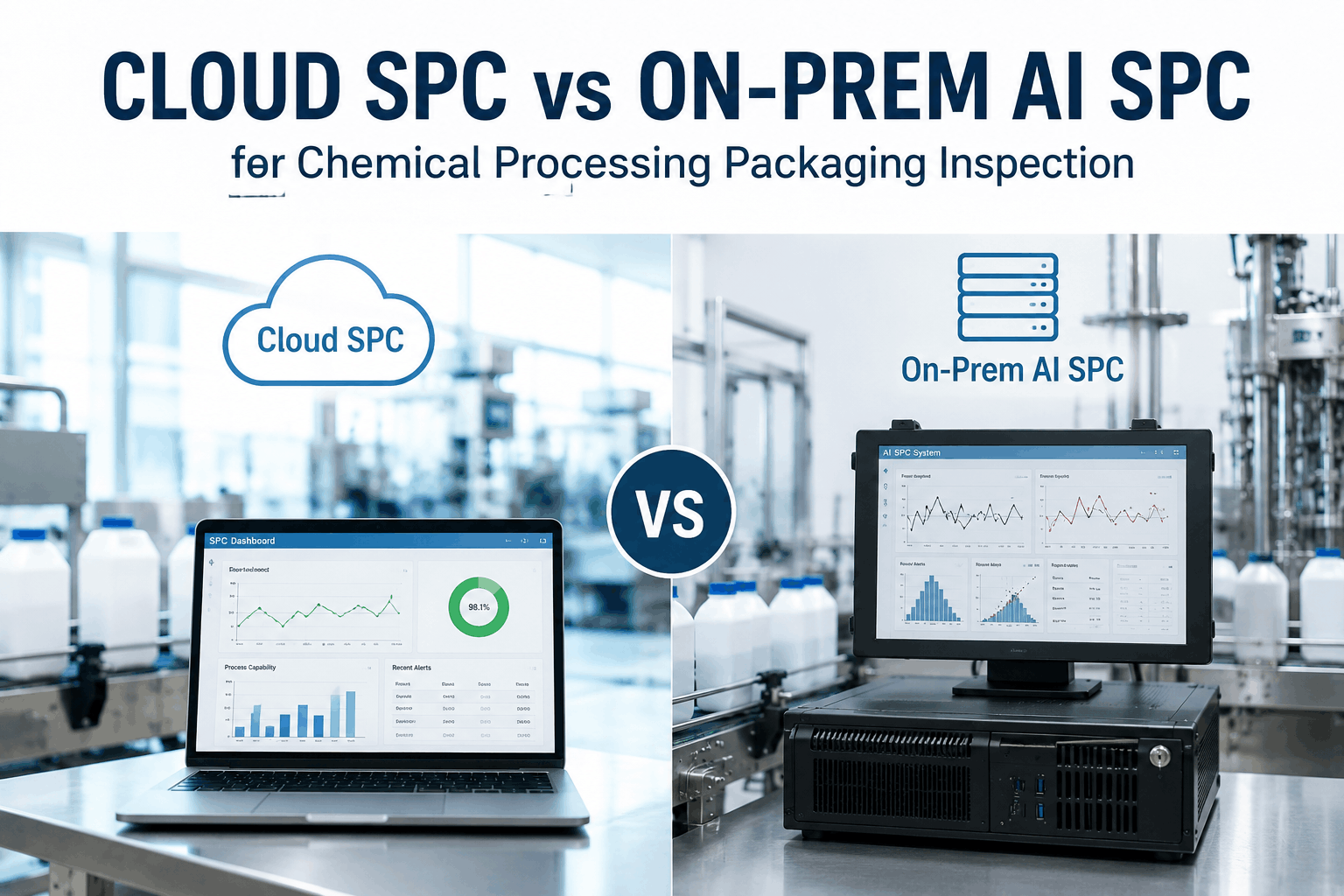
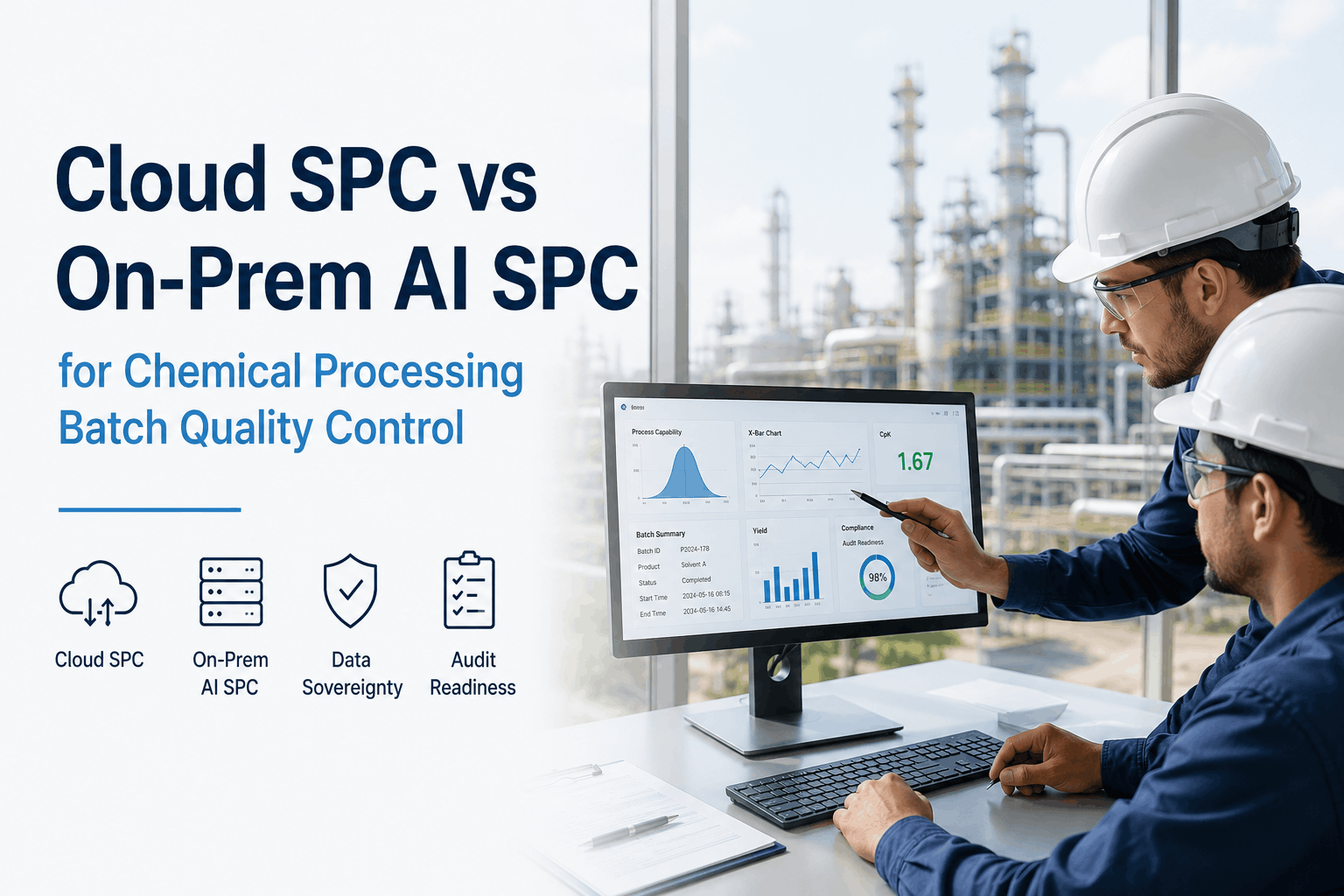
For chemical processing plants modernizing their SAP xMII SPC layer toward predictive OEE, the deployment decision is now the single biggest architectural choice they will make in the next decade. Cloud SPC promises rapid multi-site rollout and zero infrastructure overhead. On-prem AI SPC delivers sub-5ms edge latency, full data sovereignty, and protection from the $8.7 million average cost of a manufacturing data breach. The right answer is not universal — it depends on your data residency rules, latency requirements, IT capability, and 5-year TCO position. This guide gives chemical plant operators a decision framework to choose between cloud, on-prem, and hybrid AI SPC architectures — without marketing fog. iFactory delivers all three deployment modes with identical predictive OEE capability. Book an AI SPC Migration Workshop to map your deployment to your plant's specific constraints.
<5ms
Edge AI latency — defect detected before product moves 1mm
$8.7M
Average manufacturing data breach cost — a hidden cloud TCO line
80%
New OEE deployments going cloud or hybrid — pure on-prem is rare
3-Mode
iFactory delivers on-premise, cloud, and hybrid — same capability
The 6-Dimension Comparison: Cloud vs On-Prem AI SPC
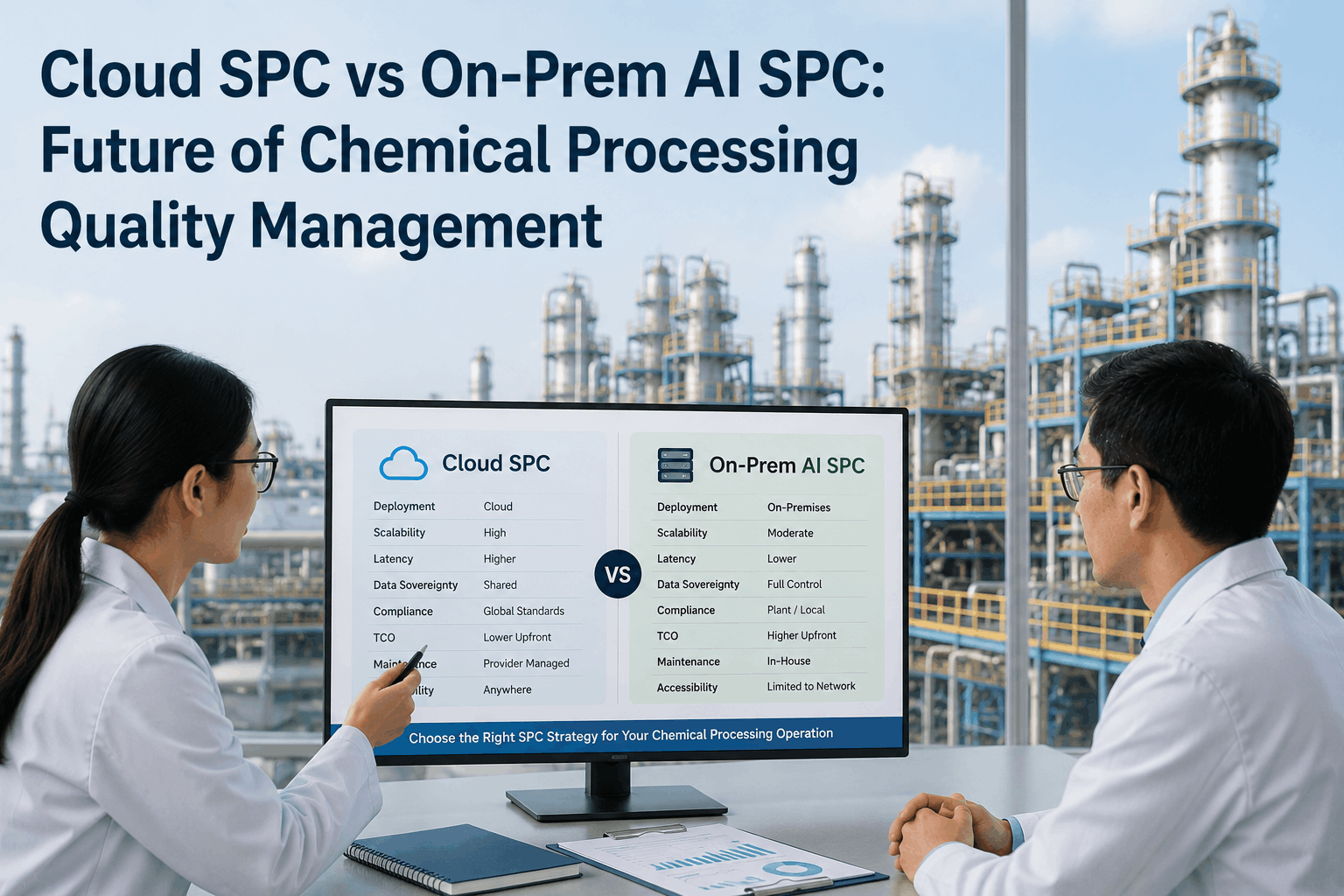
Choosing between cloud and on-prem AI SPC for predictive OEE is not a single decision — it is six decisions across six dimensions, each with different weight depending on your plant's constraints. Below is the honest comparison, with the dimension winner called out explicitly. For broader migration context, see our cloud vs on-prem AI manufacturing TCO comparison.
D1
Latency
Time from sensor signal to AI decision
50–500 ms
Round-trip to cloud region adds network latency. Acceptable for batch SPC, marginal for line-speed packaging inspection.
<5 ms
Edge inference at the machine — defect detected before product moves 1mm. Critical for high-speed packaging.
WINNER
D2
Data Sovereignty
Where batch and process IP lives
Cloud region
SOC 2 / ISO 27001, but subject to US CLOUD Act and multi-tenant security risks. Regional residency available but requires careful contract review.
Plant-local
All data behind your firewall. IEC 62443 aligned. Air-gapped capable. GDPR / PDPA / regional data laws automatically satisfied.
WINNER
D3
Multi-Site Scalability
Time to onboard additional plants
Days per site
Centralized OEE dashboards across fleet. New plants onboarded with cloud connector in days, not months. Fleet-wide benchmarking built in.
WINNER
1–2 weeks per site
Edge appliance per plant requires per-site deployment. Cross-plant analytics requires additional aggregation layer.
D4
Process Stability
SPC availability during network events
Internet-dependent
WAN outage = no AI inference. Local buffering helps but production-critical decisions still require connectivity. SLA limits matter.
100% offline-capable
Edge GPU runs all AI agents regardless of network state. SPC decisions never wait for the cloud. Critical for continuous chemical processes.
WINNER
D5
Model Updates
How AI improvements get deployed
Continuous
New AI model versions deployed automatically. Latest accuracy improvements available immediately across plant fleet.
WINNER
Scheduled
Updates routed through your change-control process. More controlled, but slower to adopt latest improvements.
D6
5-Year TCO
Total cost of ownership over half-decade
OpEx, variable
Lower upfront. Subscription + data egress + scale-up costs. 60%+ of firms report higher-than-expected cloud bills.
CapEx + OpEx
Edge appliance investment upfront. Predictable run costs. Hidden risk avoidance value: $8.7M average breach cost mitigated.
CLOUD WINS
Multi-site scalability, continuous model updates, OpEx-preferred budgets, fastest onboarding
ON-PREM WINS
Latency-critical decisions, data sovereignty, offline capability, regulated/hazardous sites
Cloud vs On-Prem Is a False Binary. The Real Answer Is Usually Hybrid.
80% of new OEE deployments now use cloud or hybrid architectures. iFactory's hybrid edge+cloud architecture delivers the latency and sovereignty of on-prem with the scalability and intelligence of cloud — best of both, no compromises.
Decision Tree: Which Mode Fits Your Plant?
The fastest way to scope your deployment is to answer four sequential questions about your plant. The decision tree below routes chemical processing plants to the right deployment mode in under 60 seconds — based on the actual operational and regulatory constraints that matter most. Read deeper context in our SAP MII migration complete guide.
Q1
Do your data residency rules require batch and process data to stay within your country or facility?
YES → Continue to Q2
NO → Skip to Q3
Q2
Does your plant require air-gapped operation (zero internet connectivity for AI inference)?
YES → ON-PREMISE (air-gapped edge deployment)
NO → HYBRID (edge inference + cloud-side learning)
Q3
Do you have packaging or in-line vision inspection requiring sub-10ms latency?
YES → HYBRID (edge inference, cloud orchestration)
NO → Continue to Q4
Q4
Do you operate multiple plants needing centralized OEE benchmarking and rapid onboarding?
YES → CLOUD (multi-site dashboards, fastest scale)
NO → CLOUD or ON-PREMISE (either works; choose by IT preference)
ON-PREMISE
~20%
of chemical plants — typically regulated EU/APAC, hazardous chemical, or pharma-adjacent sites
CLOUD
~35%
of chemical plants — typically multi-site groups, fast-scaling specialty producers, OPEX budgets
HYBRID
~45%
of chemical plants — now the dominant pattern for chemical processing with multi-site footprint
The Hybrid Edge+Cloud Architecture (Most Common Choice)
For most chemical processing plants, hybrid is not a compromise — it is the optimal architecture. Edge inference handles latency-critical decisions at the line; cloud handles cross-plant learning, fleet benchmarking, and model improvement. Process IP stays plant-local; only anonymized aggregates flow to the cloud. iFactory's hybrid architecture is built for exactly this pattern.
CLOUD LAYER
Centralized Intelligence & Fleet Analytics
Multi-Site OEE Dashboards
Fleet-Wide Model Training
Cross-Plant Benchmarking
Continuous Model Updates
↑
Anonymized aggregates only
(no raw process IP)
↓
Model improvements
deployed to edge
EDGE LAYER
Real-Time Plant Decisions
AI Vision Inspection (<50ms)
Multivariate SPC Engine
Predictive OEE Forecasting
Autonomous Root-Cause
Sub-5ms
Edge latency for line-speed decisions
100%
Offline capability during WAN outages
Fleet-wide
Cloud benchmarking across all plants
Plant-local
Raw data sovereignty preserved
5-Year TCO Reality Check — What CFOs Actually Need to Know
Cloud SPC's sticker price looks lower in Year 1. By Year 3, the picture changes. By Year 5, the comparison gets serious — particularly when you include the hidden TCO lines most cloud sales decks omit. Read the full TCO methodology in our 5-year TCO breakdown.
Per-plant subscription
Per-user licenses
Compute and storage tiers
Support and SLA upgrades
Data egress fees — every byte leaving cloud costs money
Bandwidth scaling — vibration sensors produce GBs/day
Breach risk — $8.7M average manufacturing data breach
Bill volatility — 60%+ of firms see unexpected charges
CapEx appliance — predictable 5-7 year amortization
No egress — all data stays plant-local
No breach exposure from CLOUD Act jurisdiction
Run-rate predictability — no surprise scaling charges
5-YEAR TCO VERDICT
Cloud SPC wins on Years 1–2 cost predictability. On-prem typically wins by Year 4 when usage scales. Hybrid wins on both axes — edge infrastructure cost amortizes against cloud egress savings, while keeping latency and sovereignty benefits.
Same iFactory AI. Same Predictive OEE. Three Deployment Modes.
Whatever your IT policy, data residency rules, and multi-site strategy demand — iFactory delivers identical AI-native SPC capability across cloud, on-premise, and hybrid. The migration workshop maps your specific constraints to the right architecture.
AI Manufacturing Copilots — The Layer That Sits Above Both
Regardless of which deployment mode you choose, iFactory's AI manufacturing copilots provide the same operator-facing experience. Supervisors and plant operators interact with natural-language AI assistants that read SPC charts, predict OEE drift, and recommend corrective actions — without needing to know whether the inference happened at the edge or in the cloud. Read more about iFactory's OEE measurement methodology.
C1
Supervisor Copilot
"Why did OEE drop on Reactor 4 last shift?" — Copilot traces root cause through SPC signals and returns a ranked answer with corrective action in under 10 seconds.
C2
Operator Copilot
"Should I adjust the setpoint on this batch?" — Copilot evaluates the current batch trajectory and gives a Safe / Warning / Critical recommendation with confidence score.
C3
Quality Copilot
"What's driving our Cpk drift this week?" — Copilot performs multivariate analysis across all inspection signals and identifies the top 3 contributing factors automatically.
C4
Compliance Copilot
"Generate the FDA Part 11 report for last week's batches" — Copilot produces audit-ready documentation with full ALCOA+ provenance in one click.
Outcomes from Each Deployment Mode
The data point that matters most: predictive OEE outcomes are identical across all three deployment modes. Below are real chemical processing plants — one for each mode — showing that the deployment choice affects infrastructure, not results.
An 8-reactor specialty chemical plant in Germany had a corporate IT mandate against any cloud deployment. iFactory's edge-GPU appliance was operational in 14 days, fully air-gapped, with all 6 AI agents running plant-local. Predictive OEE delivered identical results to the cloud benchmark — 21.4 OEE points gained in six months, $4.2M annual recovered value, full GDPR and ISA-99 compliance.
$4.2M
Annual value recovered
A 6-plant coating resin manufacturer needed centralized OEE benchmarking across the fleet. iFactory cloud deployment rolled out across all 6 plants in 9 weeks. The shared dashboard identified the worst-performing plant within 48 hours and delivered fleet-wide OEE lift from 64% to 79%. Predictive maintenance eliminated 73% of unplanned downtime events. Same predictive engine, cloud-delivered.
9 wks
6-plant rollout time
73%
Unplanned downtime cut
A biotech chemical facility in Japan needed sub-second AI decisions at the line (edge requirement) plus cross-plant model learning (cloud requirement). iFactory's hybrid architecture delivered both: edge inference for real-time fermentation control, cloud-side training across the company's fleet. First-pass yield moved from 68% to 87% in six months, with raw process IP staying plant-local while anonymized aggregates trained the global model.
+19
Yield points (68 → 87%)
48 hrs
Time to identify all loss patterns
What Plant Operators Say About Each Mode
Our IT mandate was on-premise only — no cloud egress for batch data. iFactory's edge appliance was operational in 14 days, fully air-gapped. Same AI capability we would have gotten in the cloud, but inside our firewall where our compliance team needed it.
Plant IT Director
Specialty Chemical Plant, Germany — On-Premise
Centralized OEE across 6 plants in 9 weeks. Before iFactory cloud, we couldn't even see how our plants compared to each other. Now we benchmark them every shift and apply best practices across the fleet.
VP of Manufacturing Excellence
Coating Resin Group, USA — Cloud
We needed both — real-time edge decisions at the fermentation line and cross-plant learning across our biotech network. Hybrid architecture made both possible without compromise. Process IP stays local; the global model still improves continuously.
Head of Process Optimization
Biotech Manufacturing, Japan — Hybrid
The decision tree iFactory provided saved us months of internal debate. Four questions, clear answer, deployment scoped in a single workshop. We chose hybrid and have not looked back.
Director of Operations Technology
Multi-Site Chemical Group, Singapore
FAQ: Cloud vs On-Prem AI SPC Deployment
Common questions from plant operators, IT leaders, and CFOs scoping cloud vs on-prem AI SPC for chemical processing predictive OEE. Question not covered here? Reach our solutions team directly.
Is iFactory available in all three deployment modes — on-premise, cloud, and hybrid?
Yes. iFactory delivers identical AI-native SPC and predictive OEE capability across all three modes. On-premise runs the full 6-agent stack on edge GPU appliance, fully air-gapped. Cloud delivers managed multi-site dashboards with SOC 2 Type II and ISO 27001 certification. Hybrid runs edge inference at the line plus cloud-side model training and fleet analytics. The same AI models, same SAP integration depth, same compliance reporting — only infrastructure differs.
What's the actual latency difference between cloud and on-prem AI SPC?
For typical chemical batch SPC, cloud latency is 50–500ms depending on cloud region and network path — acceptable for batch decisions. For high-speed packaging inspection at 1,200+ units/minute, on-prem edge inference delivers sub-5ms latency — defect detected before the product moves 1mm. If your use case mixes both (most chemical plants do), hybrid is the answer: edge for line-speed, cloud for everything else.
Will switching to cloud expose us to the US CLOUD Act?
Potentially, depending on cloud provider and region. The US CLOUD Act allows US authorities to request data held by US-headquartered cloud providers regardless of where the data is physically stored. For chemical plants with sensitive process IP, recipe data, or pharma-adjacent batch records, this is a real consideration. iFactory's on-premise deployment eliminates this exposure entirely — all data stays behind your firewall. Hybrid mode addresses it by keeping raw data plant-local and only sending anonymized aggregates to cloud.
What happens to AI SPC during a network outage?
With on-premise or hybrid deployment: nothing changes. Edge GPU runs all AI agents independently of network state. SPC decisions, reject logic, and predictive forecasting continue without interruption. With cloud-only deployment: depends on the platform's local buffering capability. iFactory cloud includes 24-hour edge buffering that queues inference requests when cloud is unreachable and reconciles results when connectivity returns. For continuous chemical processes that cannot tolerate any SPC downtime, hybrid or on-prem is the safer choice.
What are the hidden costs of cloud SPC that should be in our TCO model?
Five lines that often get missed: (1) Data egress fees — every byte leaving cloud incurs cost, and chemical plant sensor data scales fast; (2) Bandwidth scaling charges as you add plants or sensors; (3) Breach risk — the average manufacturing data breach now costs $8.7M; (4) Bill volatility — 60%+ of firms report unexpectedly high cloud bills as usage scales; (5) Multi-region replication costs if data residency requires regional copies. iFactory's TCO worksheet includes all five lines for accurate comparison.
Can we start with cloud and migrate to on-prem later if needed?
Yes. iFactory's three deployment modes share the same AI models, data schemas, and API layer — migration between modes is supported. Typical path: start cloud for fastest deployment, migrate to hybrid once edge requirements emerge, or migrate to full on-prem if data residency rules change. Migration between modes takes 2–4 weeks per plant and does not require model retraining. This optionality is part of why hybrid is the most common starting choice — it preserves flexibility.
How does deployment mode affect compliance with FDA Part 11, EU GMP, REACH?
All three modes support the same compliance frameworks: FDA 21 CFR Part 11, EU GMP Annex 11, ICH Q7, REACH, OSHA PSM. Auto-generated batch reports with full ALCOA+ data integrity provenance work identically in cloud, on-prem, and hybrid. The choice between modes is rarely a compliance decision — it's usually a data residency or latency decision. EU plants under GDPR sometimes prefer on-prem or hybrid for batch data; pharma-adjacent plants typically choose on-prem for the strongest audit posture.
Which deployment mode is most common for chemical processing in 2026?
Across iFactory's deployed chemical processing customer base: hybrid is the most common (45%), followed by cloud (35%) and on-premise (20%). The hybrid majority reflects how chemical plants typically need both edge latency for line-speed quality decisions and cloud orchestration for fleet visibility. Pure on-prem remains dominant in regulated EU/APAC sites, hazardous chemical operations, and defense-adjacent manufacturing. Pure cloud dominates in fast-growing specialty chemical groups and OPEX-preferred organizations.
Same iFactory AI. Three Deployment Modes. Your Plant's Constraints Decide.
Cloud SPC for speed and scale. On-prem AI SPC for sovereignty and latency. Hybrid for the best of both — now the dominant pattern across chemical processing. The Migration Workshop maps your specific IT policy, data residency rules, and multi-site strategy to the right architecture in 90 minutes.
On-premise, cloud, or hybrid — your choice
Sub-5ms edge latency for line-speed decisions
100% offline-capable for continuous processes
SOC 2 Type II, ISO 27001, IEC 62443 aligned
Identical predictive OEE outcomes across all modes