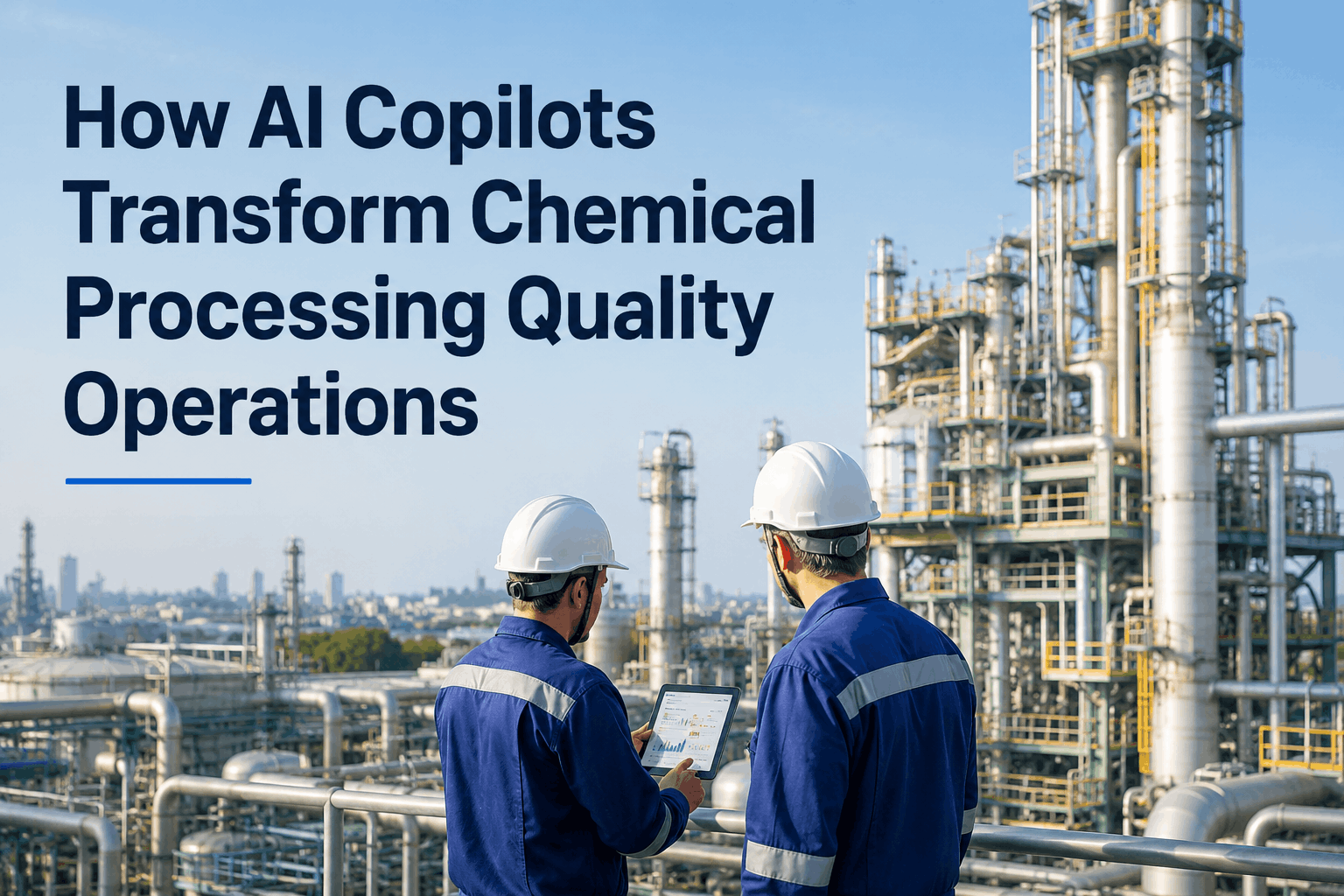
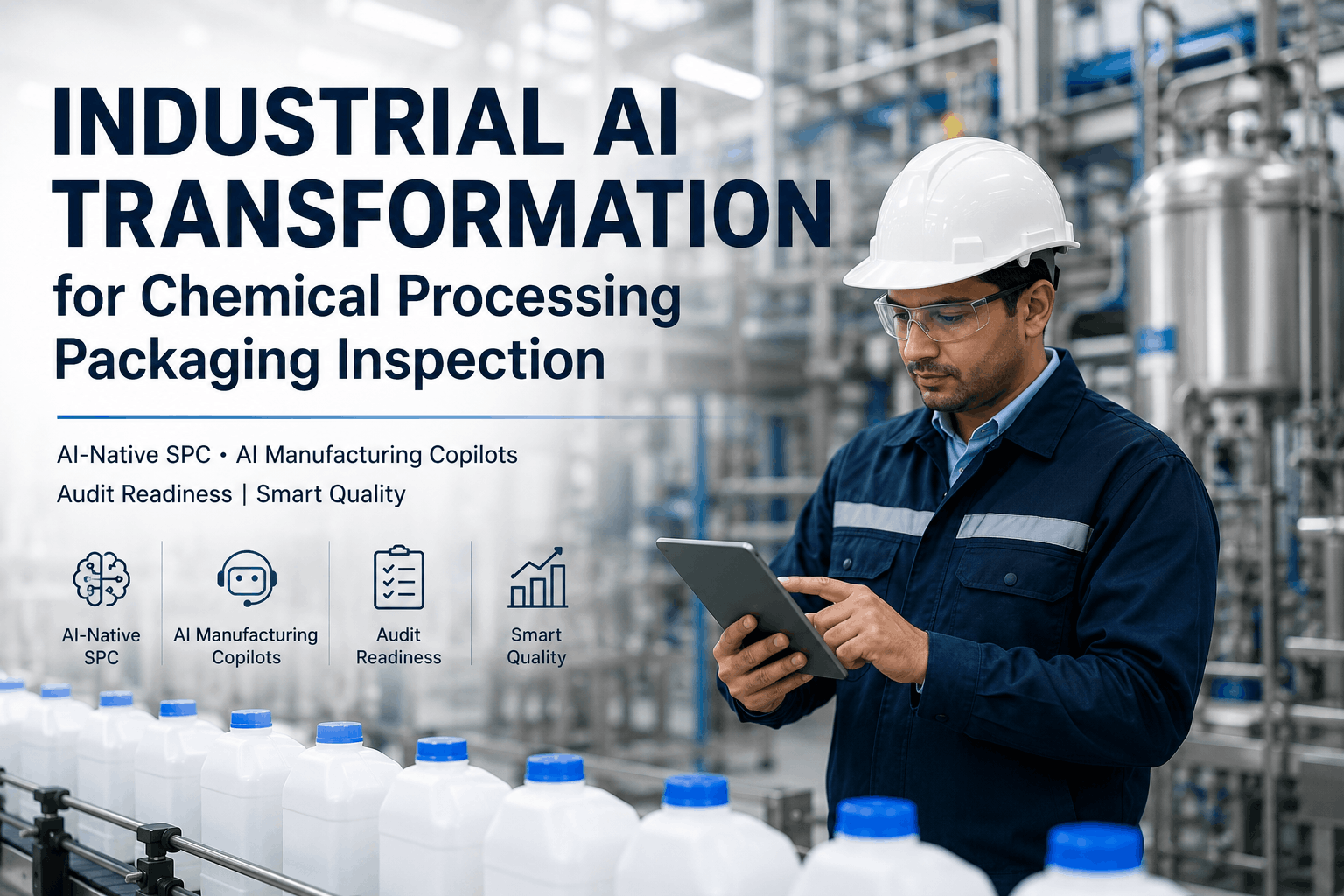
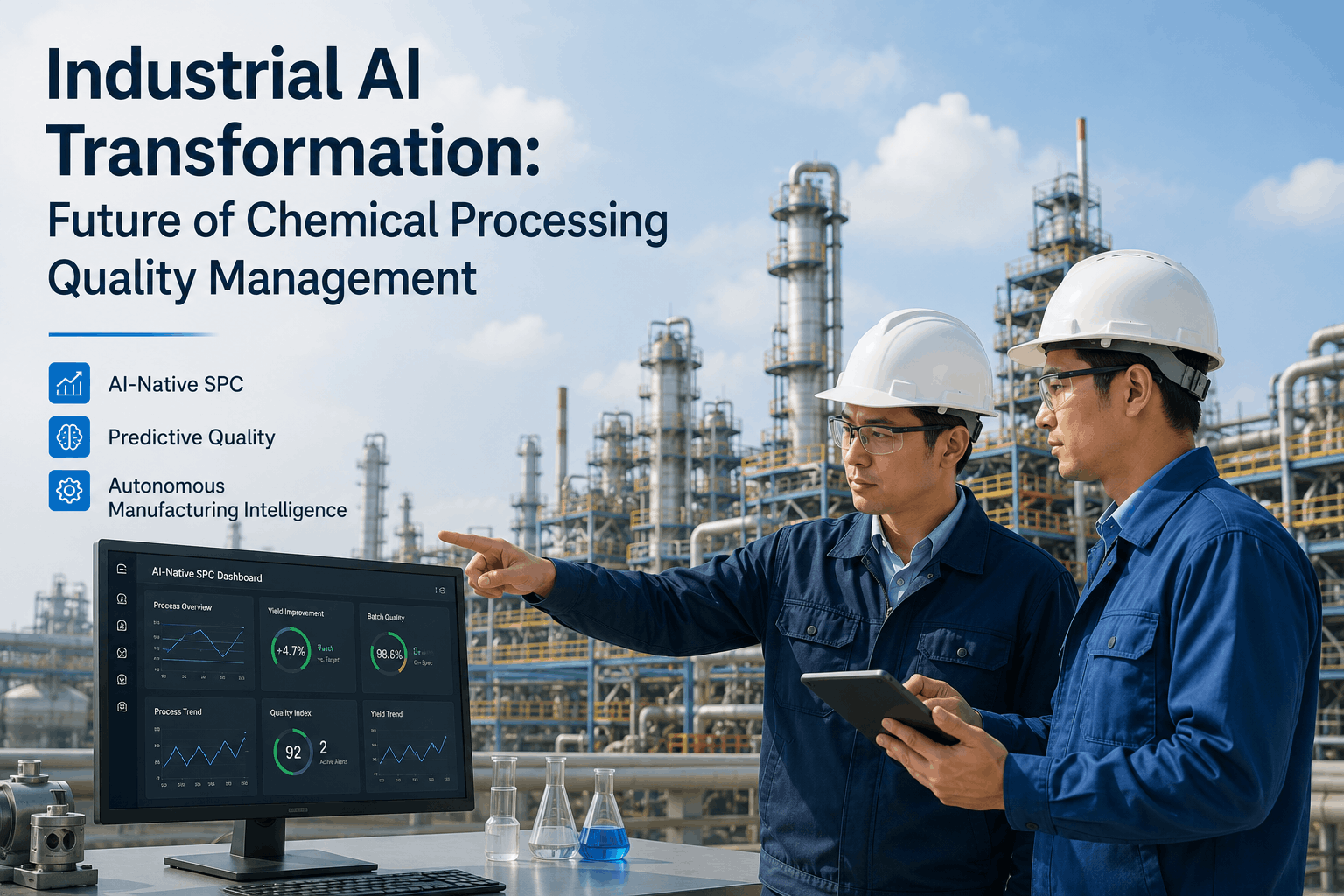
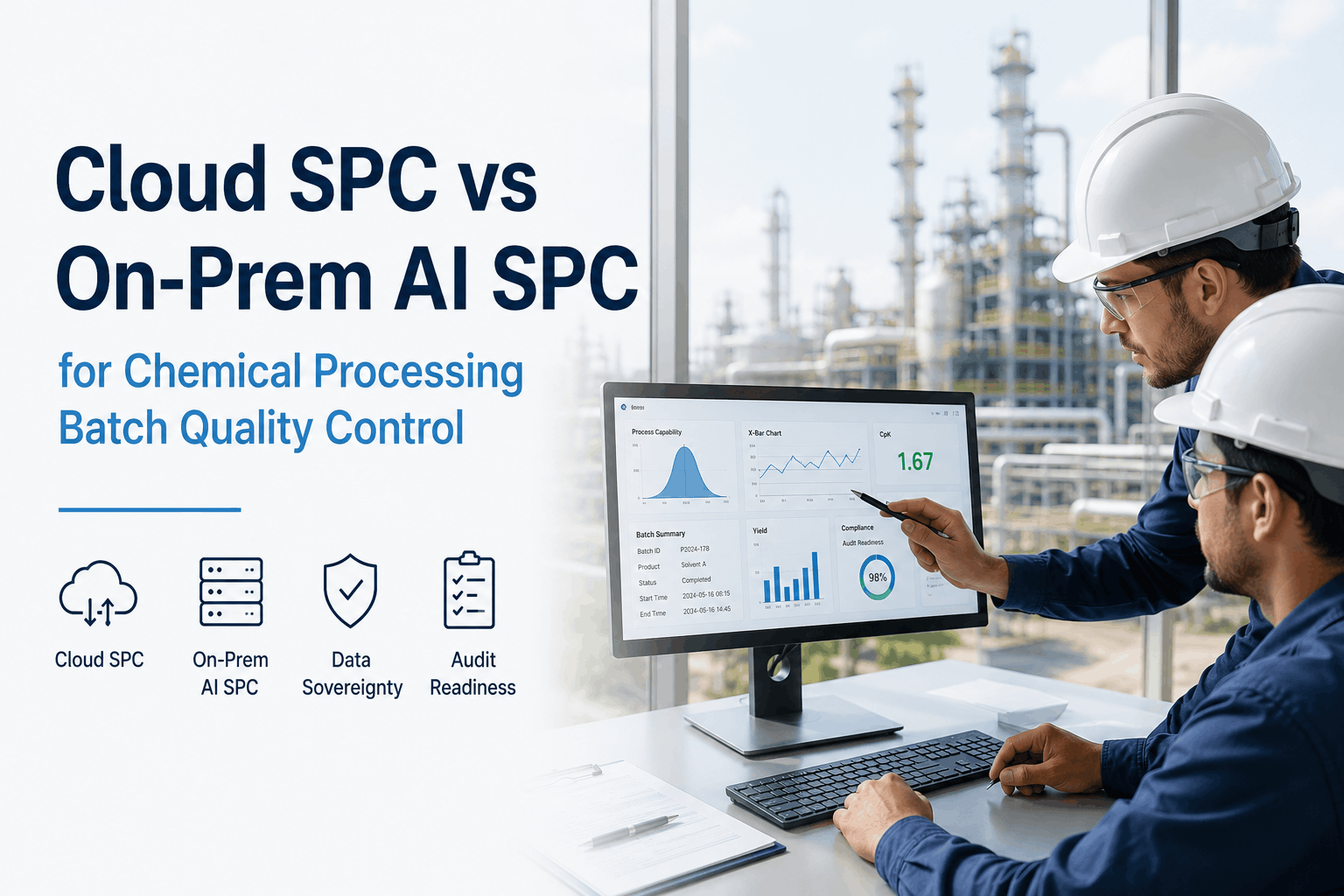
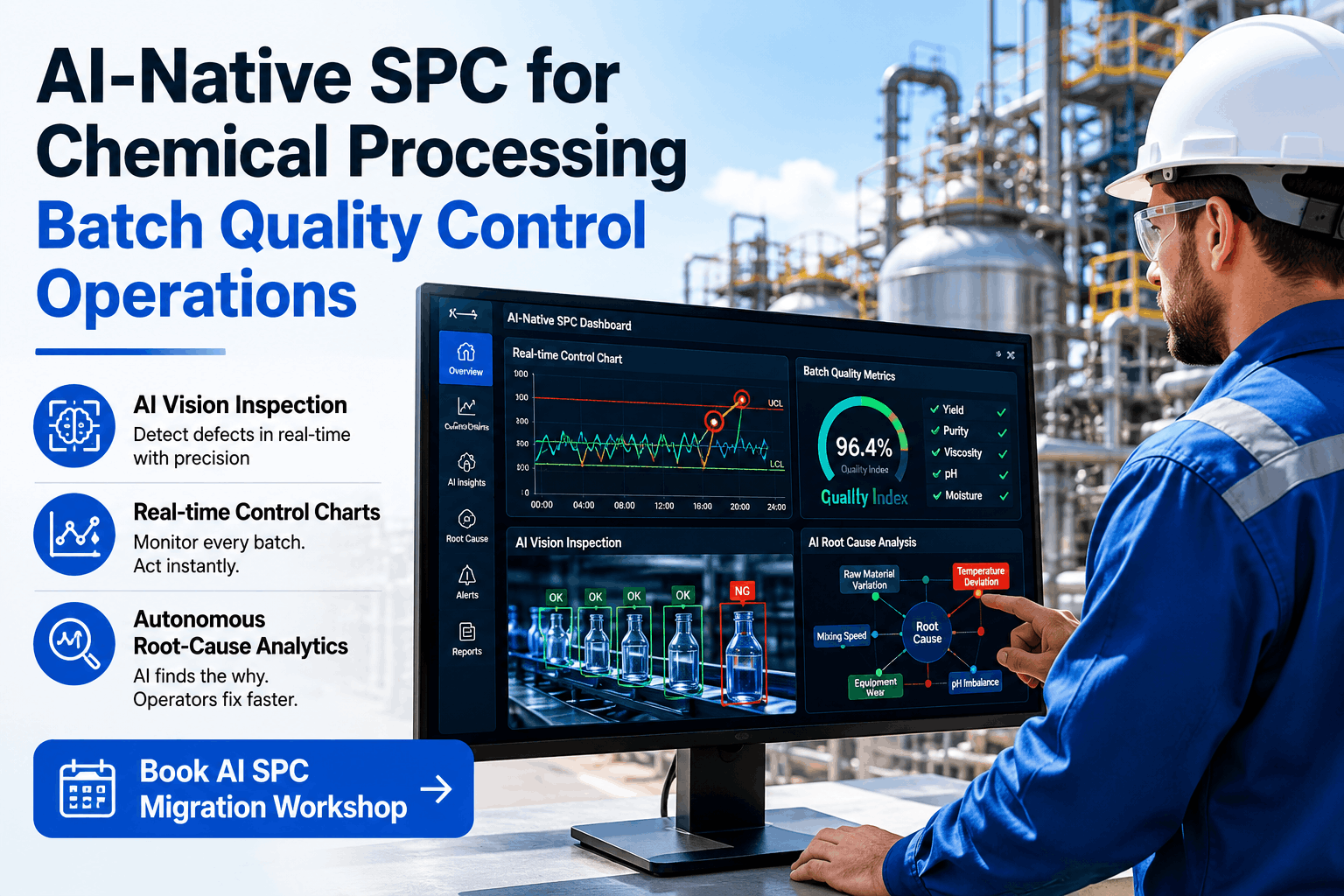
Cpk — the process capability index — is the number that tells a chemical quality director whether the plant is making product right or making it lucky. A Cpk of 1.0 means you are barely meeting specification. A Cpk of 1.33 means you have margin. A Cpk of 1.67 means your process is genuinely capable. Most chemical processing plants running SAP xMII and manual SPC are hovering between 1.0 and 1.2 — not because their process cannot do better, but because their quality system cannot respond fast enough to keep the process centred. AI copilots change this equation. They do not replace the quality engineer — they give every quality engineer the equivalent of a real-time data analyst watching every parameter, every batch, every shift. iFactory delivers AI copilots for chemical processing quality on-premise, in the cloud, or both. Book an AI SPC Migration Workshop to see Cpk improvement modelled for your process.
AI Copilots · Chemical Processing · Cpk Improvement · Batch Quality
Every Quality Engineer Gets an AI Copilot.
Every Batch Gets Smarter.
iFactory AI copilots work alongside your quality team — monitoring every process parameter, predicting Cpk drift, and recommending corrective actions before batch quality degrades. On-premise or cloud.
+0.28–0.45
Average Cpk improvement in chemical plants after AI copilot deployment — from ~1.1 to ~1.4–1.55
40–60%
More quality deviations caught by AI copilot multivariate monitoring vs. manual SPC chart review
On-Prem & Cloud
iFactory deploys both — no forced cloud migration, full data sovereignty available
What Is a Cpk and Why Is Yours Lower Than It Should Be?
Cpk measures how centred and consistent your process is relative to specification limits. A process running at the exact centre of its specification window with very low variation achieves a high Cpk. A process that drifts from centre — even if it rarely breaches limits — achieves a low Cpk. In chemical processing, Cpk degrades for one primary reason: parameter drift that goes undetected until it has already moved the process away from its optimal operating centre. Manual SPC catches the breach. AI copilots catch the drift.
Cpk Improvement Journey — From Legacy SPC to AI Copilot
Manual SPC
No alerts until breach
Barely compliant
→
xMII SPC
Reactive corrections
Marginal
→
AI Copilot
Drift detected early
Capable
→
AI Copilot + Learning
Self-optimising process
World-class
AI copilot deployment typically moves chemical plants from the 1.0–1.2 range to 1.4–1.55 within 90 days — through drift prevention, not process redesign.
What AI Copilots Do That Quality Engineers Cannot Do Alone
The quality engineer is not the bottleneck. The data volume is. A single chemical reactor generates hundreds of parameter readings per minute across temperature zones, pressure sensors, flow rates, and composition analysers. No engineer can hold all of this in their head simultaneously, correlate it in real time, and detect the early multivariate signature of a Cpk-degrading drift. AI copilots are not a replacement — they are the analyst the engineer never had enough of.
QE
Quality Engineer
What they do best
Interpret complex process chemistry interactions
Make nuanced batch disposition judgements
Design corrective actions for novel failure modes
Lead root cause investigations with domain knowledge
Limited by: reviewing 6–8 parameters manually, 30-min cycle
+
AI
AI Copilot
What it does best
Monitor 50–200 parameters simultaneously, every second
Detect multivariate drift patterns invisible to single charts
Score batch health probability in real time
Surface root cause correlation in under 5 minutes
Limited by: cannot apply chemistry domain knowledge to novel situations
=
+
Quality Team + AI
What they achieve together
Every deviation flagged before specification impact
Engineer time focused on decisions, not data gathering
Cpk improvement through drift prevention, not heroics
Continuous learning — every batch improves the model
Cpk improvement: +0.28–0.45 within 90 days
6 Ways AI Copilots Directly Improve Cpk in Chemical Processing
Process Centring Alerts
Cpk degrades when the process mean drifts from the specification centre — even if no limit is breached. AI copilots continuously calculate the running mean and alert when the process is trending off-centre, enabling correction before the drift widens the distribution and drops Cpk.
Cpk contribution: maintains mean closer to target — reduces variation driver
Raw Material Lot Compensation
Each new raw material lot introduces subtle variation in reactivity, moisture content, or purity that shifts the process mean. AI copilots detect lot-to-lot variation from incoming material characterisation data and recommend setpoint adjustments to compensate — keeping the process centred regardless of feedstock variation.
Cpk contribution: eliminates lot-change mean shifts that expand process distribution
Equipment Wear Compensation
As heat exchangers foul and pumps wear, process behaviour changes in predictable ways that traditional SPC ignores. AI copilots track equipment degradation signatures and adjust process model expectations accordingly — so the quality engineer sees the equipment-driven drift, not just the parameter reading, and can compensate with targeted setpoint adjustments.
Cpk contribution: prevents equipment-driven process spread from reaching quality limits
Adaptive Control Limit Tightening
As process stability improves, static 3-sigma limits stay wide — masking the improvement and preventing further optimisation. AI copilots continuously narrow control limits as measured process capability increases, tightening the target window progressively. Cpk improves not just from better control, but from the feedback loop that makes tighter targets visible.
Cpk contribution: enables systematic process tightening as capability evidence accumulates
Multivariate Interaction Detection
Chemical reactions involve parameter interactions that single-variable SPC cannot model. Temperature affects reaction rate which affects residence time which affects molecular weight — a cascade that static charts evaluate as independent events. AI copilots model the interaction network and detect cascade drift patterns before they propagate to final quality.
Cpk contribution: catches 40–60% more quality deviations than univariate SPC monitoring
Batch-to-Batch Learning
Every closed batch — on-spec or off-spec — updates the AI copilot's model of what optimal process behaviour looks like for that product grade. Over 60–90 days, the copilot accumulates a batch history that no human quality engineer could hold in their head, and applies it to every future batch as an always-available institutional memory.
Cpk contribution: model accuracy and prediction precision improve with every batch run
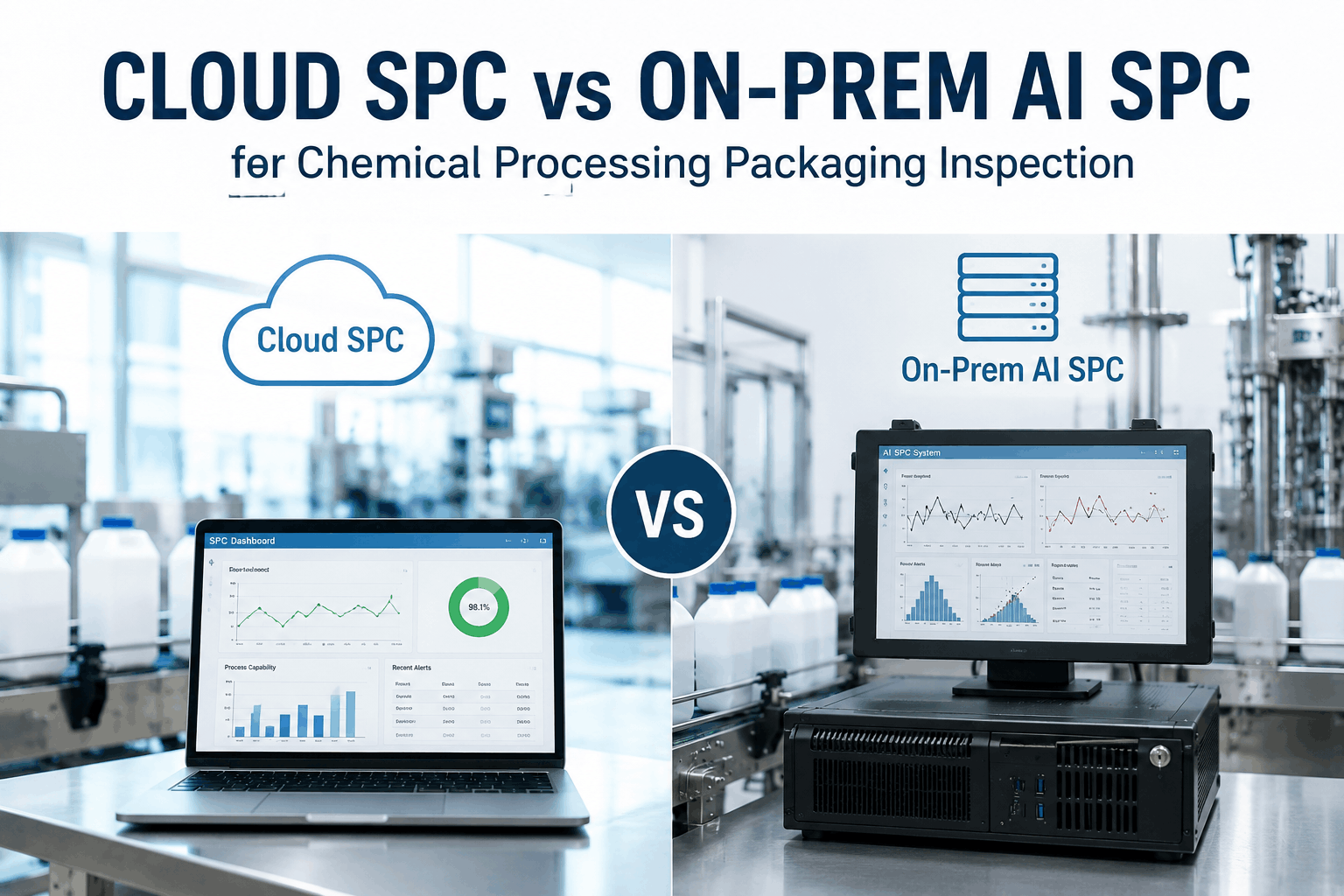
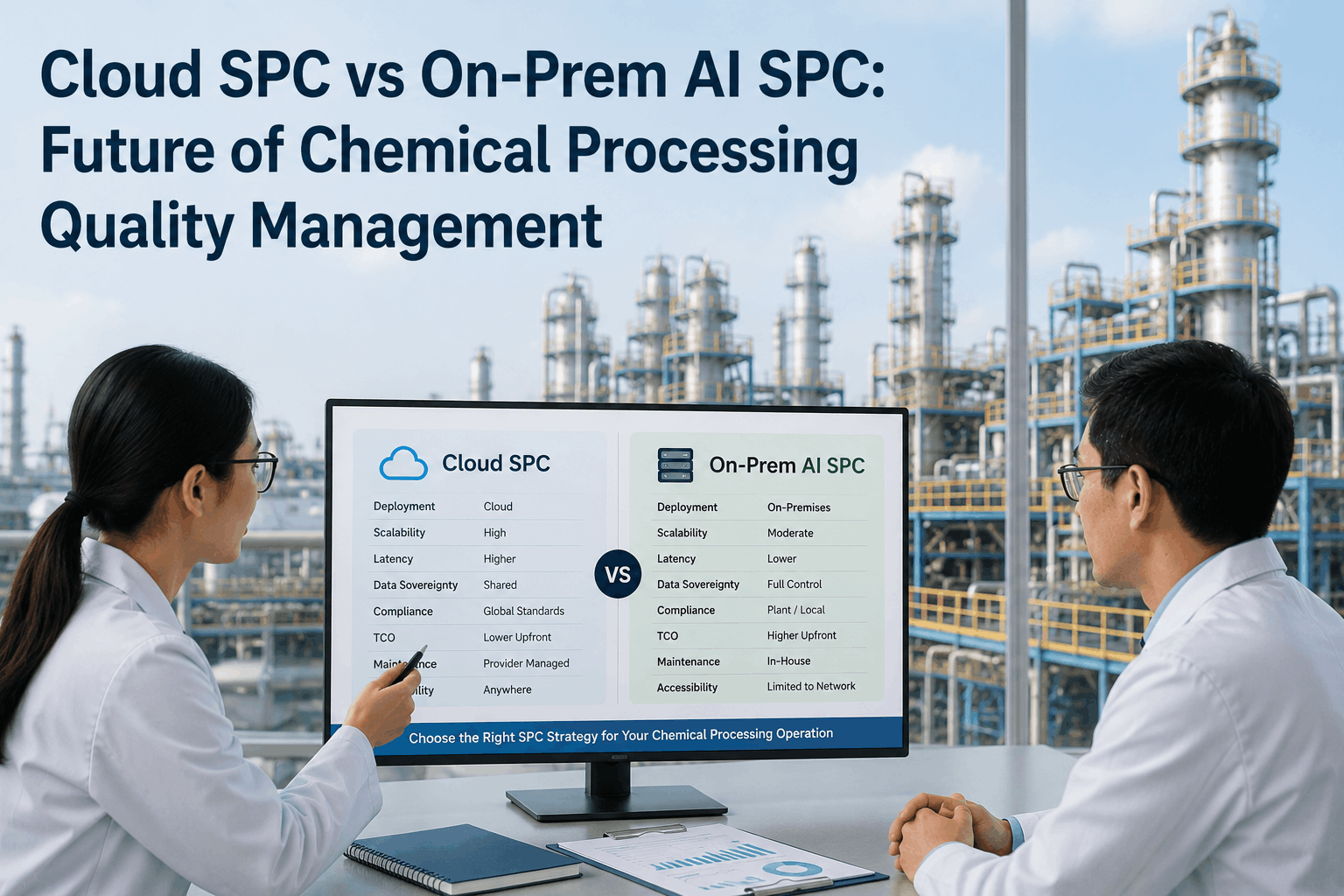
On-Premise or Cloud: iFactory Deploys Both
Chemical quality operations require a deployment choice that balances IP protection with operational intelligence. iFactory delivers full AI copilot capability in both architectures — no feature trade-offs, no performance compromise in either direction. Talk to our team about the right deployment architecture for your quality and compliance requirements.
On-Premise
Full Data Sovereignty
All Cpk data, batch parameters, and quality records stay inside your plant network
Zero proprietary formulation data transmitted externally
Sub-20ms AI copilot inference — edge processing, no cloud round-trip
FDA 21 CFR Part 11 and GMP data residency compliant
Air-gap compatible for highest-security regulated environments
Direct DCS, historian, LIMS, and SAP QM integration — no middleware
Best for: regulated chemical, pharma-chem, proprietary formulations
Discuss On-Premise Setup
OR
Cloud
Multi-Site Cpk Intelligence
Cross-facility Cpk benchmarking — identify which plant runs which grade best
Centralised quality director dashboards across all chemical plants
Mobile alerts for quality directors and supervisors anywhere
Fleet-wide learning — Cpk improvement at one site benefits all
Automatic AI copilot model updates — continuous improvement without IT effort
SOC 2 Type II compliant — encrypted, regionally configurable
Best for: multi-site chemical groups, centralised quality operations
Discuss Cloud Setup
Cpk Improvement Results: What Chemical Plants Measure
+0.28–0.45
Average Cpk improvement within 90 days of AI copilot deployment
vs. pre-deployment baseline
40–60%
More quality deviations caught via AI multivariate monitoring
Detection uplift
35–50%
Fewer false quality alarms with adaptive AI control limits
Operator workload
18–32%
Batch consistency improvement — fewer batches requiring rework or regrade
Batch quality rate
FAQ: AI Copilots for Chemical Processing Quality
What exactly is an AI copilot in chemical processing quality — how is it different from an SPC system?
An SPC system monitors individual parameters against fixed limits and fires alarms when breaches occur. An AI copilot monitors multivariate parameter combinations, adapts its sensitivity based on real-time process conditions, predicts where the process is heading rather than just where it is now, and generates targeted intervention recommendations — not just alarm notifications. The quality engineer remains the decision-maker. The AI copilot handles the continuous data monitoring, pattern recognition, and recommendation generation that would otherwise require a dedicated analyst on every shift watching every reactor simultaneously.
How does an AI copilot specifically improve Cpk — not just detect problems?
Cpk improves when process drift is caught earlier and corrected more precisely. AI copilots improve Cpk through five specific mechanisms: detecting mean drift before it moves the process distribution toward specification limits; compensating for raw material lot variation with adaptive setpoint recommendations; tracking equipment degradation signatures that cause process spread to widen; tightening control limits progressively as process capability evidence accumulates; and detecting multivariate interaction patterns that single-parameter SPC never sees. The result is a process that runs closer to its specification centre with lower variation — which is exactly what a higher Cpk measures.
Does deploying an AI copilot require replacing SAP QM or dismantling xMII?
No. SAP QM remains the system of record for inspection lots, batch disposition, and quality notifications. iFactory's AI copilot replaces the SPC intelligence layer while writing all quality outputs back to SAP QM via standard OData interfaces. SAP xMII is replaced during a 2–4 week parallel validation period — during which both systems run simultaneously and quality teams verify that iFactory outputs match or exceed xMII quality. The SAP ERP layer never sees the difference.
Book a migration workshop to review the SAP integration design for your plant.
Can AI copilots work on-premise without sending any batch data to the cloud?
Yes — this is a primary iFactory deployment mode. The on-premise deployment runs all AI copilot processing, multivariate SPC computation, Cpk calculation, and batch health scoring entirely within your plant network on local edge servers. No batch data, process parameters, formulation signatures, or quality results are transmitted externally. The on-premise deployment meets FDA 21 CFR Part 11 electronic records requirements, GMP data governance standards, and is compatible with air-gapped network environments for the most security-sensitive regulated chemical manufacturing sites.
How long before the AI copilot starts improving Cpk in our plant?
AI copilots begin generating Cpk drift alerts from the first batch run — using physics-informed initial models where historical batch data is limited. For plants with 6+ months of historian data, copilot prediction accuracy reaches production-grade within 4–6 weeks of parallel running alongside xMII. Most chemical plants see measurable Cpk improvement within 60–90 days of live deployment — first through earlier drift correction, then through the batch-to-batch learning cycle that progressively tightens process centring. The full +0.28–0.45 Cpk improvement typically materialises over 3–6 months as adaptive control limit tightening takes effect.
iFactory · AI Copilots · Chemical Processing Quality
Give Every Quality Engineer an AI Copilot.
Move Your Cpk From 1.1 to 1.4 — This Year.
iFactory AI copilots work alongside your quality team to deliver predictive Cpk improvement, multivariate drift detection, and adaptive SPC for chemical processing batch quality. On-premise or cloud. No SAP disruption. Cpk improvement in 90 days.
AI Copilot Quality
Cpk Improvement
On-Premise Available
Cloud Available
SAP QM + xMII Bridge
90-Day Deployment