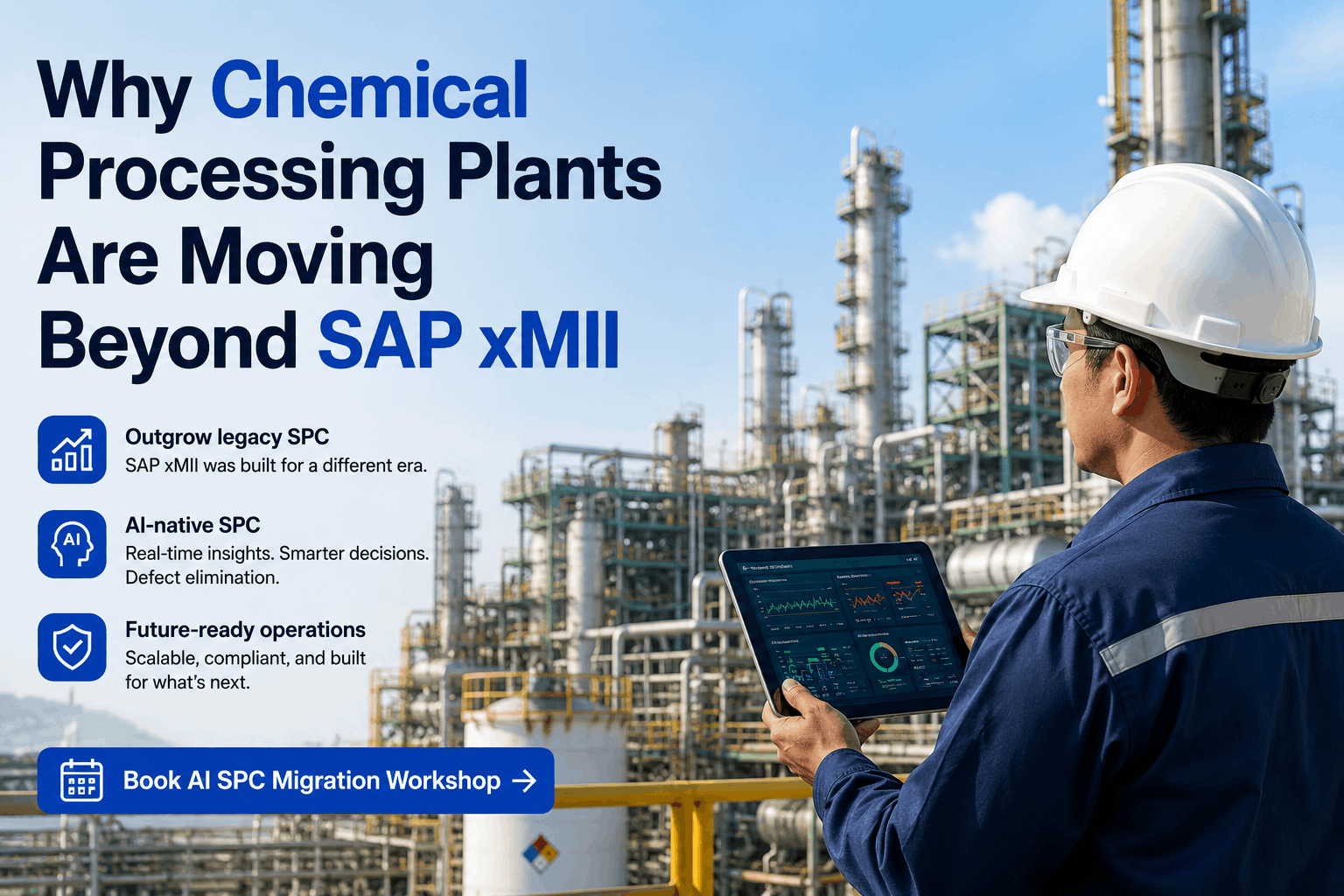
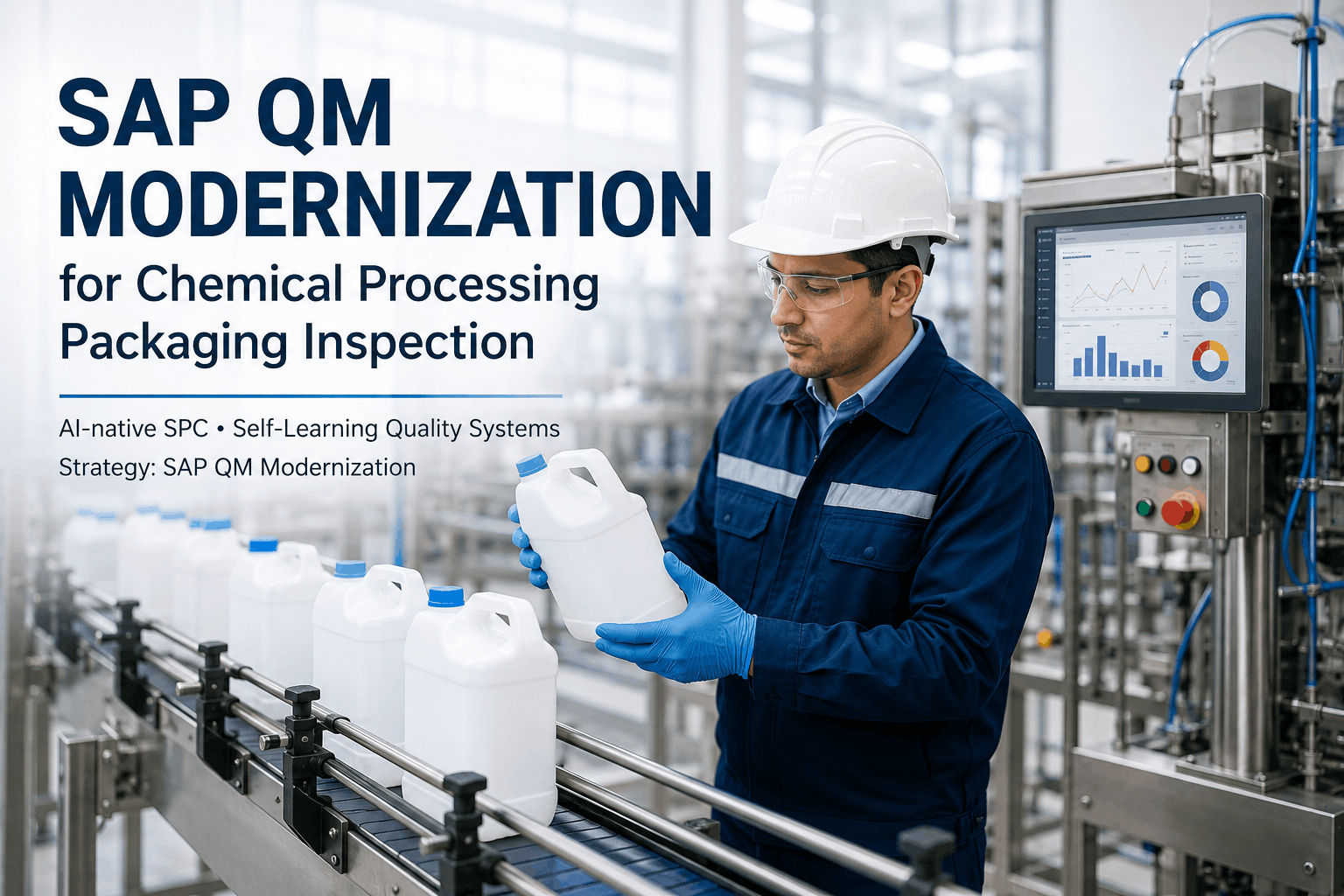
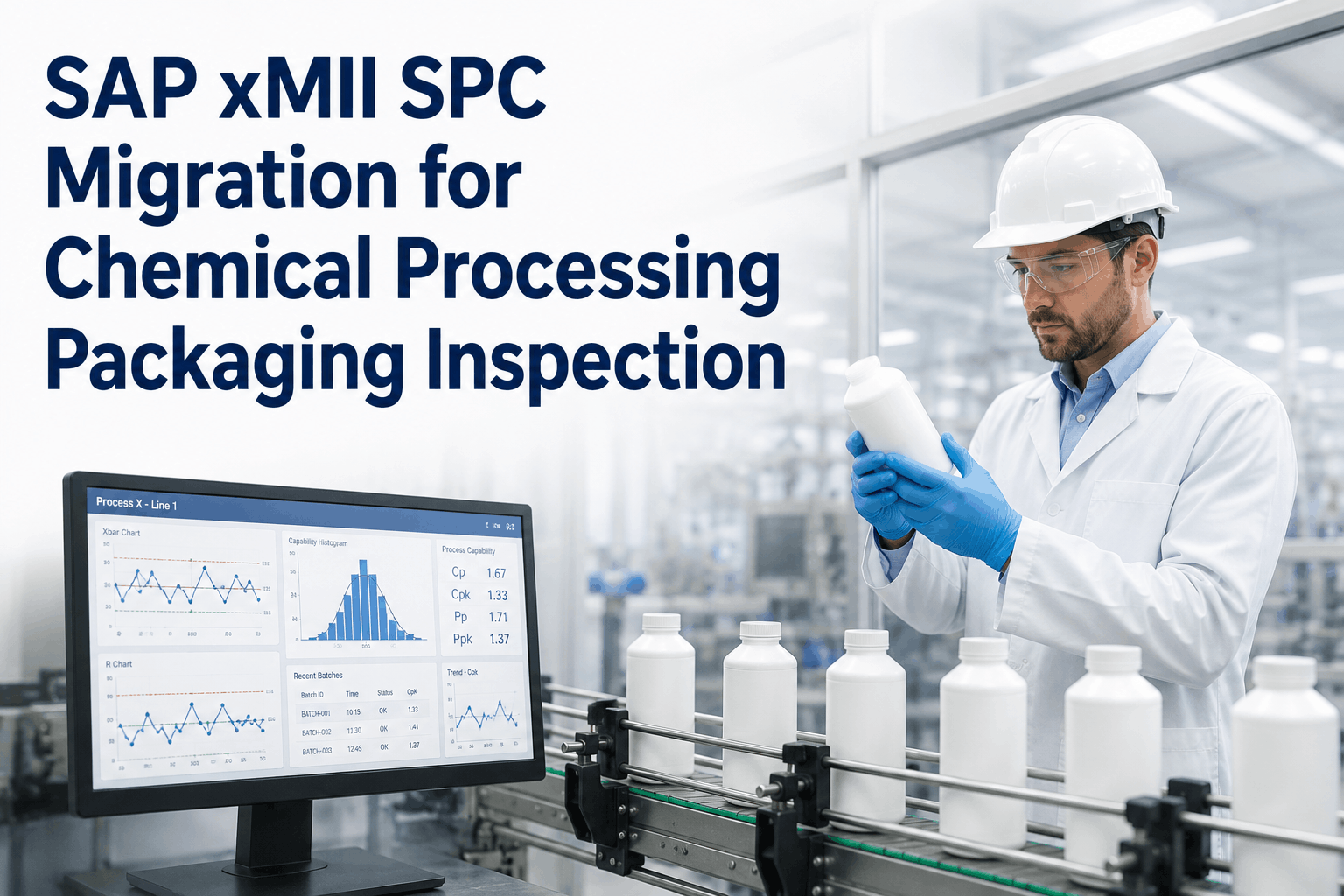
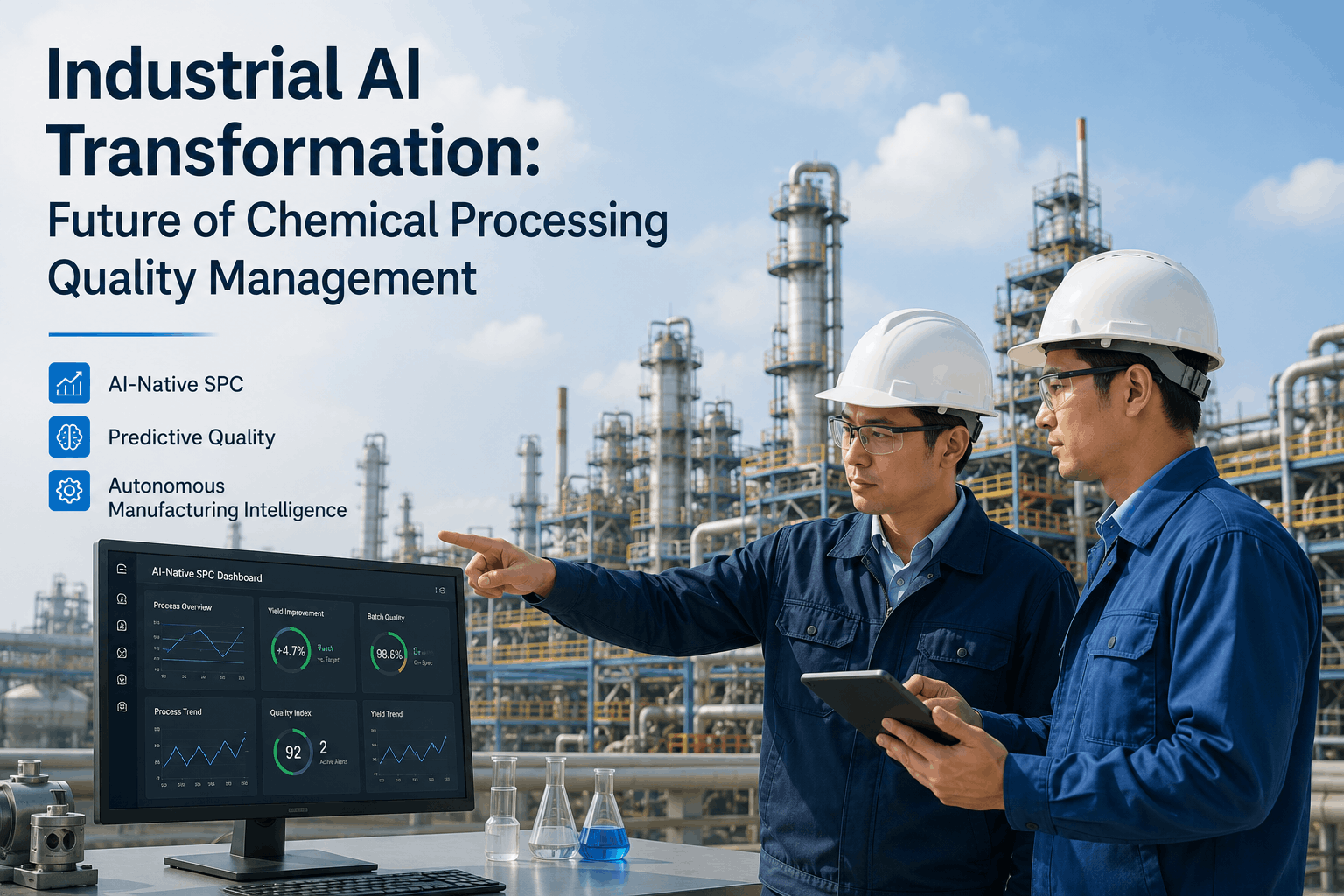
A quiet exodus is happening across chemical processing. According to IBM research, AI's revenue impact in chemicals is forecast to grow from 6% in 2025 to 14% by 2028 — translating to an $800M opportunity for a $10B chemical company. But the plants capturing this value are not the ones running the latest AI on top of SAP xMII; they are the ones replacing the underlying SPC engine entirely. The 2030 xMII end-of-mainstream-support deadline is real, but it is not the reason plants are migrating. The reason is structural: legacy xMII cannot deliver defect elimination at the level today's chemical economics demand. 70% of unplanned downtime traces back to unaddressed defects — the kind of multivariate precursors that univariate SPC was never built to see. iFactory's AI-native SPC migration replaces xMII's reactive engine with predictive, multivariate intelligence that delivers up to 30% defect reduction within the first year — fully integrated with your SAP layer, available on-premise, cloud, or hybrid, live in 8 weeks. Book an AI SPC Migration Workshop to scope your post-xMII transition.
6% → 14%
AI revenue impact in chemicals, 2025 to 2028 (IBM research)
70%
Of unplanned downtime traces to unaddressed defects
30%
Defect reduction reported within first year of AI-native SPC
2030
SAP xMII end-of-support deadline — no extensions remain
The Industry Shift: Why Now Is the Inflection Point
Three forces are converging in 2026 to make this the year chemical plants commit to their post-xMII path. Any one of them alone would justify the conversation. Together, they make further deferral economically irrational. Read the broader xMII context in our SAP MII migration complete guide.
F1
SUPPORT CLIFF
SAP xMII End-of-Life: December 31, 2030
SAP has confirmed no further extensions to xMII mainstream support. Plants running custom BLS transactions, SSCE pages, and Java enhancements face a hard deadline — and SAP DM's clean-core architecture means most customizations require redesign anyway.
F2
ECONOMIC GRAVITY
AI Revenue Impact: 6% → 14% by 2028
IBM research shows AI's revenue contribution in chemicals more than doubles by 2028. For a $10B chemical company, that's $800M in value annually. Plants on legacy xMII cannot capture this — generic SPC modules don't run multivariate predictive intelligence.
F3
DEFECT COST
Defect Elimination Is the New Cpk
Chemical plants are shifting from "managing defects" to "eliminating them at source." This requires AI vision inspection, multivariate predictive SPC, and autonomous root-cause analytics — none of which xMII natively provides.
"Everyone is experiencing pressure to use AI everywhere, but you can't risk putting AI on broken processes."
— Jeremy Barnum, CFO, JPMorgan Chase (Day 1 Keynote, SAP Sapphire 2026)
Bolt AI Onto Legacy xMII, or Build AI Into a Modern SPC Foundation? The Math Is Asymmetric.
Plants choosing the foundational path capture compounding AI value across quality, OEE, and operator productivity. Plants bolting AI onto xMII inherit its limitations forever.
What Defect Elimination Actually Means in 2026
The vocabulary matters. "Defect detection" finds problems after they occur. "Defect prevention" reduces some defect rates. Defect elimination systematically removes the root causes that produce defects in the first place — operating on the P-F Curve, addressing precursors weeks before functional failure. This is what AI-native SPC enables, and what legacy xMII fundamentally cannot. Read more in our chemical plant anomaly detection AI deep dive.
GEN 1
REACTIVE
Defect Detection
Manual visual inspection. Lab sampling. SPC charts reviewed after the fact. Defects found after production. Cost: $18K–$52K per off-spec batch.
1990s–2010s
→
GEN 2
PREVENTIVE
Defect Prevention
SAP xMII SPC modules. Univariate threshold alarms. Calendar-based maintenance. Catches some defects in flight, but multivariate root causes remain invisible.
2010s–2020s
→
GEN 3
ELIMINATIVE
Defect Elimination
AI-native multivariate SPC. LSTM forecasting predicts defect precursors hours before they manifest. Autonomous root-cause analytics. Cpk lifted into six-sigma range.
2026+
Most chemical plants in 2026 are still operating at Gen 2. The shift to Gen 3 Defect Elimination is what separates plants capturing AI's value from plants watching competitors pull ahead.
The Three Capability Gaps Driving Migration
Why specifically are chemical plants leaving xMII? Across deployed migrations, three capability gaps come up consistently. Each one represents value xMII cannot deliver — and that AI-native SPC delivers in week 4 of deployment. Background: our AI batch process optimization platform overview.
G1
No Multivariate Predictive Intelligence
xMII's SPC engine monitors one variable per chart against fixed thresholds. Modern batch reactors generate 40+ correlated time-series signals per phase. Multivariate interactions causing 60% of off-spec batches are mathematically invisible to univariate logic.
G2
No AI Vision Inspection Layer
xMII ingests quality results but does not generate them. Plants stay dependent on manual visual inspection that misses 20–30% of defects, or rule-based vision that needs reprogramming for every SKU. AI vision delivers 99.8% defect detection accuracy at line speed.
G3
No Autonomous Root-Cause Analytics
xMII surfaces deviations but cannot explain them. Operators run multi-hour Pareto analyses across DCS trends, lab data, and operator logs. AI-native root-cause traces backward through correlated variables in under 30 minutes with confidence-scored answers.
The Three Paths Forward — And the Trade-offs
Chemical plants on legacy SAP xMII have three forward paths. Each one has different cost, risk, and capability outcomes. The right choice depends on your custom-code footprint, defect economics, and 5-year roadmap. Read our step-by-step iFactory MES implementation guide for the full methodology.
PRO
Zero migration cost in the short term
CON
Hard deadline December 31, 2030 — no extensions
CON
Defect cost compounds: $200K–$2M/year lost
CON
Competitive disadvantage as AI revenue gap widens
FIT FOR
Plants with <12 months until planned shutdown
PRO
SAP-recommended path; native execution
CON
Generic SPC module — same univariate limits
CON
12–18 month migration; clean-core redesign needed
PRO
Coexists well with best-of-breed AI SPC layer
FIT FOR
Plants needing full MES replacement, not just SPC
PATH C
Best-of-Breed AI-Native SPC
PRO
8-week deployment, not 18 months
PRO
Multivariate predictive intelligence + AI vision
PRO
Up to 30% defect reduction within first year
PRO
Coexists with SAP DM, S/4HANA, ECC, or xMII
FIT FOR
Plants prioritizing defect elimination and operator productivity now
Deploy On-Premise, in the Cloud, or Hybrid
Chemical plants do not share a single IT posture. iFactory delivers identical AI-native SPC capability across all three deployment modes — the choice is yours; the defect elimination outcomes are the same. Talk to our deployment architects about which mode fits your plant.
ON-PREMISE
Air-gapped. Edge GPU on your plant network. Zero internet required. Full data sovereignty.
Best for: Regulated EU/APAC plants, hazardous chemical sites, pharma-adjacent operations
CLOUD
Managed. Zero infrastructure. Multi-site defect dashboards. SOC 2 Type II, ISO 27001.
Best for: Multi-plant operators, fast-scaling specialty groups, OPEX-preferred budgets
HYBRID
Edge + cloud. Sub-50ms inference at the line. Cloud-side learning across plant fleet.
Best for: Multi-site groups with mixed regulatory environments, federated learning
Same AI engine. Same defect elimination outcomes. Same 8-week deployment. Deployment mode affects infrastructure and IT alignment — not capability or results.
The 8-Week Migration Sequence
iFactory's migration runs alongside production throughout. xMII stays live through Week 6. AI-native SPC builds in shadow mode, validates against your historical batches, then cuts over in measured, reversible stages.
Weeks 1–2
xMII Audit & Data Mapping
Catalog every xMII SPC chart, BLS transaction, custom enhancement. Tag each as Keep, Retire, Transform, or Replace. Map DCS, PLC, LIMS tag inventory.
Weeks 3–4
AI Model Training & Shadow Mode
Train multiway PCA + LSTM models on 60–90 days of plant history. AI runs in shadow mode alongside xMII. First defect prediction baseline delivered.
Weeks 5–6
Pilot Cutover & Calibration
Cut over highest-variability batches first. Tune alert thresholds. Train operators. xMII continues as backup. Reversible via configuration.
Weeks 7–8
Full Cutover & Defect Baseline
AI-native SPC promoted to primary across plant. Compliance reporting activated. First defect elimination report delivered with measured gains.
No Production Downtime. No SAP Disruption. Defect Elimination Starts in Week 4.
iFactory's 8-week deployment program follows a structured playbook designed for chemical plants that cannot stop production. Plants completing migration consistently maintain 100% production uptime throughout.
Outcomes from Deployed Plants Moving Beyond xMII
Each outcome below is from a chemical processing facility that completed the SAP xMII to iFactory AI-native SPC migration. Six-month post-cutover data, measured against the previous 12-month xMII baseline.
An 8-reactor specialty polymer plant in Switzerland was running SAP xMII with univariate SPC charts. Multivariate root causes — feed composition drift, thermal profile interaction, catalyst aging — were invisible. iFactory's multivariate batch trajectory model identified all 5 active defect-precursor patterns within 48 hours of go-live. Six months later, total defect rate fell 38%. Deployment: on-premise.
38%
Total defect reduction
96%
Precursor detection accuracy
$2.6M
Annual recovered value
A coating resin manufacturer operating 6 plants on legacy SAP xMII migrated to iFactory cloud over 9 weeks. The cloud platform delivered a single defect dashboard across the fleet, identified the worst-performing plant within 48 hours, and lifted fleet-wide defect performance by 41%. Identical AI engine across all 6 plants, regardless of size or batch chemistry. Deployment: cloud.
41%
Fleet defect reduction
9 wks
6-plant rollout time
$3.4M
Annual recovered value
A biotech chemical facility was losing $540K annually to 5 persistent fermentation defect patterns rotating across a 10-batch train. Manual endpoint determination identified suboptimal conversion only after visible purity deviation. iFactory's temperature and nutrient correlation models identified all 5 active defect patterns within 48 hours of go-live, enabling targeted parameter adjustment without production interruption. Deployment: hybrid.
5
Active defect patterns eliminated
48 hrs
Time to identify all 5 patterns
$1.1M
Annual recovered value
What Plant Leaders Say About Moving Beyond xMII
We knew xMII was going end-of-life. What we did not realize was how much defect cost we were absorbing as "normal." Six months after the iFactory cutover, defects dropped 38% and we found ourselves wondering why we waited so long.
VP of Operations
Specialty Polymer Plant, Switzerland
SAP DM was a 14-month roadmap. iFactory was 8 weeks. We chose best-of-breed AI SPC first to start capturing defect elimination value immediately. We will plan the DM migration when we are ready — but the value is already flowing.
Manufacturing IT Director
Coating Resin Plant, Germany
The IBM research stat hit home: AI revenue impact going from 6% to 14% by 2028. We could not afford to spend the next three years running xMII while competitors captured that value. The decision to migrate was the easy part.
CIO
Multi-Site Chemical Group, USA
Five defect patterns identified in 48 hours that xMII never surfaced in years of operation. That single insight covered the migration cost in the first quarter. Defect elimination is real, and it pays for itself.
Plant Quality Lead
Biotech Manufacturing, Japan
FAQ: Moving Beyond SAP xMII for Defect Elimination
Common questions from plant operators, IT leaders, and operations directors evaluating the post-xMII path. Question not covered here? Reach our solutions team directly.
Do we have to migrate off SAP xMII before December 2030?
SAP confirmed December 31, 2030 as the end of mainstream xMII and ME support, with no further extensions. You can technically run xMII until then, but the operational economics rarely justify waiting. Plants typically lose $200K–$2M per year to defects that AI-native SPC would eliminate. Most plants that have run the cost analysis start migration planning 24–36 months before end-of-support — meaning the decision window is now.
What's the difference between defect detection, prevention, and elimination?
Defect detection finds defects after they occur — manual inspection, lab sampling, post-batch SPC review. Defect prevention reduces some defect rates through threshold alarms — what xMII SPC modules do. Defect elimination systematically removes root causes weeks before functional failure manifests, using multivariate predictive AI on the P-F Curve. The 2026 standard is elimination. xMII operates at the prevention tier; iFactory AI-native SPC operates at the elimination tier.
Should we go straight to SAP Digital Manufacturing (DM) instead?
It depends on what you need. SAP DM is excellent for execution, work orders, and master data — and SAP recommends it as the strategic successor. But DM's native SPC module is generic and univariate, same fundamental limitation as xMII. Most chemical plants need both layers: SAP DM for execution + best-of-breed AI-native SPC for predictive quality. SAP themselves recommend this hybrid coexistence pattern. iFactory is built for it.
Is iFactory available on-premise, in the cloud, or both?
Both — and hybrid. iFactory delivers identical AI-native SPC capability across on-premise (air-gapped, edge GPU), cloud (SOC 2 Type II, ISO 27001), and hybrid (edge inference plus cloud-side training) deployments. Defect elimination outcomes are identical across all three modes. The choice depends on data residency rules, IT policy, and multi-site strategy — not capability.
Can we run iFactory and SAP xMII in parallel during migration?
Yes — and we recommend it as the cornerstone of the playbook. iFactory runs in shadow mode from Week 3 through Week 6, logging every AI prediction alongside xMII results. Your QA team validates AI catches against xMII output. Cutover happens only after catch rate and false positive metrics exceed your acceptance threshold. xMII remains available as backup for 30 days post-cutover. Plants consistently maintain 100% production uptime throughout.
What defect reduction should we realistically expect?
Across deployed chemical plants, defect reduction has consistently fallen in the 25–45% range within 6–12 months of cutover. US manufacturers implementing iFactory MES alongside existing SAP systems report up to 30% defect reductions in the first year. The exact gain depends on baseline defect rate, batch chemistry complexity, and operator response speed. The AI SPC Migration Workshop includes a tailored defect reduction projection for your specific lines.
How does AI-native SPC handle our custom xMII BLS transactions?
During the Week 1–2 data mapping phase, we inventory every BLS transaction, query, SSCE page, and Java enhancement, then tag each as Keep, Retire, Transform, or Replace. Heavy custom code in xMII often means SAP DM's clean-core architecture would require full redesign anyway — making best-of-breed AI-native SPC the faster, lower-risk path. Light customization environments migrate in standard 8 weeks.
Will moving beyond xMII break our FDA Part 11 or EU GMP compliance?
No — it strengthens it. iFactory auto-generates structured batch reports formatted for FDA 21 CFR Part 11, EU GMP Annex 11, ICH Q7, REACH, and OSHA PSM. All xMII compliance records migrate intact. The AI layer adds enriched defect data with full provenance — every prediction linked to source tags, model version, and confidence score, satisfying ALCOA+ data integrity requirements. Most plants pass post-migration audits on the first attempt.
Move Beyond SAP xMII. Eliminate Defects at the Source. Live in 8 Weeks.
The 2030 deadline is real. The defect elimination opportunity is larger. iFactory's AI-native SPC delivers up to 30% defect reduction within the first year — fully integrated with your SAP layer, available on-premise, cloud, or hybrid, with zero production downtime during migration.
On-premise, cloud, or hybrid — your choice
Up to 30% defect reduction in 12 months
100% production uptime during migration
Coexists with SAP DM, S/4HANA, ECC, xMII
FDA Part 11, EU GMP Annex 11, REACH ready