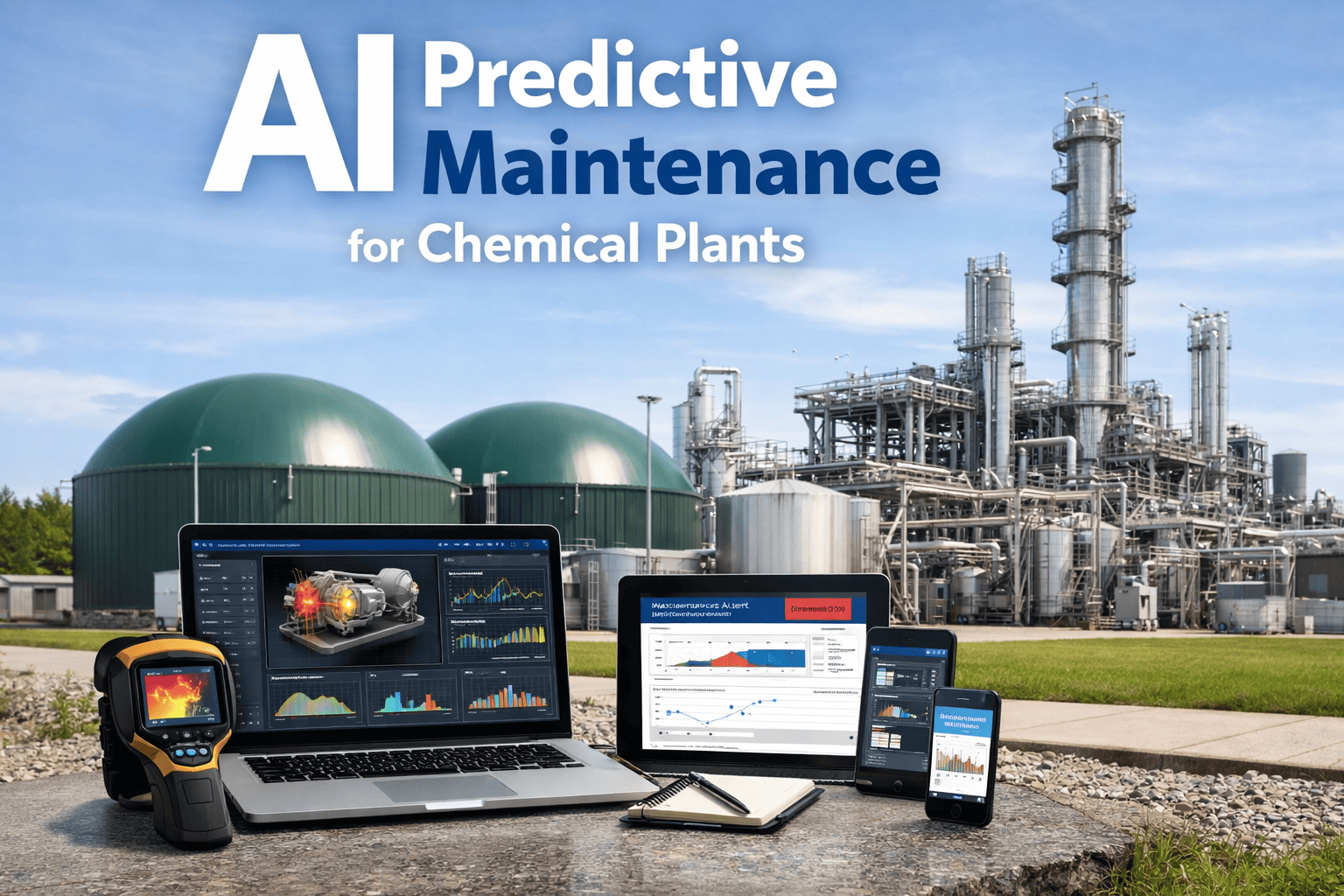
A single unplanned shutdown in a chemical plant costs between $260,000 and $2 million per event. Across the global chemical industry, unplanned downtime drains $20 billion annually. And here's the painful irony: most of these failures announce themselves weeks in advance — through subtle vibration shifts, temperature creep, acoustic changes, and current draw anomalies — but traditional maintenance programs can't hear them. AI-driven predictive maintenance changes this entirely. By analyzing real-time sensor data through machine learning models like LSTMs and anomaly detection algorithms, AI predicts equipment failures 72+ hours before they happen — turning catastrophic breakdowns into planned maintenance events. iFactory's AI-powered CMMS is built specifically for this: connecting vibration, temperature, pressure, and acoustic sensors across your reactors, pumps, compressors, heat exchangers, and pipelines into one intelligent maintenance platform that auto-detects degradation, auto-generates work orders, and keeps your plant running — all on-premise, all sovereign, all at edge speed.
The predictive maintenance market is projected to grow from $10.93 billion in 2024 to over $70 billion by 2032 — a CAGR exceeding 26%. In chemical manufacturing specifically, companies allocate 20–30% of operational budgets to maintenance, yet most still operate reactively. The math is simple: a large chemical plant losing 400 hours of unplanned downtime annually at $6,730 per hour bleeds $2.69 million yearly in preventable losses. A 50% reduction through AI predictive maintenance saves $1.35 million — before counting parts savings, extended equipment life, and avoided safety incidents. iFactory makes this transition possible in weeks, not years.
The Chemical Plant Maintenance Crisis: What the Data Shows
Chemical plants face a maintenance challenge unlike any other industry. Corrosive media, extreme temperatures, high pressures, and 24/7 continuous operation create equipment degradation patterns that are complex, fast-moving, and dangerous when missed. Here's the landscape:
The chemical-specific danger: In chemical plants, equipment failures don't just stop production — they create safety emergencies. Pressure vessel weaknesses, seal deterioration, heat exchanger tube failures, and pipeline corrosion can trigger toxic releases, fires, and explosions. The Bhopal disaster, Texas City refinery explosion, and Flixborough disaster all began with equipment failures that predictive maintenance could have detected. AI doesn't just save money in chemical plants. It saves lives.
How AI Predictive Maintenance Works in Chemical Plants
AI predictive maintenance isn't a black box — it's a layered intelligence system that collects, processes, predicts, and acts. Here's how iFactory implements each layer for chemical plant equipment:
This is iFactory's closed-loop advantage: Detection → Prediction → Work Order → Execution → Verification — all in one platform. No handoffs between siloed systems. No alerts that go into an email inbox and get forgotten. Every AI detection becomes an action that gets completed and measured. See iFactory's predictive maintenance loop in action →
Chemical Plant Equipment: What iFactory's AI Monitors
Chemical plants contain dozens of equipment types, each with unique failure modes and degradation signatures. iFactory's predictive maintenance covers the complete asset ecosystem — with AI models trained on the specific failure patterns of each equipment class:
The iFactory CMMS difference: Most predictive maintenance tools detect problems. iFactory detects them AND fixes them — through an integrated CMMS that auto-generates work orders, assigns technicians, confirms parts availability, schedules jobs during optimal windows, captures completion data with photos and digital signatures, and feeds the result back into the AI model to improve future predictions. It's a self-improving loop where every completed work order makes the next prediction more accurate.
Reactive vs. Preventive vs. AI Predictive: The Chemical Plant Comparison
Understanding why AI predictive maintenance delivers transformative results requires comparing it to the two approaches most chemical plants currently use:
Still used by 38% of maintenance teams. Equipment runs until catastrophic failure, then emergency crews scramble. In chemical plants, this means unplanned shutdowns costing $260K–$2M per event, cascade damage to connected systems, potential safety incidents, and weeks of recovery. Downtime costs have risen 65% in two years because aging equipment fails harder and parts take longer to source. This is the most expensive approach by every metric.
Used by 71% of maintenance teams — the current industry default. Parts are replaced on fixed schedules regardless of actual condition. A bearing rated for 10,000 hours gets replaced at 8,000 — even if it could safely run another 4,000. This wastes parts, wastes labor, and still misses failures that occur between scheduled intervals. Chemical plants waste 20–30% of their maintenance budget on unnecessary PM tasks while still suffering unplanned breakdowns.
Maintenance happens based on actual equipment condition — as measured by AI analyzing vibration, temperature, acoustic, and current data in real time. Parts are replaced at the optimal moment: not too early (wasting money) and not too late (risking failure). iFactory's AI predicts failures 72+ hours in advance with 88–97% accuracy, auto-generates contextual work orders, and schedules repairs during planned windows. Result: 50% downtime reduction, 40% equipment life extension, 25% maintenance cost reduction, and zero surprise shutdowns.
- 50% downtime reduction (McKinsey)
- 40% equipment life extension
- 25% maintenance cost reduction
- 70% fewer emergency repairs
- $150K+ annual savings per facility
- $260K–$2M per unplanned event
- Parts replaced too early or too late
- 20–30% of budget wasted on unnecessary PMs
- Cascade damage from missed failures
- Safety incidents from sudden breakdowns
iFactory: AI Predictive Maintenance Built for Chemical Plants
From pump bearings to reactor vessels to distillation column internals — iFactory's AI detects degradation 72+ hours before failure, auto-generates complete work orders, and keeps your plant running safely. 500+ facilities. 50+ countries. 40% less downtime. 100% on-premise. See how iFactory protects your chemical assets in 30 minutes.
Why iFactory's Architecture Is Purpose-Built for Chemical Plants
Chemical plants have unique requirements that most CMMS platforms weren't designed for. Here's why iFactory's architecture matters specifically for the chemical industry:
iFactory deployment results in chemical facilities: 500+ facilities across 50+ countries. 25–40% lower maintenance costs. 40% less unplanned downtime. 70% fewer emergency repairs. $150K+ average annual savings per facility. Enterprise chemical customers save $1.8M–$3.2M annually. 200–400% ROI within 12–18 months. A chemical manufacturer using iFactory's digital twin capability achieved $2 million in annual savings through decreased equipment failures alone.
Frequently Asked Questions
AI predictive maintenance analyzes real-time data from vibration sensors, temperature probes, acoustic detectors, current transformers, and pressure transmitters installed on pumps, compressors, heat exchangers, reactors, and pipelines. Machine learning models — including LSTMs for time-series prediction and anomaly detection algorithms — learn each asset's unique healthy signature and detect subtle deviations that precede failures by 72+ hours. iFactory processes this data on-premise at the edge with sub-10ms response, enabling immediate detection without cloud latency or dependency.
iFactory doesn't just alert — it acts. When AI detects degradation, the CMMS auto-generates a complete work order with the right technician assigned via AI-powered auto-assignment, step-by-step repair instructions, required spare parts confirmed in stock (or auto-ordered), and the job scheduled during the next optimal maintenance window aligned with production schedules. Work orders are created, tracked, and closed 50% faster than manual processes. Every completed repair feeds back into the AI model to improve future predictions.
Yes. iFactory connects directly to your existing systems via OPC-UA, Modbus, MQTT, Ethernet/IP, and PROFINET — reading from your current instrumentation without replacing anything. Non-invasive clamp-on sensors can be added to legacy equipment in hours for assets that aren't yet instrumented. 50+ pre-built ERP connectors integrate with SAP, Oracle, and Microsoft Dynamics. Most chemical plant integrations complete in 2–4 weeks.
Every maintenance action, inspection, process deviation, and safety event is logged with immutable, timestamped audit trails and digital signatures. Pre-built compliance templates support OSHA PSM, EPA RMP, ISO 9001, and REACH requirements. AI-assisted safety audits are 60% faster than manual processes. All data is stored on-premise with full encryption — and every record is retrievable in seconds when regulators visit. 49% of chemical companies report AI has helped reduce compliance-related penalties.
McKinsey research shows AI predictive maintenance reduces downtime by up to 50% and extends equipment life by 40%. iFactory facilities achieve 25–40% lower maintenance costs, 70% fewer emergency repairs, and $150K+ annual savings per site — with 200–400% ROI within 12–18 months. A chemical manufacturer using iFactory's digital twin technology achieved $2 million in annual savings. For a plant experiencing 400 hours of annual unplanned downtime at $6,730/hour, a 50% reduction saves $1.35 million yearly in prevented downtime alone. 69% of chemical companies report positive AI ROI within the first year.
Every Unplanned Shutdown Is a Failure Your AI Could Have Prevented
$20 billion in annual chemical industry downtime. $260K–$2M per event. Equipment that announces its failures weeks in advance — if you're listening. iFactory's AI listens 24/7, predicts failures 72+ hours ahead, and auto-generates the work orders that turn breakdowns into planned repairs. 500+ facilities. 50+ countries. On-premise. Sovereign. Safe. See the difference in 30 minutes.