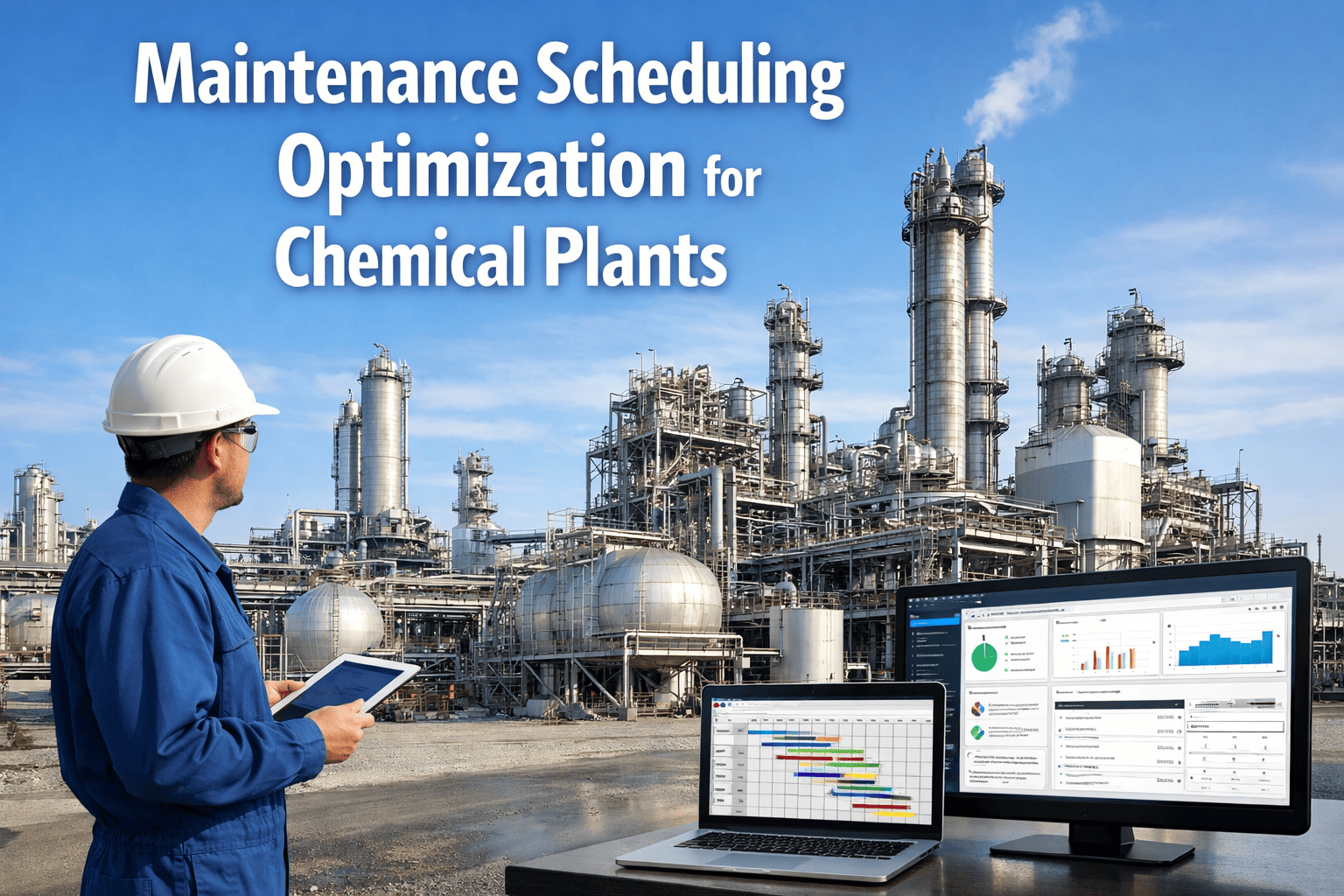
Maintenance Scheduling Optimization for Chemical Plants
By Jason on April 16, 2026
Chemical plant maintenance planners and reliability engineers face a persistent operational challenge: traditional time-based maintenance schedules and reactive work order management create inefficiencies that lead to either premature equipment servicing or unexpected breakdowns—by the time maintenance conflicts, resource shortages, or critical spare part delays are identified through manual planning or static CMMS calendars, production downtime has already accumulated, emergency labor costs have escalated 25–45%, deferred maintenance has created cascading reliability risks, and unplanned asset failures have threatened safety compliance and regulatory standing. iFactory's AI-powered maintenance scheduling optimization platform continuously analyzes equipment condition data, predictive maintenance alerts, work order backlogs, technician availability, spare part inventory levels, and production schedules across your chemical manufacturing operations, computing optimal maintenance windows and resource allocations that prevent unplanned downtime, minimize labor overtime, ensure timely servicing of critical equipment, and align maintenance execution with production priorities—delivering coordinated maintenance planning that extends asset lifespan, reduces operational costs, and strengthens overall plant reliability without disrupting established CMMS workflows or requiring capital investment in new scheduling infrastructure. Book a demo to see maintenance scheduling optimization configured for your chemical plant operations.
Intelligent Work Order Prioritization & Conflict Resolution
Traditional maintenance scheduling in chemical plants relies on static calendars and manual prioritization that frequently create resource conflicts, overlapping work orders, and production-maintenance collisions. iFactory's AI continuously evaluates equipment criticality, predictive failure probabilities, safety compliance deadlines, and production schedule constraints to automatically rank work orders, resolve scheduling conflicts, and sequence maintenance activities for optimal execution. This dynamic prioritization ensures that high-risk assets receive timely attention while lower-priority tasks are intelligently deferred without compromising long-term reliability or regulatory compliance requirements.
Dynamic Resource & Spare Part Allocation
Maintenance execution is frequently delayed by technician skill mismatches, contractor availability gaps, and critical spare part shortages that traditional scheduling systems fail to anticipate. iFactory analyzes technician certification matrices, historical performance metrics, shift coverage requirements, and real-time inventory levels to automatically assign the right personnel with the necessary tools and parts before work begins. The platform optimizes crew sizing, travel routes across plant zones, and material staging to minimize idle time, reduce labor overtime by 29–44%, and ensure that every scheduled maintenance intervention proceeds without preventable delays or resource bottlenecks.
Deployed chemical plants implementing iFactory's maintenance scheduling optimization report 38% average reduction in maintenance-related downtime, 41% decrease in labor overtime, and $460,000 annual value creation per production facility—validated across 145+ chemical manufacturing sites with rigorous work order tracking, schedule adherence analysis, and financial impact reconciliation. These measurable outcomes enable chemical companies to transform maintenance from a reactive cost center into a strategically planned, resource-optimized function that maximizes asset availability, extends equipment service life, and strengthens operational resilience without increasing headcount or capital expenditure.
Quick Answer
iFactory enables AI-powered maintenance scheduling for chemical plants through secure integration with existing CMMS platforms, ERP systems, predictive maintenance tools, production schedulers, and inventory management systems via secure APIs or middleware connectors. Optimization algorithms continuously analyze equipment condition indicators, work order priorities, technician skill matrices, spare part availability, production constraints, and safety compliance deadlines to generate dynamic maintenance schedules that balance asset reliability with operational throughput. Contextual scheduling recommendations are delivered through existing CMMS interfaces or mobile work order applications—enabling planners to optimize technician assignments, sequence work for minimal production impact, reserve critical spare parts in advance, and reduce scheduling conflicts by 56% without replacing legacy planning tools or disrupting established maintenance workflows.
How AI Maintenance Scheduling Delivers Measurable Chemical Plant Value
The workflow below shows iFactory's four-stage scheduling approach: comprehensive data integration from existing CMMS and operational systems, intelligent schedule optimization with conflict resolution and resource balancing, seamless execution enablement for maintenance teams, and continuous performance validation with adaptive model refinement for compounding maintenance excellence across chemical manufacturing operations.
1
Data Integration & Maintenance Baseline Mapping
iFactory establishes secure connectivity to existing CMMS (Maximo, SAP PM, Infor EAM), ERP, production scheduling systems, predictive maintenance platforms, and spare part inventory databases via APIs or file-based integrations—acquiring 200–450 maintenance and operational data points per production unit without modifying existing planning workflows. Platform creates unified scheduling data lake with contextual metadata including equipment criticality rankings, historical failure patterns, technician certification records, contractor availability windows, and regulatory compliance deadlines. System establishes performance baseline from 45–75 days historical work order data, identifying current schedule adherence rates, resource utilization patterns, common conflict triggers, and optimization opportunities across chemical plant maintenance operations.
450 data points/unit75-day baselineZero CMMS modification
→
2
AI Schedule Optimization & Conflict Resolution
Optimization algorithms analyze maintenance data streams to compute optimal work order sequences, technician assignments, and resource allocations that minimize production impact while maximizing asset reliability. Machine learning models evaluate equipment criticality, predictive failure probabilities, spare part lead times, production campaign schedules, and safety compliance windows to resolve scheduling conflicts before they cause delays. System generates contextual scheduling recommendations with impact projections, alternative scenarios, and resource constraints—delivered through existing planning interfaces to enable data-driven schedule adjustments without workflow disruption or alert fatigue while maintaining full audit trails for compliance reporting and continuous improvement initiatives.
Optimized maintenance schedules become operationally effective through seamless integration with field execution workflows, mobile work order applications, and real-time coordination dashboards. Platform automatically dispatches work orders to qualified technicians, reserves required spare parts from inventory or triggers procurement for critical items, and synchronizes maintenance windows with production operators to ensure safe isolation and permit-to-work compliance. Supervisors receive real-time visibility into work progress, resource utilization, and schedule adherence—enabling rapid response to emerging delays, dynamic reassignment during shift changes, and coordinated cross-functional communication that prevents maintenance-production collisions while maintaining full regulatory compliance and safety documentation.
Mobile dispatchInventory synchronizationPermit integration
→
4
Continuous Validation & Scheduling Refinement
AI maintenance scheduling becomes self-improving through continuous performance tracking, schedule adherence analysis, and adaptive model refinement. Platform measures actual impact of optimized schedules: maintenance-related downtime reduced 38%, labor overtime decreased 41%, first-time fix rates improved 34%. Statistical analysis verifies improvement significance while financial reconciliation calculates value creation based on production continuity preservation, emergency labor avoidance, spare part cost optimization, and asset lifespan extension. Results logged for continuous model refinement, executive maintenance reporting, strategic capacity planning, and organizational capability development—enabling chemical manufacturers to compound scheduling value over time while building proficiency in predictive, resource-aware maintenance orchestration.
Actual vs predictedFinancial impactContinuous learning
iFactory enables AI-powered maintenance scheduling for chemical plants through continuous analysis of equipment conditions, work order priorities, resource availability, and production constraints—recommending data-driven schedule adjustments that minimize operational disruption, optimize workforce utilization, and ensure timely servicing of critical assets without replacing existing CMMS infrastructure or disrupting established planning workflows.
Maintenance Scheduling Applications Across Chemical Manufacturing
iFactory delivers scheduling-specific optimization modules for the most critical chemical manufacturing maintenance scenarios, each designed to integrate with existing CMMS platforms, deliver immediate planning visibility, and scale toward predictive, resource-aware maintenance orchestration across production networks.
Predictive Maintenance Window Optimization
Aligns predictive maintenance alerts and equipment condition degradation trends with optimal production windows to schedule interventions before failures occur without interrupting active campaigns. AI analyzes equipment health scores, remaining useful life projections, production schedule flexibility, and resource availability to compute ideal maintenance windows that balance asset protection with operational throughput. Platform automatically generates work orders, reserves spare parts, and assigns qualified technicians while providing planners with scenario comparisons that demonstrate production impact trade-offs, enabling data-driven scheduling decisions that maximize equipment reliability and minimize unplanned downtime across continuous chemical processes.
Unplanned breakdown reduction:44–62%
Maintenance window alignment:+38% improvement
Emergency work order decrease:51–69%
Turnaround & Shutdown Planning
Optimizes major maintenance turnarounds and planned shutdowns by coordinating thousands of interdependent work orders, contractor crews, specialized equipment, and critical path activities across complex chemical plant networks. AI models analyze historical turnaround performance, equipment inspection requirements, regulatory compliance deadlines, and production restart sequences to generate optimized shutdown schedules that minimize total duration while ensuring all critical maintenance, testing, and safety verification activities are completed efficiently. Platform provides real-time critical path tracking, resource constraint alerts, and schedule compression recommendations that enable planners to identify bottlenecks, reallocate crews dynamically, and execute turnarounds 18–26% faster than traditional planning methods while maintaining strict quality and safety standards.
Streamlines preventive maintenance and regulatory inspection scheduling by automatically generating recurring work orders, aligning compliance deadlines with production cycles, and optimizing technician routing to minimize travel time and redundant equipment isolation. AI analyzes inspection frequencies, historical failure patterns, seasonal production variations, and regulatory audit schedules to dynamically adjust PM intervals, extend service cycles where condition data justifies it, and prioritize critical compliance tasks that prevent fines or operational restrictions. Platform integrates with permit-to-work systems, lockout/tagout procedures, and environmental monitoring requirements to ensure that all scheduled inspections proceed safely, efficiently, and with full documentation—strengthening regulatory compliance while reducing unnecessary maintenance labor costs.
Compliance audit readiness:99.4%
PM labor cost reduction:24–36%
Technician travel time decrease:29–43%
Emergency Response & Reactive Work Coordination
Accelerates emergency maintenance response and reactive work order execution by instantly identifying available technicians with required certifications, locating critical spare parts across warehouses, and dynamically reprioritizing scheduled activities to clear path for urgent repairs. AI analyzes equipment criticality rankings, safety impact assessments, production dependency chains, and contractor mobilization times to compute optimal emergency response strategies that minimize downtime while preventing cascading equipment failures. Platform provides real-time dispatch coordination, mobile work order updates, and cross-shift communication tools that ensure emergency repairs proceed efficiently, documentation remains complete, and production recovery is coordinated with operations teams—reducing mean time to repair by 32–48% and strengthening overall plant resilience against unexpected equipment failures.
Mean time to repair reduction:32–48%
Emergency response time:-54% decrease
Reactive work backlog clearance:+37% improvement
Measured Results from Chemical Plant Maintenance Scheduling Deployments
Performance data from 24-month deployments across specialty chemicals, commodity chemicals, agrochemicals, and pharmaceutical intermediates manufacturing—validated through work order tracking systems, schedule adherence analysis, financial impact reconciliation, and third-party verification that confirms improvement significance and operational value creation.
38%
Maintenance-Related Downtime Reduction
Measured across 145+ chemical manufacturing facilities through production scheduling analysis and maintenance log reconciliation. Range 28–52% depending on baseline scheduling maturity, equipment complexity, and production flexibility—enabling chemical manufacturers to maximize asset availability, improve throughput consistency, and strengthen competitive positioning without capital investment in additional production capacity.
41%
Labor Overtime Decrease
Unnecessary overtime and weekend maintenance premiums reduced through optimized technician scheduling, balanced workload distribution, and proactive resource allocation. Equivalent to 1,640+ hours of planned maintenance capacity annually for typical 50,000 ton/year chemical plant—enabling more predictable maintenance budgets, improved technician work-life balance, and stronger workforce retention while maintaining or improving maintenance execution quality.
$460K
Average Annual Value Creation
Combined impact from downtime avoidance, labor cost optimization, spare part efficiency gains, contractor utilization improvement, and production continuity preservation. ROI typically 5.1 months based on deployment cost $105,000–$162,000 with phased investment approach that delivers quick wins through targeted scheduling applications while building foundation for enterprise-wide maintenance orchestration capabilities.
34%
First-Time Fix Rate Improvement
Maintenance rework and repeat work orders reduced through accurate technician assignment, complete spare part reservation, and thorough pre-job planning that ensures maintenance crews arrive with correct tools, procedures, and materials. Enables faster equipment return to service, stronger procedural compliance, and sustained maintenance quality that strengthens asset reliability and operational excellence across chemical manufacturing facilities.
"As a producer of specialty chemicals with complex processing equipment and strict production deadlines, our maintenance scheduling was constantly disrupted by conflicting priorities, resource shortages, and last-minute production changes. Traditional CMMS calendars provided basic work order tracking but couldn't anticipate scheduling conflicts or optimize technician assignments across multiple production units. iFactory's AI scheduling platform continuously analyzed equipment conditions, work order backlogs, technician certifications, spare part availability, and production schedules to generate optimized maintenance plans that balanced reliability requirements with operational constraints. Planners received contextual scheduling recommendations with impact projections and alternative scenarios delivered through existing CMMS interfaces—enabling data-driven schedule adjustments without workflow disruption. Over 18 months, we reduced maintenance-related downtime by 42%, decreased labor overtime by 38%, and improved first-time fix rates to 91.4% through better resource coordination and pre-job preparation. Annual value creation: $410,000 from downtime avoidance plus $260,000 from labor optimization plus $95,000 from spare part efficiency. ROI was 4.9 months. Most importantly, our maintenance organization shifted from reactive firefighting and schedule chaos to proactive planning and coordinated execution—transforming maintenance scheduling from a administrative burden to a strategic capability that strengthens asset reliability, workforce morale, and operational competitiveness."
No. iFactory is designed specifically for brownfield chemical manufacturing environments where existing CMMS platforms (Maximo, SAP PM, Infor EAM), ERP systems, and production schedulers represent significant operational investments. Platform establishes secure connectivity via APIs, middleware, or file-based integrations without modifying underlying system configurations, data structures, or maintenance workflows. AI scheduling capabilities are layered on top of existing planning tools, computing optimized work order sequences, resource assignments, and schedule adjustments that are synchronized back to the CMMS for execution—enabling immediate scheduling improvements while preserving operational stability, compliance documentation, and planner familiarity with established interfaces and approval processes.
QHow quickly can chemical plants implement AI maintenance scheduling and see measurable efficiency improvements?
Phased deployment approach enables value delivery at multiple milestones with minimal operational disruption: Phase 1 (data integration and baseline): 4–6 weeks for system connectivity, historical work order analysis, scheduling baseline establishment, and planner training on platform capabilities. Phase 2 (initial optimization deployment): 45–75 days for first predictive maintenance window optimization, conflict resolution, or resource balancing use cases to deliver measurable improvements in schedule adherence, downtime reduction, or overtime decrease. Phase 3 (scaling capabilities): 4–6 months for cross-unit scheduling enablement, turnaround planning integration, and advanced resource analytics expansion. Chemical manufacturers typically achieve positive ROI within 5.1 months through quick-win scheduling applications that fund continued capability development while building organizational proficiency in predictive, resource-aware maintenance orchestration.
QCan iFactory support maintenance scheduling optimization across multiple chemical manufacturing sites with different CMMS platforms and maintenance practices?
Yes. Platform is designed for enterprise-scale chemical manufacturing operations with heterogeneous technology landscapes and diverse maintenance strategies. iFactory supports hybrid deployment models: cloud-hosted for cross-site scheduling benchmarking and centralized resource pooling, edge-deployed for low-latency dispatch coordination, and on-premises for facilities with strict data residency or security requirements. Standardized scheduling frameworks, configuration management, and governance protocols enable consistent optimization capabilities across sites while accommodating local CMMS variations, maintenance procedures, regulatory requirements, and operational priorities. Multi-site scheduling deployments typically deliver 32–48% greater value than single-facility approaches through knowledge sharing, model transfer learning, contractor coordination, and centralized resource optimization strategies that compound maintenance efficiency across production networks.
QWhat change management and planner adoption support is provided for maintenance scheduling optimization?
iFactory includes comprehensive change management support to ensure successful scheduler adoption and sustained value creation: role-based training programs for maintenance planners, supervisors, and reliability engineers that explain AI optimization logic, conflict resolution strategies, and scenario analysis capabilities; contextual in-application guidance that explains scheduling rationale and resource constraints in operational terms; collaborative planning tools that enable cross-shift coordination and continuous improvement; and executive reporting frameworks that communicate value creation and strategic maintenance impact. Platform is designed to augment rather than replace planner expertise—maintaining full human authority over all scheduling decisions while providing data-driven insights that enhance schedule quality, reduce planning workload, and build confidence in predictive maintenance orchestration. Discuss your change management requirements and planner workflow needs in technical call.
iFactory enables AI-powered maintenance scheduling for chemical plants through continuous analysis of equipment conditions, work order priorities, resource availability, and production constraints—delivering measurable improvements in schedule adherence, asset reliability, and workforce efficiency without replacing existing CMMS infrastructure or disrupting established planning workflows.