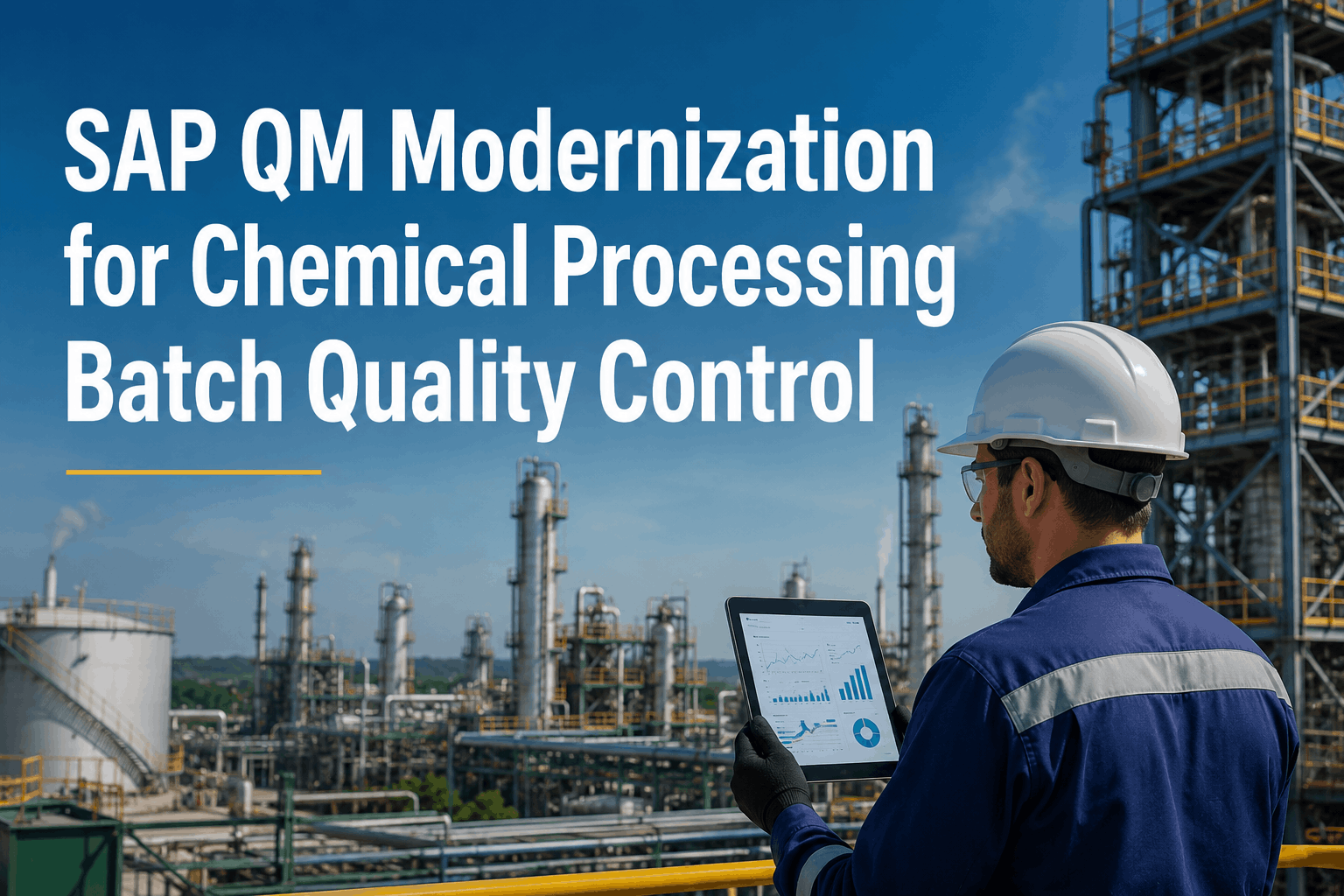
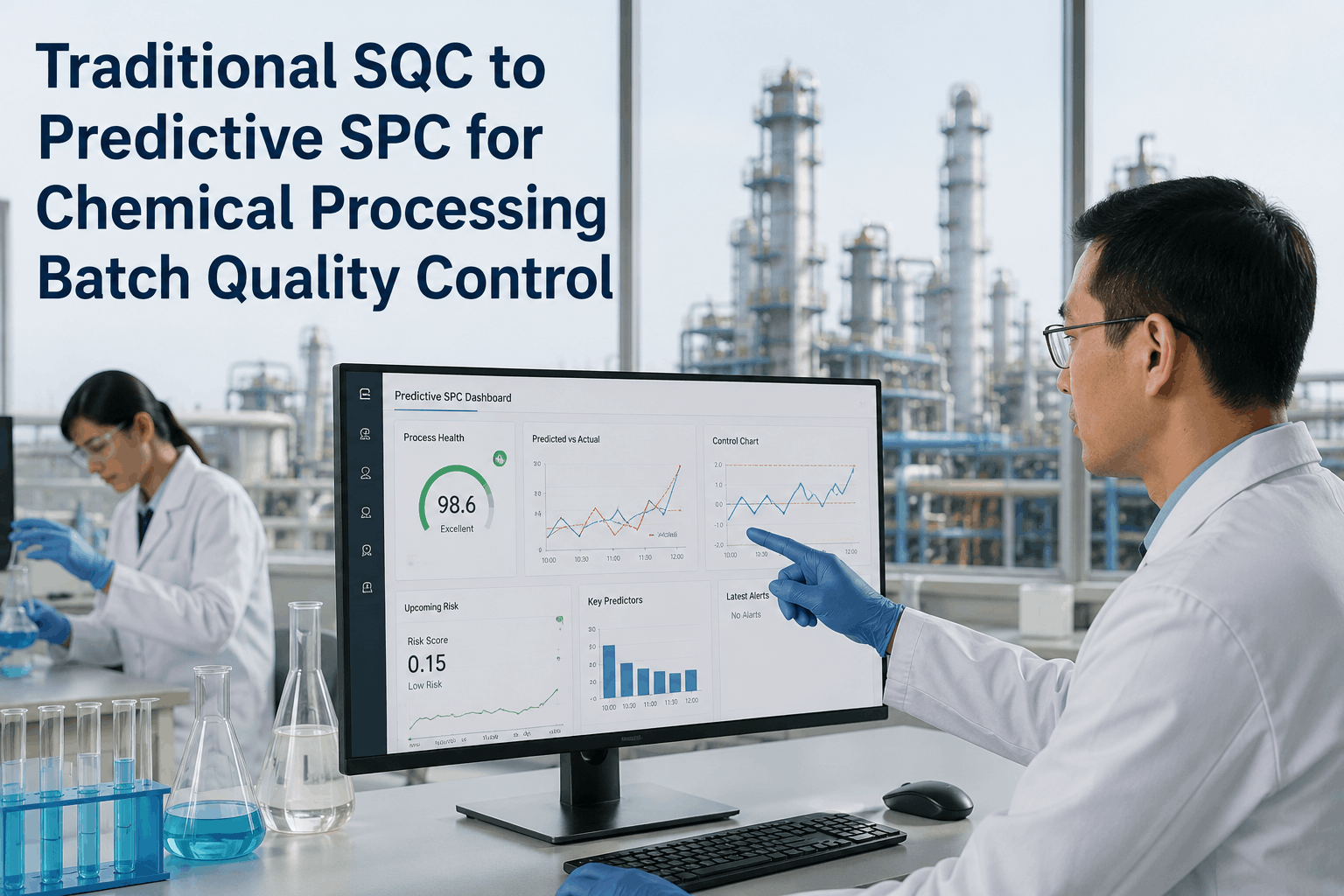
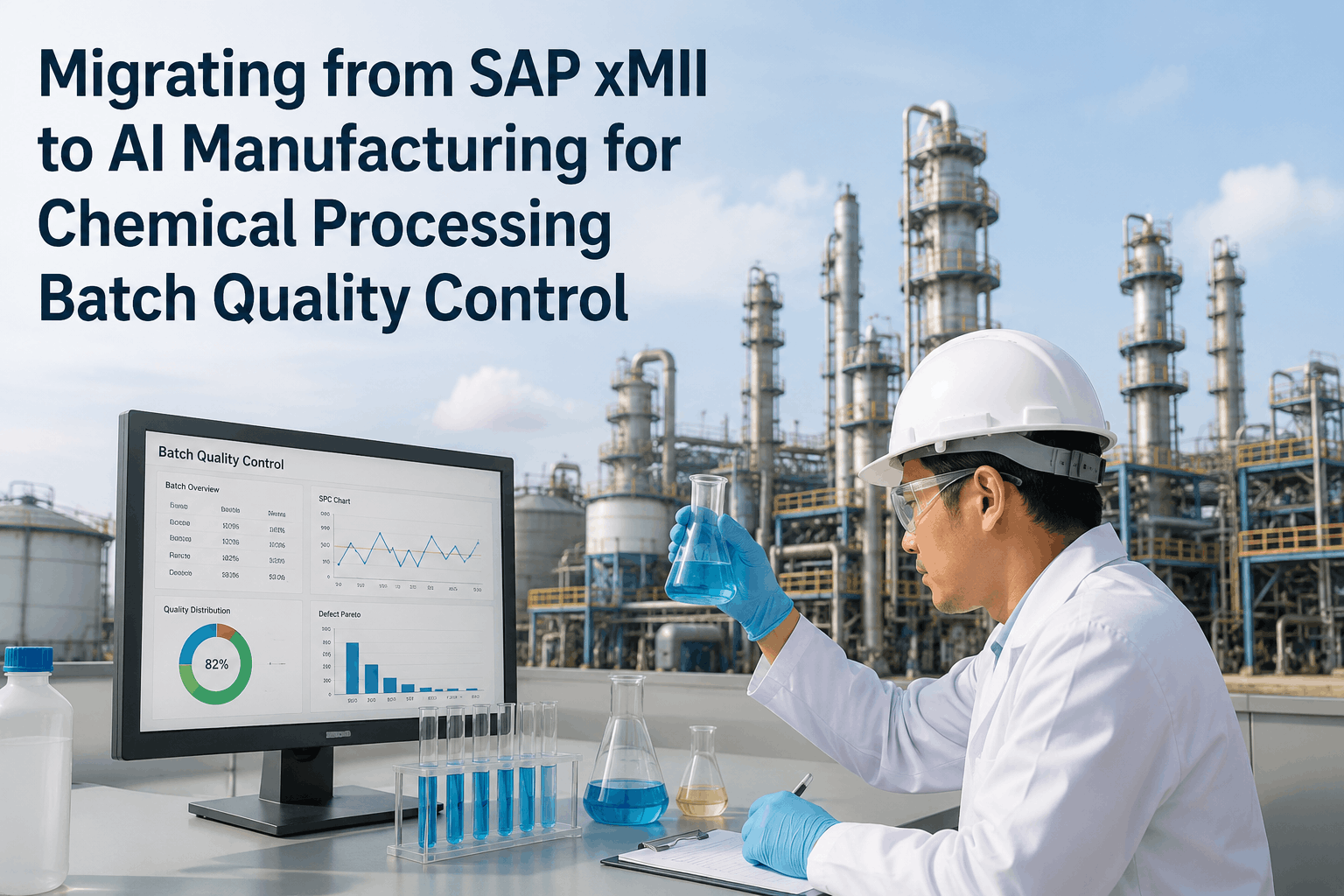
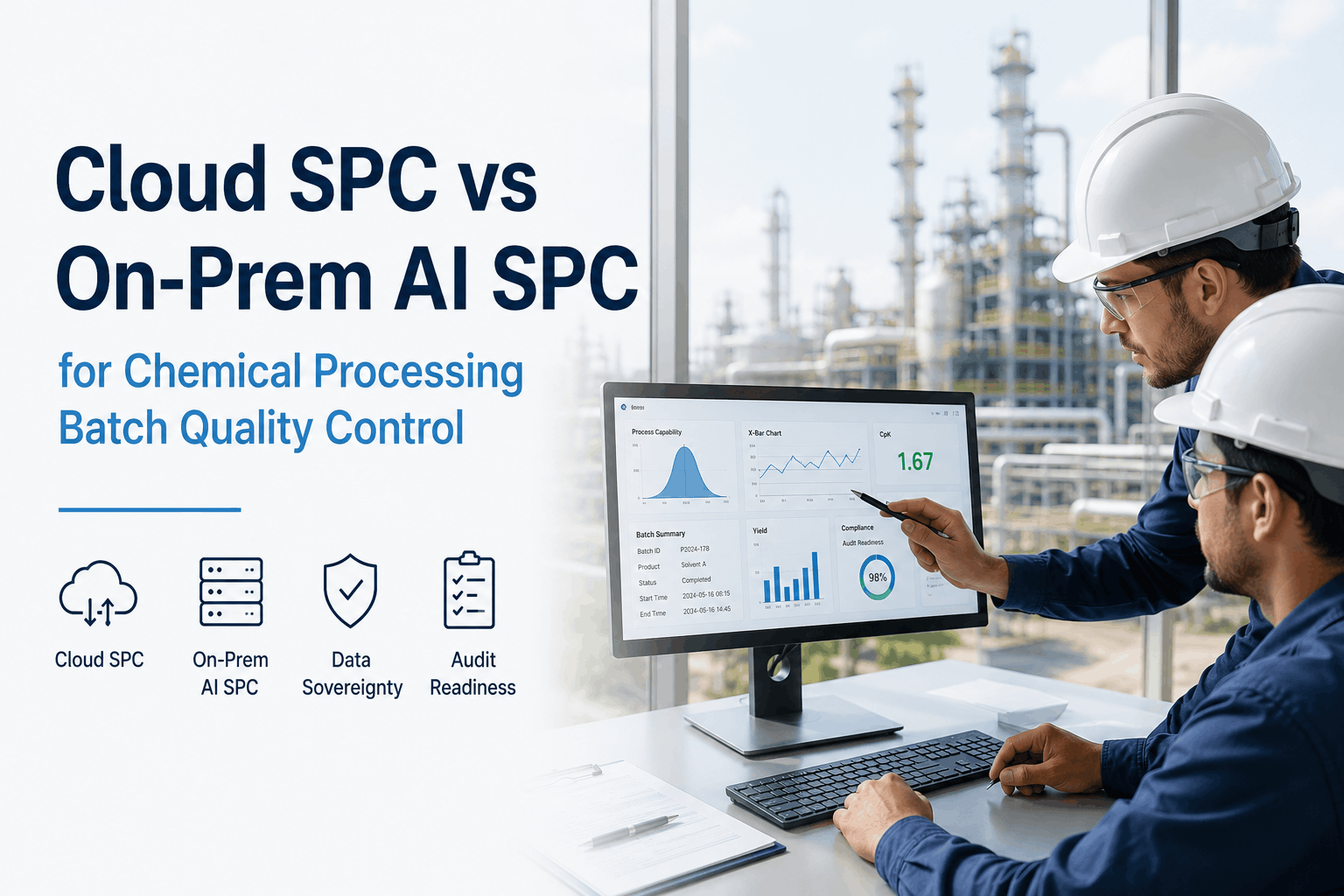
SAP QM has been the compliance backbone of chemical processing quality management for two decades — managing inspection lots, usage decisions, quality notifications, and audit trails across batch operations worldwide. But the version of SAP QM most chemical plants are running today was not designed for process stability prediction. It was designed for process stability documentation. The modern chemical plant needs both: the compliance record that SAP QM provides, and the real-time predictive intelligence that tells operators when stability is about to break — not after it already has. iFactory modernizes SAP QM with AI-native predictive SPC for chemical processing batch quality control, available on-premise or in the cloud. Book an AI SPC Migration Workshop to map the modernization path for your SAP QM environment.
SAP QM Modernization · Predictive SPC · Batch Quality · Process Stability
SAP QM Records Process Stability.
AI Predicts When It's About to Break.
iFactory adds AI-native predictive SPC to your existing SAP QM infrastructure — delivering real-time batch quality intelligence and process stability prediction without replacing the ERP systems your plant depends on.
18–32%
Batch consistency improvement in chemical plants after SAP QM + AI SPC modernization
20–40 min
Earlier process stability warning window vs. standard SAP QM inspection lot review
On-Prem & Cloud
iFactory deploys both — full IP protection on-premise, multi-site intelligence in cloud
What SAP QM Does Well — and Where It Stops
Understanding where SAP QM genuinely excels is as important as understanding where it requires modernization. The modernization case is not that SAP QM is broken — it is that SAP QM was designed to operate in a world where quality assurance happened between batches, not during them. Predictive process stability requires a real-time intelligence layer that SAP QM's architecture was never intended to provide.
SAP QM
What SAP QM Does Well
Inspection lot creation and management per batch
Usage decision and batch disposition workflow
Quality notification routing and closure tracking
Audit trail and compliance documentation (GMP, ISO)
Integration with SAP PP, MM, and SD for batch traceability
Certificate of Analysis generation and LIMS result capture
Keep: SAP QM stays as system of record
No real-time process parameter monitoring during the batch
No predictive stability alerts — only reactive notifications
No multivariate drift detection across correlated parameters
No batch health scoring or outcome probability prediction
No adaptive control limits — static 3-sigma only
No cross-batch learning — each batch evaluated in isolation
Add: iFactory AI SPC fills this gap
The Process Stability Problem in Chemical Batch Operations
Process stability in chemical processing is not a binary state — it is a continuous spectrum. A reactor can be operating within specification limits while its process signature is trending toward instability. Temperature variance increasing across consecutive batches. Pressure response time slowing. Feed composition ratio drifting from its historical mean. Individually, none of these triggers a SAP QM inspection lot failure. Together, they are the early signature of a stability breakdown that will produce an off-spec batch within the next 2–4 hours.
Process Stability Spectrum — What SAP QM Sees vs. What AI Sees
Stable
All parameters centred and consistent
Drifting
Subtle multivariate shift — within limits
Unstable
Limit approaching — correction urgent
Failing
Limit breached — batch compromised
20–40 minute intervention window created by AI predictive SPC
How iFactory Modernizes SAP QM — The 5-Layer Architecture
SAP QM + iFactory AI SPC — Modernized Architecture
Data Sources
Process Historian (PI/PHD/IP21)
DCS / PLC Real-Time
LIMS Results
SAP QM Inspection Lots
Raw Material LIMS
↓
iFactory AI SPC Engine
Multivariate Process Stability Monitoring
Predictive Batch Health Scoring
Adaptive Control Limit Management
Root Cause Correlation Engine
Continuous Compliance Audit Trail
On-Premise
or
Cloud
↓
SAP QM (Unchanged — Receives AI Outputs)
Quality Notifications ← AI stability alerts routed via OData
Inspection Lots ← AI batch disposition recommendations
Audit Trail ← Continuous automated quality records
Usage Decisions ← AI-supported with process evidence
↓
User Layer — Role-Specific Dashboards
Plant Operators: Real-time batch health + intervention alerts
Quality Engineers: Cpk trends + root cause analysis
Supervisors: Shift OEE + stability KPI overview
Quality Directors: Cross-batch analytics + compliance status
Predictive SPC Capabilities Added to SAP QM
01
Real-Time Multivariate Stability Monitoring
AI monitors all process parameters simultaneously — detecting correlated drift patterns that appear stable in individual SAP QM control charts but signal imminent stability breakdown when evaluated as a multivariate signature. Fires a targeted stability alert with the specific parameter combination driving the risk.
Detects 40–60% more stability deviations vs. SAP QM univariate SPC
02
Adaptive Control Limits
SAP QM SPC uses static 3-sigma limits set during initial configuration and rarely updated. iFactory AI calculates adaptive control limits per batch, adjusted for raw material lot variation, equipment wear state, and seasonal process variation — tightening where process capability is proven, widening where natural variation is higher.
35–50% reduction in false stability alarms vs. static SAP QM limits
03
Predictive Batch Outcome Scoring
At every point in the batch cycle, AI calculates the probability of the batch meeting specification at completion — giving quality engineers and operators a live "batch health score" updated every 60 seconds. SAP QM receives the final disposition recommendation with full process evidence attached before the inspection lot is opened.
87–94% batch outcome prediction accuracy at mid-batch
04
Automated SAP QM Notification Routing
When iFactory AI detects a process stability deviation, it automatically creates or updates a SAP QM quality notification with the full process context — parameter values, deviation magnitude, probable cause, and recommended corrective action. Quality engineers receive actionable notifications, not just raw alarms.
Quality notification response time reduced 45% vs. manual SAP QM review
05
Cross-Batch Process Stability Trending
SAP QM evaluates each batch independently. iFactory AI tracks process stability trends across consecutive batches — detecting progressive equipment degradation, gradual catalyst deactivation, or seasonal process drift that produces no single-batch alarm but represents a systematic stability risk requiring intervention.
Identifies 3–5 systematic stability risks per plant per month that SAP QM misses
06
Continuous Compliance Audit Trail
SAP QM generates compliance records after the batch closes. iFactory generates a continuous, timestamped process stability record throughout the batch — every parameter reading, every AI alert, every operator response logged in real time. FDA 21 CFR Part 11 and GMP compliant, both on-premise and cloud deployments.
Compliance preparation time: days → hours with continuous automated trail
On-Premise or Cloud: iFactory Deploys Both Without Feature Compromise
Chemical processing quality operations have the most demanding deployment requirements of any manufacturing sector: proprietary formulations, regulated substance handling, multi-territory IP protection, and GMP data governance. iFactory is the only AI-native SPC platform that delivers full predictive stability capability in both on-premise and cloud architectures — with zero feature trade-off between them. Talk to our team about the architecture that fits your compliance and IT requirements.
On-Premise
Data Sovereignty & IP Protection
All predictive SPC computation stays within your plant network
Zero batch parameters or formulation data transmitted externally
Sub-20ms AI inference latency — edge processing, no cloud dependency
FDA 21 CFR Part 11 and GMP data residency fully compliant
Air-gap compatible for highest-security regulated environments
Direct DCS, PI historian, LIMS, and SAP QM — zero middleware
Best for: regulated chemical, pharma-chem, proprietary process IP
Discuss On-Premise
OR
Cloud
Multi-Site Stability Intelligence
Cross-facility batch stability benchmarking in real time
Centralised SAP QM quality dashboards across all plants
Mobile stability alerts for quality directors and supervisors
Automatic AI model updates — continuous improvement, no IT effort
Fleet-wide learning — stability insights from one plant benefit all
SOC 2 Type II — encrypted, regionally configurable data residency
Best for: multi-site chemical groups, centralised quality operations
Discuss Cloud Setup
Modernization Outcomes: Process Stability After AI SPC Deployment
18–32%
Batch consistency improvement within 90 days of AI SPC modernization
vs. SAP QM baseline
40–60%
More stability deviations caught via AI multivariate vs. SAP QM SPC
Detection uplift
35–50%
Fewer false stability alarms with adaptive AI control limits
Operator workload
90 days
Typical time from project kickoff to full SAP QM + AI SPC cutover
Migration timeline
FAQ: SAP QM Modernization for Chemical Batch Quality Control
Does SAP QM modernization mean replacing SAP QM entirely?
No — and this is the most critical point. SAP QM remains the system of record for inspection lots, usage decisions, quality notifications, and compliance documentation throughout and after modernization. iFactory adds the predictive intelligence layer — real-time stability monitoring, multivariate drift detection, adaptive SPC — while writing all outputs back to SAP QM via standard OData interfaces. The SAP QM configuration, quality notification workflows, and ERP integration stay completely unchanged. From SAP's perspective, it receives higher-quality, faster, and more structured inputs from iFactory than it did from the previous xMII or manual entry workflow.
How does iFactory connect to SAP QM without custom ABAP development?
iFactory uses SAP's standard OData services for quality management — the same integration points SAP provides for authorised system connectivity. Quality notification creation, inspection lot status updates, usage decision recommendations, and audit trail records all flow through standard SAP QM OData APIs. No custom ABAP development is required for standard integration scenarios. Full SAP QM connector configuration typically completes in 5–10 business days, with live quality data flowing within 48 hours of deployment start.
Book a workshop to review the SAP QM integration design for your system.
What is "predictive SPC" and how does it differ from the SPC currently in SAP QM?
SAP QM SPC monitors individual parameters against fixed control limits and fires notifications when breaches occur — retrospective detection. Predictive SPC uses AI models trained on historical batch data to identify the multivariate trajectory patterns that precede process stability failures — detecting drift before any individual limit is breached. The practical difference: SAP QM SPC tells you a stability problem has occurred. Predictive SPC tells you a stability problem is developing — with a 20–40 minute intervention window during which correction is still possible.
Can iFactory be deployed on-premise to protect our proprietary chemical formulations?
Yes — on-premise is a core iFactory deployment architecture, not a premium option. All predictive SPC computation, AI model inference, process stability monitoring, and quality data processing happens entirely within your plant network. No batch parameters, process signatures, formulation data, or quality records are transmitted to external systems. The on-premise deployment meets FDA 21 CFR Part 11 requirements for electronic records and audit trails, and supports GMP data governance for pharmaceutical chemical manufacturing. Both on-premise and cloud deployments deliver identical predictive SPC capability.
How long does the SAP QM modernization take and what disruption should we expect?
The standard modernization timeline is 10–12 weeks from project kickoff to full production cutover. iFactory runs alongside the existing SAP QM and xMII configuration for a 2–4 week parallel validation period — during which quality teams verify that iFactory outputs match or exceed the previous workflow without any change to production operations. AI model training on historical batch data runs in the background during this period. Production is never disrupted during modernization. The SAP QM integration goes live in the same deployment window, adding 5–10 business days of configuration work that runs in parallel with AI training rather than sequentially.
iFactory · SAP QM Modernization · Chemical Processing
Modernize SAP QM With Predictive SPC.
Turn Compliance Records Into Stability Intelligence.
iFactory adds AI-native predictive SPC to your existing SAP QM infrastructure — delivering real-time process stability monitoring, adaptive control limits, and predictive batch scoring for chemical processing batch quality control. On-premise or cloud. No SAP disruption. 90-day modernization.
SAP QM Modernization
Predictive SPC
On-Premise Available
Cloud Available
No Custom ABAP
GMP & FDA 21 CFR Part 11