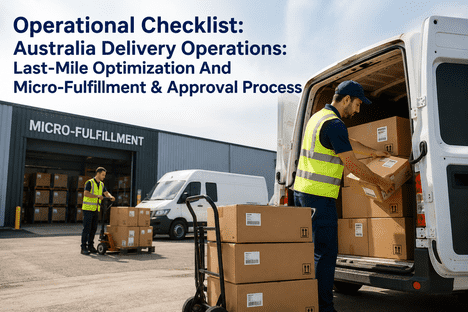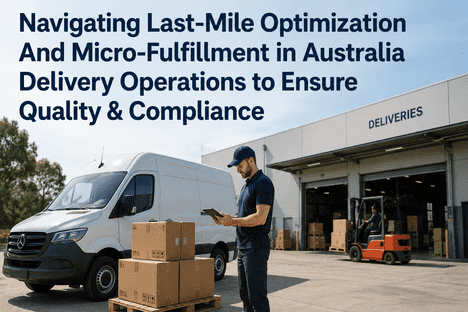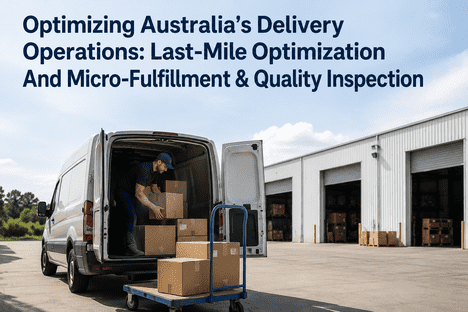
A pharmaceutical manufacturer in Melbourne packs a time-sensitive order for 14 hospital pharmacies across the Sydney metropolitan area. The order is picked, packed, and labelled at the central distribution centre in western Sydney by 10:00 AM. The delivery fleet dispatches at 11:00 AM with 28 stops across a delivery radius of 60 kilometres. By 3:00 PM, seven of the 14 hospitals have received their orders on time and in full. Two more are delivered by 4:30 PM with minor delays due to traffic congestion on the M5 motorway. The remaining five including a paediatric hospital with a critical medication shortage are not delivered until the following morning because the driver could not access the secure loading dock within the hospital's prescribed 30-minute delivery window, the shipment was returned to the depot, and the redelivery was scheduled for the next day's route. The hospital pharmacy manager files a formal complaint. The pharmaceutical distributor incurs a $2,400 service level penalty and loses the hospital's next-day delivery slot to a competitor who guarantees time-definite delivery with real-time tracking. That is the cost of running last-mile delivery operations in Australia's densely populated urban corridors without AI-driven dispatch optimisation, micro-fulfillment positioning, and pre-dispatch quality verification that ensures every shipment is accurate, compliant, and ready for time-sensitive delivery before it leaves the facility.
The Three Pillars of Australia's Delivery Operations Transformation
Australia's delivery operations face a unique set of challenges that distinguish them from markets in Europe, North America, or Asia. The population is concentrated in a handful of major urban centres Sydney, Melbourne, Brisbane, Perth, Adelaide separated by vast distances that make national distribution networks expensive and complex. Within those urban centres, traffic congestion, limited loading dock availability, and strict delivery window requirements create last-mile execution risks that can derail even the best-planned dispatch schedule. And across all product categories pharmaceuticals, food and beverage, consumer goods, industrial supplies — regulatory compliance requirements (TGA for therapeutics, FSANZ for food, state-based transport regulations) demand rigorous documentation that must accompany every shipment. The solution to these challenges rests on three interconnected pillars: last-mile route optimization, micro-fulfillment network design, and pre-dispatch quality inspection and verification.
Last-Mile Delivery — The Australian Urban Challenge
Australia's major cities present a last-mile delivery environment that is distinct from any other market. Sydney's geography — constrained by the harbour, national parks, and the Blue Mountains — creates a spoke-and-wheel road network where the M5, M4, and M2 motorways converge on the CBD, producing predictable peak-hour congestion that can double delivery times within a 15-kilometre radius of the city centre. Melbourne's urban sprawl extends 40 kilometres from the CBD in every direction, with the West Gate Bridge and Monash Freeway creating bottleneck points that affect every delivery route crossing the Yarra River. Brisbane's river-city layout, combined with the Gateway Motorway and Pacific Motorway corridors, creates a delivery environment where route efficiency depends heavily on bridge and tunnel availability. Perth's low-density urban form means delivery vehicles travel greater distances per stop than any other Australian capital city. And in every city, the delivery density is further complicated by Australia's unique combination of high-volume retail DCs, hospital loading docks with 30-minute delivery windows, and residential delivery points in apartment buildings without designated delivery areas. AI-driven last-mile route optimization that accounts for these city-specific constraints — not generic routing algorithms designed for North American or European grid patterns — is essential for achieving the on-time delivery performance that the Australian market demands.
Traditional Last-Mile Delivery vs AI-Powered Micro-Fulfillment and Quality Inspection
- Routes planned manually or with basic GPS route planners that do not integrate real-time traffic, toll costs, or delivery window constraints — dispatchers spend 2-3 hours per shift building route plans
- All inventory held at central warehouse — last-mile travel distances of 30-60 km per delivery; same-day delivery limited to a 10 km radius from the central DC; next-day delivery standard for 80% of metropolitan orders
- Quality inspection at dispatch relies on manual visual checks — picking errors detected at customer receiving, not at the loading dock; packaging damage discovered after transit; documentation gaps found at delivery causing carrier detention
- Clearance pass is a paper sign-off on the bill of lading — no digital record of what was verified, when, and by whom; carrier handover disputes resolved through time-consuming investigation of paper records
- Customer delivery windows are communicated by phone or email — no real-time tracking visibility; delivery delays communicated reactively after the window has already been missed
- Compliance documentation assembled manually after dispatch — TGA and FSANZ audit preparation requires 2-3 days of record gathering from paper files and shared drives
- AI route optimization engine integrates real-time traffic data, toll road costs, delivery window constraints, and vehicle capacity — route plans generated in under 30 seconds and updated dynamically when disruptions occur
- Micro-fulfillment hubs positioned within 10 km of population centres using AI demand forecasting — last-mile travel distance reduced to 5-15 km per delivery; same-day delivery standard for 90% of metro orders within a 2-4 hour delivery window
- AI vision inspection at the dispatch checkpoint verifies quantity, packaging integrity, and documentation completeness in under 5 seconds per pallet — errors detected and corrected before the shipment leaves the facility
- Digital clearance pass with QR code issued automatically after all checks pass — handover logged with driver ID, trailer number, and timestamp; searchable digital record resolves disputes in seconds
- Real-time tracking with proactive customer notifications — delivery ETA shared automatically; delay notifications sent before the delivery window is missed, not after
- Auto-generated compliance reports with every inspection result, document validation, and clearance pass — TGA and FSANZ audit pack generated in under 60 seconds
Industry Perspective — What Australian Logistics Leaders Say About AI-Powered Delivery Operations
The ROI of AI-Powered Delivery Operations for Australian Manufacturers and Distributors
The business case for deploying AI-powered last-mile optimization, micro-fulfillment, and pre-dispatch quality inspection in Australia's delivery operations is driven by measurable cost reduction and revenue protection across four primary value drivers. The table below maps each value driver to its data source, typical improvement range, and the annual financial impact for a mid-volume Australian manufacturer or distributor shipping 200-500 orders per day across metropolitan and regional routes.
| Value Driver | Data Source | Typical Improvement | Annual Financial Impact (200-500 orders/day) |
|---|---|---|---|
| Last-mile route optimization — reduced km driven and improved stop density | AI route engine with real-time traffic and toll integration | 25-35% reduction in km driven per delivery | $80,000-$180,000 in fuel, maintenance, and driver time savings |
| Micro-fulfillment hub positioning — faster delivery cycles and expanded same-day coverage | AI demand forecasting and hub inventory optimization | 50% faster delivery cycle time; same-day coverage expanded from 10 km to 30+ km radius | $120,000-$250,000 in revenue from expanded same-day service and improved customer retention |
| Pre-dispatch quality inspection — eliminated defective, short, or non-compliant shipments | AI vision quantity check + packaging inspection + document validation | 90% reduction in customer-reported delivery failures caused by dispatch errors | $60,000-$150,000 in avoided penalty charges, re-delivery costs, and compliance fines |
| Digital clearance and audit automation — eliminated manual paperwork and compliance preparation | Digital clearance pass + auto-generated compliance reports | 60-80% reduction in dispatch documentation labour; audit prep time reduced from days to minutes | $40,000-$90,000 in labour savings and reduced compliance risk |
Frequently Asked Questions: Australia's Last-Mile Optimization and Micro-Fulfillment
The route optimization engine integrates real-time traffic data feeds from each state's transport authority — Transport for NSW, VicRoads, Main Roads WA, Department of Transport and Main Roads QLD — providing live traffic speed, incident, and road closure data across every major urban corridor. Toll road costs are calculated using the published toll schedules for each city's toll road operator — Transurban for Sydney's M5, M4, M2, M7, and M1; Transurban and CPB Contractors for Melbourne's CityLink and EastLink — and are incorporated as a variable cost factor in the route optimization algorithm. The engine also integrates delivery window constraints from customers — hospitals with 30-minute receiving dock windows, retail DCs with 2-hour appointment slots, pharmacies with specific delivery day cutoffs — and calculates the optimal route that minimizes total cost (fuel + tolls + driver time) while meeting every delivery constraint. The route plan is recalculated dynamically when a disruption occurs — a crash on the West Gate Bridge that adds 25 minutes to a Melbourne route, or a last-minute delivery window change from a Sydney hospital — and the updated route is pushed to the driver's mobile device within seconds.
The capital investment for a micro-fulfillment hub depends on the facility size, automation level, and location. Typical hub configurations range from $150,000 for a manual 200-square-metre facility with racking and a delivery bay, to $500,000 for a semi-automated 500-square-metre hub with conveyor sorting and cross-docking capability. The payback period is typically 9-18 months, driven by three primary value sources: reduced last-mile delivery cost (25-35% reduction in km driven translates to $40,000-$90,000 per year per hub in fuel, maintenance, and driver time savings), expanded same-day delivery coverage that enables premium service offerings (same-day delivery typically commands a $15-$35 surcharge per order), and improved customer retention from faster, more reliable delivery service. iFactory's AI demand forecasting module helps determine the optimal hub location, size, and SKU mix before the capital commitment is made — so the hub is positioned and stocked to maximize ROI from day one.
Yes. The AI vision inspection model is trained on a comprehensive dataset of Australian packaging formats — pharmaceutical cartons and shippers with TGA labelling requirements, food-grade packaging with FSANZ labelling standards, industrial supply totes and crates, and mixed-SKU pallets common in Australian third-party logistics operations. The model detects unit count for regular and irregular case configurations, identifies label presence and legibility for both primary and secondary labels, inspects seal integrity for pharmaceutical and food-grade packaging, and evaluates stack stability for pallets of any configuration. The model is configured during initial deployment with a 2-hour calibration session that captures your specific packaging formats, label types, and pallet configurations. For operations handling multiple packaging formats across different product categories, the model automatically switches between detection profiles based on the product data received from the WMS. Talk to an expert about configuring the vision inspection model for your specific packaging formats and regulatory requirements.
The platform's documentation validation module is configured with a comprehensive regulatory ruleset covering Australia's federal and state-level requirements. For TGA-regulated products (pharmaceuticals, medical devices, therapeutic goods), the system validates that every shipment includes the required certificate of analysis, lot traceability records, and any applicable import/export permits. For FSANZ-regulated food products, the system validates labelling compliance with the Australia New Zealand Food Standards Code, including allergen declarations, country of origin labelling, and date marking requirements. State-specific transport regulations — including Western Australia's quarantine requirements for incoming food shipments, Queensland's transport of dangerous goods regulations, and New South Wales' pharmaceutical supply chain security requirements — are incorporated into the documentation validation ruleset. When a shipment's documentation package is assembled, the system checks every document against both the federal and destination-state regulatory requirements and blocks clearance if any gap is detected. The compliance record is stored with the shipment data and is accessible in seconds for TGA or FSANZ audit requests. Book a Demo to see the compliance documentation workflow configured for your regulatory environment.
The implementation timeline for the full iFactory delivery operations platform — including AI route optimization, micro-fulfillment coordination, AI vision quality inspection, and digital clearance workflows — typically ranges from 6 to 14 weeks depending on the number of facilities, delivery routes, and integration requirements. The deployment is phased: Phase 1 (weeks 1-4) focuses on AI vision inspection setup at the primary dispatch checkpoint, WMS/ERP integration, and digital clearance pass configuration. Phase 2 (weeks 3-8) adds route optimization engine configuration, real-time traffic data integration, and driver mobile app deployment. Phase 3 (weeks 6-14) implements micro-fulfillment hub coordination, demand forecasting model training, and cross-docking workflow configuration. The ROI timeline is typically 6-10 months for most Australian operations, with the AI vision inspection and route optimization components delivering measurable cost savings within the first 90 days of operation. Book a Demo to receive an implementation timeline and ROI projection tailored to your specific facility, route network, and product mix.
Conclusion
Australia's delivery operations are at an inflection point. Urban congestion is increasing. Customer expectations for same-day and time-definite delivery are rising. Regulatory compliance requirements from the TGA, FSANZ, and state transport authorities are becoming more stringent. And the margin for error in last-mile delivery — where a missed 30-minute hospital delivery window can trigger a $2,400 penalty and the loss of a customer to a competitor — leaves no room for manual dispatch processes, paper-based quality checks, and reactive route planning.
AI-powered last-mile route optimization, micro-fulfillment hub positioning, and pre-dispatch quality inspection create a delivery operations framework that addresses all three challenges simultaneously. Routes are optimized in real time for Australian traffic conditions and toll road costs. Inventory is positioned at micro-fulfillment hubs within 10 kilometres of major population centres, enabling same-day delivery windows that drive customer retention and revenue growth. And every shipment is inspected, verified, and cleared for departure by AI vision systems that detect quantity errors, packaging defects, and documentation gaps before the truck leaves the loading dock — eliminating the delivery failures that erode customer trust and regulatory compliance standing.
The technology to transform Australia's delivery operations with AI-powered optimization and inspection is available today. The question is not whether Australian manufacturers and distributors will adopt these capabilities — it is whether your operation will lead the transformation or play catch-up after your competitors have already deployed the last-mile optimization, micro-fulfillment, and quality verification infrastructure that defines the new standard for delivery performance in the Australian market.
iFactory's AI-powered delivery operations platform is purpose-built for Australian supply chains — with real-time last-mile route optimization that integrates Australian traffic data and toll road costs, micro-fulfillment hub coordination enabled by AI demand forecasting, AI vision quantity and packaging inspection at the dispatch checkpoint, automated documentation validation for TGA and FSANZ compliance, and digital clearance passes that ensure only verified shipments leave the facility. Book a Demo to see the platform configured for your facility and delivery network, or talk to an expert about a live walkthrough on your delivery data and compliance requirements.