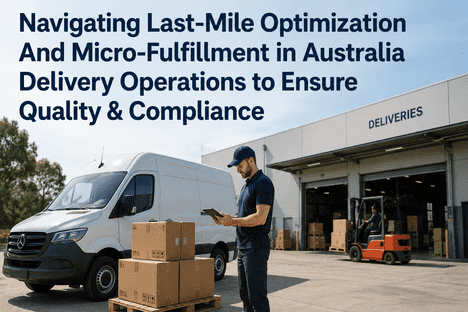
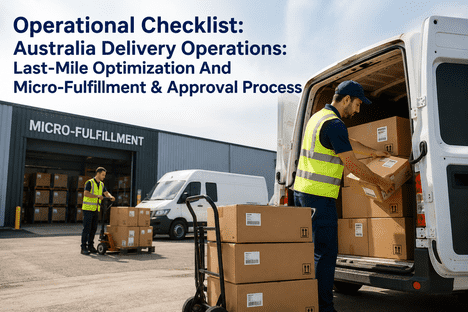
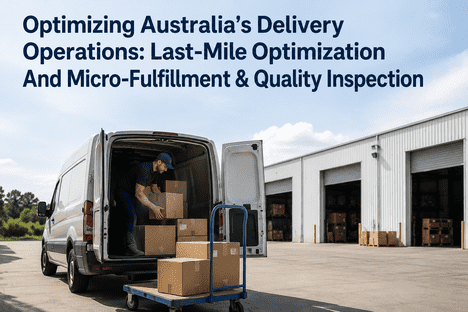
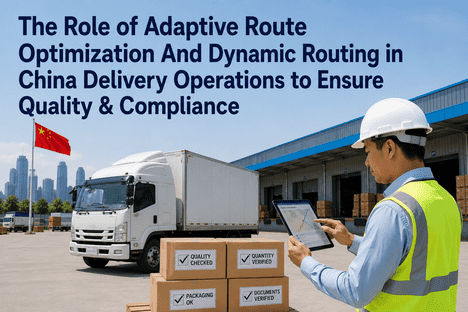
Australia's last-mile delivery network faces a convergence of pressures that demand a fundamental rethinking of how shipments are inspected, verified, and cleared before dispatch. With urban congestion intensifying across Sydney, Melbourne, Brisbane, and Perth, and the tyranny of distance adding cost and complexity to regional routes, the margin for error in pre-dispatch quality assurance has never been thinner. AI-driven inspection systems are changing this paradigm by applying computer vision, sensor fusion, and automated workflow orchestration to every shipment that leaves a micro-fulfillment center or distribution hub. Operations teams that have already Book a Demo of iFactory's AI-powered delivery quality platform are achieving measurable improvements in dispatch accuracy, on-time compliance, and customer satisfaction across Australia's most demanding delivery corridors.
DELIVERY QUALITY INTELLIGENCE
Are Your Last-Mile Shipments Leaving the Warehouse with Verified Quality?
iFactory delivers AI-driven inspection and workflow automation for delivery operations — checking product quality, verifying quantity accuracy, ensuring packaging standards, and automating clearance before every dispatch.
92%
Reduction in mis-shipped items through AI-powered quantity verification and product matching at dispatch
35%
Faster dispatch cycle time through automated documentation generation and digital approval workflows
78%
Fewer in-transit damage claims when AI vision inspection validates packaging standards before clearance
99.2%
Clearance pass accuracy achieved through integrated approval workflows and compliance verification
The Growing Challenge of Last-Mile Quality Assurance in Australia
Why Traditional Inspection Methods Cannot Keep Pace with Modern Delivery Volumes
Australia's delivery operations present a uniquely demanding quality assurance environment. A single distribution hub serving Sydney and regional New South Wales may process 15,000 to 25,000 shipments daily across a service area spanning over 800 kilometers. Each shipment requires verification of product condition, quantity accuracy, packaging integrity, and documentation completeness before it can be cleared for dispatch. Manual inspection workflows that depend on visual checks, paper checklists, and supervisor approvals create bottlenecks that delay dispatch and allow errors to slip through. Micro-fulfillment centers deployed across Australian metro areas compound this challenge by distributing inventory across dozens of smaller nodes, each requiring the same rigorous pre-dispatch inspection but with smaller staff and tighter turnaround windows. Facilities that have evaluated iFactory's delivery quality platform typically discover 5-8 recurring inspection gaps during the initial workflow audit that their existing manual processes had been missing for months.
5 Root Causes of Pre-Dispatch Quality Failures in Australian Delivery Operations
Diagnosing the Inspection Gaps Before the Next Compliance Incident
01
Manual Product Quality Verification at Scale
Visual inspection of product condition before dispatch remains the primary quality gate in most Australian distribution centers, yet human inspectors consistently miss 10-15% of visible defects during high-volume sortation periods. iFactory's AI vision inspection applies trained computer vision models that detect product damage, surface defects, and seal integrity issues at line speed, flagging non-conforming items before they enter the delivery stream.
02
Quantity Verification Errors at Handover Points
The transfer of shipments from picking to packing to dispatch staging creates multiple handover points where quantity discrepancies can be introduced. A picker may scan 24 units but only place 23 in the tote; a packer may consolidate two orders incorrectly. iFactory's AI-enabled quantity verification uses weight correlation, dimensional scanning, and count confirmation at each handover to catch discrepancies before the shipment is sealed and assigned to a route.
03
Packaging Standards Non-Compliance for Long-Haul Routes
Shipments destined for regional and remote Australian locations — Broken Hill, Mount Isa, Alice Springs — face transport durations of 12 to 36 hours over road conditions that differ dramatically from metro delivery routes. Standard packaging that survives a 30-minute Sydney metro run may fail catastrophically on a two-day journey across the Nullarbor. iFactory's AI vision system validates packaging adequacy against route-specific standards, flagging under-protected shipments before they are loaded for long-haul transport.
04
Incomplete or Inaccurate Documentation at Dispatch
Australian delivery documentation requirements vary by state, route type, and cargo classification. A shipment traveling from Melbourne to Sydney may require different chain of responsibility documentation than one moving from Brisbane to Cairns. Manual documentation preparation introduces errors — missing consignment notes, incorrect dangerous goods declarations, or outdated compliance certificates — that can delay dispatch or trigger regulatory penalties. iFactory automates documentation generation from order data and validates completeness against destination-specific requirements before issuing the clearance pass.
05
Disconnected Approval Workflows Across Multiple Stakeholders
A single shipment may require quality approval from the inspection team, compliance sign-off from the documentation desk, and final authorization from the dispatch supervisor. In most Australian distribution centers, these approvals are managed through email chains, paper forms, or siloed software systems that create delays and audit gaps. iFactory unifies all approval steps into a single digital workflow that tracks each sign-off in real time, ensuring no shipment is cleared without all required authorizations.
The True Cost of Dispatch Quality Failures in Australian Last-Mile Delivery
Assessing the Financial and Reputational Impact of Inspection Gaps
A single quality failure at the dispatch stage cascades through the entire delivery chain, incurring costs that far exceed the value of the affected shipment. Damaged goods must be returned and replaced, consuming reverse logistics capacity and triggering customer compensation. Quantity discrepancies require investigation, reconciliation, and often re-shipment at the carrier's expense. Documentation errors can result in regulatory penalties under Australia's Heavy Vehicle National Law and Chain of Responsibility provisions. Each failed delivery erodes customer trust and increases churn risk in a market where same-day alternatives are proliferating through micro-fulfillment investments from major retailers.
| Failure Mode |
Primary Quality Impact |
Secondary Operational Risk |
Annualized Cost Range |
| Damaged Goods in Transit |
Customer Returns & Refunds |
Reverse Logistics Capacity Drain |
$180K – $520K |
| Quantity Mismatch at Delivery |
Re-Shipment & Investigation Cost |
Customer Trust Erosion |
$120K – $380K |
| Packaging Failure on Regional Routes |
Product Damage & Spoilage |
Long-Haul Route Profitability |
$95K – $280K |
| Documentation Compliance Gap |
Regulatory Penalty Exposure |
HVNL / CoR Non-Compliance |
$65K – $190K |
| Incorrect Product Dispatched |
Missed Delivery SLA |
Customer Compensation |
$50K – $150K |
What Genuine AI-Powered Pre-Dispatch Quality Assurance Requires
The Architecture of an Intelligent Delivery Inspection Platform
Comprehensive AI-driven quality assurance for last-mile delivery operations requires five core capabilities that work together to eliminate inspection gaps and automate the clearance process. These capabilities must function at line speed across high-volume distribution hubs and micro-fulfillment centers alike, adapting to the specific quality requirements of each route, customer, and cargo type.
AI Vision Product Inspection
Trained computer vision models inspect every item at line speed for visible defects, surface damage, seal integrity, and label accuracy. The system flags non-conforming items and routes them to a quality hold area for resolution, preventing damaged products from entering the delivery stream.
Multi-Point Quantity Verification
Weight correlation, dimensional scanning, and AI-driven count confirmation at every handover point — picking, packing, staging, and loading — ensures quantity accuracy from warehouse to delivery vehicle. Discrepancies are flagged in real time with automated reconciliation workflows.
Route-Specific Packaging Validation
Packaging adequacy is validated against route-specific standards — metro, suburban, regional, or remote — using AI vision analysis of box integrity, cushioning adequacy, seal quality, and labeling compliance. Under-protected shipments are flagged before loading.
Automated Documentation & Compliance
All required delivery documentation — consignment notes, dangerous goods declarations, chain of responsibility forms — is generated automatically from order data and validated against destination-specific requirements. The system will not issue a clearance pass until documentation is complete.
Unified Digital Approval Workflow
All quality, compliance, and dispatch approvals are consolidated into a single digital workflow with real-time status tracking, automated escalations, and a complete audit trail. Shipments are cleared only when all required authorizations have been obtained.
QUALITY ASSURANCE AUTOMATION
Transform Your Pre-Dispatch Inspection with AI-Powered Quality Gates
iFactory's AI-driven inspection platform eliminates manual quality gaps, automates approval workflows, and ensures every shipment meets quality, quantity, packaging, and documentation standards before it leaves your facility.
The 5-Step Framework for Deploying AI-Driven Quality Assurance in Australian Delivery Operations
Step 01
Audit Current Inspection Workflows and Identify Quality Gaps
Map every quality touchpoint from goods receipt through picking, packing, staging, and loading. Identify where manual inspection creates bottlenecks, where errors are introduced at handover points, and where documentation compliance gaps exist. iFactory provides a complimentary workflow audit as part of the evaluation.
Step 02
Deploy AI Vision Stations at Critical Quality Gates
Install AI-powered vision inspection stations at packing verification and dispatch staging locations. Configure the computer vision models to detect your specific product types, defect categories, and packaging requirements. The system begins flagging quality issues within the first shift of operation.
Step 03
Configure Route-Specific Quality Standards
Define packaging, documentation, and inspection requirements for each route type in your network — metro, suburban, regional, and remote. iFactory's platform applies these standards automatically to every shipment based on its destination, ensuring appropriate quality controls for each delivery corridor.
Step 04
Implement Digital Approval and Clearance Pass Workflows
Configure automated approval routing for quality inspection, documentation compliance, and dispatch authorization. Define clearance pass criteria that require all quality, quantity, packaging, and documentation checks to pass before a shipment is cleared for loading. The system issues clearance passes automatically for compliant shipments.
Step 05
Monitor, Analyze, and Continuously Improve Quality Metrics
Deploy the unified quality dashboard that displays inspection pass rates, documentation compliance, clearance pass accuracy, and quality trend data across all distribution nodes. Operations teams that
Book a Demo receive a complimentary pre-dispatch quality assessment as part of the evaluation.
"We operate a multi-node distribution network serving the Sydney metro area and regional New South Wales, processing over 18,000 shipments daily across three distribution centers and six micro-fulfillment hubs. Our manual inspection process was the bottleneck — we were catching most errors, but the ones that slipped through were expensive. After deploying iFactory's AI-powered quality assurance platform, we eliminated manual inspection delays entirely, reduced mis-shipments by 92%, and cut our damage-related return rate by 68%. The clearance pass workflow alone saved us four hours per shift in supervisor approval time. We now have complete visibility into every shipment's quality status from the moment it is picked until it is loaded onto the delivery vehicle."
Head of Distribution Operations
Major Australian Retail and E-Commerce Logistics Provider, Sydney Metro & Regional NSW Network
Regulatory Compliance and Chain of Responsibility Requirements
Meeting Australia's Heavy Vehicle National Law and CoR Obligations Through Automated Quality Assurance
Australia's Heavy Vehicle National Law and Chain of Responsibility framework place legal obligations on every party in the transport supply chain, including consignors, packers, loaders, and receivers. Quality inspection and documentation accuracy at the dispatch stage are critical components of CoR compliance, as inaccurate documentation or improperly loaded shipments can result in penalties for all parties in the chain. AI-driven quality assurance provides the audit trail and process control needed to demonstrate compliance with HVNL requirements.
Chain of Responsibility Compliance
iFactory's digital approval workflow creates a complete audit trail of every quality inspection, documentation check, and clearance authorization. This provides verifiable evidence of compliance with CoR obligations for consignors and packers, including load restraint verification, mass compliance, and documentation accuracy.
HVNL Mass & Dimension Compliance
AI-driven dimensional scanning and weight verification at the dispatch stage ensure every shipment falls within legal mass and dimension limits before loading. The system flags over-mass or over-dimensional shipments and prevents them from being cleared, reducing CoR exposure for the consignor.
Dangerous Goods Documentation
Shipments containing dangerous goods require specific documentation, packaging, and labeling under Australian Dangerous Goods Code requirements. iFactory's platform validates dangerous goods declarations, packaging compliance, and labeling accuracy before issuing the clearance pass.
Fatigue Management Record Keeping
While driver fatigue management is primarily an operator responsibility, consignors must ensure dispatch schedules are consistent with legal driving hours. iFactory's dispatch scheduling module provides visibility into driver hour compliance and flags dispatch assignments that may create fatigue management risks.
Frequently Asked Questions
How does AI vision inspection handle product variability across different delivery routes?
iFactory's AI vision models are trained on your specific product catalog and packaging types, with the ability to detect a wide range of defects — surface damage, seal integrity issues, labeling errors, and packaging degradation. The system applies route-specific quality standards automatically, so a shipment destined for a 30-minute Sydney metro delivery may have different packaging requirements than one traveling 18 hours to Broken Hill. The AI models continuously learn from inspection outcomes, improving detection accuracy over time as they process more shipments across your network.
Can iFactory integrate with existing warehouse management and order management systems?
Yes.
iFactory features pre-built connectors for the most common WMS and OMS platforms used in Australian distribution operations, including SAP EWM, Manhattan Associates, Blue Yonder, Oracle WMS, and HighJump. The platform ingests order data, pick lists, and shipment manifests to automate inspection workflows and documentation generation. Integration across the full distribution network — including micro-fulfillment centers — is typically completed in 14-21 days.
What is the typical payback period for deploying AI-driven quality assurance in delivery operations?
iFactory's delivery quality deployments typically achieve full payback within 6 to 12 months, driven by four primary value streams: reduced return processing costs (68-78% reduction in damage-related returns, representing $150,000-$400,000 annually for a mid-size distribution hub), elimination of re-shipment costs from quantity discrepancies, reduced regulatory penalty exposure through automated documentation compliance, and improved dispatch throughput that delays the need for additional headcount or facility expansion.
How does the clearance pass workflow ensure no shipment is dispatched without full approval?
The clearance pass is the final gate in the iFactory quality workflow — no shipment receives a clearance pass until all inspection, quantity verification, packaging validation, and documentation checks have passed. The system checks each condition against configured requirements: product quality inspection must be complete and passing, quantity verification must match the order, packaging must meet route-specific standards, and all documentation must be generated and validated. If any condition is not met, the clearance pass is withheld and the shipment is routed to a resolution queue with automated notifications to the responsible team. This ensures that only fully compliant shipments are loaded for delivery.
How does iFactory handle quality assurance across multiple micro-fulfillment centers with minimal staff?
Micro-fulfillment centers are designed for rapid order processing with lean staffing, which makes manual quality inspection particularly challenging. iFactory's AI-driven inspection platform is purpose-built for this environment — AI vision stations operate with minimal human intervention, automated documentation requires no manual data entry, and the digital approval workflow routes exceptions to the appropriate team member regardless of their physical location. A single quality supervisor can monitor inspection status across multiple micro-fulfillment nodes from a centralized dashboard, with automated escalations for unresolved quality issues.
DELIVERY QUALITY ASSURANCE
Get a Comprehensive Pre-Dispatch Quality Assessment for Your Distribution Network
Our delivery operations team will assess your current inspection workflows, documentation processes, and approval workflows across your distribution network. We will identify quality gaps, quantify the cost of existing failure modes, and deliver a structured deployment plan showing how iFactory's AI-driven quality assurance platform can transform your pre-dispatch inspection process.