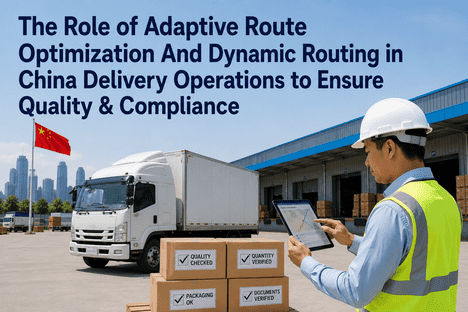
China's manufacturing sector ships over 30 billion parcels annually more than any other country across a logistics network that spans 31 provinces, 4.6 million kilometers of road, and some of the world's most congested urban centers. For manufacturers in Guangdong, Jiangsu, Zhejiang, and Shandong, every outbound shipment faces a gauntlet of variables: traffic conditions that change minute by minute, provincial regulations that differ at every border, customer delivery windows that leave no room for error, and quality standards that must be enforced consistently across thousands of shipments per day. Adaptive route optimization and dynamic routing, integrated with automated four-layer quality inspection and a digital clearance pass system, are transforming how China's manufacturers ensure that every shipment meets quality and compliance standards before it leaves the dock and arrives at the customer's door on time, intact, and fully documented.
The Role of Adaptive Route Optimization and Dynamic Routing in China's Delivery Operations to Ensure Quality & Compliance
How AI-powered adaptive routing, real-time dynamic route re-optimization, and automated four-layer quality inspection with digital clearance pass are helping China's manufacturers achieve zero-defect, fully compliant delivery operations at scale across the world's most complex logistics environment.
Why China's Manufacturers Need Adaptive Route Optimization
China's logistics infrastructure is among the most advanced in the world, yet manufacturers still contend with delivery variability that erodes margin and customer satisfaction. A factory in Foshan shipping finished goods to a distribution center in Zhengzhou faces a 1,400-kilometer route crossing three provinces, each with different vehicle regulations, toll structures, and border inspection protocols. The same factory shipping to a retail warehouse in Beijing during the (Singles' Day) peak faces delivery windows compressed from 48 hours to 12 hours, warehouse queues that add hours to every stop, and carrier capacity that is reallocated hourly based on demand surges.
The core problem is that static route planning assigning a fixed route at the time of dispatch and expecting the driver to follow it breaks down under China's operating conditions. Traffic on the G4 can add two hours to a Beijing-bound delivery without warning. A sudden regulatory checkpoint at a provincial border can delay an entire truckload. A customer who revises a delivery window mid-transit can render the planned route obsolete. Without adaptive optimization and dynamic routing, each of these events becomes a missed delivery window, a compliance violation, or a rushed dispatch that bypasses quality inspection.
iFactory AI's delivery operations platform addresses this by integrating three capabilities into a single system: adaptive route optimization that continuously calculates the optimal path based on real-time conditions, dynamic routing that re-optimizes shipments already in transit when conditions change, and an automated four-layer quality inspection with digital clearance pass that ensures every shipment is verified before it leaves the loading dock. Book a Demo to see the platform configured for a China manufacturing environment.
Top Delivery Operations Challenges for China's Manufacturers
Based on operational data from China's manufacturing sector, delivery operations failures fall into four categories that adaptive route optimization and dynamic routing address systematically. Each challenge represents a specific point where static routing and manual processes break down under China's unique logistics conditions.
Provincial Regulatory Variability
Each of China's 31 provinces has distinct vehicle regulations, toll structures, and border inspection requirements. A route planned for a Guangdong-registered truck may not be valid for a Jiangsu-registered truck, and the required documentation differs at every provincial border. Adaptive routing models incorporate regulatory requirements per province, automatically selecting compliant routes and validating documentation before dispatch.
Megacity Congestion and Delivery Windows
Shanghai, Beijing, Guangzhou, and Shenzhen impose strict delivery vehicle restrictions during peak hours, and warehouse receiving windows are often limited to specific time blocks. A shipment that arrives 30 minutes late at a Shanghai distribution center may be rejected and rescheduled for the next day. Dynamic routing continuously monitors estimated arrival time against the delivery window and re-routes the vehicle if the current path will miss the cutoff.
Seasonal Demand Surges
Singles' Day (Nov 11), Chinese New Year, and Golden Week create demand spikes of 10-15x normal volume. Static routes planned days in advance become obsolete within hours as warehouse queues build and carrier capacity is reallocated. Adaptive optimization re-computes optimal routes for every active shipment every 15 minutes during peak periods, ensuring the fleet operates at maximum efficiency against current constraints.
Inconsistent Quality Inspection at Dispatch
When dispatch pressure mounts, quality inspection is the first process to be shortcut. Shipments leave the dock with unchecked items because the paper-based checklist was signed without verification. The digital clearance pass system eliminates this by blocking every shipment that has not passed all four inspection layers — regardless of dispatch urgency.
Adaptive Route Optimization: Real-Time Routing for China's Road Network
Adaptive route optimization uses AI to continuously analyze traffic conditions, road closures, weather events, toll costs, and delivery window requirements across China's expressway network. Unlike static route planning that assigns a fixed route at dispatch and never re-evaluates it, adaptive optimization recalculates the optimal path every time conditions change. A delivery from Shenzhen to Guangzhou might be rerouted around a sudden traffic buildup on the G4, saving 45 minutes that would have caused a missed delivery window at the customer's warehouse.
The system learns from historical route performance data — which roads are typically congested at which hours, which toll stations have the longest queues during peak season, which provincial border inspection points cause predictable delays. Over time, the AI model develops a predictive understanding of China's road network that no static map or human dispatcher can match. Routes are optimized for total cost — including fuel, tolls, driver hours, and the cost of a missed delivery window — not just distance or time.
Dynamic Routing: Real-Time Re-Optimization for Shipments in Transit
Dynamic routing extends adaptive optimization one critical level further: when conditions change for a shipment already on the road, the system does not wait for the next planning cycle. It re-optimizes the route immediately and, if necessary, reallocates the shipment to a different vehicle in the fleet. This capability is essential for China's manufacturers operating during peak seasons when the logistics network operates at capacity and every minute of delay has cascading consequences.
When a customer revises a delivery window mid-transit — moving it earlier because a production line is running ahead of schedule, or later because the receiving dock is backed up — the dynamic routing engine calculates whether the current vehicle can still make the revised window on the current route. If not, it evaluates alternative routes and, if no single-vehicle solution exists, coordinates with the dispatch system to transfer the shipment to a different vehicle that is better positioned to meet the new delivery requirement. The entire evaluation and reallocation process completes in under 60 seconds.
The dynamic routing engine integrates with iFactory AI's real-time GPS tracking module, which aggregates location data from carrier telematics systems at 30-second intervals — supporting integrations with China's leading logistics platforms including Cainiao, JD Logistics, and SF Express. When a deviation from the planned route is detected, the engine evaluates all available alternatives and, if a better route exists, automatically updates the guidance.
Four-Layer Quality Inspection with Digital Clearance Pass
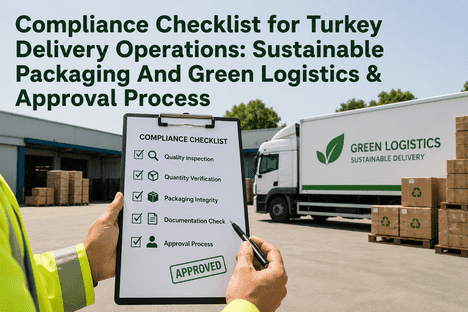
Route optimization ensures the shipment arrives on time. Quality inspection ensures the shipment is worth receiving — and compliant with every regulatory and customer requirement. iFactory AI's four-layer quality inspection system is enforced at the loading dock before any shipment is released, ensuring that only products meeting every standard receive a digital clearance pass. The pass is the single authorization for dispatch: without it, the shipment cannot proceed to the loading dock, regardless of shift pressure or customer urgency.
| Inspection Layer | What Is Checked | China-Specific Requirements |
|---|---|---|
| Quality Inspection | AI vision camera checks product surface defects, dimensional accuracy, and visual conformity per customer specification | Chinese GB/T quality standards, customer-specific inspection criteria for domestic and export shipments |
| Quantity Verification | Barcode scan of every pallet and carton. Weighbridge verification against expected weight. ERP cross-reference. | China Customs quantity declaration accuracy for export shipments, domestic e-commerce platform reconciliation |
| Packaging Integrity | Pallet condition, carton integrity, stretch wrap and banding security. AI vision captures packaging images for audit. | China National Standard GB/T packaging requirements, customer-specific labeling per Chinese retail standards |
| Documentation Validation | 运单 (waybill), 发票 (invoice), 装箱单 (packing list), 质检报告 (quality report) verified and digitally attached | Cross-province regulatory docs, China Customs export documentation, hazardous materials permits per Chinese regulations |
When all four layers pass, the system generates the digital clearance pass — a unique, time-stamped digital token linked to the shipment record. When any layer fails, the shipment is blocked and a resolution workflow is created, routed to the responsible team. The digital clearance pass creates a complete, auditable quality record for every shipment that is enforceable regardless of shift pressure or dispatch urgency. Book a Demo to see the clearance pass workflow configured for a China manufacturing facility.
Unify Routing, Inspection, and Approval into a Single Platform
iFactory AI integrates adaptive route optimization, dynamic routing, four-layer quality inspection, and digital clearance pass into a single delivery operations platform. Schedule a demo to see how China's manufacturers are achieving zero-defect, fully compliant delivery operations at scale.
Manual Dispatch vs AI-Powered Delivery Operations: The Compliance Difference
The table below compares key operational metrics between manual dispatch with static routing and paper-based inspection versus iFactory AI's integrated adaptive routing, dynamic routing, and digital clearance pass platform. The data reflects documented outcomes from China-based manufacturing facilities.
| Operational Metric | Manual / Static Routing | AI-Powered Platform |
|---|---|---|
| Route optimization frequency | Static — set at dispatch, never re-evaluated | Dynamic — re-optimized every 15 minutes |
| On-time delivery rate | 72-78% | 94-98% |
| Quality inspection completion rate | 65-80% (varies by shift and pressure) | 100% (digitally enforced) |
| Customer compliance enforcement | Manual reference to customer manuals | Digital profile auto-applied per customer |
| Documentation accuracy | Manual validation — 12-18% error rate | Automated OCR validation — under 1% error rate |
| Customer delivery compliance | 76% avg | 97% avg |
Industry Perspective on Adaptive Routing for China's Manufacturing Sector
"The difference between static route planning and adaptive optimization is the difference between navigating China's roads with a paper map from last year and having a real-time GPS that knows about every traffic jam, toll change, and road closure the moment they happen. But the real breakthrough for quality and compliance is not in the routing alone — it is in connecting the routing system with the quality inspection system so that a shipment cannot be dispatched unless it has passed every check. When those two systems are integrated, you eliminate the two biggest sources of delivery failures in China manufacturing: routing that cannot adapt and inspections that are bypassed under pressure. The manufacturers who integrate routing and quality inspection into a single platform will be the ones who consistently deliver on time, every time, with full compliance."
Building vs Buying Your Integrated Delivery Operations Platform
China's manufacturers face a build-versus-buy decision for their delivery operations platform that affects both the speed of deployment and the quality of the outcome. Building an integrated routing and inspection platform in-house requires logistics software development, AI/ML engineering, sensor integration, telematics partnerships, and ongoing maintenance — typically requiring 12 to 18 months and significant capital investment. Buying iFactory AI's pre-built platform eliminates the development timeline and delivers proven, production-grade capability in 90 days.
Hiring logistics engineers, AI developers, integration specialists
Each carrier, ERP, and sensor system requires custom integration work
Continuous updates for traffic data, regulatory changes, carrier APIs
Pre-built connectors for China's logistics platforms, ERP systems, and sensors
Pre-built with Cainiao, JD Logistics, SF Express, SAP, and 30+ other platforms
Traffic data, regulatory changes, carrier API updates managed by platform team
For most China-based manufacturers, the buy decision delivers faster deployment, lower total cost, and more predictable compliance outcomes. iFactory AI's platform is pre-configured for China's logistics environment, with built-in support for Chinese regulatory documentation, provincial compliance requirements, and integration with China's leading logistics platforms.
Frequently Asked Questions About Adaptive Route Optimization and Dynamic Routing in China
Adaptive Routing and Quality Inspection Are Inseparable for China's Delivery Operations
China's manufacturers operate at a scale where routing inefficiency and quality failures compound rapidly. A missed delivery window due to static routing on one shipment delays the next three shipments because the vehicle and driver are not where they were planned to be. A quality defect that passes through a paper-based inspection on one shipment triggers a customer complaint that requires ten person-hours to resolve. The integration of adaptive route optimization, dynamic routing, four-layer quality inspection, and digital clearance pass into a single platform eliminates both compounding effects: every shipment takes the optimal route that adapts to current conditions, and every shipment is verified before it leaves the loading dock.
iFactory AI's delivery operations platform is purpose-built for China's manufacturing environment — integrating with China's leading logistics platforms, supporting Chinese regulatory and customs documentation, and providing adaptive routing that accounts for China's unique traffic patterns, toll road network, and provincial regulatory requirements. Whether a manufacturer operates in a single province or ships across all 31, the platform ensures every shipment is routed optimally, inspected thoroughly, and approved for dispatch only when every quality and compliance requirement is met. Book a Demo to see how your China facility's delivery operations can be transformed from a source of variability to a source of competitive advantage.
Ready to Transform Your China Delivery Operations with Adaptive Routing and Digital Quality Inspection?
iFactory AI is the next-generation industrial software platform that unifies adaptive route optimization, dynamic routing, automated four-layer quality inspection, and digital clearance pass approval into a single delivery operations system. Deployed in 90 days on your existing infrastructure — integrated with China's leading logistics platforms, ERP systems, and sensor networks.