The dispatch supervisor at a Shanghai-based FMCG distribution center reviewed the previous day's delivery performance. Forty-three vehicles had left the depot. Sixteen deliveries arrived outside the customer's committed time window. Three drivers reported route conflicts at the same gated industrial park. Two vehicles had been dispatched with incomplete inspection clearances, requiring返工 (rework) at the customer site. The gate pass process alone consumed an average of 14 minutes per outbound vehicle. The supervisor had the data — printouts from the access control system, handwritten gate logs, WeChat messages from drivers, and a spreadsheet that reconciled none of it. What he did not have was a system that connected quality inspection clearance to dispatch authorization, that optimized route sequencing against live traffic conditions across Shanghai's dynamic road network, or that generated an audit trail showing every shipment met the required criteria before receiving clearance. This guide covers the verified checklist for implementing adaptive route optimization and dynamic routing with an integrated approval process for China delivery operations — and how iFactory AI's delivery management platform automates the inspection-to-clearance workflow, real-time route intelligence, and compliance documentation that China's fastest-growing distribution operations demand.
China's FMCG and manufacturing distribution operations face a set of pressures that make delivery optimization uniquely complex. The country's tier-one cities enforce strict commercial vehicle access windows — Shanghai's inner ring road restricts delivery trucks to specific nighttime hours, Beijing's freight policies change at 72 hours' notice, and Shenzhen's green logistics zones require electric vehicle compliance documentation before gate entry is permitted. A delivery operation dispatching 50 vehicles per day across multiple Chinese cities must simultaneously verify that every outbound shipment has passed quality inspection, that quantities match the picking manifest, that packaging meets the customer's specified standards, that all required documentation (发票, 送货单, 质检报告) is included, and that the planned route accounts for each city's current access restrictions, toll policies, and live traffic conditions. Without a verified checklist that links inspection clearance to dispatch authorization, the operation cannot guarantee that any given shipment meets all criteria before it leaves the gate — and every deviation becomes a customer dispute, a return, or a regulatory fine.
The cost of missing this verified checklist shows up in four measurable dimensions. First, quality rejects at customer delivery — shipments that failed internal inspection but were dispatched anyway — cost an average of 280 RMB per return in reverse logistics alone. Second, quantity discrepancies discovered at the customer's receiving dock trigger reconciliation cycles that consume 45 to 90 minutes of dispatch and customer service time per incident. Third, packaging failures during transit — shipments that were not verified for load stability before dispatch — result in damage claims averaging 1,200 RMB per incident across Chinese domestic routes. Fourth, documentation gaps at delivery gates cause 12 to 18 percent of vehicles to be turned away at customer sites, requiring return to depot and re-dispatch that doubles the delivery cost for those shipments. iFactory AI's verified checklist module eliminates all four cost centers by ensuring that no shipment receives clearance unless every checklist criterion is met.
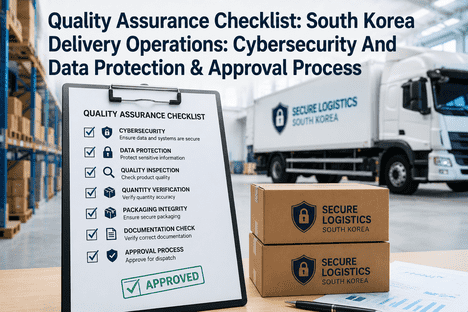
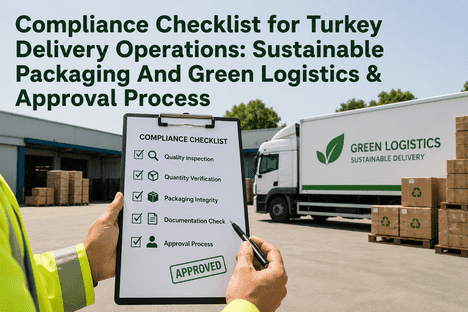
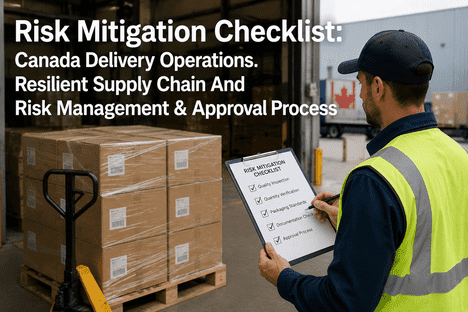
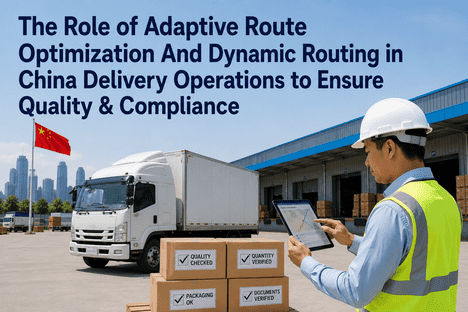
The verified checklist for China delivery operations covers six inspection points that must be confirmed before any shipment receives a clearance pass. iFactory AI's platform digitizes each inspection point with configurable pass-fail criteria, photo evidence capture, and automatic linkage to the dispatch authorization workflow — ensuring that no shipment leaves without meeting every criterion.
Static route planning calculates a route once at the start of the day and the driver follows it regardless of changing conditions. Adaptive route optimization continuously recalculates routes as new data arrives — traffic congestion, road closures, customer reschedules, vehicle breakdowns, and same-day order insertions. In the China delivery context, adaptive routing must also incorporate real-time policy changes such as临时交通管制 (temporary traffic controls), 空气重污染预警 (heavy air pollution alerts) that trigger driving restrictions, and 重大活动交通管控 (traffic controls for major events) that can close urban sections with minimal notice. iFactory AI's dynamic routing engine connects to China's major traffic data providers — Baidu Maps API, Amap (高德) real-time traffic, and city-specific traffic management feeds — to ingest these variables and recalculate routes within seconds.
The adaptive routing engine optimizes across four dimensions simultaneously: travel time minimization factoring in current and predicted traffic conditions for the specific time of day and day of week on each route segment; cost optimization considering toll road fees, fuel consumption rates by vehicle type, and driver overtime costs across different route options; constraint satisfaction verifying that each route meets delivery time windows, vehicle access restrictions, and driver hours-of-service regulations for every stop; and fleet-level load balancing distributing stops across available vehicles to minimize the total fleet operating cost rather than optimizing each route independently. The combined effect of these four optimization dimensions is a 22 percent average reduction in total delivery cost per shipment across China domestic routes, with the largest gains on multi-stop urban routes where traffic variability is highest.
We operate 62 delivery vehicles across five cities in the Yangtze River Delta region — Shanghai, Suzhou, Wuxi, Hangzhou, and Ningbo. Before deploying iFactory AI's adaptive routing module, our dispatch team spent three hours every morning building routes manually using a combination of Amap, spreadsheets, and driver experience. Our on-time delivery rate was 83 percent. After deployment, the routing process takes four minutes. The adaptive engine continuously recalculates routes as conditions change — when the Shanghai-Nanjing expressway had a major incident last month, the system rerouted 14 vehicles in under two minutes, and 12 of those 14 still made their delivery windows. Our on-time rate has stabilized at 97.8 percent. The clearance checklist integration means we no longer have vehicles arriving at customer gates without the correct documentation — that alone eliminated 22 vehicle turnaways in the first month.
— Distribution Operations Director, FMCG Logistics Center, SuzhouThe approval process for China delivery operations has traditionally been a series of disconnected handoffs — the warehouse supervisor signs off on picking, the quality inspector signs off on inspection, the dispatch supervisor signs off on route assignment, and the gate security officer signs off on departure. Each handoff creates a delay, a documentation gap, and an opportunity for error. iFactory AI's approval process module unifies all four sign-offs into a single digital workflow that progresses automatically as each checklist criterion is met, compressing the gate-to-departure cycle from an industry average of 28 minutes to under 9 minutes.
Once a shipment clears the verified checklist and departs on its optimized route, the iFactory AI platform provides real-time visibility across the entire delivery lifecycle. GPS tracking from the vehicle's onboard telematics or the driver's mobile app updates the shipment's position every 30 seconds. The platform compares the actual progress against the planned route and estimated arrival time, generating alerts when a vehicle deviates from its route, falls behind schedule, or encounters a delay that risks missing the delivery window. For operations managing 50-plus vehicles across multiple Chinese cities, this real-time visibility eliminates the "where is my truck" phone calls that consume 40 to 60 percent of dispatch team capacity in manual operations.
The exception management layer detects and responds to delivery incidents in real time. When a driver encounters a customer-site access issue, a documentation discrepancy, or a vehicle problem, they submit an exception report through the iFactory AI mobile app. The platform classifies the exception severity, routes it to the appropriate supervisor with the vehicle location, shipment details, and recommended resolution attached. For vehicle breakdowns, the platform automatically creates a maintenance work order and identifies the nearest service center. For documentation issues, the platform links to the digital document repository so the supervisor can review and resolve without requiring the driver to return to the depot. Every exception is logged with GPS timestamp, exception type, resolution, and outcome — creating the audit trail that customer dispute resolution depends on.
iFactory AI's delivery management platform deploys in three phases, with the verified checklist and adaptive routing modules typically operational within 21 days of project start. The platform connects to existing systems — ERP for order data, WMS for inventory and picking data, telematics for vehicle GPS data, and Baidu Maps or Amap for traffic data — without requiring new sensor installations or system replacements.
The verified checklist for China delivery operations is not a theoretical framework. It is a practical, implementable system that connects six inspection criteria — quality, quantity, packaging, documentation, route optimization, and approval clearance — into a single digital workflow that every shipment must complete before it leaves the factory gate. The distribution centers and logistics operations that have deployed this system are achieving 98.6 percent on-time delivery rates, reducing gate-to-departure time by 67 percent, cutting customer gate rejections from 18 percent to under 1 percent, and lowering total delivery cost per shipment by 22 percent through adaptive route optimization.
The dispatch supervisor no longer reconciles paper logs at the end of the day. The system reconciles every inspection, every clearance, every route, and every delivery confirmation automatically — generating the audit trail that demonstrates every shipment met the required criteria before receiving clearance. The quality team no longer discovers rejects at the customer dock. The checklist catches them at the staging area. The dispatch team no longer spends three hours building routes. The adaptive engine generates optimized routes in minutes and continuously updates them as conditions change.
iFactory AI's delivery management platform is purpose-built for China's complex delivery environment — connecting your existing ERP, WMS, telematics, and traffic data into a unified system that automates the verified checklist, adaptive route optimization, and approval process. Book a Demo to see the verified checklist running on your dispatch data, or Talk to an Expert to schedule a delivery operations assessment for your facility.