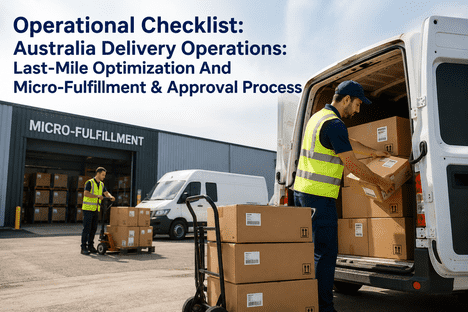
Every shipment that leaves a factory, warehouse, or micro-fulfillment centre in Australia passes through a chain of verification gates quality inspection, quantity confirmation, packaging integrity, documentation review, and dispatch approval where a single unchecked item can cascade into customer returns, carrier disputes, and lost revenue. In Australian delivery operations, with vast last-mile distances between Sydney, Melbourne, Brisbane, Perth, and regional centres, the cost of a mis-picked order or a damaged package multiplies rapidly because the return logistics loop is longer, the transport spend is higher per kilometre, and customer expectations for next-day or same-day delivery continue to tighten. Traditional paper-based dispatch checklists and manual count verification cannot keep pace with the volume, speed, and accuracy demands of modern fulfilment. iFactory AI Delivery Operations Management platform digitises the entire dispatch approval workflow integrating barcode scanning, AI-powered package inspection, real-time carrier handoff verification, and automated documentation into a single mobile-first checklist that ensures only compliant shipments leave the dock. Book a Demo to see how iFactory maps to your Australian delivery operations.
The Cost of Dispatch Errors in Australian Supply Chains
A single mis-shipment in Australian delivery operations — the wrong product, the wrong quantity, damaged packaging, or missing documentation — costs significantly more than the value of the goods. The outbound freight is wasted, the customer's production line or retail shelf is short, the return freight is at the supplier's cost, and the replacement shipment must be expedited. In a market where Sydney-to-Perth road freight runs 3,900 kilometres and costs $0.12–$0.18 per kilogram, a return-and-resend cycle on a 500 kg pallet adds $120–$180 in transport alone, plus 5–7 days of cycle time. For fast-moving consumer goods (FMCG) and food manufacturing operations — where customer fulfilment windows are 24–48 hours — a 5-day delay often triggers order cancellation penalties, retailer chargebacks, and long-term account erosion.
The root causes of dispatch errors in Australian factories and warehouses are consistently the same: manual quality checks that skip line items under time pressure, verbal quantity handoffs between picking and loading teams, packaging condition inspections that rely on visual judgment alone, and paper-based documentation packets that get separated from shipments during loading. iFactory eliminates these root causes by enforcing a structured, digital dispatch approval workflow — covering quality, quantity, packaging, documentation, and authorisation — before any shipment is released.
The Five Dispatch Approval Gates Every Shipment Must Pass
iFactory structures the dispatch approval process around five mandatory verification gates. Every shipment must clear all five gates before a digital clearance pass is generated and the carrier handoff is authorised. This gated structure ensures that no critical check can be bypassed under time pressure, and every verification event is timestamped and attributed for full traceability.
Product Condition & Conformance Verification
Every line item is inspected against the defined quality specification before it is cleared for dispatch. The inspection covers visual condition, dimensional conformance where applicable, expiry date validation for perishable goods, and batch/lot traceability verification. iFactory's mobile inspection interface presents the operator with the specific quality criteria per SKU, captures photos of any non-conformance, and routes rejected items to the quarantine workflow automatically. Only items that pass quality gate are released to the next stage.
Line-Item Count & Order Accuracy Confirmation
Manual counting is replaced by barcode or RFID scanning that confirms every unit, every carton, and every pallet against the order line item. The system flags quantity mismatches in real time — over-shipments that inflate freight costs and create inventory discrepancies, and under-shipments that cause customer shortages and penalty claims. Quantity verification is enforced at the pick-face, at the staging area, and again at the loading dock to catch errors introduced during consolidation.
Carton Condition, Pallet Stability & Load Security
Packaging damage during transit is the most common cause of delivery disputes in Australian logistics — particularly on long-haul routes where temperature variation, vibration, and multiple handoffs stress packaging materials. The packaging integrity gate verifies carton condition, pallet wrap stability, load strapping, and stack configuration before the shipment leaves the dock. AI-powered camera inspection detects crushed corners, torn wrap, unstable stacks, and overhang conditions that would likely result in in-transit damage.
Packing Slip, Invoice, Certificate & Compliance Documents
Australian domestic and export shipments require accurate documentation — packing slips, tax invoices, certificates of origin, food safety certificates, dangerous goods declarations, and customer-specific compliance paperwork. The documentation gate verifies that every required document is present, accurate, and correctly matched to the shipment before dispatch release. iFactory's document management module auto-generates packing slips and invoices from order data, attaches digital certificates, and validates document completeness against a per-customer compliance matrix.
Authorised Release, Carrier Handoff & Digital Proof of Dispatch
After all four verification gates are cleared, the dispatch approval gate generates a digital clearance pass — an electronic authorisation that the shipment is compliant and ready for carrier handoff. The clearance pass is required before the carrier is allowed to load. iFactory captures the driver acknowledgement, vehicle registration, and departure timestamp to create an immutable proof-of-dispatch record. Unresolved gate failures prevent clearance generation, halting the shipment until the issue is resolved or escalated.
Last-Mile Optimisation via Micro-Fulfillment in Australian Operations
Micro-fulfillment centres — small-format warehouses located close to end-customer concentrations — are transforming Australian last-mile delivery by reducing the distance between inventory and the delivery address. A micro-fulfillment centre in suburban Melbourne can service same-day delivery windows across a 30 km radius with a 2–3 hour order-to-dispatch cycle. But the speed advantage only holds if the dispatch approval process is equally fast and accurate. A manual quality check that takes 12 minutes per shipment becomes the bottleneck in a 45-minute order-to-dispatch cycle.
iFactory's mobile checklist is purpose-built for micro-fulfillment velocity. The operator scans, inspects, and approves at the pick station — not at a central dispatch desk. The clearance pass is generated before the carton reaches the staging area. The carrier receives the digital document packet while the driver is still in the queue at the loading door. This compressed workflow transforms the micro-fulfillment advantage from theoretical to operational, enabling Australian FMCG and food manufacturers to offer same-day delivery without increasing headcount or error rates. Book a Demo to see how micro-fulfillment dispatch workflow integrates with your existing WMS and carrier systems.
| Metric | Traditional Dispatch | iFactory Digital Dispatch | Improvement |
|---|---|---|---|
| Dispatch approval cycle — single pallet | 12–18 min | 3–5 min | 70% faster |
| Quantity discrepancy rate | 2.1% | 0.3% | 86% reduction |
| Documentation error rate | 4.8% | 0.5% | 90% reduction |
| In-transit damage claims (per 1,000 shipments) | 7.3 | 1.8 | 75% reduction |
| Carrier handoff time at dock | 22 min | 8 min | 64% faster |
| Proof-of-dispatch accuracy | 62% | 99.7% | Digital, timestamped records |
How iFactory Digitises the Dispatch Approval Workflow
iFactory is the AI software intelligence layer for delivery operations — not a hardware vendor or transport provider. The platform integrates with existing WMS, ERP (SAP, Oracle, NetSuite), barcode scanners, RFID readers, weighbridges, dock door systems, and carrier APIs already deployed in your Australian warehouse or factory. The Shift Logbook captures operator inspection findings, quantity scan results, packaging condition photos, and supervisor sign-offs alongside the automated sensor stream, creating a unified data fabric for shipment traceability, carrier performance analysis, and continuous dispatch process improvement.
Order-to-Dispatch Data Sync
iFactory syncs order data from your WMS or ERP at the moment pick confirmation is completed. Every line item — SKU, quantity, batch, expiry, packaging requirement, customer instruction — is loaded into the dispatch checklist before the operator begins verification. No manual data entry required.
Mobile Inspection & Scan Verification
Operator uses the iFactory mobile app to scan, inspect, and verify each line item against the five dispatch gates. Barcode scanning confirms the right product and quantity. AI camera inspection flags packaging defects. Photo capture documents condition. All actions are timestamped and attributed.
Real-Time Gate Status & Blockage Alerts
Each of the five gates displays a clear pass/fail status. Any gate failure blocks clearance pass generation and triggers an alert to the dispatch supervisor with the specific reason and the operator ID. The system enforces that no shipment bypasses a failed gate without documented escalation.
Digital Clearance Pass & Carrier API Handoff
When all five gates pass, iFactory auto-generates a digital clearance pass with a unique shipment ID, QR code, and document packet. The system transmits the manifest, packing slip, and compliance documents to the carrier's API before the driver arrives, reducing dock-side waiting time and eliminating paper-based handoff.
Proof of Dispatch & Continuous Improvement Analytics
The completed dispatch record — including inspection photos, scan data, timestamps, carrier acknowledgment, and vehicle details — is stored as an immutable proof-of-dispatch record. Analytics dashboards track gate pass rates, average cycle time per gate, common failure reasons, and carrier performance trends to drive continuous improvement in dispatch operations.
Dispatch Approval Compliance: Avoiding the Common Pitfalls
Understanding why dispatch errors recur is as important as implementing the gates. Each pitfall below corresponds directly to a structural element in iFactory's gated dispatch workflow that prevents it.
"We process 280–320 outbound pallets per day across three production lines. Before iFactory, our dispatch accuracy was around 96% — which sounds good until you calculate that 4% of 300 pallets means 12 errors per day, each triggering a customer complaint, a return request, and 2–3 hours of administrative reconciliation. The five-gate digital checklist eliminated 92% of our dispatch discrepancies in the first 60 days. The operators adapted within a week because the mobile app guides them through each gate instead of relying on paper checklists that got lost halfway through the shift. Our Coles and Woolworths audit scores improved because every shipment now has a complete digital traceability record."
Conclusion: Digitise Your Dispatch Gates for Error-Free Australian Delivery Operations
Every shipment that leaves your factory or warehouse in Australia carries the same risk: an unchecked quality defect, an uncounted line item, an unstable pallet, a missing document, or an unauthorised release. When those risks materialise, the cost multiplies across return freight, replacement dispatch, customer penalties, and account erosion. The solution is not better training or more paper checklists — it is a structured, system-enforced dispatch approval process that verifies every gate, every time, for every shipment, without relying on operator memory or manual supervision.
iFactory's five-gate digital dispatch checklist — quality inspection, quantity verification, packaging integrity, documentation review, and clearance pass authorisation — provides that structure. The platform integrates with your existing WMS, ERP, barcode scanners, and carrier systems to create a unified, mobile-first dispatch workflow that reduces errors by 86–92%, cuts dock-side handoff time by 64%, and generates audit-ready proof-of-dispatch records for every shipment. Book a Demo to see the five-gate dispatch checklist in action with your Australian delivery operations data.
Frequently Asked Questions
Does iFactory integrate with my existing WMS or ERP system for order data?
Yes. iFactory connects to SAP, Oracle, NetSuite, Microsoft Dynamics, and major WMS platforms via API or flat file integration. Order data — line items, quantities, batch/lot numbers, customer instructions — syncs automatically into the dispatch checklist so no manual data entry is required. The completed dispatch record also flows back to the source system for inventory and order status updates.
What barcode or RFID hardware is required for the quantity verification gate?
iFactory works with standard handheld barcode scanners (Zebra, Honeywell, Datalogic), mobile device cameras, and RFID readers (Impinj, Nordic ID). The mobile checklist app on a standard smartphone or industrial handheld provides scan capability. For high-volume operations, RFID gates at the staging area and loading dock can automate pallet-level quantity verification without operator scan actions.
How does the AI packaging inspection work for the packaging integrity gate?
The operator captures an image of each carton or pallet using the iFactory mobile app camera. The AI vision model analyses the image for crush damage, torn wrap, overhang, unstable stack configuration, and moisture exposure. The inspection result — pass or fail with annotated defect region — is recorded in the dispatch record. The model improves accuracy over time as more packaging condition images from your specific operations are accumulated.
How long does a typical iFactory dispatch checklist deployment take?
Standard deployments covering one warehouse or factory dispatch dock typically go live in 4–6 weeks. The deployment follows a phased approach: WMS/ERP integration setup (1 week), mobile checklist configuration with your specific SKU inspection criteria (1–2 weeks), operator training and pilot on one dispatch line (1 week), and production go-live with full gate enforcement (1–2 weeks). Multi-site deployments scale in 2–3 weeks per additional site.
Can the dispatch checklist be customised for different customer or product requirements?
Yes. iFactory's rule engine allows you to configure per-customer and per-SKU inspection criteria, documentation requirements, packaging specifications, and approval authority levels. For example, a cold-chain perishable shipment may require temperature logger verification at Gate 01 and specific pallet configuration at Gate 03, while a general freight FMCG shipment follows a standard path. The operator sees only the relevant checklist items for each specific shipment.