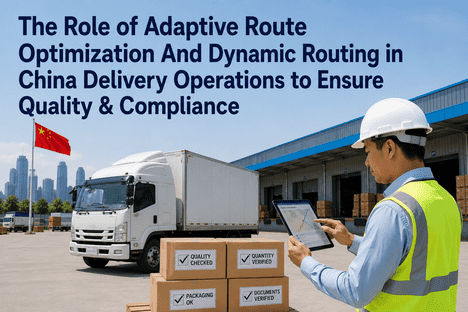
China's manufacturing sector — the world's largest — produces and ships goods across a logistics network of unprecedented scale and complexity. From the industrial heartlands of Guangdong, Jiangsu, and Zhejiang to distribution centers in Shanghai, Beijing, and Shenzhen, manufacturers face a daily challenge: getting the right product to the right customer at the right time, with zero defects, across a territory where traffic congestion, regulatory variation between provinces, and massive seasonal demand surges (Chinese New Year, Golden Week, Singles' Day) can disrupt even the best-planned dispatch operations. Adaptive route optimization and dynamic routing, powered by AI and integrated with a four-layer quality inspection and digital clearance pass system, are transforming China's delivery operations from a cost center into a competitive advantage.
The Delivery Operations Challenge in China
China's logistics infrastructure is among the world's most advanced, yet manufacturers still contend with delivery variability that erodes margin and customer satisfaction. A manufacturer in Dongguan shipping to a distributor in Chengdu faces a 1,500-kilometer route spanning multiple provinces, each with different vehicle regulations, toll structures, and inspection requirements. The same manufacturer shipping to a retail chain in Shanghai during Singles' Day faces port congestion, warehouse bottlenecks, and delivery windows measured in hours rather than days.
The root cause of delivery failures in China's manufacturing sector is not a lack of logistics capacity. It is the inability to dynamically adapt routes to changing conditions, enforce quality inspection consistently across every shipment, and integrate the approval process so that only verified shipments leave the dock. Adaptive route optimization solves the routing challenge. The four-layer quality inspection and digital clearance pass solve the quality and approval challenge. Together, they form the foundation for zero-defect delivery operations at China's scale.
iFactory AI's delivery operations platform is purpose-built for this environment — integrating with China's leading logistics platforms (including Cainiao, JD Logistics, and SF Express), supporting Chinese regulatory compliance documentation, and providing real-time route optimization that accounts for China's unique traffic patterns, toll road networks, and provincial regulatory requirements.
Adaptive Route Optimization: AI That Navigates China's Logistics Network
Adaptive route optimization uses AI to continuously analyze traffic conditions, road closures, weather events, and toll road costs across China's expressway network. Unlike static route planning that assigns a fixed route at dispatch time, adaptive optimization recalculates the optimal path in real time as conditions change. A delivery from Shenzhen to Guangzhou might be rerouted around a sudden traffic buildup on the G4京港澳高速, saving 45 minutes of transit time that would have caused a missed delivery window at the customer's warehouse in Huangpu District.
The system learns from historical route performance data — which roads are typically congested at which hours, which toll stations have the longest queues during peak season, which provincial border inspection points cause delays. Over time, the AI model develops a predictive understanding of China's road network that no static map or human dispatcher can match. Routes are optimized not just for distance or time, but for the specific delivery window requirements of each customer and the operating hours of each receiving dock.
Dynamic Routing: Responding to Change in Real Time
Dynamic routing extends adaptive optimization one level further: when a shipment is already in transit and conditions change — a customer revises the delivery window, a port closure at Shanghai's Yangshan Deep-Water Port forces a diversion, a sudden regulatory inspection checkpoint appears on the planned route — the system dynamically reassigns the optimal route or even reallocates the shipment to a different vehicle in the fleet.
For China's manufacturers, this capability is particularly valuable during the seasonal demand surges that define the country's retail calendar. During the 双十一 (Singles' Day) peak, delivery volumes increase 10-15x, and the logistics network operates at the edge of capacity. Static routes planned days in advance become obsolete within hours as warehouse queues build, customer delivery windows shift, and carrier capacity is reallocated to higher-priority shipments. Dynamic routing enables the dispatch system to re-optimize every active shipment every 15 minutes, ensuring that the fleet is always operating at maximum efficiency against the current set of constraints.
The dynamic routing engine integrates with iFactory AI's real-time GPS tracking module, which aggregates location data from carrier telematics systems at 30-second intervals. When a deviation from the planned route is detected — whether caused by traffic, driver decision, or customer request — the engine evaluates all available alternatives and, if a better route exists, automatically updates the route guidance in the driver's mobile application.
The Four-Layer Quality Inspection System
Route optimization ensures the shipment arrives on time. Quality inspection ensures the shipment is worth receiving. iFactory AI's four-layer quality inspection system is enforced at the loading dock before any shipment is released, ensuring that only products meeting every quality, quantity, packaging, and documentation standard receive a digital clearance pass.
AI-powered visual inspection and dimensional verification ensure every product meets customer specifications. For China's electronics and automotive manufacturers, this includes PCB visual inspection, component placement verification, and surface finish quality assessment. Inspections are recorded digitally with timestamp, inspector ID, and supporting images, creating an auditable quality record for every shipment.
Every pallet and carton is scanned at the loading dock, with the actual count and weight verified against the ERP sales order. Discrepancies trigger an automatic alert and block the shipment from dispatch until resolved. For China's FMCG manufacturers shipping high-volume, low-margin products, quantity accuracy is critical — a single pallet miscount can wipe out the margin on an entire truckload.
Pallet stability, carton condition, stretch wrap integrity, and banding security are verified before dispatch. AI vision cameras capture packaging condition images that are stored in the shipment record. For manufacturers shipping fragile goods — electronics, glass, precision instruments — across China's long-haul routes, packaging integrity verification at the loading dock prevents damage claims that typically run 2-5% of shipment value.
China's regulatory environment requires specific documentation for cross-province shipments, hazardous materials transportation, and export processing. The system validates that every required document — 运单 (waybill), 发票 (invoice), 装箱单 (packing list), 质检报告 (quality inspection report) — is present, correctly completed, and digitally attached to the shipment record. For export shipments, additional customs documentation is validated against China Customs requirements.
Digital Clearance Pass: The Approval Gate for Every Shipment
When all four inspection layers pass, the system generates a digital clearance pass — a unique, time-stamped digital token linked to the shipment record. This pass is the single authorization that the shipment can proceed to the loading dock and the carrier can depart. No manual signature, no paper form, no supervisor override is required for standard shipments.
If any inspection layer fails, the shipment is blocked automatically, and a resolution workflow is created. The failed item is routed to the responsible team — quality for inspection failures, warehouse for quantity or packaging issues, documentation team for paperwork errors. Each workflow has a defined resolution path and escalation timer. The shipment cannot proceed until all failures are resolved and the relevant inspection layer is re-executed and passes.
For China's manufacturers, the digital clearance pass system eliminates a critical operational problem: shipments that leave the dock with unchecked items because the dispatcher was under pressure to meet a delivery window. The system enforces the checklist regardless of shift pressure, ensuring that every shipment meets the same quality standard — whether it is the first dispatch of the morning or the last truck leaving before Chinese New Year.
Technology Coverage: What Each Module Detects and Controls
Stop Managing Route Planning and Quality Inspection in Separate Silos
How AI Fuses Routing and Quality into a Single Delivery Operations Platform
The value of integrating route optimization with quality inspection and digital approval is not in having more data from each function. It is in correlating that data to make better dispatch decisions in real time. When the quality inspection system detects a recurring packaging defect on a specific route — for example, damage caused by vibration on a particular road surface — the AI correlates that defect data with route information and automatically adjusts the packaging specification for shipments assigned to that route.
Similarly, when the dynamic routing system sees that shipments to a particular customer are consistently arriving outside the delivery window due to congestion on the optimal route, the system adjusts the dispatch time or assigns an alternative route for future shipments to that customer. The correlation across routing and quality data creates a closed feedback loop: every shipment generates data that improves the next shipment.
This integration is what distinguishes iFactory AI's platform from standalone route optimization tools or inspection systems. The platform is designed as a unified delivery operations layer where routing, quality, and approval are not separate modules but components of a single system that shares data, correlates events, and optimizes across all dimensions simultaneously.
Expert Review: What Makes China's Delivery Operations Unique
Building Your Integrated Delivery Operations Platform
Transitioning from manual dispatch with static routes and paper-based inspection to an AI-powered, integrated delivery operations platform follows a repeatable maturity path. These four levels define how China's manufacturers progress from fragmented logistics to unified, AI-driven delivery control.
Where does your operation sit on this maturity path? Talk to an Expert and we will assess your current delivery operations and map the next capability to deploy.
Conclusion
China's manufacturing sector operates at a scale where even small improvements in delivery operations generate significant competitive advantage. Adaptive route optimization ensures that every shipment takes the optimal path through China's complex road network, adjusting in real time to traffic, weather, and regulatory conditions. Dynamic routing extends that optimization to shipments already in transit, re-routing and re-allocating as conditions change. The four-layer quality inspection system ensures that only verified, inspected, and documented shipments leave the loading dock. And the digital clearance pass enforces the entire process without human discretion.
Together, these capabilities form a unified delivery operations platform that eliminates the three root causes of delivery failure in China's manufacturing environment: routing that cannot adapt to changing conditions, quality inspection that is inconsistently applied, and approval processes that are bypassed under operational pressure. iFactory AI's platform was purpose-built for this environment — integrating with China's leading logistics platforms, supporting Chinese regulatory documentation, and providing real-time route optimization tailored to China's unique logistics landscape. Talk to an Expert to see how your delivery operations can be transformed from a cost center to a competitive advantage.