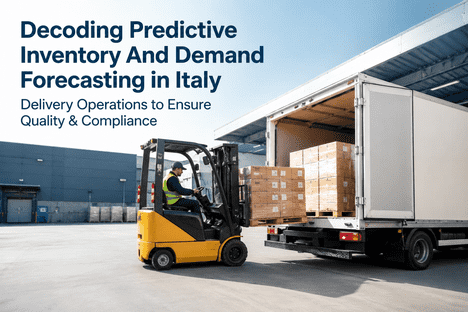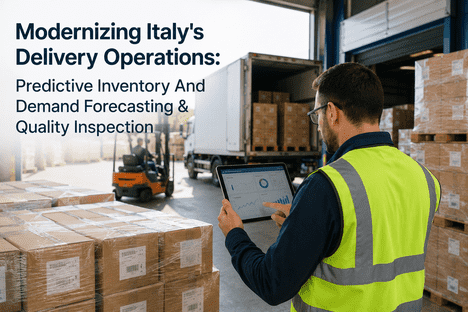
Italy's manufacturing sector is at a turning point in delivery operations management. The country's industrial output — from automotive components in Turin to precision machinery in Emilia-Romagna to pharmaceuticals in Lombardy — depends on a logistics network that moves finished goods from factory floor to customer delivery with zero defects. Yet most Italian manufacturers still operate their delivery processes with disconnected systems: inventory managed in spreadsheets, demand projected from historical averages, quality inspected by visual sampling, and dispatch clearance handled through paper checklists. An integrated AI platform changes this architecture fundamentally — predictive inventory models that anticipate stock requirements from production schedules and order pipelines, demand forecasting engines that learn from seasonal patterns and market signals, and multi-checkpoint quality inspection stations that verify product condition, quantity, packaging, and documentation before any shipment receives a clearance pass. Manufacturers across Italy are adopting this integrated approach to achieve what was previously impossible: zero-defect shipping at scale without adding inspection headcount or slowing dispatch velocity. The future of Italian delivery operations is already taking shape in facilities where predictive analytics, AI vision inspection, and digital clearance workflows work together as a single, orchestrated system — and the results are measurable from the first shipment. Operations leaders evaluating their modernization path can book a demo to see how the platform applies to their specific product mix and distribution network.
Modernizing Italy's Delivery Operations with Predictive Inventory, Demand Forecasting, and Zero-Defect Quality Inspection
iFactory's Delivery Management platform gives Italian manufacturers predictive inventory optimization, AI-driven demand forecasting, and multi-checkpoint quality inspection — all connected through a single control tower that verifies every shipment against 45 criteria before issuing a digital clearance pass.
Four Pillars of Modernized Delivery Operations for Italian Manufacturers
An integrated delivery operations platform replaces disconnected legacy processes with four interconnected capabilities that work together as a single system. Predictive inventory and demand forecasting ensure the right stock is available at the right location. Multi-checkpoint quality inspection verifies every shipment against standardized criteria. The control tower provides end-to-end visibility from order creation through dispatch to proof of delivery. Each capability reinforces the others — better demand forecasts improve inventory accuracy, verified shipments reduce post-dispatch discrepancies, and control tower visibility enables continuous improvement. Operations leaders who schedule a platform review typically start with one pillar and expand across all four as the ROI from the initial deployment becomes visible.
Predictive Inventory Optimization
Core Focus: Real-time stock visibility across all sites with automated reorder point calculation based on lead time variability, demand volatility, and service level targets. Safety stock levels adjust dynamically as demand patterns and supplier reliability change.
AI Demand Forecasting
Core Focus: Machine learning models trained on 3-5 years of historical order data, seasonal patterns, promotional calendars, and external market signals. Forecasts are generated at the SKU-location level with 4-12 week horizons, updated weekly as new order data flows in.
Multi-Checkpoint Quality Inspection
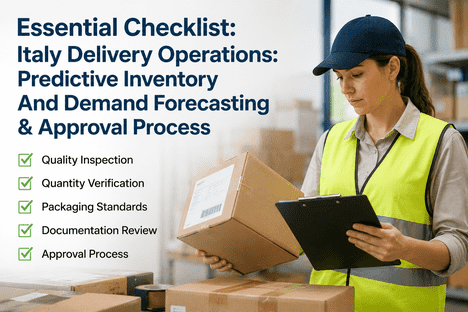
Core Focus: AI vision verification of product condition, unit count, packaging integrity, and documentation completeness at the dispatch station. Each checkpoint must pass before the next opens. Shipments that fail any checkpoint are held with automated exception workflow.
Control Tower & Digital Clearance
Core Focus: Unified shipment tracking from order creation through dispatch, in-transit milestones, and proof of delivery. Digital clearance pass generated automatically when all checkpoints pass. Exception dashboards with real-time alerts and resolution tracking.
"We were managing inventory across three warehouses with spreadsheets and email. Our demand forecast was a twelve-month average that never accounted for the seasonal spikes in our automotive component orders. Every September, we would either run out of stock on our top 20 SKUs or carry excess inventory that tied up working capital through November. The quality inspection process added another layer of uncertainty — our operators inspected a sample of each shipment visually, but discrepancies still reached the customer about 1.5% of the time. After deploying the integrated platform with predictive inventory, AI forecasting, and multi-checkpoint inspection, our inventory accuracy went from 87% to 98%, forecast error dropped from 42% to 18%, and our post-dispatch discrepancy rate fell below 0.2%. The platform paid for itself in the first seven months through reduced inventory carrying costs alone."
Traditional Delivery Operations vs AI-Powered Integrated Platform
The gap between traditional delivery operations and an AI-powered integrated platform is visible across every dimension of logistics performance — inventory accuracy, forecast reliability, inspection speed, dispatch accuracy, and exception resolution. The comparison below maps the operational reality of each approach across the metrics that matter most to Italian manufacturing operations. Plant and logistics managers evaluating their modernization options often schedule a technical assessment to benchmark their current performance against the AI-powered baseline.
| Operational Dimension | Traditional Approach | AI-Powered Platform | Impact for Italian Manufacturers |
|---|---|---|---|
| Inventory Management | Spreadsheet-based tracking, periodic cycle counts, static reorder points | Real-time visibility across all sites, dynamic reorder points, AI-optimized safety stock | Inventory accuracy improves from 85-90% to 97-99%. Working capital tied to excess stock reduced 20-35%. |
| Demand Forecasting | 12-month rolling average, manual adjustments, no seasonal pattern recognition | ML models trained on 3-5 years of data, weekly updates, SKU-location level forecasts | Forecast error (MAPE) drops from 30-50% to 12-20%. Stockouts reduced by 40-60%. |
| Quality Inspection | Visual sampling by operator, paper checklists, manual data recording | AI vision on every unit, 45-criteria digital checklist, automated pass-fail with exception workflow | Inspection time drops from 10-15 min to under 2 min per pallet. Discrepancy rate below 0.3%. |
| Dispatch Clearance | Paper-based sign-off, manual carrier coordination, disconnected documentation | Digital clearance pass, automated carrier notification, integrated document validation | Clearance time reduced 70%. Documentation-related delays eliminated. Audit trail generated automatically. |
| Exception Management | Phone calls and emails, no structured escalation, manual resolution tracking | Real-time alerts with defect classification, automated escalation, timestamped resolution history | Average exception resolution time from 4 hours to 25 minutes. Root cause analysis data captured for each event. |
| Customer Visibility | Phone or email status requests, manual tracking number lookup, delayed POD | Real-time customer portal with shipment status, inspection results, and digital POD on delivery | Customer inquiry response time from hours to real-time. Dispute resolution accelerated 60%. |
Four Signals That Your Delivery Operations Are Ready for AI-Powered Modernization
Most Italian manufacturers do not need a full digital transformation roadmap to justify modernizing their delivery operations. A targeted investment in predictive inventory, demand forecasting, and quality inspection typically delivers measurable ROI within the first two quarters. The four signals below indicate that the conditions for a successful modernization are already in place. Supply chain leaders who recognize two or more of these signals in their operation typically book a platform walkthrough to map the capabilities to their specific requirements and timeline.
Phased Implementation: From Current State to AI-Powered Delivery Operations
The transition from traditional delivery operations to an AI-powered integrated platform follows a structured three-phase roadmap designed to deliver value at each stage while building toward full modernization. Each phase can be deployed independently, allowing manufacturers to align investment with operational priorities and budget cycles. Teams planning their modernization journey typically book a platform demo to see how each phase applies to their specific product categories, distribution network, and customer requirements.
Foundation: Inventory Digitization and Demand Baseline
Deploy real-time inventory tracking across all warehouses and distribution points. Configure the demand forecasting engine with 3-5 years of historical order data. Establish baseline forecast accuracy metrics. Train the team on digital inventory workflows and exception management. Timeline: 4-6 weeks.
Scale: AI Forecasting and Quality Inspection Deployment
Activate AI-driven demand forecasting with weekly model updates and automated reorder point calculation. Deploy AI vision inspection stations at dispatch points with multi-checkpoint verification. Configure the control tower dashboard for end-to-end shipment visibility. Timeline: 6-10 weeks.
Optimize: Full Control Tower and Continuous Improvement
Expand the platform across all product categories and distribution sites. Activate customer portal with real-time shipment tracking and inspection data. Establish continuous improvement cycle with weekly exception analysis and monthly forecast accuracy reviews. Timeline: 4-6 weeks post-expansion.
Modernizing Italy's Delivery Operations — Frequently Asked Questions
How does predictive inventory optimization differ from traditional reorder point systems used in Italian manufacturing?
Traditional reorder point systems calculate a fixed minimum stock level based on average daily usage and a static lead time. Predictive inventory optimization replaces the static calculation with a dynamic model that updates reorder points and safety stock levels continuously as demand patterns, lead times, and supplier reliability change. The system learns from actual consumption data — if a specific SKU shows increasing demand velocity, the reorder point rises automatically. If a supplier's delivery reliability deteriorates, safety stock increases to compensate. The result is inventory that adapts to real conditions rather than reacting to them after the fact. For Italian manufacturers managing hundreds or thousands of SKUs across multiple sites, this automation eliminates the manual effort of periodic reorder point review while improving service levels. Book a Demo to see how predictive inventory optimization applies to your specific product portfolio and distribution network.
Can the demand forecasting engine handle Italy's seasonal and regional demand variations across different industrial sectors?
Yes. The machine learning models are trained to recognize and account for multiple demand drivers simultaneously — seasonal patterns (agricultural equipment demand peaking before planting and harvest seasons), regional variations (automotive component demand concentrated in Piedmont and Emilia-Romagna, pharmaceutical demand distributed nationally), promotional calendars (B2B trade show cycles, customer-specific promotional events), and external market signals (raw material price trends, macroeconomic indicators). The model processes data at the SKU-location level, meaning forecasts account for the specific demand pattern of each product at each warehouse or distribution point. Forecast accuracy typically reaches 80-88% within three months of deployment, compared to 50-70% with traditional moving average or exponential smoothing methods. Talk to an expert about model training requirements for your specific product sectors and regional distribution patterns.
How does the multi-checkpoint quality inspection system integrate with existing production and warehouse processes?
The inspection system connects to existing warehouse and production systems through standard APIs — no WMS migration, no production system replacement, and no new hardware infrastructure required for the initial deployment. AI vision cameras are installed at existing dispatch inspection stations and connected to the platform through a gateway appliance that processes images locally and transmits only inspection results to the cloud control tower. The inspection station integrates with barcode scanners, label printers, and conveyor systems already in place. For facilities using manual inspection stations, the platform provides a tablet-based interface that guides operators through the digital checklist and captures AI vision results from a USB-connected camera. The integration scope for a single-site deployment is typically completed within the Phase 1 window. Book a Demo to review the integration architecture for your specific warehouse and production systems.
What is the typical ROI timeline for Italian manufacturing operations deploying the integrated platform?
Most Italian manufacturers achieve positive ROI within 6-9 months of deployment. The primary ROI drivers vary by operational priority. For companies prioritizing inventory optimization, reduced carrying costs from excess stock reduction typically deliver ROI within 5-7 months. For companies prioritizing quality improvement, the reduction in post-dispatch discrepancies, customer returns, and invoice disputes typically delivers ROI within 4-6 months. For companies prioritizing operational efficiency, the labour savings from automated inspection and digital clearance workflows typically deliver ROI within 6-8 months. Manufacturers deploying all four pillars simultaneously typically see combined ROI within the first two quarters. iFactory provides a site-specific ROI assessment as part of the initial engagement process, modelling the expected savings based on the operation's current performance data. Talk to an expert to request an ROI assessment for your Italian manufacturing operation.
Can the platform handle multi-site operations across different regions of Italy with different product mixes and customer requirements?
Yes. The platform is designed for multi-site deployment from the ground up. Each site operates its own inspection checkpoints, inventory policies, and demand forecasting models configured for its specific product mix, customer base, and regional requirements. The control tower aggregates data across all sites into a single management view, enabling cross-site performance comparisons, centralized exception monitoring, and consistent customer service regardless of the originating site. For manufacturers with sites in different Italian regions — automotive components in Piedmont, machinery in Veneto, pharmaceuticals in Lombardy — each site's configuration is independent while the management view provides consolidated visibility. New sites can be added to the platform in under a week once the initial deployment is complete. Talk to an expert about multi-site deployment architecture for your regional distribution network.
Modernize Your Delivery Operations with Predictive AI and Zero-Defect Quality Inspection.
iFactory's Delivery Management platform gives Italian manufacturers the tools to achieve predictive inventory accuracy above 97%, AI-driven demand forecasting with 80%+ accuracy, and multi-checkpoint quality inspection that catches discrepancies before dispatch — all through a single control tower that connects your existing systems without infrastructure replacement.