Essential Checklist: Italy Delivery Operations: Predictive Inventory And Demand Forecasting & Approval Process
By Arel Dixon on June 15, 2026
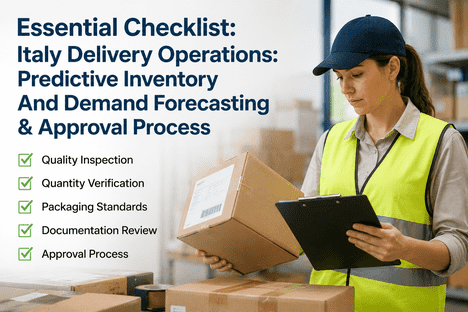
Every shipment leaving a manufacturing facility in Italy carries the same risk: the goods may not meet quality specifications, the quantity may not match the order, the packaging may not survive the transport, the documentation may not satisfy customs, or the clearance pass may be issued before all checks are complete. When any of these failures occurs, the result is a rejected shipment, a return, a penalty, or a delayed delivery — each carrying a cost that erodes margin and damages customer trust. Predictive inventory and demand forecasting reduce the likelihood of stock-outs and overstocks, but they do not eliminate the need for rigorous physical inspection at the point of dispatch. The shipment that leaves the loading bay with incorrect specifications, damaged packaging, or incomplete documentation will fail regardless of how accurately the inventory was forecast. This checklist provides a structured framework for Italy delivery operations to inspect every outbound shipment across five sequential checkpoints — quality, quantity, packaging, documentation, and clearance — so that only shipments that meet every criterion receive the approval pass. Use it with iFactory AI Delivery Management to digitise each checkpoint, capture inspection results in real time, and generate an auditable clearance record for every shipment leaving your Italian facility.
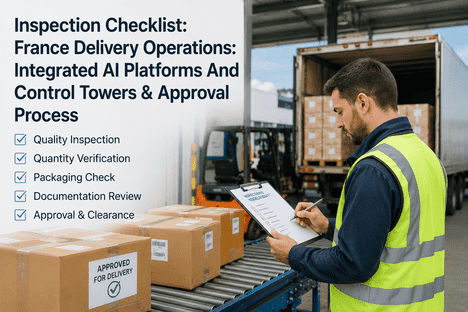
Five Checkpoints Every Outbound Shipment Must Pass Before It Leaves Your Italy Facility. Use This Checklist to Ensure None Are Missed.
iFactory AI Delivery Management digitises each inspection checkpoint — quality, quantity, packaging, documentation, and clearance — and generates an auditable pass record for every shipment. Reduce rejected deliveries, customs holds, and penalty charges with a structured approval workflow purpose-built for Italy delivery operations.
Quality inspection is the first gate that every outbound shipment must pass. Before any quantity count or packaging check begins, the goods must meet the agreed specifications. iFactory AI Delivery Management integrates with your quality control system to record inspection results at the line level and flag any deviation from the accepted tolerance range.
#
Criteria
Acceptable Range
Method
1.1
Visual surface inspection matches specification
No visible defects, discolouration, or damage
AI vision scan + human verification
1.2
Dimensional measurements within tolerance
±0.5 mm or as defined per product spec
Laser measurement / calliper check
1.3
Weight check within tolerance
±1% of declared weight per unit
Inline weighing station
1.4
Material composition verified against spec
100% match to approved BOM
Spectrometer / lab test result cross-check
1.5
Functional test passed (if applicable)
Per product-specific functional criteria
Automated test rig / manual test
Checkpoint 2 — Quantity Verification
Quantity verification ensures that the number of units, pallets, or lots in the shipment matches the order. Predictive inventory and demand forecasting reduce the risk of over- or under-production, but the final count at the loading bay is the last opportunity to catch a discrepancy before the shipment leaves the facility. iFactory AI Delivery Management reconciles the pick list against the actual count in real time.
#
Criteria
Acceptable Range
Method
2.1
Unit count matches pick list
100% match
Barcode / RFID scan of each unit
2.2
Pallet count matches manifest
100% match
Pallet tag scan at loading bay
2.3
Case / box count verified
100% match to packing list
Automated case counter + visual check
2.4
Overflow / partial lot quantities documented
Exact partial count recorded in system
Manual count with system reconciliation
Checkpoint 3 — Packaging Integrity
Packaging integrity determines whether the goods will arrive at the customer in the same condition they left the factory. Damaged or inadequate packaging is one of the leading causes of in-transit damage and customer rejection. Each outbound shipment must pass a packaging integrity check before it is cleared for dispatch. iFactory AI Delivery Management captures packaging inspection results at the pallet and case level.
#
Criteria
Acceptable Range
Method
3.1
Packaging material meets spec (type, grade)
Per approved packaging BOM
Visual inspection + spec cross-ref
3.2
Seals and closures intact
No broken seals, tape lift, or gaps
Visual + tamper-evident check
3.3
Pallet stability and strapping secure
No tilt, shift, or loose strapping
Visual + tilt test
3.4
Labelling correct and legible
SKU, batch, quantity, barcode all readable
AI barcode scan + label check
3.5
Handling instructions visible
Fragile / this way up / stack limit marked
Visual check
Checkpoint 4 — Documentation Review
Documentation errors are the most common cause of customs holds and delivery delays in Italy cross-border shipments. Incomplete or incorrect documentation can stop a shipment at the border, incur penalty charges, and damage the customer relationship. Every outbound shipment must pass documentation review before clearance is granted. iFactory AI Delivery Management digitises document collection, validation, and audit trail generation.
#
Criteria
Acceptable Range
Method
4.1
Commercial invoice complete and accurate
All fields filled, totals match shipment
System field validation
4.2
Packing list matches physical load
100% match between list and scan data
System reconciliation
4.3
Certificate of origin attached
Valid, stamped, and dated
Document scan + AI content check
4.4
Customs declaration filed (if applicable)
Declaration number confirmed in system
Customs system API check
4.5
Regulatory / compliance certificates attached
All required certs present and valid
Document checklist + system validation
Real-Time Inspection Data · Automated Clearance · Auditable Trail
Four Checkpoints Done. One Gate Remains Before Your Shipment Leaves Italy — Clearance Approval.
iFactory AI Delivery Management consolidates results from all four checkpoints and presents a pass/fail dashboard. Only shipments that pass every criterion receive an automated clearance pass. No manual approvals, no skipped checks, no guesswork.
Clearance is the final gate in the outbound delivery process. It grants authorisation for the shipment to leave the facility only when all preceding checkpoints have recorded a pass result. The clearance pass is the single auditable record that confirms the shipment was inspected, verified, and approved before departure. iFactory AI Delivery Management generates the clearance pass automatically when all criteria are met and prevents dispatch if any checkpoint has failed or is incomplete.
#
Criteria
Acceptable Range
Method
5.1
Quality inspection status = Passed
All quality criteria met
System auto-verification
5.2
Quantity verification status = Passed
All quantity criteria met
System auto-verification
5.3
Packaging integrity status = Passed
All packaging criteria met
System auto-verification
5.4
Documentation review status = Passed
All documentation criteria met
System auto-verification
5.5
Clearance pass generated and attached
Digital pass with timestamp and inspector ID
System generation + audit log
100%
Inspection coverage across all five checkpoints — every outbound shipment passes every gate before dispatch
60%
Reduction in shipment rejections reported by Italy facilities using a structured five-checkpoint clearance workflow
90%
Faster clearance approval cycles when inspection data is captured digitally and clearance passes are auto-generated
0
Missed checkpoints when the five-gate approval workflow is enforced by iFactory AI Delivery Management
How iFactory AI Delivery Management Enforces the Five-Checkpoint Workflow
A checklist is only effective if every item is actually checked. iFactory AI Delivery Management digitises the entire five-checkpoint workflow so that no gate can be skipped, no criterion can be ignored, and no clearance pass can be issued without a complete set of pass results. The platform connects to your existing inventory, quality, and shipping systems and enforces the approval sequence automatically.
SQ
Sequential Gate Enforcement
Checkpoints must be completed in order. Quality inspection must pass before quantity verification begins. Quantity must pass before packaging is checked. The system prevents advancing to the next gate if the current gate has any failed or incomplete criteria.
RT
Real-Time Inspection Capture
Inspection results are captured at the point of inspection using handheld scanners, tablet interfaces, or connected weighing and measurement stations. No paper forms, no delayed data entry, no transcription errors.
AL
Automated Clearance Pass
When all five checkpoints record a pass, the clearance pass is generated automatically with a timestamp, inspector ID, and audit trail. The shipment is authorised for dispatch without any manual approval bottleneck.
AI
Predictive Inventory Integration
Demand forecast data feeds into the quantity verification step, so the system can flag discrepancies between the forecast order quantity and the actual shipment quantity before the load leaves the bay.
AU
Audit-Ready Records
Every inspection result, every pass or fail decision, and every clearance pass is stored in an immutable audit trail. Records are exportable for customer quality reviews, regulatory audits, and internal compliance reporting.
DA
Deviation Alert & Escalation
If any criterion fails, the system alerts the shift supervisor and quality manager immediately. Escalation rules ensure that failed shipments are reviewed, corrected, or quarantined before they can be dispatched.
We implemented the five-checkpoint workflow using iFactory AI Delivery Management at our Bologna facility six months ago. Before the system, we relied on paper checklists that were filled out inconsistently — some inspectors skipped the packaging check entirely, others signed off clearance without verifying the documentation. The rejection rate from our Italian customers was running at 4.2 percent of outbound shipments. After deploying the digital five-gate workflow with sequential enforcement, rejection dropped to 1.1 percent. More importantly, we now have an auditable record for every shipment. When a customer asks whether the packaging was inspected before dispatch, we can show them the digital pass with the inspector ID and timestamp. That level of visibility has strengthened our customer relationships and reduced dispute resolution time from weeks to hours.
— Logistics Manager, FMCG Manufacturing Facility, Bologna, Italy — 12,000 Outbound Shipments per Year
Conclusion
Predictive inventory and demand forecasting solve the problem of having the right stock at the right time. They do not solve the problem of shipping defective, miscounted, poorly packaged, or undocumented goods. A shipment that fails quality inspection, carries the wrong quantity, uses inadequate packaging, or travels without complete documentation will be rejected by the customer or held at customs regardless of how accurately the inventory was forecast. The five-checkpoint workflow — quality, quantity, packaging, documentation, and clearance — closes this gap by ensuring that every outbound shipment is inspected, verified, and approved before it leaves the facility.
Italy delivery operations that have adopted the digital five-gate workflow using iFactory AI Delivery Management report a 60 percent reduction in shipment rejections, a 90 percent reduction in clearance approval time, and zero missed checkpoints because the system enforces the inspection sequence and prevents dispatch without a complete set of pass results. The workflow integrates with existing inventory, quality, and shipping systems and generates an auditable clearance pass for every outbound shipment.
Download the full inspection checklist template and see how iFactory AI Delivery Management enforces the five-checkpoint workflow across your Italy delivery operations. Book a Demo to see the platform running on your shipment data, or talk to an expert about a free delivery operations assessment for your Italian facility.
Frequently Asked Questions
The sequential gate enforcement is designed to prevent shipments from leaving without passing all checkpoints, not to slow down the process. In practice, the digital workflow is faster than a paper-based system because inspectors capture results at the point of inspection and the system advances to the next gate automatically. For urgent shipments, each checkpoint can be completed in under two minutes when inspection data is captured digitally and connected to automated measurement stations. The clearance pass is generated instantly when the final gate passes, so the total inspection cycle for a standard outbound shipment is typically eight to twelve minutes across all five checkpoints. The time saved by eliminating paperwork, manual data entry, and supervisor sign-off more than compensates for the structured gate sequence. Book a Demo to see how fast the five-gate workflow processes an outbound shipment from inspection to clearance.
Yes. Every criterion in every checkpoint is configurable per product type, customer, destination, and shipment class. iFactory AI Delivery Management allows the quality manager to define different inspection criteria for different product categories — for example, food-grade products require hygiene and seal integrity checks that standard packaged goods do not. Customer-specific requirements can be added as additional criteria within any checkpoint, and the system will enforce them automatically when a shipment for that customer is processed. Criteria can include pass/fail checks, measurement ranges, document presence requirements, and photo or video evidence capture. The configuration is managed through the platform's criteria library and can be updated at any time without IT involvement. Talk to an expert about configuring custom checklist criteria for your product range and customer base.
Predictive inventory and demand forecasting feed directly into checkpoint 2 (quantity verification). The forecast order quantity from the demand planning system is compared against the actual shipment quantity during the pick list reconciliation step. If the shipment quantity deviates from the forecast by more than a configurable tolerance — typically 2 to 5 percent depending on the product — the system flags a discrepancy that must be resolved before the checkpoint can pass. This integration ensures that the demand forecast is not just a planning tool but an active part of the dispatch approval process. For example, if demand forecasting predicted an order of 1,000 units but only 950 units are available for shipment, the system alerts the planning team to either adjust the forecast or authorise the partial shipment before the clearance pass can be issued. Book a Demo to see how iFactory AI Delivery Management connects demand forecasts to the quantity verification checkpoint.
A failed checkpoint does not quarantine the shipment permanently. The platform supports a re-inspection workflow. When a criterion fails, the shipment is placed on hold and the inspector records the reason for failure. The shipment can be corrected — for example, replacing damaged packaging, adding missing documentation, or adjusting the quantity — and then re-routed through the failed checkpoint for a fresh inspection. The system maintains a complete history of all inspection attempts, including the failure reasons, corrective actions taken, and the final pass result. This audit trail is essential for quality analysis and continuous improvement. For example, if packaging integrity failures recur on a specific product line, the data can be analysed to identify whether the packaging spec itself needs to be revised. The re-inspection workflow ensures that shipments are not permanently blocked but also that no shipment can bypass the failed checkpoint. Talk to an expert to see the re-inspection and corrective action workflow in iFactory AI Delivery Management.
Every Outbound Shipment That Leaves Your Italy Facility Without Passing All Five Checkpoints Is a Risk You Do Not Need to Take. Digitise the Workflow and Eliminate Guesswork.
iFactory AI Delivery Management for Italy delivery operations — five sequential inspection checkpoints (quality, quantity, packaging, documentation, clearance), predictive inventory and demand forecasting integration, AI-powered deviation alerts, automated clearance pass generation, and audit-ready records for every outbound shipment.