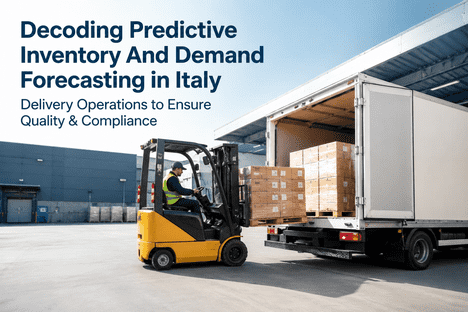
Decoding Predictive Inventory And Demand Forecasting in Italy Delivery Operations to Ensure Quality & Compliance
By Arel Dixon on June 15, 2026
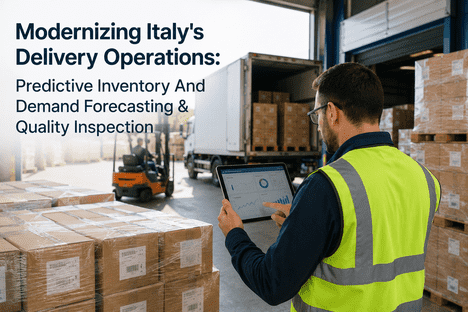
Italy's manufacturing sector is decoding a fundamental insight about delivery operations: predictive inventory and demand forecasting are not separate functions from quality inspection — they are the same system. When a manufacturer knows through demand forecasting which products will ship in which volumes to which destinations over the next four to twelve weeks, and maintains predictive inventory that has the right stock positioned at the right distribution centre before the order arrives, the quality inspection process becomes an integrated clearance gate rather than a disconnected final check. Every shipment leaving an Italian factory today can be verified against a complete digital record that starts with the demand forecast, flows through inventory allocation, and ends with AI-driven inspection of product quality, quantity accuracy, packaging standards, and documentation completeness before a digital clearance pass is issued. The insight that connects these capabilities is that error-free dispatch is not a quality outcome achieved at the inspection station. It is a supply chain outcome designed into the delivery process from the forecast stage — and the Italian manufacturers leading this transition are proving that the integration of predictive analytics with quality verification produces results that neither capability delivers alone.
This article examines how Italy's forward-thinking manufacturers are decoding the relationship between predictive inventory, demand forecasting, and AI-driven quality inspection to build delivery operations where every shipment is verified, documented, and cleared against standardized criteria before it leaves the facility. The platform that enables this integration — iFactory's Delivery Management system — connects demand signals, inventory positions, inspection results, documentation status, and clearance workflows into a single control tower that gives operations managers real-time visibility into every shipment from forecast to final delivery. Operations leaders evaluating this approach for their Italian facilities can book a demo to see how the platform connects predictive inventory and demand forecasting with multi-checkpoint quality inspection in a single integrated workflow.
Predictive Inventory · Demand Forecasting · AI Quality Inspection · Digital Clearance
Italy's Manufacturers Are Decoding the Connection Between Demand Forecasting, Inventory Optimization, and Zero-Defect Quality Inspection at Dispatch.
iFactory's Delivery Management platform connects predictive inventory and AI demand forecasting with multi-checkpoint quality inspection — AI vision verification of product condition, quantity, packaging, and documentation — so every shipment leaves the Italian factory with a verified, documented, and auditable clearance record.
Inventory accuracy achieved when predictive inventory optimization replaces manual cycle counts and static reorder points in Italian distribution operations
80%+
Demand forecast accuracy achieved when AI models trained on historical order data replace 12-month rolling averages in Italian manufacturing operations
99.7%
Dispatch accuracy rate when AI-driven quality inspection with multi-checkpoint verification replaces visual sampling and paper-based clearance at the dispatch station
65%
Reduction in post-dispatch discrepancies when integrated predictive inventory, demand forecasting, and quality inspection replace disconnected departmental processes
How Predictive Inventory and Demand Forecasting Create the Foundation for Zero-Defect Dispatch in Italian Manufacturing
The connection between demand forecasting and error-free dispatch is not immediately obvious. Forecast accuracy appears to be a supply chain metric — relevant to inventory planners and procurement teams but not to quality inspectors or dispatch operators. The connection becomes visible when the delivery process is viewed as a single system rather than a series of departmental handoffs. A demand forecast that predicts the next four weeks of orders at the SKU-location level with 80% accuracy enables the inventory system to position the right products at the right distribution centre before the customer order arrives. When the order does arrive, the inventory is already allocated, the pick list is generated, and the product moves to the inspection station with a complete digital context — the forecast that triggered its positioning, the order that confirmed the demand, and the quality documentation that must accompany it. The inspection station does not start from zero. It starts from a verified forecast-to-order chain that has already confirmed demand validity, inventory availability, and allocation accuracy.
This changes what quality inspection means. Instead of inspecting a shipment in isolation — checking whether this specific product unit meets the quality standard at this moment — the inspection station verifies that a shipment whose existence was predicted weeks in advance, whose inventory was positioned based on that prediction, and whose order confirmed the demand signal, meets every quality, quantity, packaging, and documentation criterion before it receives clearance. The dispatch operator sees not just the physical product but the entire digital chain that produced it. Discrepancies that originate in the forecast or inventory stage — wrong product positioned, incorrect quantity allocated, missing documentation — are caught at the inspection gate instead of reaching the customer.
The Four-Stage Framework — How Predictive Inventory and Demand Forecasting Connect to Quality Inspection and Clearance
1
Forecast
AI demand forecasting models trained on 3-5 years of Italian market data predict orders at the SKU-location level with 80%+ accuracy. Forecasts update weekly as new order data and market signals flow in.
2
Allocate
Predictive inventory optimization positions stock at the correct distribution centre based on forecast demand. Reorder points adjust dynamically as demand velocity and lead times change.
3
Inspect
Multi-checkpoint AI vision inspection verifies product condition, unit count, packaging integrity, and documentation completeness. Each checkpoint must pass before the next gate opens.
4
Clear
Digital clearance pass generated automatically when all inspection checkpoints pass. Pass is attached to the shipment record and accessible to the carrier. Every checkpoint result is documented for audit.
AI-Driven Inspection Across Five Checkpoints: What Gets Verified Before Every Shipment Leaves the Italian Factory
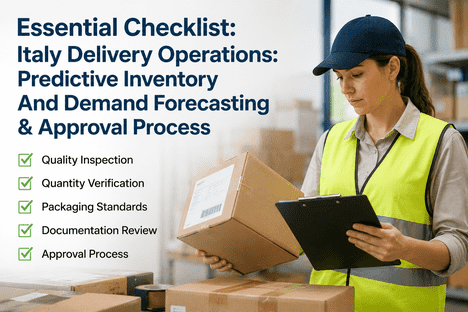
The inspection station is the physical point where the digital chain — forecast, inventory allocation, order confirmation — meets the physical product. Every shipment passes through five sequential checkpoints, each with a defined set of verification criteria. AI vision handles the measurable checks automatically: product condition is verified against reference images, unit count is calculated from captured images, packaging integrity is inspected for tears, crushing, and seal quality, and documentation fields are extracted via OCR and validated against order requirements. The operator confirms AI results, resolves exceptions, and authorizes clearance. The total inspection cycle is under two minutes per pallet — compared to 10-15 minutes for a fully manual inspection — without reducing the number or rigour of the checks performed.
Five Inspection Checkpoints — Every Shipment Passes Through All Five Gates Before Clearance
Q
Quality
AI vision inspects product condition against reference. Damage, discolouration, and seal integrity verified. Products that fail are segregated and replacement orders initiated automatically.
N
Quantity
AI vision counts units per SKU and compares against the packing list and order. Over, under, and split-shipment conditions flagged for resolution before the shipment advances.
P
Packaging
Carton condition, sealing method, labelling accuracy, and pallet stability inspected. AI vision detects tears, incorrect labels, and unstable stacks against defined standards.
D
Documents
All required documents uploaded, fields extracted via OCR, validated against order requirements and compliance rules. Missing or incorrect documents flagged with automated escalation.
C
Clearance
System verifies all prior checkpoints passed, carrier assignment confirmed, label validated, and digital clearance pass generated. Pass accessible to carrier at pickup.
The Control Tower: What Operations Managers See Across Three Decision Horizons
The control tower dashboard organizes delivery operations data across three decision horizons — real-time dispatch visibility, daily operations management, and programme-level performance analysis. Each horizon is designed for a different decision type and time frame, and all three are fed from the same data stream: demand forecasts, inventory positions, inspection results, and clearance status for every active shipment.
Real Time
Dispatch Station View
The dispatch operator sees the current status of every active shipment at the inspection station: which checkpoints have passed, which are pending, which have flagged exceptions, and the clearance status. AI vision results are displayed alongside operator confirmations. Exceptions are colour-coded by severity and include the specific defect classification and image evidence. The operator resolves exceptions — correct the condition and re-inspect, override with authorization, or reject — and the system records every action with timestamp and operator ID.
Live checkpoint statusAI vision results per stationException resolution workflow
Daily
Operations Management View
The operations manager sees the daily dispatch plan against actual clearance rates, exception trends by category and checkpoint, and forecast accuracy tracking. Inventory positions for the current day's shipments are displayed against forecast demand. Discrepancy patterns — recurring quality issues on a specific product line, documentation errors on a specific destination — are flagged for corrective action. The manager can drill into any exception for the complete resolution history and root cause data.
Dispatch vs clearance trackingException trend analysisForecast accuracy monitoring
Programme
Executive Dashboard
The executive dashboard aggregates dispatch accuracy, inventory accuracy, forecast error, and discrepancy rate across all sites into a single management view. Performance trends are displayed against baseline and target, segmented by product category, site, and customer. CAPA effectiveness tracking links every corrective action to the discrepancy that generated it and monitors subsequent performance to confirm recurrence prevention. Audit documentation — inspection records, clearance logs, exception histories — is generated automatically and available for any date range at a single export click.
From Forecast to Final Delivery — Every Shipment Verified Against 45 Standardized Criteria Before Clearance.
iFactory's Delivery Management platform connects AI demand forecasting and predictive inventory with multi-checkpoint quality inspection, automated documentation validation, and digital clearance — all through a single control tower that connects to your existing systems.
How Automated Documentation and Compliance Workflows Eliminate Dispatch Bottlenecks
Documentation is the most persistent bottleneck in Italian delivery operations. Every outbound shipment requires a specific set of documents — commercial invoice, packing list, certificate of origin, transport document, customs declaration, compliance certificates — and each document must be present, correctly filled, and matched to the order. In a manual process, the documentation check relies on a clerk comparing each document against a checklist, taking five to ten minutes per shipment and producing a binary pass-fail result with no structured error data. When a document is missing or incorrect, the clerk flags the shipment, the dispatcher pauses clearance, and the documentation team investigates — a cycle that often delays the dispatch wave by 30 to 60 minutes.
Manual Documentation vs Automated Document Extraction — What Changes at the Italian Dispatch Station
Manual Documentation Review
Process: Clerk prints each document, manually compares fields against paper checklist. Missing or incorrect fields trigger a phone call to the documentation team.
Time: 5-10 minutes per shipment. Delay compounds when documents need correction — 30-60 minutes for the documentation team to investigate and reissue.
Accuracy: 2.3% of shipments cleared with incorrect documentation, requiring post-dispatch correction. Errors discovered at customs cause penalty fees and delivery delays.
Result: Documentation delays affect 15-20% of dispatch waves. Errors discovered after dispatch cost 5-10x more to correct.
Automated Document Extraction and Validation
Process: Documents uploaded to the control tower at pick confirmation. OCR engine extracts all fields in under 15 seconds. Automated comparison against order requirements and compliance rules.
Time: Under 30 seconds per shipment for full document validation. Exceptional documents only — less than 5% require human review. No dispatch wave delays.
Accuracy: 99.5%+ document field extraction accuracy. Errors caught before customs submission. Compliance rules applied automatically per destination and product type.
Result: Documentation-related delays virtually eliminated. Customs compliance errors reduced by 80%+ through automated validation.
"
The connection between demand forecasting and dispatch accuracy became visible to us in the first month of deployment. Our forecast model predicted a 30% order increase for a specific product category in the Lombardy region based on seasonal patterns from the previous three years. The inventory system positioned additional stock at the Milan distribution centre automatically. When the orders arrived — within 4% of the forecasted volume — the inventory was already in place, the picking was completed without a stockout, and the shipments moved through inspection and clearance without a single discrepancy. Before the platform, that same demand scenario would have caused a stockout by Wednesday, emergency transfers from other sites on Thursday, and partial shipments that generated customer credits and penalty fees. The forecast-to-clearance chain saved us an estimated 28,000 euros in that single month alone — and that was before we measured the impact on customer satisfaction.
— Operations Director, Italian Consumer Goods Manufacturer, 2 Distribution Centres, 850 SKUs, 35,000 Shipments per Year
What Deployment Looks Like — From Data Connection to Live Integrated Platform
The integrated platform connects to the systems already running across the Italian manufacturing operation. No ERP replacement, no WMS migration, and no new hardware procurement for the initial deployment. The operator sees the control tower dashboard on the same terminal that displays the order and inventory data. The implementation pathway follows a consistent structure regardless of facility size or product mix.
PHASE 1 — DAYS 1-10
System Integration and Model Training
Connection to ERP, WMS, and demand history sources. AI demand forecasting model trained on 3-5 years of historical order data. Predictive inventory configuration with dynamic reorder points. AI vision model trained on site-specific product images and document samples.
Deliverable: Live demand forecasting and inventory optimization active. AI inspection configured for first product category.
PHASE 2 — DAYS 11-20
Parallel Run and Exception Validation
The integrated platform runs alongside existing dispatch processes. Every AI inspection result is compared against manual inspection. Every automated clearance decision is verified against supervisor sign-off. Forecast accuracy is tracked against actual orders. Inventory positions validated against physical counts.
Deliverable: Validation report with site-specific accuracy data for all platform capabilities.
PHASE 3 — DAY 21+
Live Operations and Continuous Improvement
The integrated platform becomes the primary operations layer. Predictive inventory and demand forecasting drive stock positioning. AI inspection and automated clearance become the default workflow. Continuous improvement cycle: weekly forecast accuracy review, monthly exception trend analysis, quarterly programme performance assessment.
Deliverable: Live integrated platform with automated KPI tracking and continuous improvement cycle active.
Conclusion
Italian manufacturing operations generate the data needed to connect demand forecasting, inventory optimization, quality inspection, and dispatch clearance into a single, integrated delivery process. Every order history record, inventory transaction, inspection image, document upload, and carrier event is a signal that describes a shipment's journey from forecast to final delivery. The obstacle has never been the absence of data. It has been the absence of a layer that connects all those signals into a single operations view where predictive analytics drive inventory positioning and quality verification ensures every shipment meets the standard before dispatch.
The platform fills that gap by combining AI demand forecasting and predictive inventory optimization with multi-checkpoint quality inspection — AI vision verification of product condition, quantity, packaging, and documentation — and digital clearance workflows that issue clearance passes only when every criterion is satisfied. The documented outcomes across Italian manufacturing operations making this transition are consistent: inventory accuracy above 97%, demand forecast accuracy above 80%, dispatch accuracy above 99.7%, and post-dispatch discrepancies reduced by over 65%.
iFactory's Delivery Management platform is built for Italian manufacturing operations where predictive inventory, demand forecasting, and quality inspection must work together as a single system. Book a Demo to see the platform configured for your product portfolio and distribution network, or talk to an expert about a free integrated platform assessment for your Italian delivery operations.
Frequently Asked Questions
The platform connects predictive inventory and quality inspection through a shared digital shipment record that flows from the demand forecast through inventory allocation to the inspection station and final clearance. When a demand forecast generates an inventory allocation, the system creates a digital shipment record with the product details, expected quantity, and required documentation. When the order arrives and the product moves to the inspection station, the digital record contains all the context the inspector needs — the forecast that triggered the allocation, the inventory position at the time of picking, and the documentation requirements for the specific destination. The AI vision inspection results are written directly to the same digital record, and when all checkpoints pass, the clearance pass is generated from that record. No data is re-entered at any stage. Every step in the forecast-to-clearance chain is documented in a single, auditable shipment record. Book a Demo to see how the digital shipment record connects forecast data to inspection results and clearance documentation.
Yes. The machine learning models are trained to recognize and account for multiple demand drivers simultaneously — seasonal patterns (agricultural equipment peaking before planting and harvest, heating fuel rising before winter, tourism-related demand surging in summer), regional variations (automotive components concentrated in Piedmont and Emilia-Romagna, pharmaceuticals in Lombardy, food products distributed nationally with regional preferences), promotional calendars (trade show cycles, customer-specific promotional events), and external market signals. The model processes data at the SKU-location level, meaning forecasts account for the specific demand pattern of each product at each warehouse or distribution point. Talk to an expert about model training requirements for your specific industrial sector and regional distribution pattern.
When a checkpoint criterion fails, the platform blocks advancement to the next checkpoint and prevents clearance pass generation until the exception is resolved. The failed criterion is highlighted on the dashboard with the specific failure reason — for AI vision checks, the captured image and defect classification are attached to the exception record. The operator has three resolution options: correct the condition and re-inspect (e.g., repackage a damaged carton or correct a documentation field), override with supervisor authorization for approved deviations (logged with supervisor ID and reason), or reject the shipment for return to stock or quarantine. The exception and its resolution are logged permanently in the shipment record with timestamps and operator identification. For time-sensitive shipments, an escalation workflow notifies the next-level supervisor if an exception remains unresolved after a configurable threshold. The system also tracks exception patterns — if a specific product line or destination generates repeated failures, the platform surfaces the pattern for process improvement. Book a Demo to see the exception resolution workflow in action.
Yes. iFactory's pre-deployment ROI assessment uses the operation's existing data — shipment volumes, current inventory accuracy, forecast error rates, post-dispatch discrepancy rates, manual inspection time per shipment, documentation error rates, and labour allocation across dispatch roles — to build a site-specific model of current operational costs and estimate the savings that the integrated platform would deliver. The assessment quantifies the impact of predictive inventory on stockout reduction and carrying cost optimization, the improvement in forecast accuracy from AI models versus current methods, the labour savings from AI vision inspection and automated documentation workflows, and the reduction in post-dispatch discrepancy costs. The output includes a projected cost reduction range, estimated payback period, and ROI timeline. The assessment is available at no cost as part of the initial engagement process. Talk to an expert to request an integrated platform ROI assessment for your Italian manufacturing operation.
Your Forecast Data, Inventory Positions, and Quality Records Already Tell the Full Story of Every Shipment. See What Happens When They Are Connected in a Single Platform.
iFactory's Delivery Management platform for Italian manufacturing operations — AI demand forecasting with 80%+ accuracy, predictive inventory optimization with 97%+ accuracy, multi-checkpoint AI vision inspection, automated documentation validation, and digital clearance — all connected through a single control tower that integrates with your existing systems.