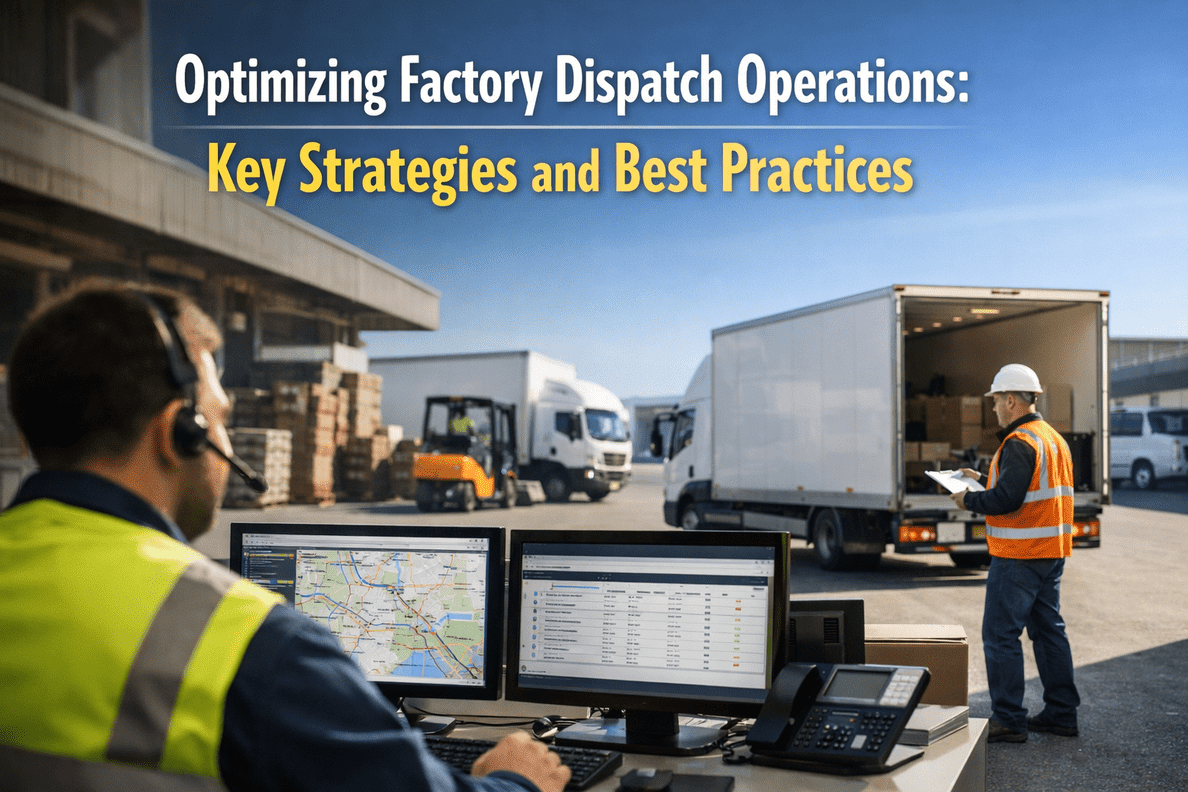
Pennsylvania is the fifth-largest manufacturing state in the U.S., with over 14,000 manufacturing establishments generating $100B+ in annual output across steel, pharmaceuticals, food processing, defense, and advanced materials. Every one of these plants has a delivery department — the internal operational function managing gate entries, inbound receiving, vehicle inspections, internal material transfers, and dispatch sequencing. And in most of them, that department still runs on paper manifests, radio check-ins, and supervisor whiteboards. That is changing. Pennsylvania factories across Pittsburgh, Philadelphia, Allentown, Erie, and the Lehigh Valley are deploying AI-driven platforms that automate dispatch sequencing, digitize gate pass management, and generate real-time compliance documentation as a byproduct of daily operations. This guide covers what that AI transformation looks like inside the factory delivery department specifically — not fleet routing on highways, but the AI-powered workflows that control what happens from the moment a vehicle pulls up to your gate to the moment finished goods leave your dock. For specific questions, talk to our support team directly.
Pennsylvania Manufacturing · AI · 2026
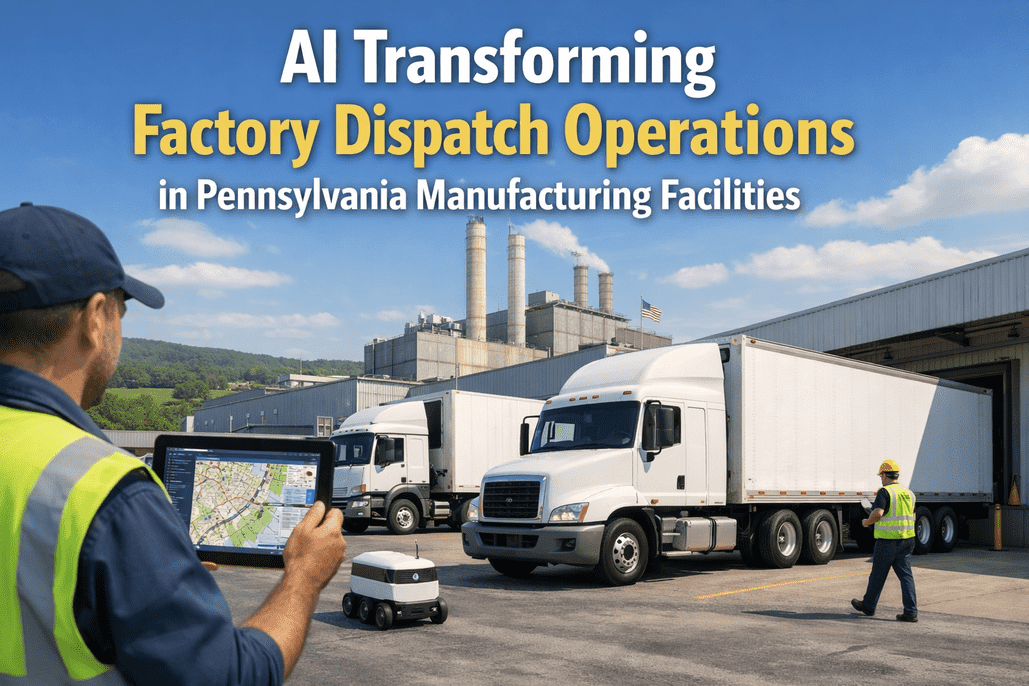
AI Transforming Factory Dispatch Operations in Pennsylvania Manufacturing Facilities
Pennsylvania's 14,000+ manufacturers face rising labor costs, tightening DEP environmental compliance, and FDA/DOT audit pressure — all converging on the factory delivery department. AI-powered dispatch sequencing, digital gate pass automation, and real-time material tracking are giving Pennsylvania plant managers the operational visibility and compliance documentation their facilities need in 2026.
Book a Demo
14,000+
Manufacturing establishments in Pennsylvania — 5th largest manufacturing state in the U.S.
$100B+
Annual Pennsylvania manufacturing output — factory delivery departments are the last undigitized function
90%
Reduction in dispatch errors when AI sequencing replaces manual supervisor scheduling
14 days
iFactory go-live timeline for a complete Pennsylvania factory delivery department deployment
Why Pennsylvania, Why Now
The 4 Pressures Forcing Pennsylvania Factory Delivery Departments to Digitize in 2026
01
Rising Labor Costs and Shrinking Headcount Availability
Pennsylvania's manufacturing labor market is tightening in every industrial corridor — Pittsburgh, Allentown, York, and Erie. Plants that previously absorbed gate queue inefficiencies with extra staff are finding that headcount is no longer available at the rates that made manual delivery department operations viable. AI automation of dispatch sequencing and gate processing reduces the labor intensity of delivery department operations without reducing throughput.
A 20-vehicle/day plant loses 280+ minutes of dock time daily on manual gate passes — recoverable with AI automation
02
Pennsylvania DEP Environmental Compliance Pressure
Pennsylvania DEP's Air Quality program and vehicle idling regulations create documentation obligations for factory operations. Plants in proximity to residential communities — a common configuration in Pennsylvania's industrial corridors — face heightened scrutiny for vehicle queue buildup at factory gates. Digital gate pass management generates the dwell-time documentation that DEP compliance requires, automatically, as a byproduct of daily gate operations.
PA DEP idling regulations: vehicles idling over 5 minutes face enforcement — gate queue data is now a compliance record
03
FDA, DOT, and DEA Audit Frequency Increasing
Pennsylvania's pharmaceutical manufacturing cluster — among the densest in the U.S. — faces FDA 21 CFR Part 11 documentation requirements that extend to inbound material chain of custody. Defense and aerospace plants in the Delaware Valley face ITAR and AS9100 receiving documentation audits. Food manufacturers face FSMA traceability requirements. Manual paper-based delivery departments cannot produce the documentation these audits require without hours of fragmented record assembly.
FDA audits for pharma plants require chain-of-custody records from supplier to production floor — paper receiving does not comply
04
JIT Production Schedules Eliminating Material Delay Tolerance
Pennsylvania's automotive, steel, and defense supply chain plants operate under JIT schedules with zero buffer for inbound material delays. A misrouted shipment, delayed receiving confirmation, or material location failure that stops production for 30 minutes in a Pennsylvania steel plant or defense supplier generates costs that dwarf the annual subscription cost of the AI platform that would have prevented it. The operational tolerance for manual delivery department processes is gone.
30–40% of production stoppages attributed to "material unavailability" are actually locating failures — not stock-outs
AI in Action
How AI Is Transforming Each Function of the Pennsylvania Factory Delivery Department
01
AI-Powered Gate Pass Management
From 15–20 minutes to under 2 minutes per vehicle
Before AI: Pennsylvania plant security staff manually verify driver IDs, check paper manifests against expected deliveries, call the receiving department by phone or radio to confirm dock availability, and complete a handwritten gate log — averaging 15–20 minutes per vehicle. At a plant processing 20 vehicles per day, this consumes 5–7 hours of gate staff and supervisor time daily that generates zero value. After AI: Drivers pre-register through a mobile app before reaching the gate. The AI system cross-references the vehicle registration, driver credentials, and cargo manifest against expected deliveries automatically. Security verifies and approves in under 2 minutes on mobile. The gate record — vehicle type, arrival timestamp, dwell time, gate officer ID — is generated automatically.
87% faster processing
Auto DEP dwell documentation
Zero paper gate logs
02
AI Inbound Receiving Verification
45–60 minutes reduced to under 10 minutes per shipment
Before AI: Receiving staff manually match delivery notes to purchase orders, count quantities by hand, note discrepancies on paper, and file documents in binders that become inaccessible within weeks and unauditable within months. For Pennsylvania pharma and defense plants, this paper-based process cannot produce the FDA 21 CFR Part 11 or AS9100 chain-of-custody records required during audits. After AI: Receiving staff use mobile barcode scanning to verify materials against POs automatically. Quantity discrepancies are flagged instantly. Photo proof of delivery is captured and linked to the shipment record. The complete receiving transaction — supplier, carrier, material, quantity, timestamp, condition — is available in iFactory's audit dashboard within seconds of the receiving dock closure, satisfying FDA, FSMA, AS9100, and DEP traceability requirements simultaneously.
78% faster receiving
FDA 21 CFR compliant record
Photo POD on every shipment
03
AI Dispatch Sequencing Engine
Manual 2–3% error rate reduced to under 0.3%
Before AI: Pennsylvania factory dispatch supervisors manually review all active orders, mentally sequence by urgency, assign vehicles and drivers based on availability and familiarity, and discover SLA conflicts only when a missed delivery surfaces as a customer complaint — typically hours or days after the sequencing error was made. The manual process produces a consistent 2–3% dispatch error rate that, across a mid-size Pennsylvania plant dispatching 50 loads per week, generates 1–3 SLA failures weekly. After AI: iFactory's dispatch sequencing engine ingests all active orders and sequences them automatically by SLA priority tier, vehicle capacity, load compatibility, driver certification, and compliance status. SLA conflicts are surfaced to supervisors before dispatch — allowing re-sequencing or escalation before the miss occurs. Every dispatch event captures vehicle ID, driver, route, departure time, and return mileage — supporting DOT and customer audit documentation automatically.
90% fewer dispatch errors
Pre-dispatch SLA alerts
DOT documentation auto-captured
04
AI Vehicle Inspection — Auto-Block on Failure
100% inspection coverage with timestamped audit trail
Before AI: Vehicle inspections in Pennsylvania factories are completed on paper checklists that are frequently unsigned, undated, and unfiled. PennDOT vehicle safety requirements for commercial vehicles operating on industrial sites require documented inspection records — but paper logs are routinely incomplete and unverifiable during surprise inspections. Vehicles with known issues continue operating because there is no enforcement mechanism between the paper checklist and the dispatch assignment. After AI: Drivers and operators complete digital pre-use inspection checklists on mobile before each use. Failed items are logged with timestamp, operator ID, and mandatory photo documentation. Vehicles with unresolved failed items are automatically blocked from dispatch assignment until a repair work order is completed and verified in the system. The result is a continuous, person-attributed inspection log that satisfies PennDOT, OSHA, and DOT requirements without any manual record assembly.
100% inspection coverage
PennDOT/OSHA ready
Auto-block non-compliant vehicles
05
AI Internal Material Location Tracking
30–40% of production stoppages eliminated
Before AI: Materials at most Pennsylvania factories have a digital record up to the moment they arrive at the receiving dock — and then they disappear into the plant floor with no system of record for their location, transfer history, or current status. When production calls the stores department asking for a component that was received two days ago, the search involves walking the plant floor, calling multiple departments, and sometimes discovering that the material was signed out to the wrong station. These locating failures stop production lines, generate overtime, and create the statistical anomaly where "material unavailability" is the reported cause of a stoppage that is actually a location management failure. After AI: Every internal transfer — dock to stores, stores to production, production to quality, quality to dispatch — is logged on mobile in under 30 seconds. Any supervisor can locate any material in under 30 seconds from any device. The same transfer records extend the FDA and AS9100 chain-of-custody documentation from the receiving dock all the way to production floor consumption.
Real-time material location
30-second locate
Chain-of-custody extended to production
06
AI Incident and Exception Management
Real-time escalation replacing days-later discovery
Before AI: Delivery department incidents at Pennsylvania plants — gate security events, receiving discrepancies, vehicle damage, hazmat near-misses at docks, driver behavior violations — are discovered hours or days after occurrence when paper logs are reviewed or complaints surface. OSHA incident reporting requirements mandate documentation within specific timeframes. Pennsylvania facilities under DEP monitoring face additional documentation obligations for environmental near-misses. Manual incident management systems consistently fail to generate the documentation these requirements demand in the timeframes they require. After AI: Incidents are captured in real time on mobile with photo documentation, auto-classification by severity category, and automatic escalation routing to the responsible supervisor. Incident records are timestamped, linked to the vehicle or shipment involved, and immediately available in iFactory's audit dashboard — satisfying OSHA, DEP, and customer audit requirements without any manual report assembly.
Real-time escalation
OSHA/DEP documentation
Photo-linked incident records
Pennsylvania Manufacturing Plants That Automate Their Delivery Departments in 2026 Will Outperform Those That Wait
iFactory deploys in 7–14 days across gate management, inbound receiving, dispatch sequencing, vehicle inspection, material tracking, and incident management. No hardware. No IT project. Complete Pennsylvania regulatory documentation generated automatically. Need a compliance gap assessment for your facility?
Talk to our support team.
Book a Demo
The Numbers
What Pennsylvania Factories Measure After Deploying iFactory's AI Platform
87%
Gate Pass Time Cut
15–20 min manual to under 2 min AI-assisted. A 20-vehicle/day plant recovers 280+ minutes of dock availability daily.
Before: 15–20 min
After: under 2 min
78%
Faster Inbound Receiving
45–60 min per shipment drops to under 10 min. FDA 21 CFR, FSMA, and AS9100 records generated automatically on every transaction.
Before: 45–60 min
After: under 10 min
90%
Dispatch Error Reduction
AI sequencing drops errors from 2–3% to under 0.3%. SLA misses surfaced before dispatch — not discovered after customer complaint.
Before: 2–3% errors
After: under 0.3%
100%
Audit Trail Coverage
Every gate event, receiving transaction, inspection, transfer, dispatch, and incident is timestamped and person-attributed. Retrievable in under 60 seconds.
Before: hours to assemble
After: 60-second retrieval
40%
Inbound Delay Reduction
Digital gate and receiving workflows reduce inbound delays by 40%, protecting JIT production schedules from upstream variability that would otherwise stop lines.
Before: frequent line stops
After: 40% fewer delays
3–6 mo
Full Platform Payback
Recovered dock time, eliminated dispatch errors, reduced compliance overhead, and avoided penalty exposure combine for 3–6 month payback on the platform investment.
Legacy: 18–24 mo payback
iFactory: 3–6 months
Before vs. After AI
Pennsylvania Factory Delivery Department: Manual Operations vs. AI-Powered iFactory
Pennsylvania Industry Sectors
How AI Factory Delivery Automation Applies Across Pennsylvania's Key Manufacturing Sectors
Pharmaceuticals
Delaware Valley / Lehigh Valley
FDA 21 CFR Part 11 requires electronic records with audit trails for inbound material handling. iFactory's receiving workflow generates a compliant digital record on every transaction — linking supplier, carrier, lot number, quantity, and timestamp without any separate compliance data entry step. DEA Schedule documentation for controlled substance receiving is handled through the same mobile workflow.
FDA audit record retrieval: under 60 seconds vs. 4–8 hours manual assembly
Steel & Metals
Pittsburgh / Mon Valley
High-volume inbound raw material deliveries — coil, billet, scrap — at Pittsburgh-area steel plants require rapid receiving verification and internal material routing. Gate queues at steel plant receiving docks during peak shift starts generate idle emissions and dock capacity losses that iFactory's AI gate processing eliminates. Real-time internal tracking prevents the locating failures that stop furnace charging schedules.
280+ minutes of dock time recovered daily at a 20-vehicle inbound operation
Defense & Aerospace
Delaware Valley / York
ITAR-controlled component receiving requires documented chain of custody from supplier to secure storage — a record that paper-based receiving cannot produce at audit standard. AS9100 traceability requirements extend this chain from gate entry through production floor consumption. iFactory's mobile receiving and transfer workflows generate both records automatically on every transaction without additional data entry.
AS9100 traceability from supplier to production: complete digital record, zero additional data entry
Food & Beverage
Lancaster / Lebanon / Statewide
FDA FSMA traceability rules require lot-level chain of custody for inbound ingredients from supplier through receiving dock to production use. Pennsylvania food manufacturers receiving 40–60 inbound ingredient deliveries daily on paper cannot produce the FSMA-compliant records that FDA enforcement requires without complete digitization of the receiving workflow. Temperature-controlled inbound receiving adds an additional documentation layer iFactory captures automatically.
FSMA traceability: digital lot-level chain from supplier to production use, auto-generated on every delivery
Pennsylvania Manufacturing's AI Transformation Has Reached the Factory Gate. Is Your Delivery Department Ready?
iFactory's AI-powered platform automates every function of your factory delivery department — gate pass management, inbound receiving, dispatch sequencing, vehicle inspection, internal material tracking, and incident management — generating FDA, DEP, PennDOT, OSHA, and AS9100 documentation automatically as a byproduct of daily operations. Deploys in 7–14 days. No hardware. No IT project. No implementation fees. Book a demo to see iFactory running in a live Pennsylvania factory delivery environment.
FAQ
Pennsylvania Factory Delivery AI Automation — What Plant Managers Ask First
What does "AI in factory dispatch operations" actually mean for a Pennsylvania manufacturing plant — is this the same as route optimization for trucks?
No — and this distinction is critical for Pennsylvania plant managers evaluating solutions. Route optimization software for trucks manages how vehicles travel between locations on public roads. AI in factory dispatch operations — what iFactory delivers — manages what happens inside and immediately around your factory facility. Specifically: how inbound vehicles are processed at your gate (AI-assisted pre-registration and compliance verification), how inbound materials are received and documented at your dock (AI-powered PO matching and discrepancy detection), how internal materials are tracked between stores, production, quality, and dispatch (real-time location logging at every transfer), how outbound loads are sequenced and assigned (AI priority sequencing by SLA tier, vehicle capacity, and compliance status), and how incidents are captured and escalated (real-time AI classification and routing by severity). None of this happens on a public road. All of it happens within the operational boundary of your Pennsylvania manufacturing facility. The AI is not optimizing routes between cities — it is eliminating the manual coordination failures that generate gate queue buildup, receiving backlogs, dispatch errors, and audit documentation gaps inside your plant.
Talk to our support team to map iFactory's AI functions to your specific facility's delivery department workflow.
Which Pennsylvania regulatory frameworks does iFactory's AI platform automatically generate documentation for?
iFactory generates compliance-relevant documentation for six major Pennsylvania and federal regulatory frameworks as a byproduct of daily delivery department operations — no separate compliance reporting workflow required. For pharmaceutical manufacturers in the Delaware Valley and Lehigh Valley: FDA 21 CFR Part 11 electronic record and audit trail requirements are satisfied by iFactory's mobile receiving workflow, which generates a timestamped, person-attributed digital record for every inbound transaction. DEA Schedule controlled substance chain-of-custody documentation is captured through the same receiving workflow. For defense and aerospace plants: AS9100 component traceability from supplier to production floor is generated automatically by iFactory's receiving and internal transfer workflows. ITAR documentation for controlled component receiving is captured at dock entry. For all Pennsylvania industrial facilities: Pennsylvania DEP vehicle idling documentation is generated automatically from iFactory's gate dwell-time records. PennDOT vehicle inspection compliance records are generated from iFactory's digital inspection checklists with timestamped, photo-documented results and auto-block enforcement. OSHA incident documentation is generated from iFactory's real-time incident capture workflow with severity-based escalation and photo documentation. FDA FSMA lot-level traceability for food manufacturers is generated from mobile barcode-scanning receiving workflows. All documentation is retrievable in under 60 seconds through iFactory's audit dashboard — eliminating the 4–8 hour manual assembly that Pennsylvania compliance teams currently dedicate to each audit event.
Book a demo to see the audit documentation interface live.
How does iFactory's AI dispatch sequencing engine work and what does it do that a Pennsylvania supervisor cannot do manually?
iFactory's AI dispatch sequencing engine does five specific things that manual supervisor sequencing cannot do reliably at scale. First, it processes all active dispatch orders simultaneously — a supervisor reviewing 20–50 open orders manually introduces sequencing errors because the human brain cannot hold all constraint variables in working memory simultaneously. The AI processes all orders against all constraints in real time. Second, it enforces SLA priority tiers automatically — ensuring that time-critical customer orders are always sequenced ahead of standard orders regardless of which supervisor is on shift or how tired they are at the end of a long day. Third, it surfaces SLA conflicts before dispatch rather than after — calculating projected completion times against SLA deadlines for all in-progress orders and alerting the supervisor when a breach is probable, allowing re-sequencing or escalation before the miss occurs. Fourth, it enforces compliance-based vehicle assignment automatically — blocking the assignment of vehicles with open failed inspection items to any dispatch order, regardless of availability pressure. A tired supervisor under throughput pressure will occasionally assign a vehicle with a known issue because "it's just a short run." The AI does not. Fifth, it captures the per-vehicle, per-trip data record that DOT and customer audit documentation requires — vehicle ID, driver, departure time, route, return mileage — without any additional data entry from the dispatcher. The result is a dispatch error rate drop from 2–3% manual to under 0.3% AI-assisted. For a Pennsylvania plant dispatching 50 loads per week, this eliminates 1–1.5 SLA failures weekly that were previously absorbed as a cost of doing business.
Talk to our support team about configuring dispatch sequencing rules for your specific SLA structure and vehicle fleet.
How long does iFactory take to deploy in a Pennsylvania manufacturing facility and what does the process require from our team?
iFactory deploys in 7–14 days for a standard Pennsylvania factory delivery department and requires three phases of engagement from your team. Phase 1 — Data Onboarding (Days 1–3): iFactory's onboarding team works directly with your operations manager to upload your vehicle registry, driver roster, supplier list, dock schedule, and existing PO templates into the platform. This requires approximately 4–6 hours of your team's time and no IT department involvement. The only data required is what your delivery department already maintains — even if it is currently in a spreadsheet or binder. Phase 2 — Configuration and Training (Days 4–7): iFactory configures inspection checklists for your specific vehicle types, dispatch SLA rules matching your customer contract structure, gate pre-registration workflows for your supplier roster, and user access levels for security staff, receiving teams, drivers, and supervisors. Mobile app training for operational staff takes 2–4 hours — the apps are designed for people who do not consider themselves software users. Phase 3 — Go-Live with Monitoring (Days 8–14): Your delivery department operates fully on iFactory with the platform support team monitoring data quality and resolving workflow gaps in real time during the first week of full operations. Because iFactory is cloud-based and mobile-first, there is no server installation, no network reconfiguration, and no IT infrastructure project for the core deployment. Pennsylvania manufacturers with multiple sites — a common configuration in the Pittsburgh-Philadelphia-Lehigh Valley industrial corridor — can deploy site-by-site on the same 7–14 day schedule per site under a single platform agreement.
Talk to our support team about your specific facility configuration and deployment timeline.
What is the realistic ROI for a Pennsylvania manufacturing plant that deploys iFactory's AI delivery department platform?
The ROI calculation for a Pennsylvania factory delivery department AI deployment has five independent financial components. Recovered dock time: a plant processing 20 inbound vehicles per day at 15–20 minutes manual gate time recovers 280+ minutes of dock availability daily — equivalent to $40,000–$120,000 in annual recovered productivity depending on dock staff cost structure and receiving throughput value. Dispatch error elimination: reducing SLA failure rates from 2–3% to under 0.3% eliminates re-dispatch transport costs, customer penalty payment exposure, and supervisor recovery time — typically worth $50,000–$200,000 annually for a mid-volume Pennsylvania plant depending on contract terms and shipment value. Compliance overhead reduction: audit documentation assembly that previously required 4–8 hours of staff time per event now takes under 60 seconds — saving 20–40 staff-hours per audit across FDA, DEP, PennDOT, OSHA, and customer audits. Avoided penalty exposure: OSHA violations for inadequate inspection records can reach $15,625 per violation per day. Pennsylvania DEP vehicle idling citations can reach $25,000 per violation. FDA 483 observations for inadequate chain-of-custody documentation carry warning letter and consent decree exposure far exceeding any platform subscription cost. Production stoppage prevention: eliminating the 30–40% of production stoppages caused by material locating failures at JIT plants recovers production schedule value that is plant-specific but typically represents the highest single ROI component in automotive, steel, and defense supply chain environments. Combined, these components produce full platform payback within 3–6 months of go-live for the typical Pennsylvania manufacturing plant.
Talk to our support team for an ROI calculation calibrated to your plant's vehicle volume, dispatch frequency, and regulatory exposure profile.
Can iFactory handle Pennsylvania manufacturing operations across multiple plant sites — and does the platform adapt to different industry compliance requirements at each site?
iFactory is built as a multi-depot, multi-site platform from its core architecture — a single deployment covers all Pennsylvania facilities in your portfolio under one unified dashboard with site-specific configurations maintained independently per location. This is particularly relevant for Pennsylvania manufacturers with a common multi-site profile: a pharmaceutical manufacturing campus in the Delaware Valley, a food processing plant in Lancaster County, and a component assembly facility in Allentown, each operating under different regulatory frameworks. Under iFactory's multi-site architecture, the pharma site can be configured with FDA 21 CFR Part 11 receiving workflows and DEA chain-of-custody documentation, the food plant with FDA FSMA lot-level traceability templates, and the assembly facility with AS9100 receiving verification — all running simultaneously under the same platform agreement, with corporate operations leadership seeing a consolidated cross-site dashboard. At the site level, each plant manager sees only their facility's operations. At the corporate level, operations directors see KPI comparisons across all sites — gate dwell times, receiving cycle times, dispatch error rates, inspection compliance rates, and incident frequencies — enabling performance benchmarking across the Pennsylvania manufacturing portfolio. For manufacturers with operations outside Pennsylvania, iFactory's compliance configuration extends to CARB and LCFS in California, Schedule M and FSSAI in India, LkSG in Germany, and Vision 2030 documentation standards in the UAE.
Book a demo to see multi-site configuration running across multiple factory delivery departments simultaneously.
Pennsylvania's AI Manufacturing Transformation Is Underway. Your Factory Delivery Department Should Not Be the Last Function Digitized.
72% of manufacturers have partially implemented smart factory strategy — the delivery department consistently lags behind every other function. iFactory closes this gap with a purpose-built AI platform that deploys in 7–14 days and generates compliance documentation for every Pennsylvania regulatory framework automatically. Book a demo to see it operating in a live factory environment.