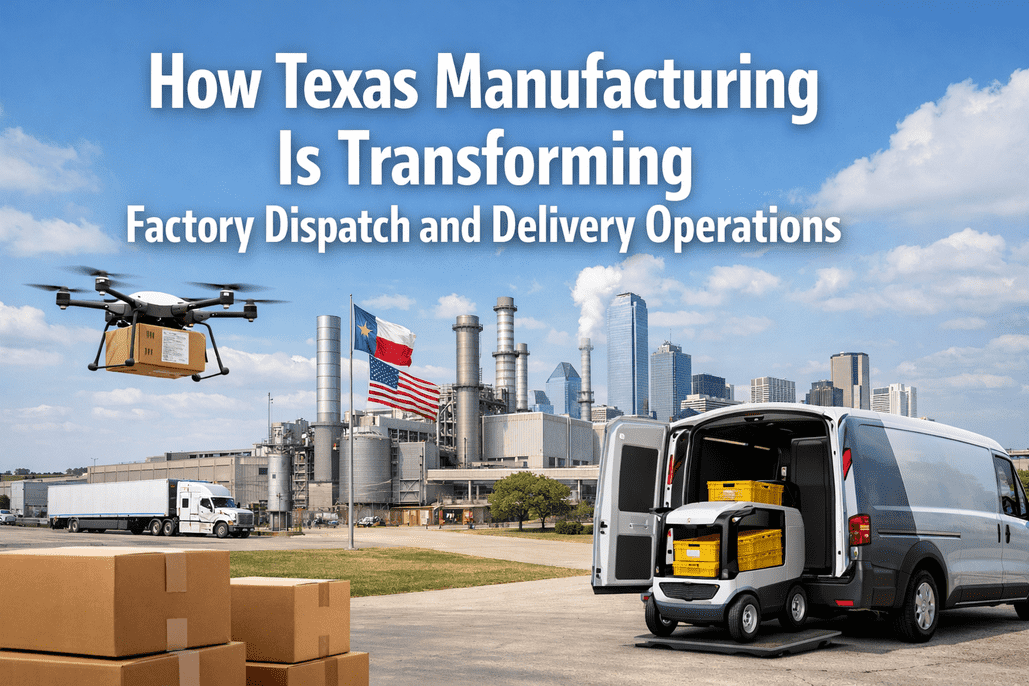
Texas is home to over 22,000 manufacturing establishments and processes more freight tonnage than any other U.S. state. Yet inside the factory gate — where inbound vehicles queue, materials transfer between stores and production, and dispatch supervisors sequence outbound loads — most Texas plants still run on paper logs, manual radio calls, and whiteboard schedules. This operational gap is closing fast. Across automotive, petrochemical, food processing, and aerospace plants in Houston, Dallas-Fort Worth, San Antonio, and the Permian Basin, factory delivery departments are deploying AI-driven dispatch sequencing, digital gate pass automation, and real-time internal tracking to cut dwell times, eliminate dispatch errors, and generate the audit-ready documentation Texas's growing regulatory and ESG reporting environment demands. This page explains what that transformation looks like, the numbers behind it, and how iFactory delivers it in 14 days. Questions? Talk to our support team directly.
Texas Manufacturing · Automation · 2026
How Texas Factories Are Transforming Dispatch and Delivery Operations with Automation
With 22,000+ manufacturing plants, Texas leads U.S. industrial output — but most factory delivery departments still run on paper. AI-driven gate pass automation, smart dispatch sequencing, and real-time material tracking are changing that. Here is what the digital transformation of factory delivery looks like in practice — and why Texas plants that move first will outperform those that wait.
Book a Demo
22,000+
Manufacturing establishments operating in Texas — more than any other U.S. state
$387B
Texas manufacturing GDP — the delivery department is the most under-digitized function in every plant
87%
Reduction in gate pass processing time when plants move from manual paper to digital workflows
14 days
iFactory go-live timeline — from contract to fully operational digital delivery department
Why Texas, Why Now
Texas Manufacturing Is Growing Faster Than Its Delivery Infrastructure Can Handle
Texas added $42B in manufacturing investment between 2021 and 2024 — new semiconductor fabs, EV battery plants, LNG processing facilities, and aerospace component manufacturers. Every new plant adds inbound freight volume, outbound dispatch complexity, and regulatory reporting obligations. The delivery department — gate management, inbound receiving, internal transfers, vehicle inspections, incident documentation — cannot scale on the same manual processes that worked when plants were smaller and shipment volumes lower.
$42B
New Manufacturing Investment (2021–2024)
Semiconductor, EV, aerospace, and energy plants all adding inbound and outbound freight volume that manual delivery department processes cannot absorb without creating gate queues, receiving backlogs, and dispatch SLA failures.
280 min
Daily Dock Time Lost Per 20-Vehicle Plant
A Texas plant processing 20 inbound vehicles per day at the average manual gate time of 15–20 minutes loses 280+ minutes of dock availability daily — equivalent to 1.5–2 full-time employees absorbed by gate queue management alone.
2–3%
Manual Dispatch Error Rate
Manual dispatch sequencing in Texas factories produces error rates of 2–3% — with SLA misses frequently undetected until a customer complaint surfaces. AI-driven sequencing reduces this to under 0.3%, with real-time SLA alerts for every in-progress dispatch.
72%
Smart Factory Adoption Rate — Delivery Lags
72% of manufacturers have partially implemented smart factory strategy. The delivery department — gate pass, inbound receiving, dispatch, vehicle inspection — consistently lags behind production, maintenance, and quality in digitization, creating a data blind spot that costs measurable operational efficiency daily.
Texas Industry Breakdown
Which Texas Plant Types Are Digitizing Delivery Operations — and Why
Automotive & EV
Dallas-Fort Worth / San Antonio
JIT production schedules require inbound material receiving accuracy within 15-minute windows. A single misrouted inbound shipment or missing gate pass record can halt a production line. Digital gate-to-floor material tracking eliminates the locating failures that cause 30–40% of production stoppages attributed to "material unavailability."
30–40% of production stoppages are locating failures, not stock-outs
Petrochemical & Energy
Houston / Permian Basin
OSHA and TCEQ compliance documentation requires timestamped vehicle inspection records, hazmat material chain of custody from gate to storage, and incident reports generated within hours of occurrence. Paper-based delivery departments cannot produce this documentation under enforcement timelines without hours of manual assembly from fragmented binders.
TCEQ/OSHA audit documentation retrievable in under 60 seconds with iFactory
Food & Beverage
Statewide / Rural Texas
FDA FSMA traceability rules require a documented chain of custody for inbound ingredients from supplier through receiving dock to production floor. Texas food manufacturers processing 40–60 inbound deliveries per day on paper cannot produce FDA-compliant receiving records without a digital inbound receiving workflow generating timestamps and PO verification automatically.
FDA FSMA requires digital receiving chain of custody — paper logs do not comply
Aerospace & Defense
Fort Worth / Houston
AS9100 and ITAR compliance require component traceability from supplier to production station — including the receiving dock record that bridges the supplier's documentation to the factory's internal chain of custody. Digital inbound receiving with photo POD and PO verification generates this record automatically on every shipment.
AS9100 traceability audit: paper records require 4–8 hrs to assemble vs. 60 seconds digital
What Automation Covers
6 Factory Delivery Functions Texas Plants Are Automating Right Now
01
Gate Pass Automation — Pre-Arrival to Exit
Drivers pre-register via mobile before reaching the gate. Security staff verify vehicle compliance, driver credentials, and cargo manifest through a mobile checklist — completing the gate process in under 2 minutes vs. 15–20 minutes on paper. The system automatically records vehicle type, arrival and exit timestamps, dwell time, and gate officer ID — generating the compliance record and the idle-time documentation that Texas Environmental Quality regulations increasingly require from industrial gate operations.
Under 2 min processing
87% time reduction
Auto compliance record
02
Mobile Inbound Receiving — PO Verification and Photo POD
Receiving staff verify inbound materials against purchase orders on mobile — scanning barcodes, flagging quantity discrepancies, and capturing photo proof of delivery in real time. The receiving record is closed in under 10 minutes vs. 45–60 minutes on paper — and simultaneously generates the FDA FSMA, AS9100, and TCEQ chain-of-custody documentation linking supplier, carrier, material, quantity, and timestamp. No separate compliance documentation step. No paperwork binder. No scan-to-email reconciliation at month-end.
78% faster completion
Photo POD on every shipment
Auto chain-of-custody
03
AI-Driven Dispatch Sequencing with SLA Priority
Dispatch orders are sequenced automatically by SLA priority tier, vehicle capacity, load compatibility, driver availability, and compliance status. The AI sequencing engine identifies SLA conflicts before dispatch — alerting the supervisor to re-sequence or escalate, rather than discovering the miss after a customer complaint. Manual dispatch error rates of 2–3% drop to under 0.3%. Each dispatch event records vehicle ID, driver, departure time, route, and return — building the data set required for fuel efficiency and emissions reporting under Texas Commission on Environmental Quality frameworks.
90% error reduction
Real-time SLA alerts
Per-trip fuel data captured
04
Digital Vehicle Inspection Checklists — Auto-Block on Failure
Drivers and yard equipment operators complete digital pre-use inspection checklists on mobile before each shift or trip. Failed inspection items are logged with timestamp, operator ID, and photo documentation. Vehicles with unresolved failed items are automatically blocked from dispatch until a verified repair work order is completed. For Texas plants operating under TXDOT and OSHA vehicle safety requirements, this generates a continuous, timestamped inspection record that withstands enforcement audit — replacing paper logs that are frequently incomplete, unsigned, or undiscoverable during surprise inspections.
100% inspection coverage
Auto-block non-compliant vehicles
TXDOT/OSHA ready
05
Real-Time Internal Material Location Tracking
Materials are logged at every internal transfer point — from receiving dock to stores, stores to production, production to quality hold, quality to dispatch. Each transfer creates a timestamped, person-attributed record accessible from any device. Supervisors can locate any material in the facility in under 30 seconds — eliminating the 30–40% of production stoppages that are actually material locating failures rather than stock-outs. For Texas automotive and aerospace plants running JIT schedules, this is not a convenience — it is a production schedule protection mechanism.
Real-time location
30–40% stoppage reduction
Full chain-of-custody
06
Incident and Exception Management with Auto-Escalation
Delivery department incidents — gate security events, receiving discrepancies, vehicle damage, hazmat spillage near docks, driver behavior violations — are captured in real time on mobile with photo documentation, auto-classification, and escalation routing based on severity. Texas plants previously discovering incidents days after occurrence now receive supervisor alerts within minutes. Incident records are timestamped, person-attributed, and linked to the vehicle or shipment record — generating the documentation OSHA, TCEQ, and customer audit requirements demand without any manual incident report assembly.
Real-time escalation
Photo documentation
OSHA-ready records
Texas Plants That Digitize Delivery Operations in 2026 Will Outperform Those That Wait Until Enforcement Forces the Change
iFactory deploys in 7–14 days. No hardware. No IT project. No implementation fees. Every delivery department function goes live simultaneously — gate pass, inbound receiving, dispatch, inspection, material tracking, and incident management. Questions about your facility?
Talk to our support team.
Book a Demo
Numbers That Matter
What Texas Factory Delivery Departments Measure After Going Digital
87%
Gate Pass Time Cut
15–20 min manual to under 2 min digital. 280+ minutes of dock time recovered daily at a 20-vehicle plant.
78%
Faster Receiving
45–60 min per shipment drops to under 10 min. FDA, FSMA, and AS9100 chain-of-custody generated simultaneously.
90%
Fewer Dispatch Errors
2–3% manual error rate drops to under 0.3% with AI sequencing. SLA misses caught before dispatch, not after complaint.
100%
Audit Coverage
Every gate, receiving, inspection, dispatch, transfer, and incident event timestamped and person-attributed. Retrievable in under 60 seconds.
3–6 mo
Full Payback
Recovered dock time, eliminated dispatch errors, reduced compliance overhead, and avoided penalty exposure combine for 3–6 month platform payback.
40%
Inbound Delay Reduction
Digital gate and receiving workflows reduce inbound delays by 40% — directly protecting JIT production schedules from upstream variability.
14 days
Go-Live Timeline
From contract to fully operational in 7–14 days. Cloud-based, mobile-first. No server installation, no hardware procurement, no IT department project.
$25.5B
Market by 2035
Global delivery management software market growing from $11.6B (2025) to $25.5B (2035). Texas industrial growth is a primary adoption driver.
Before vs. After
Texas Factory Delivery Department: Manual vs. iFactory Digital Operations
Real Outcomes
What iFactory Customers Achieve Within 90 Days of Deployment
280+ minutes
Daily Dock Time Recovered
A Texas plant receiving 20 vehicles per day recovers 280+ minutes of dock availability daily by moving gate processing from 15–20 minutes manual to under 2 minutes digital. This directly expands daily receiving capacity — absorbing more inbound volume without adding headcount.
90% error drop
Dispatch Error Elimination
Moving from manual to AI-sequenced dispatch reduces error rates from 2–3% to under 0.3%. For a plant dispatching 50 loads per day, this eliminates 1–1.5 dispatch errors daily — each of which previously generated re-dispatch costs, SLA penalty exposure, and supervisor recovery time.
60 seconds
Audit Documentation Retrieval
Texas plants operating under OSHA, TCEQ, TXDOT, FDA FSMA, or AS9100 frameworks that previously required 4–8 hours of manual record assembly per audit event now retrieve complete, timestamped, person-attributed documentation in under 60 seconds from iFactory's audit dashboard.
3–6 months
Full Platform Payback
Recovered dock time, reduced dispatch errors, lower compliance overhead, avoided penalty exposure, and eliminated manual documentation labor combine to produce full platform payback within 3–6 months of go-live — typically the fastest payback of any digital investment in the manufacturing technology stack.
Texas's Fastest-Growing Industries Can't Afford a Paper-Based Delivery Department in 2026
iFactory digitizes every function of your factory delivery department — gate pass automation, mobile inbound receiving, AI dispatch sequencing, digital vehicle inspection, real-time material tracking, and incident management — in 7–14 days. No hardware. No IT project. No heavy implementation fees. Book a demo to see iFactory running in a live Texas factory delivery environment.
FAQ
Texas Factory Delivery Automation — Questions Operations Leaders Ask First
What exactly is a "factory delivery department" and how is it different from a courier or last-mile delivery service?
A factory delivery department is the internal operational unit within a manufacturing plant that manages everything that happens at the plant's physical boundary — vehicles entering and exiting through gate management, inbound raw materials being received and documented at the dock, internal materials moving between stores, production, quality, and dispatch, yard vehicles being inspected before use, and outbound loads being sequenced and dispatched to customers or distribution points. This is fundamentally different from a courier or last-mile delivery service, which manages package delivery to end consumers. A factory delivery department never touches a parcel — it manages the movement of raw materials, components, sub-assemblies, finished goods, and vehicles within and around the plant perimeter. iFactory is built specifically for this internal department — not adapted from a courier logistics tool or a consumer parcel tracking platform. For Texas plants in automotive, petrochemical, food processing, and aerospace, this distinction matters because the compliance frameworks (TXDOT, TCEQ, OSHA, FDA FSMA, AS9100) are industrial — not consumer delivery regulations.
Talk to our support team if you want to map your specific plant's delivery department functions to iFactory's module coverage.
How does AI-driven dispatch sequencing work in a Texas factory environment — and what does it actually automate?
iFactory's AI dispatch sequencing engine does four things that manual sequencing cannot do reliably at scale. First, it ingests all active dispatch orders and ranks them automatically by SLA priority tier — ensuring that time-critical customer shipments are always sequenced ahead of standard orders without requiring the supervisor to manually review and re-sort a dispatch list. Second, it matches available vehicles and drivers to orders based on load compatibility, vehicle capacity, driver certification, and compliance status — blocking non-compliant vehicles from assignment automatically. Third, it identifies SLA conflicts before dispatch — surfacing alerts to the supervisor when a combination of order volume and available capacity makes an SLA breach probable, allowing re-sequencing or escalation before the miss occurs rather than after a customer complaint surfaces it. Fourth, it captures the per-vehicle, per-dispatch data set — vehicle ID, driver, departure time, route, return mileage — that Texas regulatory frameworks and internal KPI reporting require. The result is a dispatch error rate drop from 2–3% manual to under 0.3% digital, with real-time supervisor visibility rather than end-of-day reconciliation.
Book a demo to see AI dispatch sequencing running live in a factory dispatch environment.
Which Texas regulatory frameworks does iFactory's documentation automatically satisfy — and for which industries?
iFactory's factory delivery department platform generates compliance-relevant documentation for six major Texas and federal regulatory frameworks as a byproduct of daily operations — no separate compliance reporting workflow required. For petrochemical and energy plants: TCEQ material handling documentation, OSHA hazmat chain-of-custody records, and incident reports with timestamped escalation trails. For food and beverage manufacturers: FDA FSMA traceability records linking supplier, carrier, inbound material, quantity, and receiving timestamp for every shipment. For automotive and aerospace plants: AS9100 component traceability records covering the receiving dock bridge between supplier documentation and factory floor chain of custody. For all Texas industrial plants: TXDOT vehicle inspection records (timestamped, person-attributed, with failed-item documentation and repair verification), OSHA incident records with photo documentation and escalation history, and general audit trail documentation for Texas Workforce Commission workplace compliance reviews. The key mechanism is that iFactory captures all of this data during the normal daily operations of the delivery department — gate entries, receiving transactions, inspection completions, dispatch events — rather than requiring a separate reporting or data entry workflow. All records are retrievable in under 60 seconds through iFactory's audit dashboard.
Talk to our support team for a compliance gap assessment specific to your plant type and Texas regulatory exposure.
How does iFactory deploy in 7–14 days and what does the implementation process actually require from our team?
iFactory deploys in three phases over 7–14 days with minimal demand on your internal team. Phase 1 (Days 1–3): Data onboarding. iFactory's onboarding team works with your operations manager to upload your vehicle registry, driver roster, supplier list, and PO templates. This requires approximately 4–6 hours of your team's time, primarily from whoever manages your existing vehicle and supplier records — no IT involvement required at this stage. Phase 2 (Days 4–7): Configuration and mobile training. iFactory configures inspection checklists for your vehicle types, dispatch SLA rules matching your customer contracts, gate pre-registration workflows for your supplier roster, and user access levels for security staff, receiving teams, drivers, and supervisors. Mobile app training for operational staff takes 2–4 hours — the apps are designed for plant operational personnel, not software users, so adoption is typically faster than any other platform your team has deployed. Phase 3 (Days 8–14): Go-live with monitoring. Your delivery department operates live on iFactory with the platform team monitoring data quality and resolving any workflow gaps in real time during the first week of full operations. Because iFactory is cloud-based and mobile-first, there is no server hardware to install, no network reconfiguration required, and no IT department project to manage for the core deployment.
Book a demo to walk through the deployment plan for your specific facility.
What is the realistic ROI for a Texas factory that digitizes its delivery department with iFactory?
The ROI calculation for a Texas factory delivery department digitization has five independent components that each stand on their own. Recovered dock time: a plant receiving 20 vehicles per day recovers 280+ minutes of dock availability daily by reducing gate processing from 15–20 minutes to under 2 minutes — equivalent to $40,000–$120,000 in annual recovered labor productivity depending on your dock staffing cost structure. Dispatch error elimination: reducing dispatch errors from 2–3% to under 0.3% eliminates re-dispatch costs, customer SLA penalty payments, and supervisor recovery time — typically worth $50,000–$200,000 annually for a mid-volume Texas plant. Compliance overhead reduction: audit documentation that previously required 4–8 hours of manual assembly now takes under 60 seconds — saving 20–40 staff-hours per audit event across TXDOT, TCEQ, OSHA, and customer audits. Avoided penalty exposure: OSHA violations for inadequate inspection records can reach $15,625 per violation per day. TCEQ penalties for inadequate hazmat chain-of-custody documentation can reach $25,000 per violation. A single avoided enforcement event covers years of iFactory subscription cost. Production stoppage prevention: eliminating the 30–40% of production stoppages caused by material location failures in plants running JIT schedules can recover hundreds of thousands of dollars annually in production schedule recovery costs. Combined, these five ROI components produce full platform payback within 3–6 months of go-live for the typical Texas manufacturing plant.
Talk to our support team for an ROI calculation specific to your plant's vehicle volume, dispatch frequency, and regulatory exposure.
Does iFactory work for multi-site Texas manufacturing operations — and does it support plants outside Texas?
iFactory is built as a multi-depot, multi-site platform from its core architecture — a single iFactory deployment covers all facilities in your Texas or national portfolio under one unified dashboard with site-specific configurations. Each site maintains its own gate pass workflows, vehicle inspection checklists, dispatch SLA rules, supplier rosters, and compliance documentation templates — while corporate operations leadership sees a consolidated view across all sites simultaneously. For Texas manufacturers with plants in Houston, Dallas-Fort Worth, San Antonio, and the Permian Basin, this means one platform contract, one integration project, and one training program covering all sites — with site managers maintaining local operational control and corporate leadership maintaining portfolio-level visibility. For manufacturers with plants outside Texas, iFactory's compliance documentation framework configures to local regulatory requirements for each site. In California, this covers CARB, LCFS, and AB 2061. In India, it supports Schedule M GMP and FSSAI. In Germany, it aligns with LkSG supply chain traceability. In the UAE, it supports Vision 2030 smart manufacturing documentation standards. The underlying data model — timestamped, person-attributed records for every gate, receiving, inspection, dispatch, transfer, and incident event — satisfies all of these frameworks from a single platform.
Book a demo to see multi-site configuration running live across multiple factory delivery departments.
iFactory Is the Only Platform Built Specifically for the Factory Delivery Department — Not Adapted from a Courier Tool
Gate pass automation, AI dispatch sequencing, mobile inbound receiving, digital vehicle inspection, real-time material tracking, and incident management — all in one platform, live in 14 days, built for Texas manufacturing operations. Book a demo to see iFactory running in a real factory delivery environment.