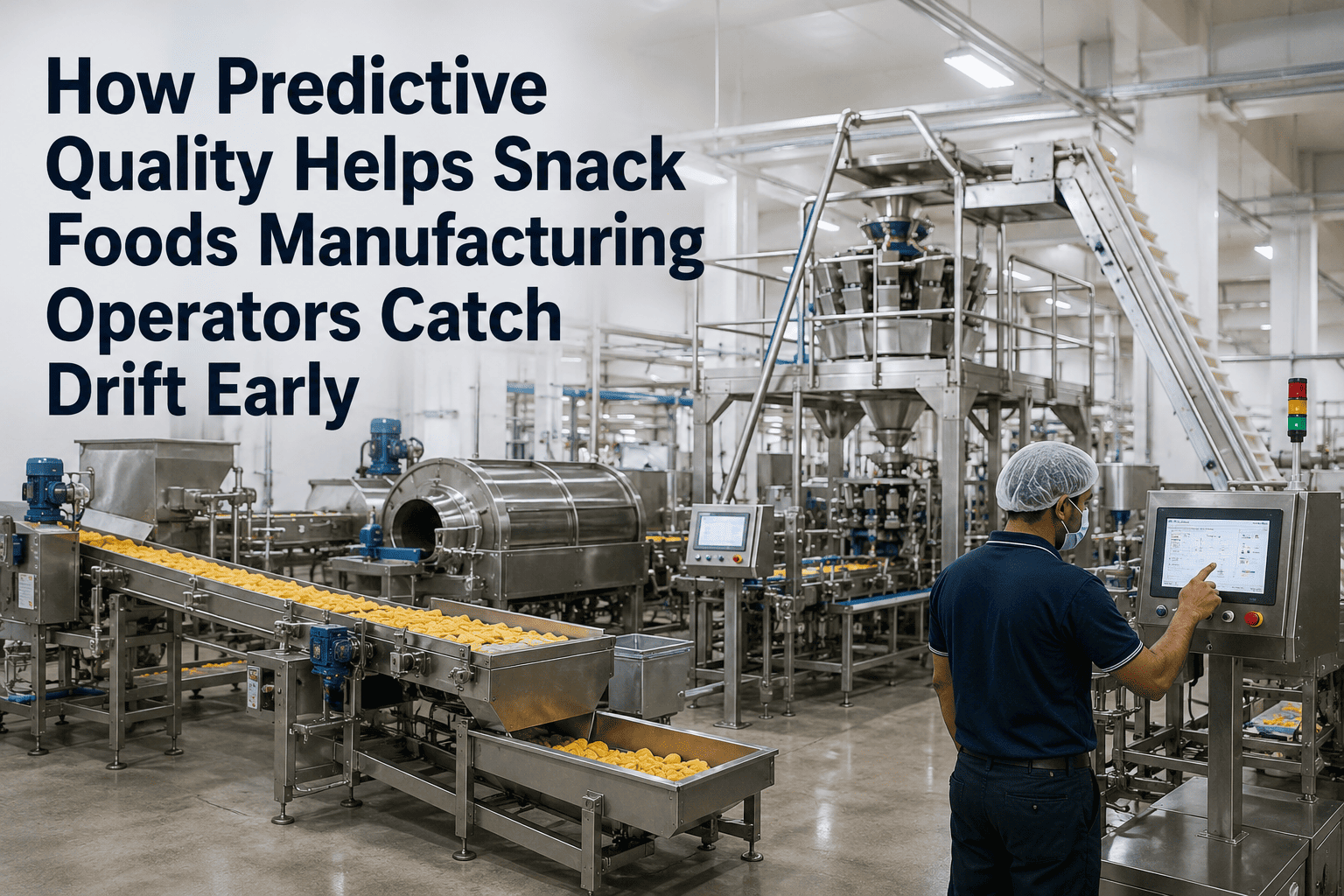
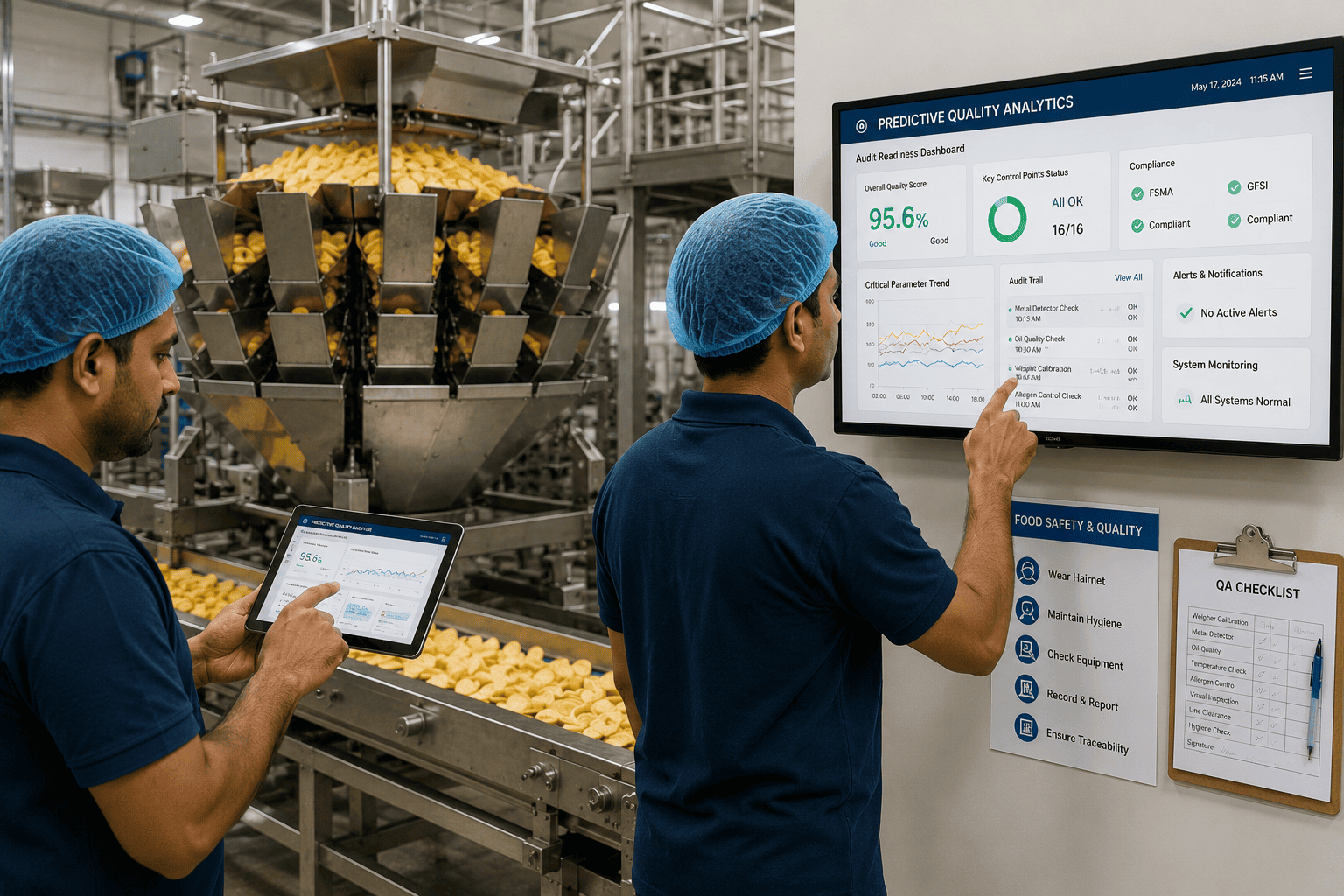
You're running a frying line at 4:00 AM. The seasoning coverage on the third batch looks off — slightly lighter than yesterday's run. You check the weight data from the tumbler. Numbers look normal on the sheet, but something doesn't feel right. You call the shift supervisor. Investigation takes 90 minutes. By then you've lost half a shift of production and diverted three batches that might be out of spec. This scenario happens 2-3 times per week on most snack food lines. AI-native SPC eliminates it. Real-time control charts alert you before deviation becomes batch loss. No spreadsheets. No delays. Schedule a demo to see how AI-native SPC works on your line.
SNACK FOODS MANUFACTURING · AI-NATIVE SPC · OPERATORS
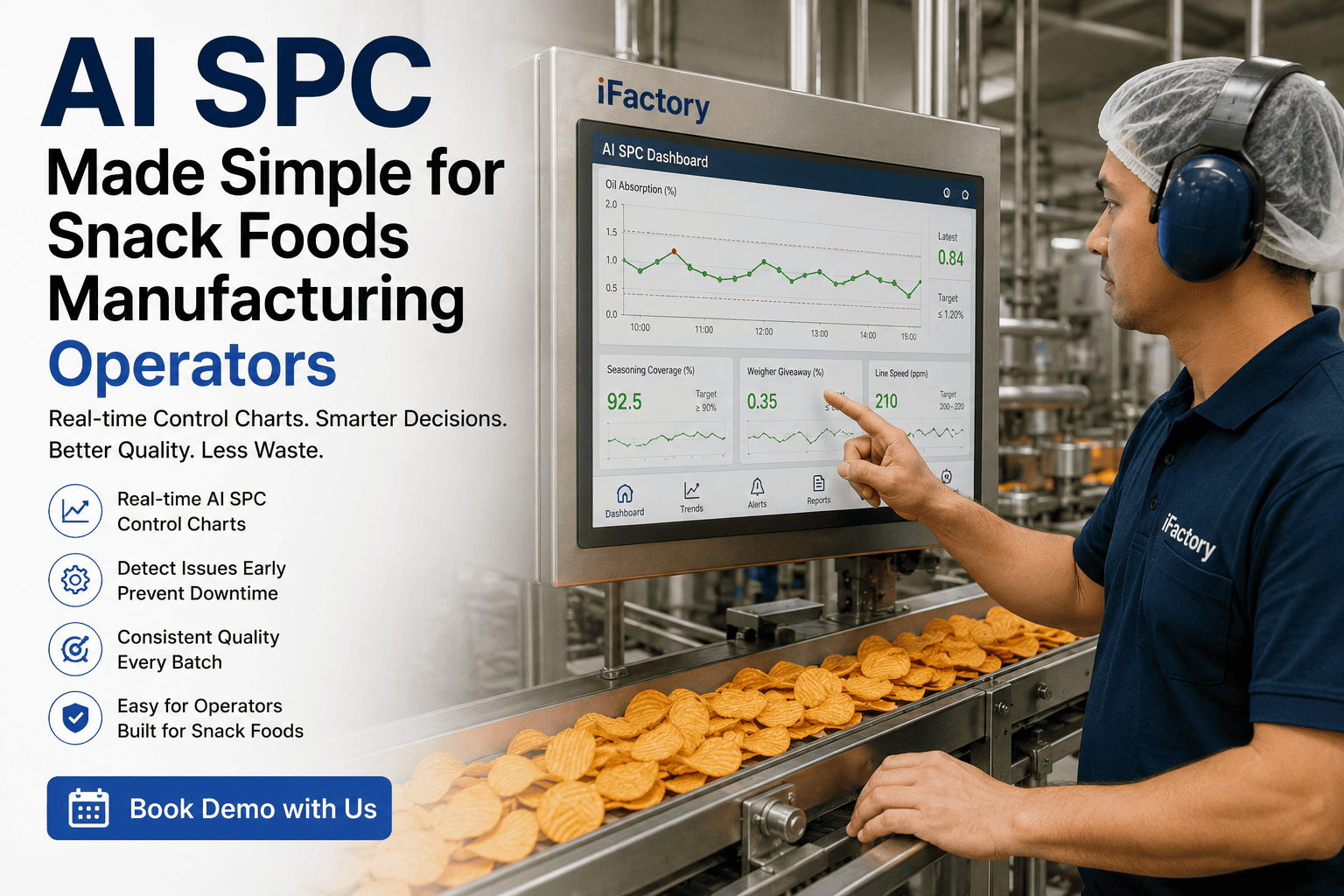
AI SPC Made Simple for Snack Foods Manufacturing Operators
Real-time control charts purpose-built for snack foods operators. Catch quality drift before it becomes batch loss. No training required. No spreadsheets. AI monitors your line 24/7 and alerts you only when action is needed.
30-50%Unplanned Downtime Reduction
2-3Fewer Investigations Per Week
$18K-24KScrap Reduction Per Month
6-12Weeks to Live Monitoring
The Snack Foods Operator's Problem
Snack food lines operate on thin margins. A seasoning tumbler that drifts 5% too light looks fine on a spreadsheet but costs you 8-12% yield loss on that batch. A fryer temperature that creeps 2°C higher than yesterday increases oil consumption 6-8% and product color variation. A weigher nozzle that clogs slowly delivers 12-15 gram variance over 4 hours — invisible in manual checks, catastrophic in final product consistency.
The real problem is not the equipment. It is that you don't know these things are happening until damage is already done. You're running a production line with yesterday's data.
Current StateManual quality checks 3-4 times per shift. Excel spreadsheets updated manually. Deviation discovered 1-2 hours after it occurs. Investigation time: 60-120 minutes. Batch already in risk zone.
Downtime Cost Per EventInvestigation time: 1.5 hours. Production stop: 30-45 min. Batch diversion or rework: 4-8 hours. Average cost per event: $4,000-8,000. Frequency: 2-3 events per week = $8,000-24,000 weekly cost.
AI-Native SPC Future StateReal-time monitoring 24/7. Deviation alert within 5-10 minutes of onset. Operator response time: 5-15 minutes. Batch saved before significant loss. Cost per prevented event: $3,500-7,500.
How AI-Native SPC Works on Your Snack Line
AI-native SPC is not a software tool you learn to use. It is a system that learns your line and alerts you automatically. Here is what happens on your fryer, tumbler, weigher, and packaging line.
Real-Time Monitoring
Fryer Oil & Temperature
- AI monitors fryer temperature every 30 seconds
- Detects drift before it becomes oil consumption problem
- Alert: "Fryer temp trending 1.8°C high — check heater, verify thermostat"
- You respond in 10 minutes. Oil consumption stays normal.
- Without AI: You discover the problem 4 hours later when oil consumption jumps 8%
Documented savings: 4-6% oil consumption reduction per month
Real-Time Monitoring
Seasoning Tumbler & Coverage
- AI tracks weight variance batch-to-batch from tumbler discharge
- Normal range learned from your line baseline (not a textbook value)
- Alert: "Seasoning weight -12g vs average — tumbler speed drift or coating nozzle issue"
- You check tumbler RPM, adjust nozzle. Batch 47 is good. Batches 48-50 diverted and reworked at planned time.
- Without AI: Drift discovered after 6-8 batches already out of spec
Documented savings: 3-5% yield improvement, -2-3 batches diverted per week
Real-Time Monitoring
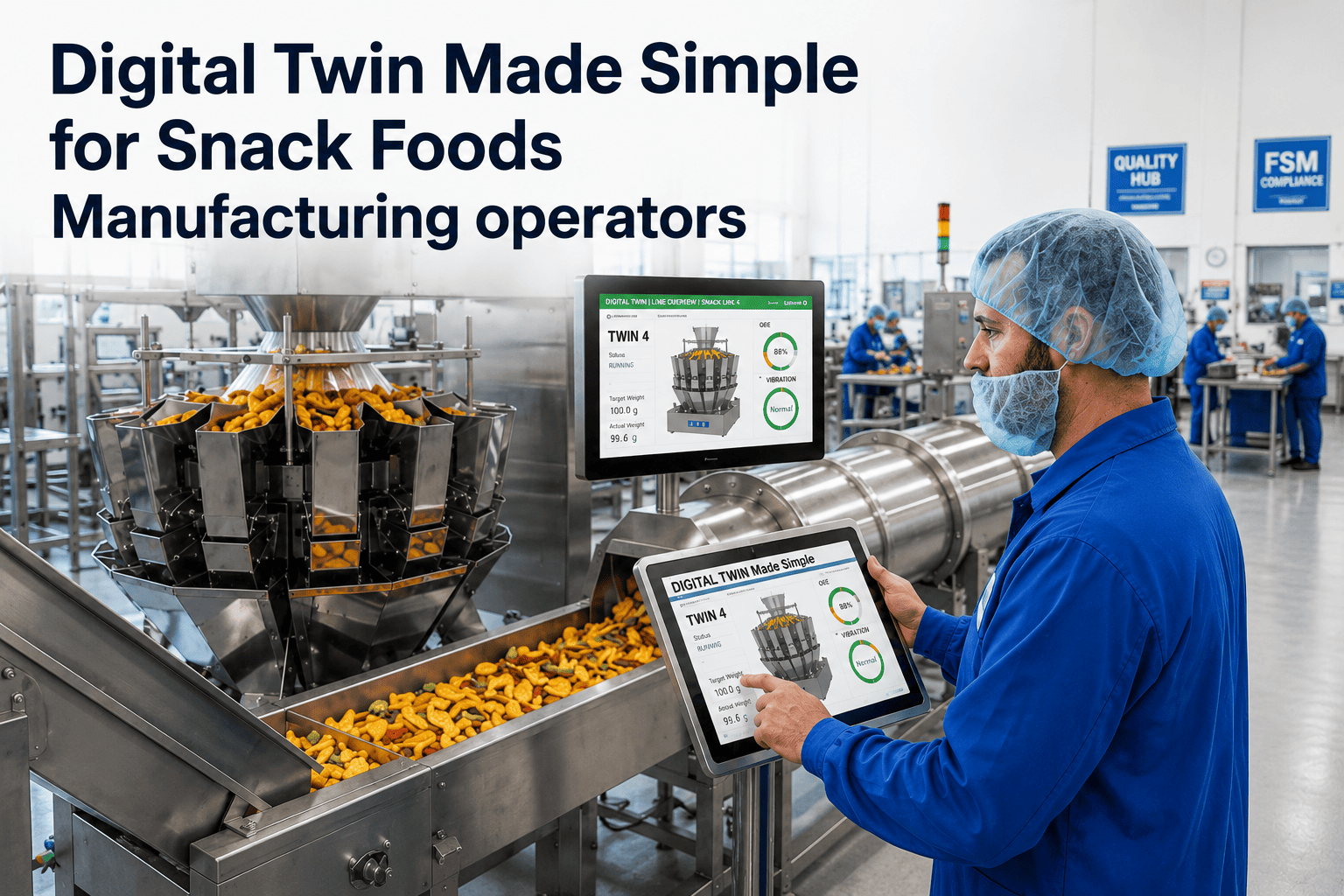
Multi-Head Weigher & Giveaway
- AI monitors each weigher head independently
- Detects nozzle clogging, servo drift, or air pressure loss before scale shifts
- Alert: "Weigher Head 3 trending +8g variance — clogging or servo drift likely"
- You inspect head 3, clean or adjust. Weights hold stable.
- Without AI: You discover one head is consistently giving away 12g per package after 500+ units
Documented savings: 2-4% package weight giveaway reduction
Predictive Alert
Line Downtime Prevention
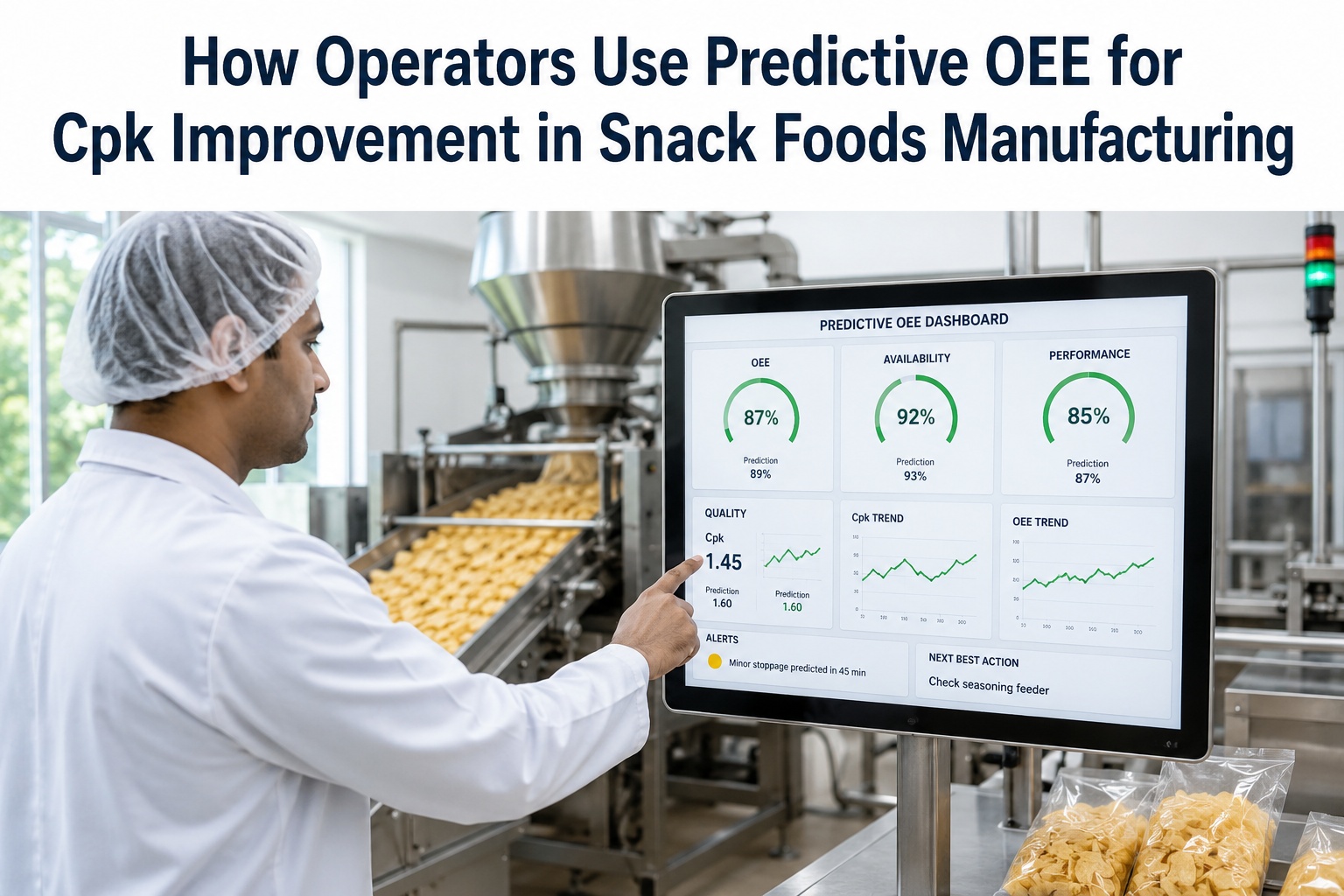
- AI detects early signs of equipment stress (vibration patterns, flow inconsistency, thermal drift)
- Alert: "Seasoning motor vibration increasing — bearing likely wearing — plan maintenance before shift end"
- You schedule 30 min maintenance at lunch break. Line stays up.
- Without AI: Motor fails at 2 PM. Line down 4 hours for bearing replacement.
Documented savings: -60% to -75% emergency downtime (operator shift-level data)
AI-native SPC is not about quality control. It is about giving you real-time visibility into what your equipment is actually doing so you can respond before small drift becomes batch loss and unplanned downtime.
What the Data Actually Shows: Real Snack Foods Deployments
These numbers come from operating snack foods lines, not vendor projections. Operators using AI-native SPC report measurable changes within the first 30 days of deployment.
Fryer Oil ConsumptionBaseline: 240 liters per 12-hour shift. With AI monitoring temperature drift: 228-232 liters per shift (4-6% reduction). Single fryer saves $400-600/month in oil cost alone.
Batch Diversion & ReworkBaseline: 4-6 batches diverted or reworked per week due to late deviation detection. With AI: 1-2 batches per week. Time saved: 6-8 hours per week of investigation + rework. Cost saved: $3,000-4,800/week.
Unplanned Equipment DowntimeBaseline: 2-3 emergency maintenance events per week (fryer shutdown, weigher malfunction, motor bearing failure). With AI predictive alerts: 0-1 events per week. Downtime eliminated: 8-12 hours per week.
Quality Investigation TimeBaseline: 2-3 quality investigations per shift, averaging 60-90 minutes each = 2-4.5 hours operator time per shift. With AI: 0-1 investigation per shift, 15-20 minutes each. Time saved: 30-40% of operator investigation labor.
What AI-Native SPC Actually Teaches You
After 4-6 weeks running AI-native SPC on your line, you start seeing patterns in equipment behavior that manual data never revealed. The system teaches you how your line actually works — not the design spec, but your actual line.
01
Your Tumbler's True Baseline
You'll discover that 8 AM tumbler batches consistently weigh 4g higher than 3 PM batches — not because the tumbler is different, but because ambient humidity and temperature affect coating flow. AI learns this. You'll know when 3 PM batches are actually out of spec baseline vs just "normal 3 PM variation."
02
Your Fryer's Temperature Profile
Real fryers don't maintain exact setpoint. Your fryer probably drifts 0.5-1.5°C per hour based on ambient conditions, oil age, and line throughput. AI will show you the actual drift curve. You'll know when a 2°C climb is normal end-of-day drift vs early sign of thermostat failure.
03
Your Weigher's Drift Pattern
Each weigher head drifts at slightly different rates. Head 1 might lose 2g per 2 hours. Head 3 might lose 4g per 2 hours. Manual SPC assumes all heads drift the same. AI learns individual head patterns. You'll know exactly when to clean or adjust.
04
Your Line's Critical Coupling Points
You'll discover that tumbler drift always precedes seasoning coating issues by 45-60 minutes, or that fryer temperature spike triggers downstream color variation 30 minutes later. AI reveals these cause-effect chains. You respond faster because you see the leading indicator, not the symptom.
Why AI-Native SPC Is Different From Spreadsheet SPC
| Aspect | Manual / Spreadsheet SPC | AI-Native SPC |
|---|
| Data Entry | You write down 10 measurements per hour manually | Sensor feeds 1000+ data points per hour automatically to AI system |
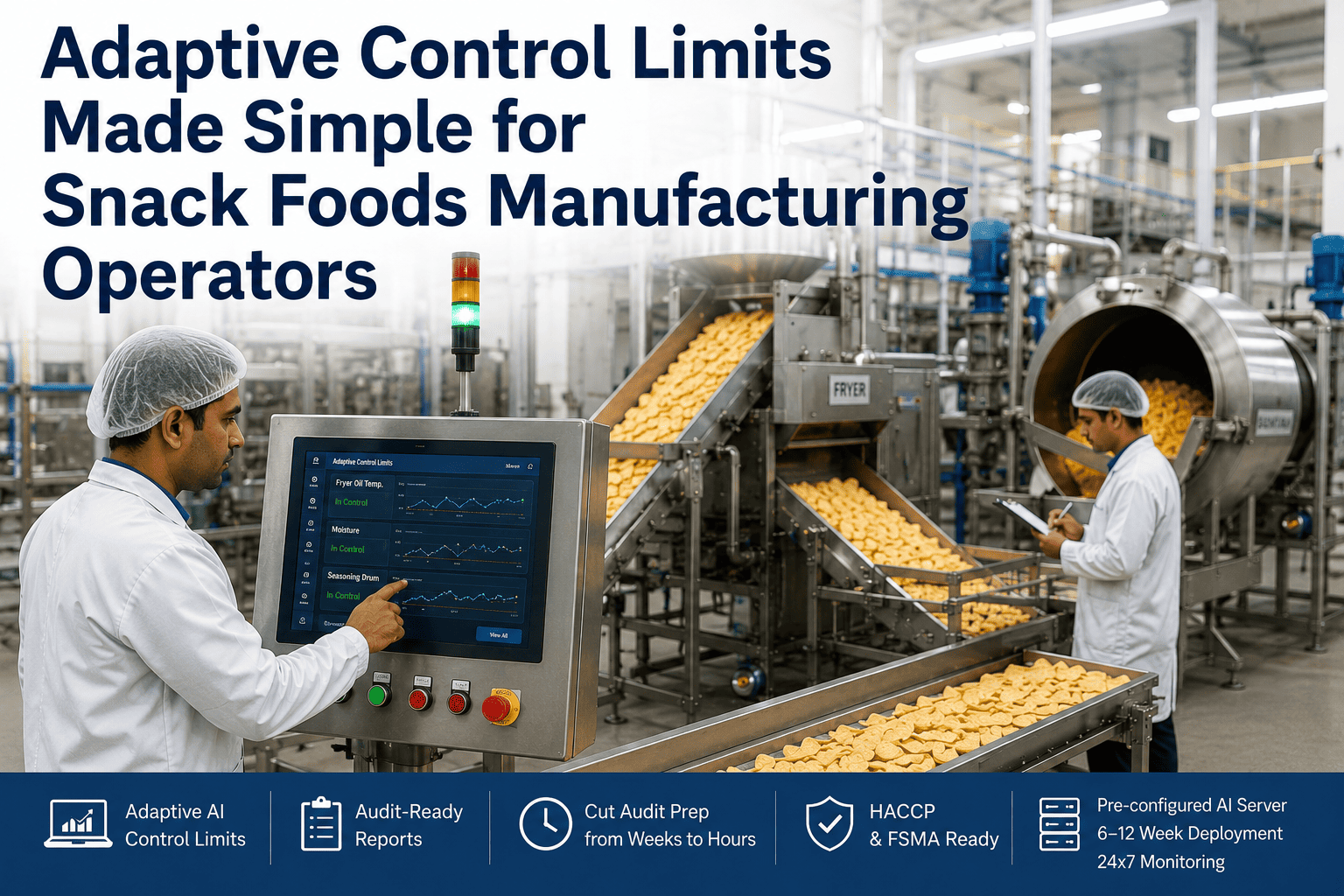
| Control Limits | Set once at line commissioning; never updated | AI learns your line's actual baseline; adapts to seasonal, wear, and ambient changes |
| Alert Threshold | You decide when something is "concerning"; often too late | AI alerts you when deviation becomes statistically significant; 30-60 minutes before visible damage |
| Investigation Time | 60-90 minutes per event; manual root cause analysis | 5-10 minutes; AI suggests likely cause ("Fryer temp trending — likely thermostat" vs just showing data) |
| False Alarms | Spreadsheet SPC: rare but late; you miss real drift | AI learns normal variation; almost zero false alarms; catches real drift early |
| Batch Damage | Discovered after 4-8 batches already affected | Detected before batch is out of tolerance; 1-2 batches maximum affected |
How Deployment Works: From First Day to 24/7 Monitoring
Week 1-2: System SetupiFactory team installs edge AI server (12U, fits in your control room). Connects to your PLC/SCADA via existing network. Pulls 2-3 weeks of historical data from your line. AI begins learning your baseline.
Week 3-4: You See Real DataDashboard shows your line's actual behavior: fryer temp drift, tumbler variance, weigher precision, equipment stress patterns. You see things you've suspected but never quantified.
Week 5-6: Alerts Go LiveAI starts alerting you in real time. First week: you'll get alerts that feel like "false alarms" — but check them and you'll find minor drift you were missing. By week 6, you're responding to alerts before problems develop.
Month 2-3: Full OperationsSystem is tuned to your line. You're catching drift 30-60 minutes early. Batch diversion and emergency downtime drop. Oil consumption, packaging weight, and seasoning consistency improve measurably.
Frequently Asked Questions
Do I need to learn special software to use AI-native SPC?
No. You get a simple dashboard on your phone or control room screen. Alerts come as text/sound notifications. Most operators start using the system after 30 minutes of orientation. The complexity is handled by the AI — not by you.
What if my line doesn't have sensors or PLC connection?
iFactory can integrate with legacy lines using camera-based measurement or manual sensor installation. For most snack lines (fryer, tumbler, weigher, packaging), existing equipment already generates the data. Integration typically takes 2-4 weeks depending on your current setup. To evaluate your specific line,
reach out to our technical team for a site assessment.
What happens if AI alerts me to a problem, but I'm busy with another task?
Alerts are prioritized. Critical alerts (equipment failure risk, imminent batch loss) notify you immediately. Informational alerts (minor drift, preventive maintenance reminder) queue in your dashboard. You respond when you can. The system won't let critical drift become batch loss while you're handling something else.
Can AI-native SPC replace quality control staff?
No. It amplifies what your QC staff can do. Instead of waiting 90 minutes for a problem to show up in final testing, they know about it in real time and can respond immediately. Staff time shifts from investigation and firefighting to process optimization and improvement projects.
How much does it cost to deploy AI-native SPC on one line?
How long does the system take to actually help me?
Week 1-2: You see your line's actual behavior (baseline learning). Week 3-4: You start getting alerts on real drift you were missing. Week 5-6: You're catching problems 30-60 minutes before they become visible. By month 3: you're seeing documented improvement in oil consumption, batch diversion rate, and emergency downtime. Measurable ROI typically appears by month 2.
SNACK FOODS OPERATORS · AI-NATIVE SPC · REAL-TIME MONITORING
Stop Running Your Line on Yesterday's Data
AI-native SPC gives you real-time visibility into your equipment's actual behavior. Catch quality drift before it becomes batch loss. No training, no spreadsheets, no delay. Deploy in 6-12 weeks and start preventing downtime immediately.