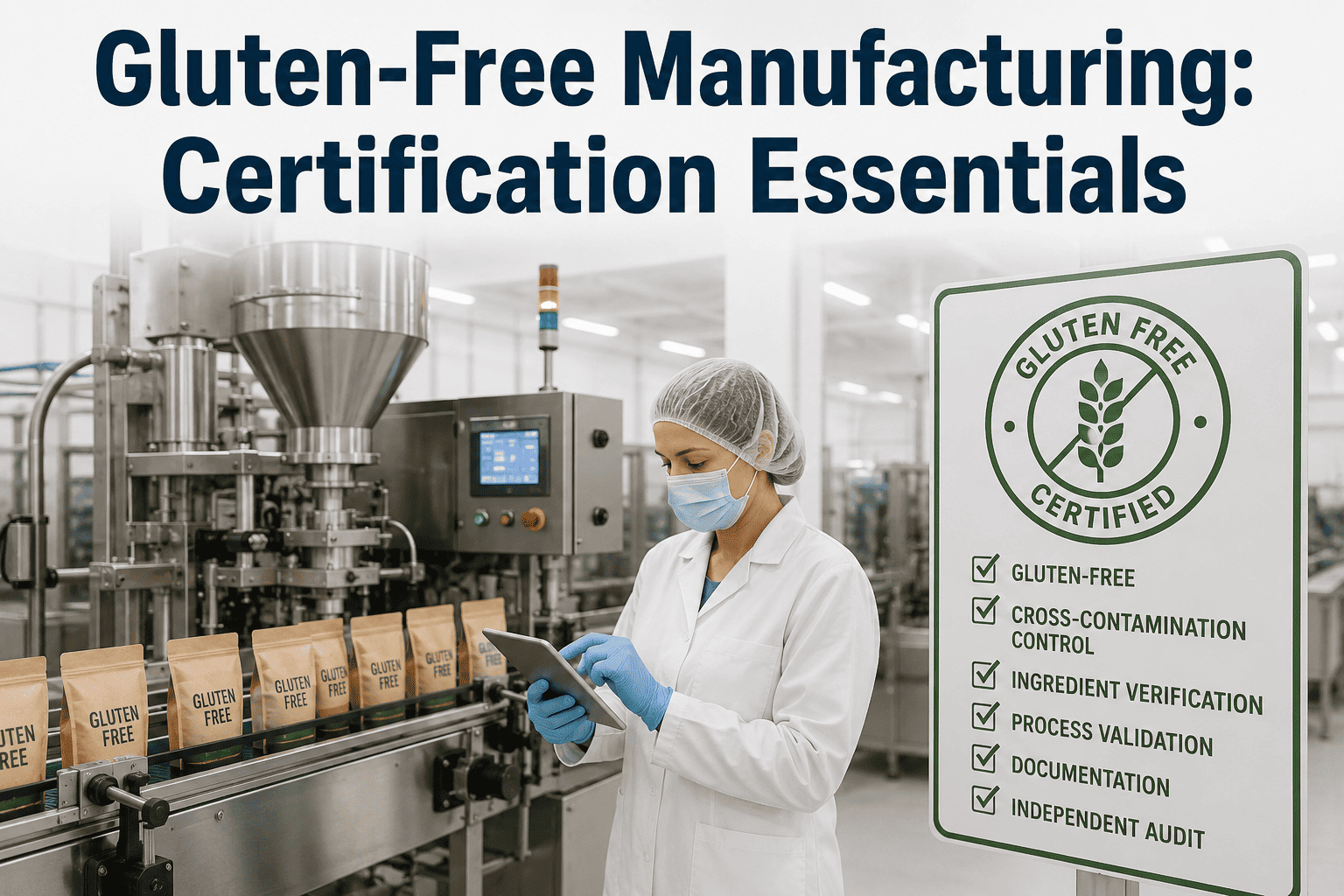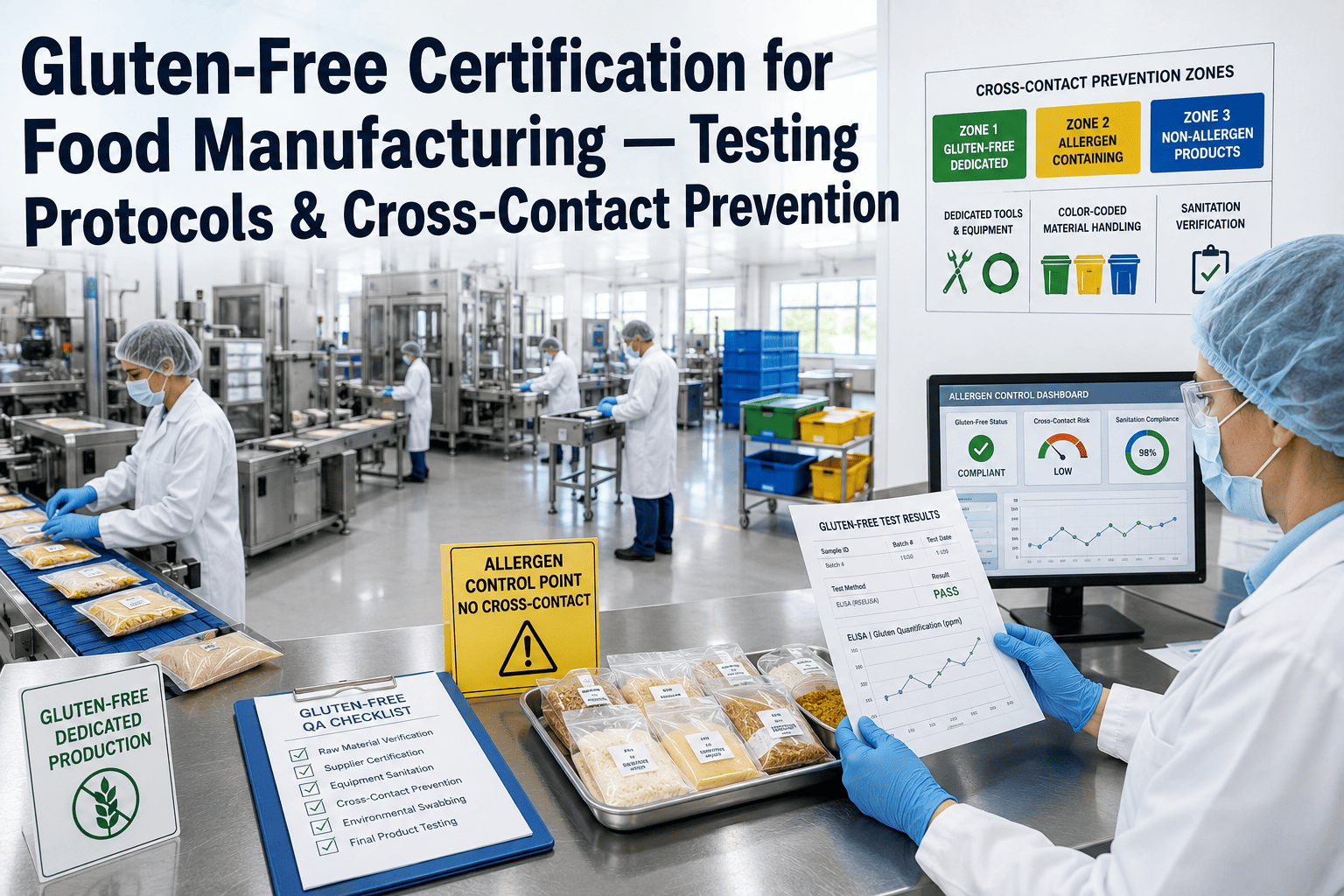
A single trace of wheat flour dust settling on a shared conveyor can push a "gluten-free" batch over the legal threshold, and the consequence is not a minor labeling correction — it is a recall that erodes the trust of a customer population with a genuine medical need. Quality managers pursuing gluten-free certification quickly learn that the hard part is not the initial ELISA test result; it is proving, batch after batch, that shared-line cross-contact controls actually hold up in daily production. iFactory AI helps quality teams track cleaning validation, testing schedules, and cross-contact risk points so gluten-free certification stays defensible year-round, not just on audit day.
Why the Gluten Threshold You Certify To Matters More Than the Label
Not all "gluten-free" claims are held to the same threshold, and the gap between the federal minimum and the leading third-party certification standard is exactly where consumer trust and legal exposure diverge. Manufacturers who certify to the stricter standard are protecting a more sensitive population and building a harder-to-challenge claim, but they are also accepting a tighter operational margin for error on every shared line.
The Certification Path, Step by Step
Facility and Formulation Risk Assessment
A certifying body reviews every ingredient, supplier, and shared-equipment touchpoint to identify where gluten-containing grains could enter the process, before any testing begins.
Cleaning Validation on Shared Lines
Facilities running gluten-containing and gluten-free products on the same equipment must validate that cleaning procedures reliably bring residue below the certification threshold, documented with test data, not assumption.
ELISA Testing of Finished Product Batches
Representative samples from production runs are tested via ELISA to confirm gluten content is below the certifying body's threshold, with sampling frequency scaled to shared-line risk.
On-Site Audit and Documentation Review
An auditor verifies that written procedures match what actually happens on the floor, reviewing changeover sequencing, staff training records, and supplier documentation.
Certification Award and Continuous Monitoring
Once certified, ongoing testing and periodic re-audits confirm the facility continues to meet the standard as recipes, suppliers, or line configurations change.
Gluten Testing Methods Compared
| Method | What It Measures | Best Use | Limitation |
|---|---|---|---|
| Sandwich ELISA | Intact gluten protein (gliadin) concentration | Most finished product and raw ingredient testing | Less reliable on heavily fermented or hydrolyzed products |
| Competitive ELISA | Gluten fragments in fermented or hydrolyzed foods | Fermented products like soy sauce or beer | Requires specialized lab expertise to interpret |
| Lateral Flow Swab Testing | Surface residue on equipment after cleaning | Rapid on-site validation between production runs | Qualitative screening only, not a quantitative ppm result |
| Mass Spectrometry | Precise gluten peptide identification | Investigating disputed or borderline results | Higher cost, longer turnaround than routine ELISA |
Shared-Line Readiness Checklist
A written procedure alone is not sufficient; the certifying body requires evidence the procedure works consistently.
Scheduling gluten-free runs first on a shared line reduces residue risk compared to running them after gluten-containing products.
High-volume shared lines warrant more frequent testing than dedicated gluten-free-only equipment.
Auditors frequently find that written procedures exist but staff training documentation has lapsed.
Quality Manager Perspective
Our facility runs gluten-free granola on the same line as three wheat-containing cereal products, and when we decided to certify to the stricter 10 ppm standard instead of just meeting the federal 20 ppm labeling rule, our cleaning validation had to improve significantly to hold that margin consistently. We now run lateral flow swab tests after every changeover as a rapid check before the line restarts, with full ELISA testing on finished batches on a fixed schedule tied to volume. The investment paid off within the first certification cycle — we passed our on-site audit with zero major nonconformities, and our retail buyers specifically asked which certification standard we held before finalizing a private-label agreement.
— Quality Manager, Shared-Line Cereal and Snack ManufacturerConclusion
Gluten-free certification is won on the production floor, not the certificate itself — cleaning validation, testing frequency, and production sequencing are what keep a shared line under threshold every single run. Quality managers who treat these as a continuously monitored process rather than an annual audit event are the ones whose certification survives scrutiny from both auditors and the consumers who depend on it. Book a demo to see how iFactory AI keeps cross-contact controls documented and audit-ready.
Frequently Asked Questions
The FDA's federal labeling rule sets a maximum of 20 parts per million for any food labeled "gluten-free," and manufacturers can make this claim without third-party certification as long as they can substantiate compliance. Third-party certifying bodies like GFCO apply a stricter 10 ppm threshold along with ongoing testing and audit requirements, giving the claim additional credibility with retailers and consumers who specifically look for the certification mark.
Yes, shared-line certification is common and achievable, but it requires validated cleaning procedures with documented test evidence, appropriate production sequencing, and more frequent testing than a dedicated gluten-free facility would need. Many certified products on the market today are produced on shared lines that meet these documented control requirements. Book a demo to assess your shared-line readiness.
Testing frequency is generally tied to production volume and shared-line risk rather than a single fixed schedule, with high-volume shared lines tested more frequently than dedicated gluten-free-only equipment. Certifying bodies typically require an ongoing testing plan as part of certification, not a one-time test at initial audit.
Modified food starches, malt-based flavorings, hydrolyzed vegetable proteins, and shared spice blends are among the most common hidden sources of gluten cross-contact, since they are often sourced from suppliers who also process wheat. Supplier-level documentation and periodic ingredient testing catch risks that formulation review alone would miss.
Auditors typically review cleaning validation records, testing history, staff training documentation, ingredient and supplier files, and production sequencing procedures, then observe an actual changeover to confirm written procedures match floor practice. Facilities that maintain these records continuously rather than assembling them before the audit consistently pass with fewer nonconformities. Contact support for an audit-readiness review.