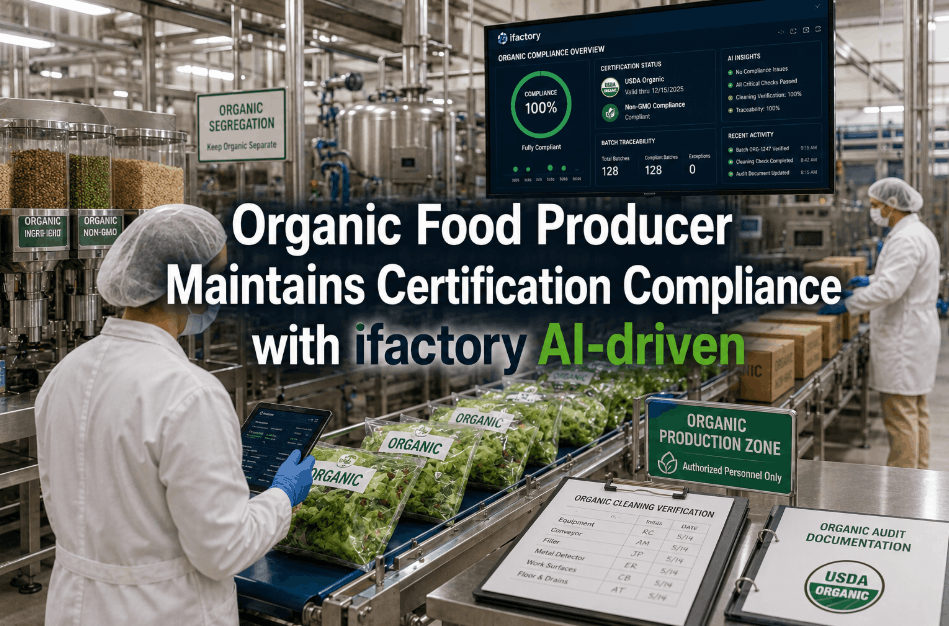
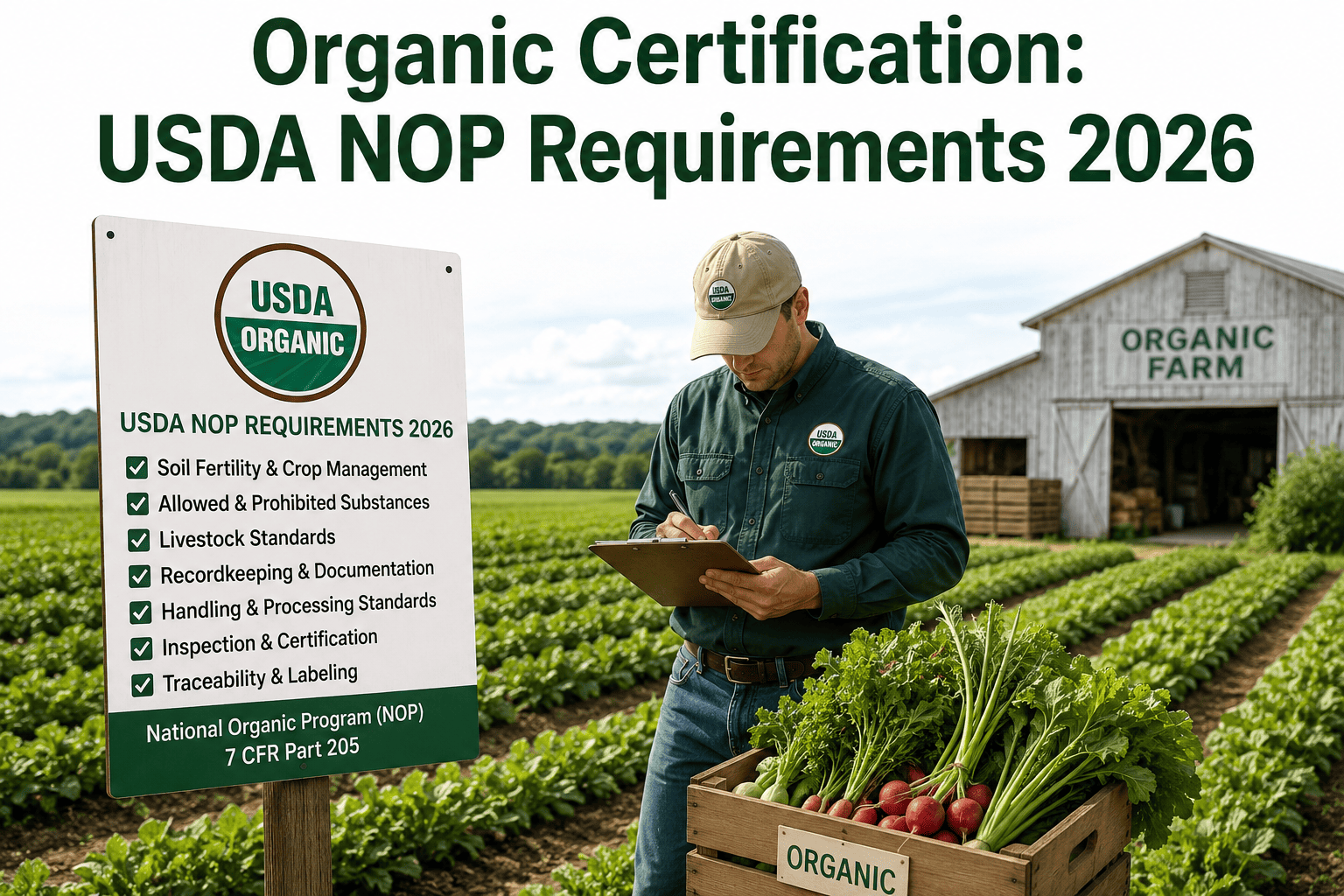
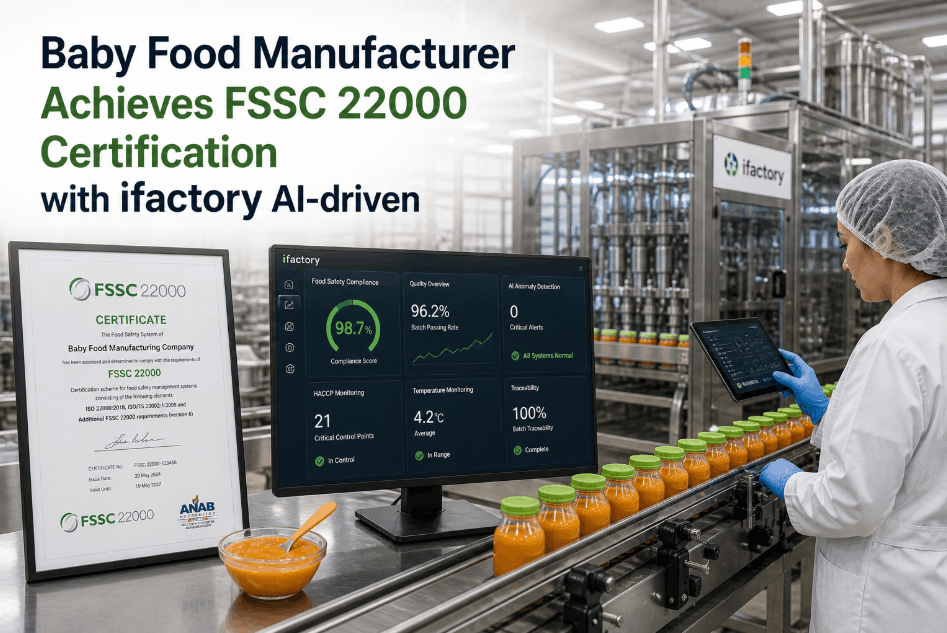
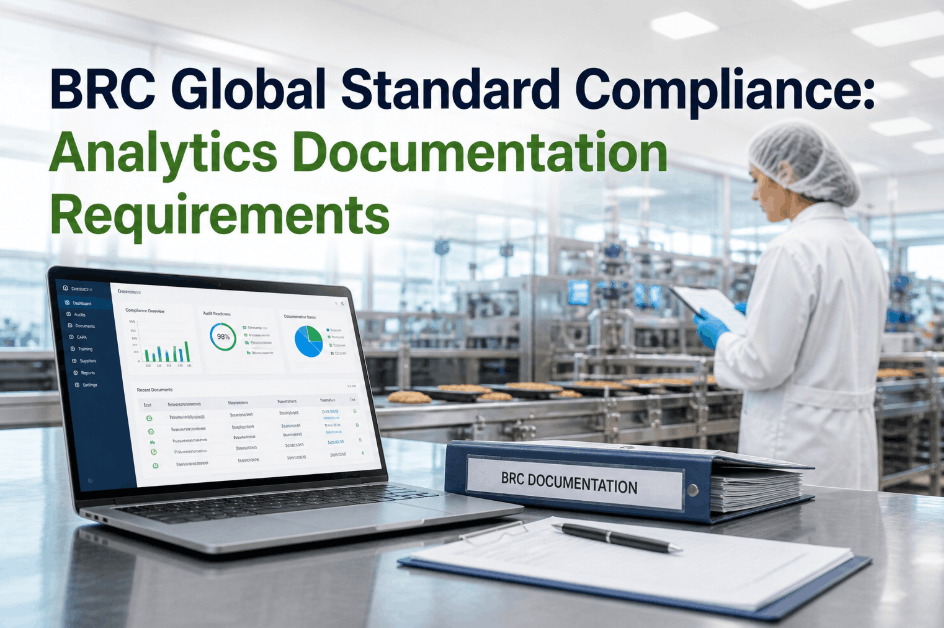
An established organic food producer operating three production facilities faced mounting pressure to maintain simultaneous USDA Organic and Non-GMO Project certifications across a complex, multi-ingredient processing environment. Manual compliance tracking, paper-based cleaning logs, and siloed segregation records were creating audit vulnerabilities, documentation gaps, and near-miss contamination events that threatened to jeopardize certifications held for over a decade. After deploying ifactory's AI-driven compliance tracking platform, the producer achieved 100% audit documentation completeness, eliminated all cross-contamination near-misses, and reduced certification renewal preparation time by 74%.
PROTECT YOUR CERTIFICATIONS BEFORE THE NEXT AUDIT
Stop Managing Organic Compliance on Spreadsheets and Paper Logs
ifactory's AI-driven compliance platform gives organic producers real-time visibility into cleaning verification, ingredient segregation, and audit-ready documentation — across every line, every shift.
100%
Audit Doc Completeness
01 / The Facility
A Multi-Certified Organic Producer, A Growing Compliance Burden
Facility TypeOrganic food processing. Three production facilities. Fourteen active processing lines. Dual certification: USDA Organic and Non-GMO Project Verified across all product SKUs.
Scale380+ active organic and conventional SKUs. 1,200+ ingredient lots under traceability management annually. Over 280 scheduled cleaning and sanitation events per month across all facilities.
Compliance Team24-person quality and compliance team. Three certified organic system plans (OSP) maintained simultaneously. Annual third-party audits conducted by two accredited certifying agents.
Compliance Failures Pre-DeploymentAveraging 14 documentation gaps per audit cycle. 6 cross-contamination near-miss events in the 18 months prior to deployment. Three corrective action requests (CARs) issued by certifying agents in the prior two audit years.
Prior SystemPaper-based cleaning logs. Manual segregation check sheets. Spreadsheet-driven lot traceability. No real-time visibility into line status, cleaning verification, or ingredient routing during production.
Annual Compliance CostPre-deployment compliance management expenditure of approximately $680,000 annually — including labor for manual documentation, audit preparation, corrective action response, and external consultant fees.
02 / The Challenge
The Fragility of Manual Compliance in a Dual-Certification Environment
Maintaining USDA Organic and Non-GMO Project certification simultaneously across a multi-facility, multi-line operation requires an unbroken chain of documentation — from ingredient sourcing through in-process segregation, cleaning verification, and finished product release. Any gap in that chain during an audit cycle creates grounds for a corrective action request, a temporary suspension of certification, or in the worst case, decertification. Yet this producer's compliance infrastructure was built entirely on manual processes that could not keep pace with the speed and complexity of modern organic food production.
14
Documentation gaps per audit cycle
Each audit cycle exposed an average of 14 documentation gaps — missing cleaning sign-offs, incomplete segregation records, and untraceable ingredient lot transitions — all requiring retroactive reconstruction that consumed 3–5 weeks of compliance staff time.
6
Near-miss cross-contamination events (18 months)
Six events where conventional or non-verified ingredients came within one process step of organic lines — each requiring full production holds, internal investigations, and written responses to certifying agents before operations could resume.
3
Corrective action requests issued
Three CARs issued by certifying agents in two consecutive audit years — each requiring documented root cause analysis, corrective procedure implementation, and follow-up verification — consuming an estimated 240 compliance labor-hours per CAR cycle.
62%
Cleaning records completed in real time
Only 62% of scheduled cleaning and sanitation events were logged at the point of completion. The remaining 38% were reconstructed after the fact from memory or supervisor sign-off — a documentation model that certifying agents had flagged as a systemic weakness.
"Every audit cycle felt like a forensic investigation into our own records. We knew the cleaning had been done, but proving it in a format that satisfies two separate certifying agents — across three facilities — was consuming weeks of compliance capacity we didn't have."
03 / The Solution
ifactory AI-Driven Compliance Tracking: Real-Time Visibility Across Every Certification-Critical Control Point
Following evaluation of four compliance management platforms, the producer selected ifactory for its configurable organic systems plan (OSP) mapping, AI-driven anomaly detection for segregation deviations, and demonstrated capability to generate audit-ready documentation in the exact format required by USDA National Organic Program (NOP) and Non-GMO Project verification standards. The platform was deployed to cover all three primary compliance domains — cleaning and sanitation verification, ingredient segregation tracking, and audit documentation generation — under a unified compliance interface accessible by quality teams across all three facilities. To explore how ifactory structures compliance deployments for organic food producers, book a demo with our food compliance team.
VERIFY
Digital cleaning and sanitation verification replaced paper-based logs with real-time electronic sign-off at the line — capturing operator ID, timestamp, cleaning agent used, contact time, and rinse verification for every scheduled cleaning event. AI-driven exception alerts triggered automatically when any cleaning step was missed, delayed, or completed out of sequence relative to the approved OSP procedure.
TRACK
AI-driven ingredient segregation monitoring tracked every organic and conventional ingredient lot from receiving through production routing — flagging routing anomalies in real time when ingredient movement deviated from approved segregation pathways defined in each facility's OSP. Physical barrier status, dedicated equipment assignments, and line changeover sequences were validated automatically against certification requirements before each production run.
DOCUMENT
Automated audit documentation generation compiled continuous compliance records — cleaning logs, segregation reports, lot traceability chains, and corrective action records — into audit-ready packages formatted to the specific documentation requirements of both the USDA NOP and Non-GMO Project verification standards, exportable on demand at any point in the certification cycle.
ANALYZE
Compliance analytics dashboards delivered facility-level and line-level visibility into cleaning completion rates, segregation deviation frequency, open corrective actions, and certification risk scores — enabling quality managers to identify systemic compliance weaknesses before they became audit findings, rather than after.
04 / Implementation
Full Compliance Platform Live Across Three Facilities in 45 Days
Days 1–10
OSP Mapping and Compliance Control Point Configuration
All three facility organic systems plans mapped into ifactory's compliance framework. Each certification-critical control point — cleaning sequences, segregation checkpoints, equipment dedication rules, and lot traceability requirements — configured per the approved OSP for each facility. Non-GMO Project verification protocols mapped in parallel, with shared control points identified and unified into single-entry digital workflows to eliminate duplicate documentation burden.
Days 11–28
Phased Rollout — Highest-Risk Lines First
Deployment prioritized the four production lines with the highest historical near-miss frequency and the greatest organic/conventional product interleaving. Digital cleaning verification and segregation tracking activated on priority lines by Day 16, with real-time compliance data flowing to quality dashboards from Day 17. Remaining ten lines activated in two subsequent phases with quality team training integrated into each activation window.
Days 29–38
Lot Traceability Integration and AI Baseline Establishment
ifactory's lot traceability module integrated with the producer's existing ERP and receiving systems — creating an unbroken digital chain from supplier certificate of organic transaction (COT) through finished product lot disposition. AI engine trained on the producer's ingredient routing patterns and historical segregation deviation data, establishing facility-specific deviation baselines within 14 days of live data ingestion.
Days 39–45
Audit Documentation Templates Validated, Platform Fully Live
Audit documentation export templates validated against the specific format requirements of both certifying agents. First full compliance package generated and reviewed by quality director on Day 42 — covering all three facilities, all fourteen lines, and the full 45-day deployment period. Certifying agent representatives previewed the documentation format and confirmed it met NOP and Non-GMO Project record requirements without modification.
05 / Results
12 Months of Measured Compliance Performance
The transition from manual compliance tracking to AI-driven real-time monitoring produced measurable improvements across every tracked compliance dimension within the first full audit cycle after deployment. Documentation completeness reached 100% for the first time in the producer's certification history. Cross-contamination near-miss events fell to zero. And audit preparation — previously a multi-week crisis-management exercise — became a same-day documentation export from the ifactory platform.
| Metric |
Before ifactory |
After ifactory |
Change |
| Audit documentation completeness | ~78% per cycle | 100% per cycle | Full documentation coverage |
| Cross-contamination near-miss events | 6 in 18 months | 0 in 12 months | 100% elimination |
| Corrective action requests (CARs) issued | 3 in 2 years | 0 in first audit year | Zero CARs post-deployment |
| Cleaning records completed in real time | 62% | 99.3% | +37.3 percentage points |
| Audit preparation time | 3–5 weeks per cycle | Less than 1 day | −74% preparation time |
| Segregation deviation detection speed | Hours to days (manual) | Real-time (AI alert) | Instant deviation visibility |
| Annual compliance management cost | ~$680,000 | ~$390,000 | −43% cost reduction |
| Lot traceability chain completeness | Partial (manual gaps) | 100% digital chain | Full COT-to-disposition coverage |
| Compliance staff hours on documentation | ~1,840 hrs/year | ~480 hrs/year | −74% documentation labor |
| Deployment timeline | N/A | 45 days (all 3 facilities) | Fully live in 45 days |
100%
Audit Doc Completeness
See How ifactory Eliminates Organic Certification Risk at Your Facility
Get a live walkthrough of cleaning verification, segregation tracking, and one-click audit documentation built for USDA Organic and Non-GMO compliance.
"Our certifying agent told us this was the cleanest audit documentation package they had reviewed from a facility of our complexity. That comment alone justified the entire platform investment — and we were only six months in."
06 / Key Analysis
Why the Compliance Transformation Was This Comprehensive
01
Real-time cleaning verification closed the documentation gap that manual logs structurally cannot close. The 38% of cleaning events previously recorded after the fact — not at the point of completion — represented a systemic documentation weakness that no process improvement within a paper-based model could resolve. Digital at-line verification with AI exception alerting made incomplete or retroactive records technically impossible, driving real-time completion rates from 62% to 99.3% within the first 60 days of full deployment.
02
AI-driven segregation monitoring eliminated near-miss events by detecting routing deviations before they reached the production line. Each of the six prior near-miss events occurred because a segregation deviation — an incorrectly routed ingredient lot, an equipment assignment error, or a line changeover sequence violation — was not identified until product was already in process. ifactory's real-time routing validation triggered alerts at the point of deviation, allowing quality teams to intervene before any organic integrity risk materialized.
03
Automated audit package generation converted a 3–5 week crisis into a same-day compliance task. Prior audit preparation required compliance staff to manually reconstruct cleaning records, consolidate segregation logs from three facilities, and compile lot traceability chains across 1,200+ annual ingredient lots — a process consuming 3–5 weeks of dedicated quality labor per cycle. ifactory's automated documentation engine generates the complete audit package on demand, formatted to certifying agent specifications, in under four hours of staff time.
04
Unified dual-certification compliance tracking eliminated the documentation duplication burden across USDA Organic and Non-GMO requirements. Previously, compliance staff maintained separate documentation streams for each certification standard — creating parallel record-keeping obligations that doubled labor on shared control points. ifactory's OSP mapping engine identified 68 shared control points across both standards and unified them into single-entry workflows, eliminating redundant documentation while satisfying both certifying agents' requirements simultaneously.
07 / Business Impact
Operational, Financial, and Strategic Outcomes Beyond Certification Maintenance
Certification Security
Both USDA Organic and Non-GMO Project certifications renewed without corrective action requests for the first time in three audit cycles. The producer's certifying agents noted the quality of documentation as a benchmark for facilities of comparable complexity.
Financial Recovery
Annual compliance management expenditure reduced from $680,000 to approximately $390,000 — a $290,000 annual saving driven primarily by the elimination of retroactive documentation labor, external consultant fees for audit preparation, and corrective action response costs.
Quality Team Capacity
Eliminating 1,360 annual hours of documentation labor recovered significant quality team capacity — redeployed toward supplier qualification, new product compliance review, and proactive process improvement initiatives that had been deferred due to documentation burden.
Market Confidence
Clean audit records and demonstrable real-time compliance visibility strengthened the producer's position with two major retail partners who conduct their own supplier compliance assessments — supporting contract renewals and qualifying the producer for new premium organic category programs.
$680K
Annual compliance spend before
$390K
Annual compliance spend after
Zero
Corrective action requests
$290K
Annual savings achieved
08 / Conclusion
Certification Compliance at Scale: The Compounding Value of AI-Driven Organic Compliance Tracking
This organic food producer's transformation from a documentation-gap-prone manual compliance model to a real-time AI-driven compliance platform eliminated the structural vulnerabilities that had produced repeated audit findings, near-miss contamination events, and unsustainable documentation labor burdens. ifactory's compliance tracking platform gave the producer continuous, control-point-level visibility across all three facilities — and the AI monitoring engine converted that visibility into proactive deviation alerts, unbroken documentation chains, and audit-ready packages that certifying agents can review with confidence.
The $290,000 in annual compliance cost savings is a direct financial outcome. The zero corrective action requests in the first post-deployment audit year is a certification security outcome. And the recovery of 1,360 annual compliance labor hours is a capacity outcome that compounds as those hours are redirected toward supplier quality, new product development, and continuous improvement. To assess what ifactory's compliance tracking deployment would look like for your organic or natural food facility, book a demo with ifactory's food compliance team.
100% Audit Documentation. Zero CARs. Compliance Live in 45 Days.
See how ifactory's AI-driven compliance tracking platform delivers real-time cleaning verification, ingredient segregation monitoring, and one-click audit documentation for USDA Organic and Non-GMO certified facilities.
09 / FAQ
Frequently Asked Questions
How does ifactory's AI-driven platform support USDA Organic certification compliance?
ifactory maps each facility's approved organic system plan into its compliance framework, creating digital control points for every certification-critical activity — cleaning and sanitation verification, ingredient segregation, equipment dedication, and lot traceability. The AI engine monitors activity against OSP requirements in real time, alerting quality teams to deviations before they become audit findings. Audit documentation packages are generated automatically in NOP-compliant format, eliminating retroactive record reconstruction.
Can ifactory manage both USDA Organic and Non-GMO Project compliance simultaneously?
Yes. ifactory's compliance framework is configurable to map multiple certification standards simultaneously. Shared control points across USDA Organic and Non-GMO Project requirements are identified during OSP mapping and unified into single-entry digital workflows — eliminating duplicate documentation burden while satisfying both certifying agents' record requirements. Each standard's audit package is generated separately in the format required by its respective certifying agent.
How does ifactory detect ingredient segregation deviations in real time?
ifactory's lot traceability module tracks every ingredient lot from receiving through production routing against the approved segregation pathways defined in each facility's OSP. When an ingredient movement deviates from its approved pathway — incorrect line routing, equipment assignment conflict, or out-of-sequence changeover — the AI engine triggers an immediate alert to the quality team, allowing intervention before any organic integrity risk reaches the production line.
How long does ifactory deployment take for a multi-facility organic food producer?
Deployment timelines depend on facility count, line complexity, and existing ERP or receiving system integration requirements. This producer achieved full compliance platform coverage across three facilities and fourteen production lines within 45 days — with deployment prioritized by line risk tier so compliance visibility began accruing on the highest-risk lines before full network completion. No operational interruptions occurred during installation.
What ROI timeline should organic food producers expect from ifactory's compliance platform?
Producers with significant audit preparation labor, active corrective action histories, or high documentation gap rates typically recover platform investment costs within the first full certification cycle. This producer recovered its first-year platform cost in documentation labor savings and eliminated consultant fees within seven months of full deployment. The $290,000 in annual ongoing savings represents a sustained return from a one-time compliance infrastructure investment.
Does ifactory's audit documentation meet the format requirements of accredited certifying agents?
ifactory's audit documentation templates are validated against the specific record format requirements of USDA NOP and Non-GMO Project verification standards. During this deployment, certifying agent representatives previewed the documentation format prior to the first audit cycle and confirmed it met their requirements without modification. Templates are configurable to accommodate the specific record format preferences of individual certifying agents.