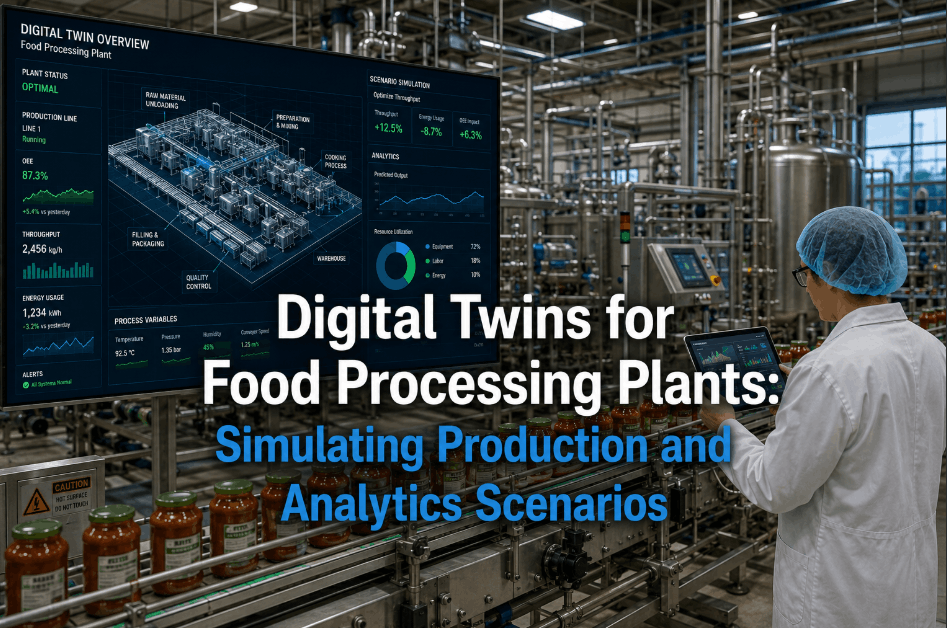
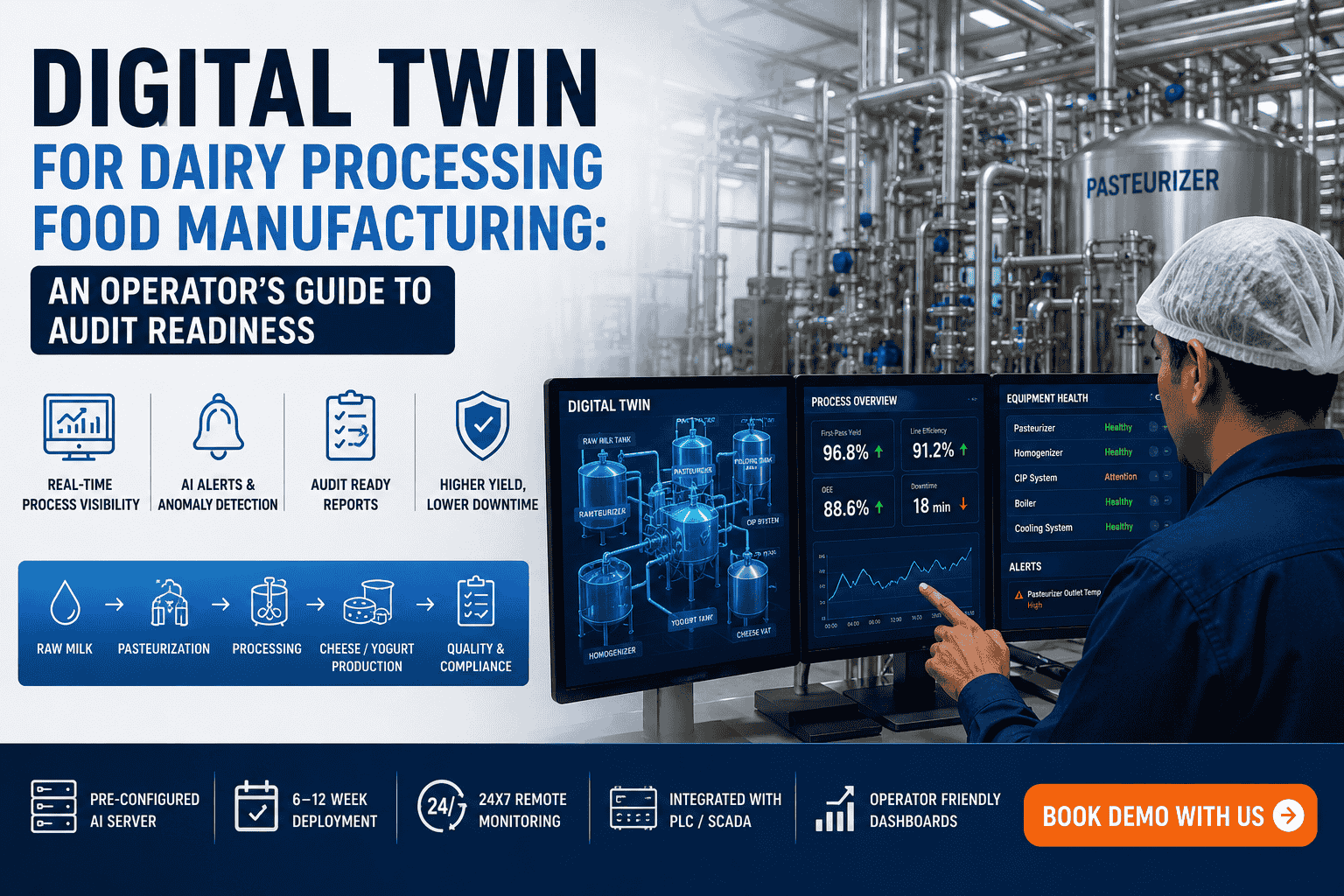
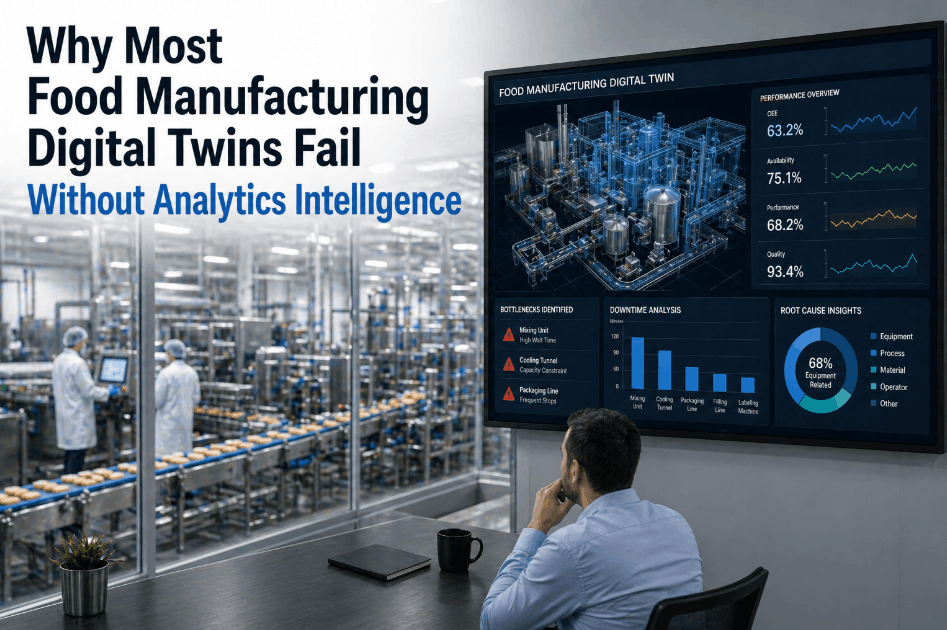
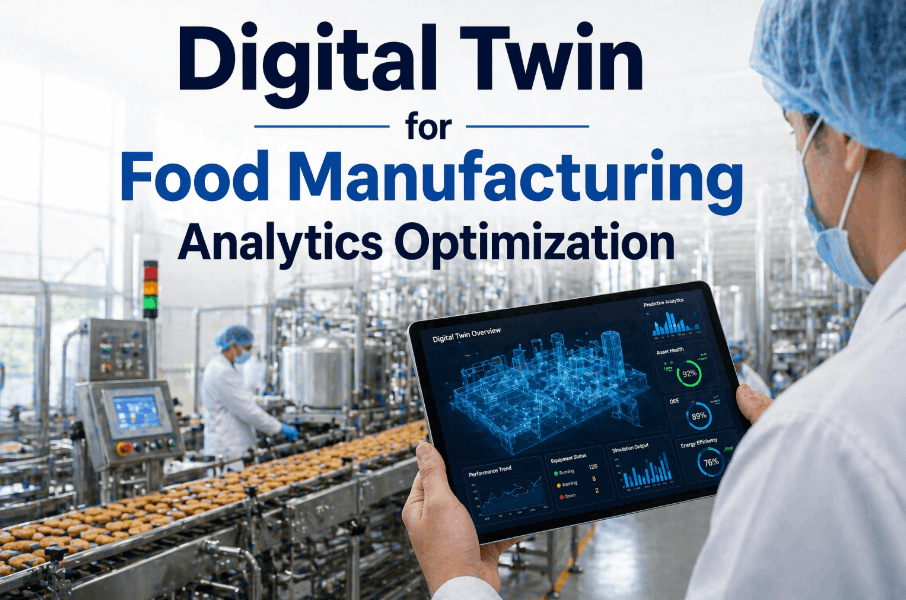
Digital twin technology is fundamentally transforming how food processing plants operate, plan, and optimize. By creating a real-time virtual replica of your physical plant — integrating live IoT sensor data, equipment telemetry, and production analytics — a digital twin for food processing enables plant managers to simulate production scenarios, predict equipment failures, and model cleaning-in-place (CIP) windows before making a single change on the floor. In an industry where margins are tight, compliance is non-negotiable, and downtime is catastrophic, the ability to test decisions virtually before executing them physically is no longer a competitive advantage — it is an operational imperative. Book a demo to see how iFactory's digital twin platform connects to your existing plant systems and builds your virtual model in days, not months.
See Your Food Plant as a Living Digital Model
Simulate production scenarios, model equipment failures, and optimize analytics windows — all before touching a single line on the floor.
What Is a Digital Twin in Food Processing?
A food plant digital twin is a continuously updated virtual model of your physical processing environment — built from live data streams sourced from IoT sensors, PLCs, SCADA systems, MES platforms, and historian databases. Unlike a static CAD drawing or a periodic simulation model, a digital twin evolves in real time as your plant operates. It mirrors actual temperatures, flow rates, conveyor speeds, batch compositions, energy consumption, and equipment health status — second by second — so that every virtual scenario you run is grounded in current operational reality. When you book a demo with iFactory, you will see exactly how sensor data from your existing instrumentation feeds the twin without requiring new hardware investments.
The distinction between a traditional plant simulation and a true digital twin lies in bidirectional data flow and AI-driven inference. Traditional simulations are run periodically using manually entered parameters. A digital twin ingests live operational data continuously, uses machine learning to calibrate model accuracy against real-world performance, and updates its predictions as conditions change. This means your production simulation for food manufacturing reflects not a theoretical plant, but your actual plant — with its specific equipment wear patterns, supplier variability, and workforce behaviors factored in.
Why Food Processing Plants Need Digital Twin Technology Now
Food manufacturers in 2025–2026 face a convergence of pressures that make reactive operations untenable. Regulatory demands under FDA's FSMA, EU Food Safety Law, and GFSI frameworks require documented process controls and traceability that manual records cannot reliably support. Retailer supply agreements enforce OEE (Overall Equipment Effectiveness) thresholds with financial penalties for shortfalls. And consumer demand volatility — driven by seasonal trends, health movements, and supply disruptions — demands rapid line reconfiguration that traditional planning cycles cannot absorb.
15–25%
Average OEE improvement from digital twin deployment in F&B plants
30–40%
Reduction in unplanned downtime through predictive failure modeling
20–35%
CIP time optimization possible through scenario simulation
The smart food factory digital twin addresses each of these pressures simultaneously. Scenario simulation lets planners model the downstream impact of a SKU changeover before scheduling it. Predictive analytics surface equipment stress indicators 2–4 weeks before failure. And automated compliance data capture eliminates the documentation burden that consumes supervisor time on every shift. Schedule a demo to see how iFactory maps these capabilities to your specific production environment.
Core Use Cases: How Digital Twins Optimize Food Plant Operations
01
Production Scenario Simulation
Test any production decision virtually before committing resources. Model SKU changeovers, ingredient delays, and line reconfigurations against your live plant state — so every scheduling choice is backed by real data, not assumptions.
02
Equipment Failure Impact Modeling
Know the production cost of a failure before it happens. iFactory identifies at-risk equipment 2–4 weeks early and models the downstream batch, CIP, and throughput impact — giving maintenance and production teams time to plan a coordinated response.
03
CIP Window Optimization
Simulate CIP sequencing, timing, and chemical parameters against your regulatory requirements and production schedule. iFactory customers achieve 20–35% CIP time reductions without compromising sanitation compliance.
Talk to a specialist about your CIP setup.
04
Real-Time Analytics Window Optimization
The digital twin continuously evaluates which time periods, batch groupings, and equipment combinations produce the strongest KPI signal. As your plant evolves, analytics windows recalibrate automatically — keeping every metric meaningful and actionable.
iFactory Digital Twin Platform: Built for Food and Beverage Manufacturing
iFactory's virtual food plant platform is designed from the ground up for the complexity of food and beverage manufacturing — not adapted from a generic IoT monitoring tool. The platform integrates with the sensor infrastructure, historian databases, and ERP systems already present in your plant, building a calibrated digital twin from existing data without requiring plant shutdown, hardware replacement, or extended commissioning periods.
IoT Sensor Integration
Native connectivity to temperature, pressure, flow, vibration, and vision sensors via MQTT, OPC-UA, Modbus, and REST APIs — ingesting data at 1-second resolution for real-time twin fidelity.
AI-Driven Predictive Analytics
Machine learning models trained on your plant's specific equipment signature, product mix, and failure history — not generic industry averages — for failure prediction accuracy above 90%.
Scenario Simulation Engine
Run unlimited production, maintenance, and reconfiguration scenarios against the current digital twin state — with full downstream impact modeling across batch scheduling, CIP, and energy.
Compliance Data Capture
Automated FSMA, HACCP, and GFSI-aligned process documentation generated from live sensor data — eliminating manual record-keeping and providing audit-ready traceability.
CMMS Work Order Automation
Predictive alerts automatically generate CMMS work orders with component, location, failure mode, parts list, and scheduling recommendations — closing the loop from detection to resolution.
Energy & Sustainability Modeling
Model the energy impact of production scenario choices before execution — identifying configurations that reduce steam, compressed air, and electrical consumption without compromising throughput.
Before vs. After: Digital Twin Impact on Food Plant Performance
The operational gap between food plants running on reactive management and those with food plant digital optimization through digital twin technology is measurable across every key performance metric — from OEE and downtime to compliance costs and energy efficiency.
| Performance Area |
Traditional Operations |
iFactory Digital Twin |
Measurable Impact |
| Equipment Failure Response |
Reactive — discovered after failure, costly emergency repair |
Predictive — 2–4 week warning, planned intervention |
30–40% downtime reduction |
| Production Scenario Planning |
Spreadsheet-based, historical averages, no real-time inputs |
Simulated against live plant state with full impact modeling |
15–25% OEE improvement |
| CIP Scheduling |
Fixed calendar cycles — often over-cleaned or under-optimized |
Simulation-optimized sequencing meeting regulatory standards |
20–35% CIP time reduction |
| Compliance Documentation |
Manual records — audit risk, supervisor time burden |
Automated from sensor data — audit-ready, traceable |
Eliminated manual record risk |
| Energy Consumption |
Unmodeled — energy cost of scenario choices unknown |
Modeled per scenario — energy-optimized production planning |
10–20% energy cost reduction |
Regulatory Drivers Accelerating Digital Twin Adoption in Food Manufacturing
Food plant scenario planning through digital twins is increasingly driven not just by operational efficiency goals, but by regulatory requirements that demand documented process control and traceability at a level that manual systems cannot reliably deliver. Three regulatory frameworks are directly accelerating adoption across global food manufacturers.
01
FDA FSMA Traceability Rule
FDA's Food Safety Modernization Act Traceability Rule (Section 204) requires lot-level traceability from raw material receipt through finished goods distribution for high-risk foods. iFactory's digital twin captures every process parameter, batch condition, and equipment state in a sensor-verified, audit-ready record — satisfying Section 204 requirements without manual data entry.
02
GFSI Scheme Requirements
BRC, SQF, FSSC 22000, and other GFSI-recognized schemes require documented HACCP plans, process monitoring, and corrective action records. Digital twin-driven continuous monitoring provides the real-time process validation evidence that GFSI auditors increasingly expect as a demonstration of food safety culture maturity.
03
ESG & Sustainability Reporting
Food manufacturers with public ESG commitments or retailer sustainability requirements need verifiable energy consumption, water usage, and waste generation data. iFactory's digital twin generates source-traceable sustainability metrics per production run — enabling accurate Scope 1 and Scope 2 reporting without estimation.
Ready to Simulate Your Food Plant Digitally?
iFactory connects to your existing sensors, historian, and ERP systems to build a calibrated digital twin — with production scenario simulation live in days.
Expert Perspective on Digital Twin ROI in Food & Beverage
The food manufacturers seeing the strongest ROI from digital twins in 2025–2026 are those treating the twin not as a monitoring tool but as a decision engine. When you simulate a production scenario against your live plant state rather than a historical average, you stop optimizing for a plant that no longer exists and start optimizing for the plant you actually have — with its current equipment condition, its current supplier inputs, and its current workforce reality. That distinction is worth 15–25 OEE points. The digital twin makes every production decision evidence-based, and in food manufacturing, evidence-based decisions are also the safest ones.
Frequently Asked Questions: Digital Twins for Food Processing Plants
What data sources does a food plant digital twin require?
A food plant digital twin integrates IoT sensors, PLC/SCADA outputs, MES batch records, and ERP data — all of which exist in most modern food facilities. iFactory connects to your existing infrastructure via OPC-UA, Modbus, MQTT, and REST APIs without requiring new hardware.
Book a demo to map your current data sources to the twin architecture.
How long does it take to deploy a digital twin in a food processing plant?
iFactory's platform connects to existing plant systems and delivers a calibrated digital twin in days to weeks, not months. The deployment timeline depends on the number of integration points and the completeness of existing sensor coverage — not on lengthy commissioning or plant shutdown requirements.
Can a digital twin support food safety and HACCP compliance?
Yes. iFactory continuously captures process parameters — temperatures, dwell times, CCP measurements — in a sensor-verified record that satisfies HACCP documentation requirements. The twin provides real-time CCP monitoring with automated alerts when critical limits approach, closing the compliance loop before a deviation occurs.
How does digital twin technology improve CIP efficiency?
iFactory's simulation engine models alternative CIP sequences, timing windows, and chemical concentration scenarios against your regulatory requirements and production schedule — identifying configurations that reduce CIP duration 20–35% while maintaining full sanitation compliance. All CIP outcomes are documented in sensor-verified records.
What is the ROI timeline for a food plant digital twin?
Most iFactory customers achieve positive ROI within 6–12 months, driven by downtime reduction (30–40%), OEE improvement (15–25%), and CIP optimization (20–35%). The combination of predictive maintenance savings and production throughput gains typically delivers payback well within the first year of operation.
Does iFactory's digital twin work with existing ERP and MES systems?
Yes. iFactory integrates with major ERP platforms (SAP, Oracle, Microsoft Dynamics) and MES systems via standard APIs — pulling production orders, bill of materials, and scheduling data into the twin to enrich scenario simulation accuracy.
Schedule a consultation to review integration compatibility with your current stack.
Simulate. Optimize. Operate with Confidence.
iFactory's digital twin platform gives food processing plants the ability to model every production decision before it is made — reducing downtime, optimizing CIP, and delivering compliance documentation automatically from live sensor data.