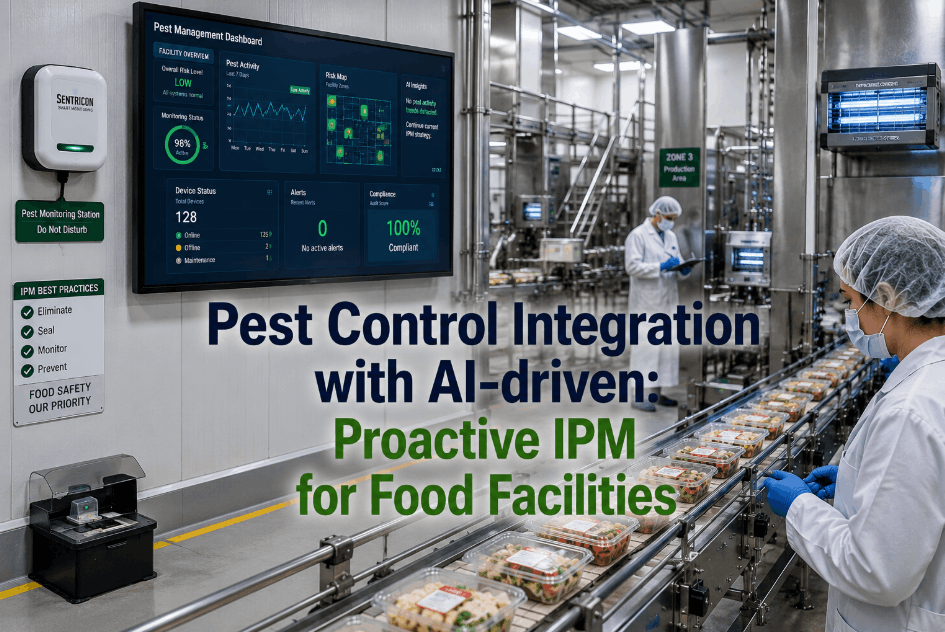
Pest control in food processing facilities has entered a new era — one driven by data, AI-powered detection, and integrated pest management (IPM) programs that are proactive, not reactive. For food plant managers and compliance officers, traditional pest control methods — periodic inspections, paper logbooks, and calendar-based bait station checks — are no longer sufficient to meet the rigorous audit standards of FDA FSMA, GFSI schemes, and retailer food safety codes. AI-driven pest control integration transforms how food facilities track bait station inspections, document pest activity, seal structural vulnerabilities, and build a defensible, audit-ready compliance record. Book a demo to see how iFactory's compliance tracking platform connects your IPM program to real-time digital documentation.
What Is Integrated Pest Management (IPM) in Food Facilities?
Integrated Pest Management (IPM) for food facilities is a science-based, multi-layered approach to pest prevention that prioritizes proactive controls over reactive extermination. Unlike traditional pest control — which responds to infestations after they occur — IPM in food manufacturing combines environmental monitoring, structural exclusion, biological controls, and chemical interventions in a coordinated framework designed to prevent pest entry and establishment before any product or equipment is compromised.
An effective food facility IPM program covers six core pillars: pest identification, facility inspection and risk mapping, bait station placement and monitoring, building gap sealing and exclusion, pest activity documentation, and corrective action tracking. Each pillar requires consistent, verifiable records that food safety auditors — from BRC inspectors to SQF certification bodies — will scrutinize. AI-driven compliance platforms like iFactory digitize every pillar, replacing inconsistent paper logs with structured, time-stamped digital records that support both daily operations and audit readiness. Book a demo to see how IPM documentation integrates with your existing food safety system.
Why Traditional Pest Control Fails Food Plant Audits
The gap between what food safety auditors expect from an IPM program and what most food plants can actually demonstrate with paper-based systems is widening every year. GFSI-recognized schemes — including BRC Global Standard, SQF, and FSSC 22000 — now require not only that pest control activities occur, but that they are documented with precision: dates, times, pest species observed, bait station consumption levels, corrective actions taken, and contractor sign-off. A paper logbook stored in a supervisor's office fails this standard on multiple dimensions.
Common failure points in traditional food plant pest control programs include missed bait station inspection intervals, undocumented structural deficiencies, pest sightings recorded informally (or not at all), and contractor reports that exist as PDFs in email inboxes rather than integrated compliance records. When an auditor asks for trend data on rodent activity near a specific production zone over the past 90 days, a food facility relying on paper-based systems cannot produce it quickly — or reliably. AI-driven IPM integration eliminates these failures by embedding pest control documentation directly into your facility's compliance workflow.
AI-Driven Pest Control Integration: How It Works in Food Manufacturing
AI-powered pest control tracking for food facilities replaces disconnected, manual processes with a unified digital compliance system. Every bait station has a digital record. Every structural gap identified during inspection is logged with location, severity, and remediation timeline. Every pest sighting — whether reported by a line operator, a quality technician, or a contracted pest control provider — is captured in a timestamped, searchable record linked to the relevant zone of your facility map.
Bait Station Inspection Management: The Foundation of Food Facility Pest Compliance
Bait station tracking is the most audited element of any food facility IPM program. Regulators and certification auditors expect documented evidence that every bait station in your facility is inspected on schedule, that consumption and activity levels are recorded at each visit, and that any significant findings trigger documented corrective actions. Without a digital tracking system, maintaining this standard across a facility with dozens or hundreds of bait stations is operationally difficult and audit-risky.
iFactory's pest control compliance module assigns unique digital records to every bait station — interior, exterior, and perimeter — with GPS-linked facility map placement, inspection frequency requirements, and automated scheduling. When an inspection is due, the assigned technician receives a digital task. When the inspection is completed, consumption levels, rodent evidence indicators, station condition, and corrective actions are recorded in a structured digital form — not a handwritten entry on a clipboard. Book a demo to see bait station tracking in action within iFactory's compliance platform.
AI-driven trend analysis surfaces patterns that manual inspection logs cannot reveal. If a cluster of bait stations in your raw materials receiving area shows elevated rodent consumption over a three-week period, iFactory flags the trend and prompts a corrective inspection of the structural exclusion in that zone — before a product safety risk or an audit finding materializes. Proactive pest management in food plants requires exactly this kind of predictive intelligence layered over structured inspection data.
Structural Exclusion Tracking: Closing the Gaps That Let Pests In
Pest exclusion — the systematic identification and sealing of structural entry points — is the most cost-effective layer of any food facility IPM program. Every unsealed pipe penetration, damaged door sweep, cracked foundation vent, or misaligned loading dock seal is a potential pest entry point that no amount of bait station density can compensate for. Food safety auditors are trained to identify these vulnerabilities, and they expect to see documented evidence that your facility identifies and remediates them systematically.
iFactory's building gap and exclusion tracking workflow enables facility managers and pest control contractors to log every structural deficiency found during inspections — with location on your facility map, photographic documentation, risk severity rating, assigned remediation owner, and target completion date. As repairs are completed, technicians log verification evidence and close the record digitally. The result is a complete, time-stamped history of your facility's exclusion management program — exactly what auditors need to see that pest prevention is managed proactively, not reactively. Book a demo to explore how exclusion tracking integrates with your broader food safety compliance program.
Pest Documentation for Food Safety Audits: What Auditors Expect
Meeting the pest control documentation requirements of BRC, SQF, FSSC 22000, and FDA FSMA requires more than records of service visits from your pest control contractor. Modern food safety audit standards expect a comprehensive, queryable body of evidence demonstrating that your IPM program is active, data-driven, and continuously improving. The documentation requirements span five key areas that every food facility compliance team must address.
iFactory IPM Compliance Module: Built for Food Facility Pest Management
iFactory's pest control compliance tracking module is purpose-built for the documentation intensity of food facility IPM programs — integrating bait station management, pest activity logging, structural exclusion tracking, and contractor coordination into a single platform connected to your broader food safety and compliance ecosystem.
IPM Integration with Food Safety Compliance: Connecting Pest Control to the Broader System
Pest control in food manufacturing does not operate in isolation. A rodent sighting near a production line has immediate implications for HACCP plan review, product hold decisions, and customer notification protocols. A bait station consumption spike in a dry storage area may trigger a review of raw material traceability records for the batches processed during that period. An effective AI-driven IPM integration connects pest control documentation to the broader food safety management system — so that pest findings automatically surface in the right compliance workflows, not just in a pest control logbook that no one reviews until the auditor arrives.
iFactory's compliance tracking platform links pest control records to HACCP critical control point monitoring, food safety incident management, corrective and preventive action (CAPA) workflows, and supplier quality records — creating an integrated compliance ecosystem where a pest finding in zone three automatically populates the relevant HACCP review checklist and notifies the food safety manager. This integration is what separates a digitized pest log from a true AI-driven food safety compliance system. Book a demo to see how iFactory connects your IPM program to your complete food safety management framework.
Before vs. After: Digital IPM Integration Impact on Food Plant Pest Compliance
| IPM Program Area | Traditional Approach | iFactory AI-Driven IPM | Compliance Outcome |
|---|---|---|---|
| Bait Station Tracking | Paper logs, missed intervals, incomplete records | Digital scheduling, automated alerts, full inspection history | Zero missed inspections, audit-ready records |
| Pest Activity Logging | Informal reports, email chains, inconsistent detail | Structured digital entries with photos, zones, and corrective actions | Complete, queryable pest activity history |
| Structural Exclusion | Verbal reports, deferred repairs, no tracking | Logged deficiencies, assigned remediation, verified close-out | Documented proactive exclusion management |
| Contractor Integration | Separate PDF reports, disconnected from internal records | Contractor records integrated into unified compliance system | Single source of truth for all IPM activity |
| Audit Preparation | Hours of manual report compilation before each audit | On-demand report generation for any date range or zone | Audit readiness as a continuous state, not a pre-audit scramble |


-inspection-checklist.png)


