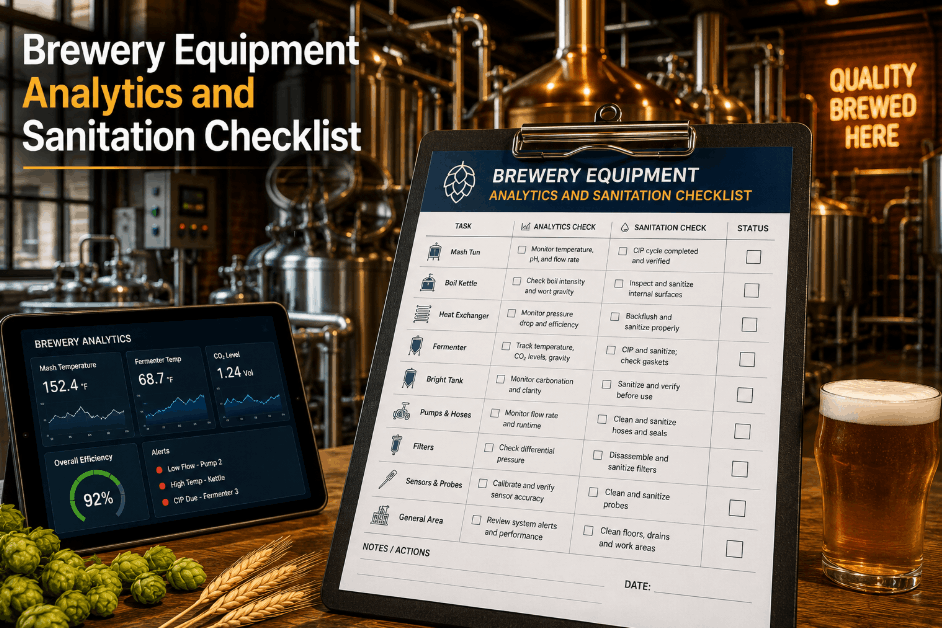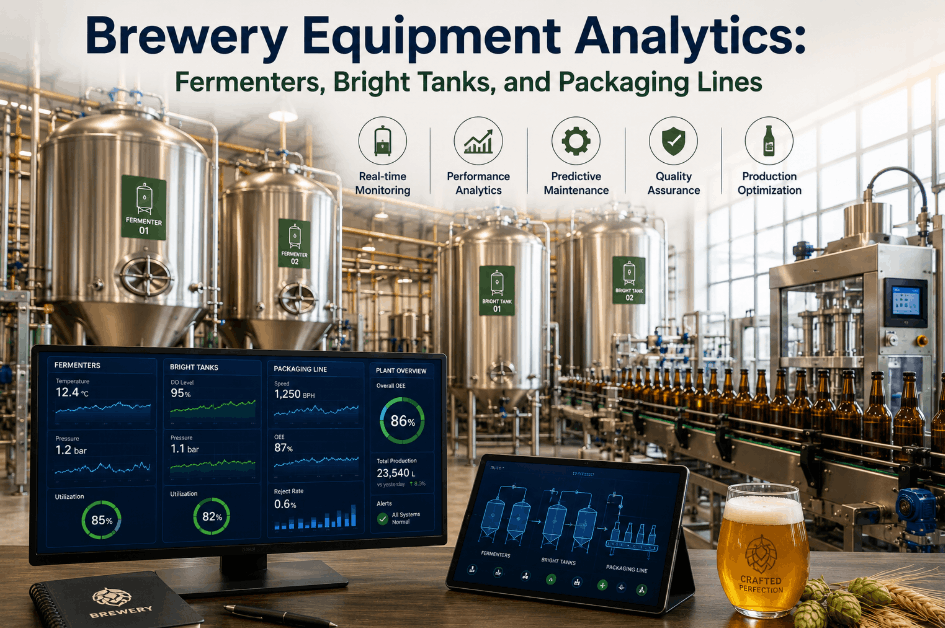
Brewery equipment analytics is transforming how craft and commercial breweries manage fermenters, bright tanks, kegging lines, and packaging systems. In an industry where a single failed glycol chiller can ruin an entire batch, or a miscalibrated CIP cycle can cause contamination across multiple vessels, reactive maintenance is no longer an acceptable strategy. AI-driven preventive analytics gives brewery operations teams the power to predict failures before they happen, automate PM schedules around actual equipment condition, and protect every barrel of beer from production line to packaged product. If your brewery is still relying on manual inspection logs and spreadsheet-based maintenance schedules, book a demo to see what AI-driven brewery asset management looks like in practice.
Ready to Eliminate Unplanned Downtime Across Your Brewery?
See how AI-driven preventive analytics protects your fermenters, bright tanks, and packaging lines — from glycol chillers to canning systems.
Why Brewery Equipment Analytics Is No Longer Optional
Every craft brewery and commercial brewing operation runs on a network of temperature-critical, pressure-sensitive, and chemically intensive equipment. Fermenters must hold precise temperature bands for days or weeks. Bright tanks require consistent carbonation pressure management. Kegging lines operate under high-cycle mechanical stress. Packaging systems — fillers, cappers, labelers, and palletizers — run at speeds where a single sensor failure causes downstream jams that halt the entire line.
The challenge is that most brewery maintenance programs were designed for manual inspection rounds and calendar-based PM schedules — systems built for equipment that was simpler, slower, and cheaper to replace. Modern brewery equipment is none of those things. A custom-spec 120-barrel fermenter represents a six-figure capital investment. A high-speed canning line failure during a peak production run costs thousands per hour in lost throughput. Brewery equipment analytics closes the gap between what your maintenance team can see during inspection rounds and what is actually happening inside your fermentation vessels, refrigeration systems, and packaging machinery 24 hours a day.
Fermenter Analytics: Protecting Your Most Critical Brewery Asset
Fermenters are the heart of every brewing operation — and also among the most analytically complex assets to manage. Temperature control failures, pressure excursions, seal degradation, and incomplete CIP cycles all create risk that compounds through downstream production. Brewery AI-driven platforms monitor fermenter health across multiple data streams simultaneously, building a continuous picture of vessel condition that no manual inspection schedule can match.
Glycol Chiller Analytics
AI tracks compressor current, glycol temperature differentials, and chiller cycle efficiency — detecting thermal control degradation 2–4 weeks before it affects fermenter temperature stability or puts an active batch at risk.
Pressure & CO₂ Management
Continuous pressure profile monitoring flags stuck PRVs, leaking seals, and blocked vent lines before they create safety risks or product quality failures — tracked against expected fermentation curves per vessel.
CIP Sanitation Analytics
Every CIP cycle validated by caustic concentration, rinse conductivity, temperature, and flow rate — catching incomplete sanitation cycles that pass visual inspection but create contamination risk across fermenter batches.
Agitator & Seal Wear Tracking
Vibration analytics, motor current trending, and bearing temperature monitoring identify mechanical wear signatures early — enabling planned seal and bearing replacements before active fermentation runs are disrupted.
Bright Tank Analytics: From Green Beer to Packaged Product Without Surprises
Bright tanks bridge fermentation and packaging — holding fully conditioned, carbonated beer under pressure while awaiting packaging runs. Bright tank analytics focuses on the pressure, temperature, and carbonation consistency that determines whether beer reaches the package in optimal condition. Carbonation level drift, temperature excursions during extended holding periods, and pressure seal failures all create quality and yield losses that analytics platforms are purpose-built to prevent.
AI-driven bright tank analytics continuously models the relationship between holding time, temperature stability, and carbonation retention — generating alerts when holding conditions deviate from the profile that protects beer quality. For breweries managing multiple bright tanks across different product lines and packaging schedules, this level of continuous oversight is impossible to replicate through manual monitoring rounds. Proactive breweries using brewery AI-driven platforms report a significant reduction in bright tank-related packaging quality rejects.
Carbonation Pressure Analytics
Track CO₂ pressure stability across all bright tanks in real time. AI models identify slow pressure leaks and PRV performance degradation before carbonation levels in packaged product fall outside specification — protecting both quality and brand reputation across every SKU.
Temperature Stability Monitoring
Bright tank temperature excursions during extended holds can compromise flavor stability and accelerate staling reactions. Analytics platforms monitor glycol jacket performance per vessel, detecting cooling efficiency loss on individual tanks before temperature-sensitive beer is affected.
Holding Time and Quality Risk Scoring
AI models correlate holding time, temperature history, and carbonation trend data to generate per-tank quality risk scores — enabling packaging scheduling decisions that prioritize tanks at elevated quality risk and reduce overall product loss from extended or suboptimal holds.
Bright Tank CIP Validation Analytics
Bright tank CIP effectiveness directly determines microbial risk in finished beer. Analytics validate each CIP run against defined sanitation parameters, flagging incomplete cycles and generating CMMS work orders for investigation — eliminating the manual record review that most brewery QA teams rely on.
Brewery Packaging Line Analytics: Where Production Speed Meets Equipment Complexity
Packaging lines represent the highest mechanical complexity in any brewery — and the highest cost of unplanned downtime. A mid-size craft brewery running a 60-can-per-minute canning line that stops unexpectedly during a production run loses not just throughput, but also the labor, materials, and scheduling cost of a disrupted workflow. Brewery packaging analytics applies predictive maintenance logic to every mechanical subsystem in the packaging train.
Filler and Seamer Analytics
Fill head valve wear, seamer chuck and roll pressure drift, and fill volume consistency tracked continuously. AI detects the early mechanical signatures of fill head fouling and seamer component wear before they cause seal failures, underfills, or line stoppages — the three most costly packaging line failure modes in craft brewery operations.
Conveyor and Drive System Monitoring
Motor current trending, belt tension analytics, and drive bearing vibration monitoring across all conveyor segments in the packaging line. Conveyor failures during production runs cause jams that halt the entire line — predictive analytics reduces this from a regular occurrence to a rare event through early-stage mechanical degradation detection.
Labeler and Packaging Integrity Analytics
Labeler application consistency, adhesive system performance, and packaging integrity check rates monitored per production run. AI models track label application accuracy and reject rate trends, identifying labeler calibration drift and adhesive system degradation before they cause downstream quality failures at retail.
Brewery Preventive Analytics: Building the AI-Driven PM Schedule
Traditional brewery preventive maintenance operates on fixed intervals — change that seal every 90 days, clean that heat exchanger every quarter, rebuild that pump on a 6-month cycle. These schedules are designed for the worst-case scenario: they assume maximum degradation rates regardless of actual equipment condition. The result is maintenance labor spent on equipment that doesn't need service while equipment that is actually degrading continues to run until it fails.
AI-driven brewery preventive analytics replaces interval-based scheduling with condition-based PM generation. Every fermenter, bright tank, glycol chiller, CIP pump, packaging line drive, and utility system generates continuous condition data. When that data deviates from the established healthy baseline in ways that historically precede failure, the platform generates a CMMS work order — with the specific component, recommended action, and urgency level — before the failure occurs. Breweries using AI-driven brewery equipment PM platforms report that 60–70% of their maintenance work orders are now predictive rather than reactive — a fundamental shift in how brewery asset management operates.
Brewery Asset Management ROI: What Analytics Delivers
The return on brewery equipment analytics investment is measurable across four categories: batch loss prevention, emergency maintenance cost reduction, packaging line efficiency improvement, and staff productivity gains. Quantified results from craft breweries operating iFactory's AI-driven analytics platform demonstrate consistent returns across all four dimensions.
See Brewery Equipment Analytics, Digital Twin Simulation and Preventive Maintenance Live
iFactory integrates fermenter analytics, bright tank monitoring, CIP tracking, glycol chiller analytics, and packaging line predictive maintenance into one AI-driven platform — protecting every batch from grain to glass.
5-Phase Brewery Analytics Implementation Roadmap
A structured deployment approach that delivers measurable returns at every phase — from quick-win predictive alerts on existing brewery equipment to a fully integrated AI-driven brewery asset management platform covering every asset from raw materials intake to finished goods packaging.
Brewery Equipment Audit and Analytics Baseline (Weeks 1–3)
Inventory all fermenters, bright tanks, glycol chillers, CIP systems, and packaging line assets. Map existing sensor infrastructure and identify analytics gaps. Establish condition baselines for every monitored asset — the foundation for AI-driven anomaly detection and predictive maintenance scheduling across the brewery. Many breweries using iFactory's brewery analytics platform discover previously unknown equipment health issues within the first two weeks of monitoring.
Sensor Integration and Data Pipeline Activation (Weeks 4–8)
Connect temperature sensors, pressure transmitters, vibration monitors, CIP conductivity probes, and glycol system meters to the iFactory analytics platform. Validate data quality per asset and configure alert thresholds based on brewing process requirements. High-priority assets — glycol chillers and critical fermenters — go live first, delivering immediate monitoring value while remaining assets are onboarded.
AI Model Training and Predictive Alert Activation (Weeks 8–14)
AI models train on brewery-specific equipment behavior patterns, learning the normal operating signatures of each fermenter, bright tank, packaging line drive, and utility system. Predictive maintenance alerts activate as models reach confidence thresholds — the first predicted failure prevention typically occurs within 10–12 weeks of this phase for most craft breweries.
CMMS Integration and Automated Work Order Generation (Weeks 14–18)
Connect iFactory's analytics platform to your brewery CMMS. Predictive maintenance alerts automatically generate work orders with component identification, recommended action, urgency level, and parts requirements — eliminating manual work order entry and ensuring maintenance teams act on analytics insights within defined response windows.
Full Brewery Analytics Coverage and Continuous Optimization (Week 18+)
Expand analytics coverage to all brewery assets including raw material handling, water treatment, boiler and steam systems, and finished goods cold storage. Activate digital twin simulation for production planning and capacity optimization. AI models continuously improve prediction accuracy as historical maintenance and failure data accumulates across your entire brewery asset portfolio.
Brewery Analytics Compliance and Industry Standards
Brewery equipment analytics supports compliance with the regulatory and quality standards that govern modern brewing operations — from food safety certification requirements to environmental reporting obligations.
Frequently Asked Questions: Brewery Equipment Analytics
Every Fermenter, Every Bright Tank, Every Packaging Line — Monitored and Protected.
iFactory's AI-driven brewery equipment analytics platform delivers predictive maintenance for your entire brewing operation — from glycol chillers to canning lines — ensuring every batch reaches the package in optimal condition, every time.