A missing hairnet or an unworn cut-resistant glove is easy to miss during a walk-through, but it is exactly the kind of small compliance gap that leads to a serious injury or a failed audit. EHS managers cannot physically watch every station on every shift, which is precisely the gap AI-driven safety monitoring closes, watching PPE compliance, ergonomic risk, and slip-trip-fall conditions continuously across the plant floor. Instead of relying on scheduled spot checks, safety teams get a constant, unbiased view of real conditions as they happen. EHS teams ready to see this running on their own floor layout can book a demo.
AI WORKER SAFETY · FOOD MANUFACTURING · 2026
Catch Safety Gaps Before They Become Incidents
Continuous AI monitoring for PPE compliance, ergonomic risk, and slip-trip-fall conditions across every zone of the plant floor.
Why Scheduled Walk-Throughs Miss So Much
Most food plants rely on a combination of scheduled safety walk-throughs and worker self-reporting to catch PPE and safety compliance gaps, and both methods share the same fundamental limitation: they only capture a snapshot in time. A hairnet slips off twenty minutes after the safety officer walks past, a worker reaches into an awkward position to grab a heavy case for the hundredth time that shift, or a wet floor near a wash station sits unmarked for ten minutes before someone notices, and none of it gets caught by a check that happens once or twice a shift.
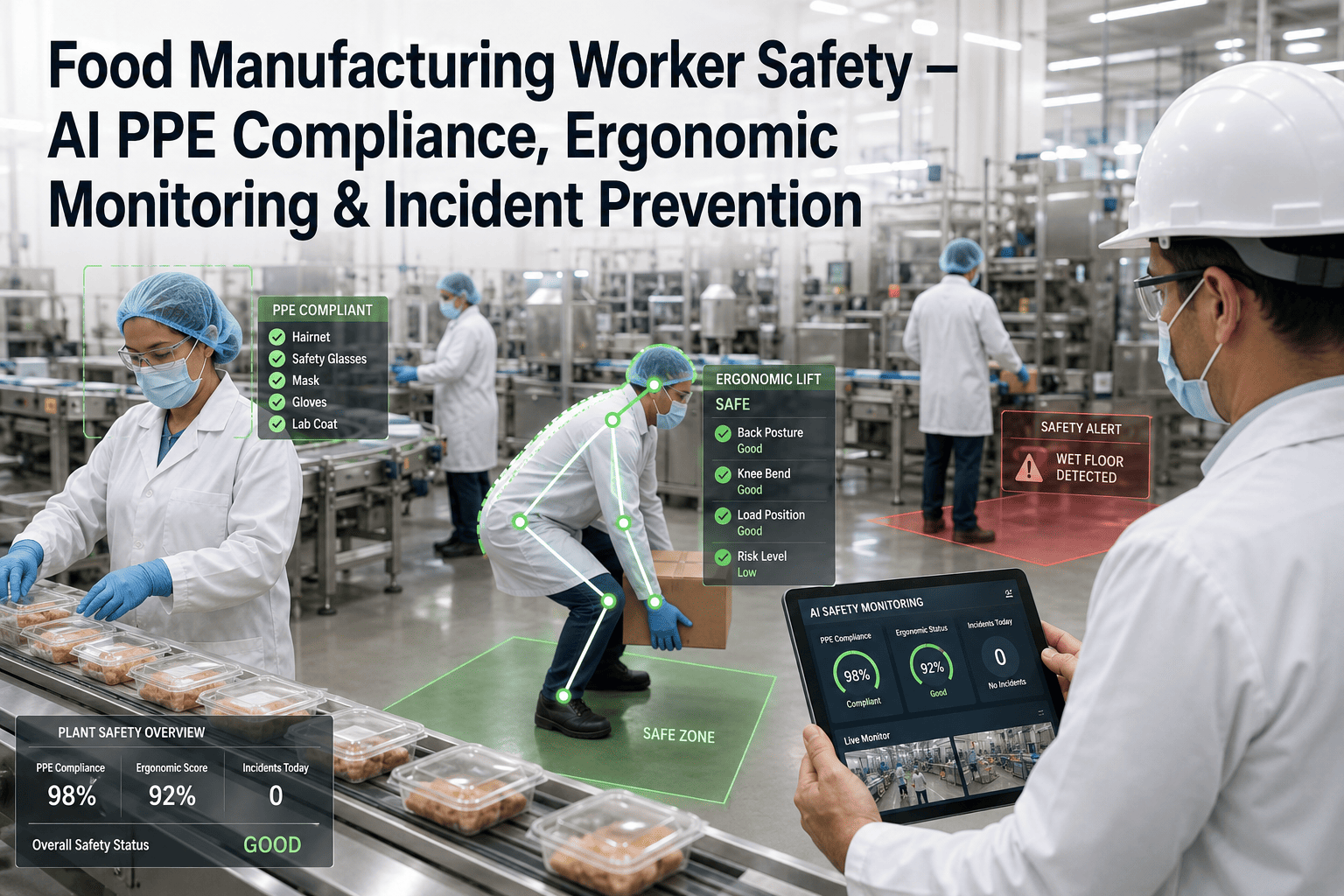
AI-driven monitoring changes the detection window from occasional to continuous. Cameras positioned across key zones watch for defined safety conditions in real time, flagging a missing hairnet, an unworn glove, an at-risk lifting posture, or a floor hazard the moment it appears, so a supervisor can respond within minutes rather than discovering the gap during the next scheduled walk-through.
What Gets Monitored, Zone by Zone
PPE Compliance
Hairnets, gloves, cut-resistant sleeves, and safety glasses detected at required stations continuously.
Ergonomic Risk
Repetitive lifting posture and awkward reach patterns flagged before they lead to a strain injury.
Slip & Trip Hazards
Wet floors, spills, and blocked walkways identified and routed for immediate cleanup.
Restricted Zones
Unauthorized entry into active machine zones or forklift paths flagged in real time.
SEE YOUR OWN FLOOR, MONITORED LIVE
Watch Continuous Safety Monitoring in Action
Get a walkthrough of how AI safety monitoring would perform across your specific plant layout.
Common Incident Types and Detection Windows
Different hazard types develop and resolve on different timelines, which is why continuous monitoring matters more for some risk categories than others.
| Hazard Type | Typical Cause | Detection Advantage |
|---|---|---|
| PPE Non-Compliance | Equipment removed mid-shift for comfort or convenience | Flagged within seconds of removal |
| Repetitive Strain Risk | Awkward lifting posture repeated over a shift | Pattern flagged before injury develops |
| Slip and Fall Risk | Spills or wet floors near wash and cook zones | Flagged within minutes of occurrence |
| Restricted Zone Entry | Worker enters an active machine or forklift path | Flagged instantly, before contact occurs |
What EHS Managers Are Saying
We used to find out about PPE gaps during our weekly walk-through, which meant we were always a week behind the actual problem. Now I get a real-time alert if someone pulls off a glove near the slicing line, and our near-miss reports have dropped significantly since we started catching these moments as they happen instead of after the fact.
EHS Manager, Processed Meat Facility
Frequently Asked Questions
Does this monitor individual workers in a way that feels like surveillance?
Most deployments are configured to detect compliance conditions rather than track individual worker identity, meaning the system flags whether required PPE is present at a station or whether a hazard exists in a zone, without building a personal monitoring profile on specific employees. Plants that want individual accountability tracking can configure that separately, but it is a deliberate choice rather than a default, and most EHS teams find condition-based alerts achieve the safety goal without raising the concerns that identity-based tracking can create among staff.
How does the system distinguish a genuine safety gap from a brief, harmless moment?
Alert rules are configured around defined thresholds, such as PPE being absent for longer than a brief moment rather than triggering on every instant of natural adjustment, which keeps the system from flooding supervisors with alerts over normal, momentary movement. These thresholds are calibrated during the pilot phase specifically to match your plant's real operating patterns, so the system learns the difference between a worker adjusting a glove and a worker who has genuinely removed required PPE for an extended period.
Can this help with OSHA and food safety audit documentation?
Yes, every flagged condition and the resulting response is logged automatically, building a continuous, timestamped safety monitoring record that supports both internal audits and external inspections. This is particularly useful for demonstrating an active, ongoing safety program rather than relying on periodic checklist records, since auditors increasingly look for evidence of continuous monitoring rather than point-in-time compliance snapshots. Teams can review reporting formats through support.
What happens after an alert fires, does it go straight to management?
Alert routing is configurable to match your existing safety response structure, typically going first to the shift supervisor or floor lead responsible for that zone rather than escalating directly to plant leadership for every event. Repeated or unresolved alerts can be configured to escalate automatically after a defined period, ensuring nothing gets missed while still respecting the normal chain of responsibility your team already uses for safety response.
How long does it take to deploy across a full plant?
A pilot covering the highest-risk zones, typically cutting stations, wash areas, and forklift paths, is usually operational within three to four weeks. Full plant coverage across every zone generally completes within eight to ten weeks depending on facility size and camera placement requirements. EHS managers can book a demo to get a rollout plan scoped to their own floor layout.
AI WORKER SAFETY · FOOD MANUFACTURING
Move From Scheduled Checks to Continuous Coverage
Join food plants already catching PPE and safety gaps in real time, before they become incidents.