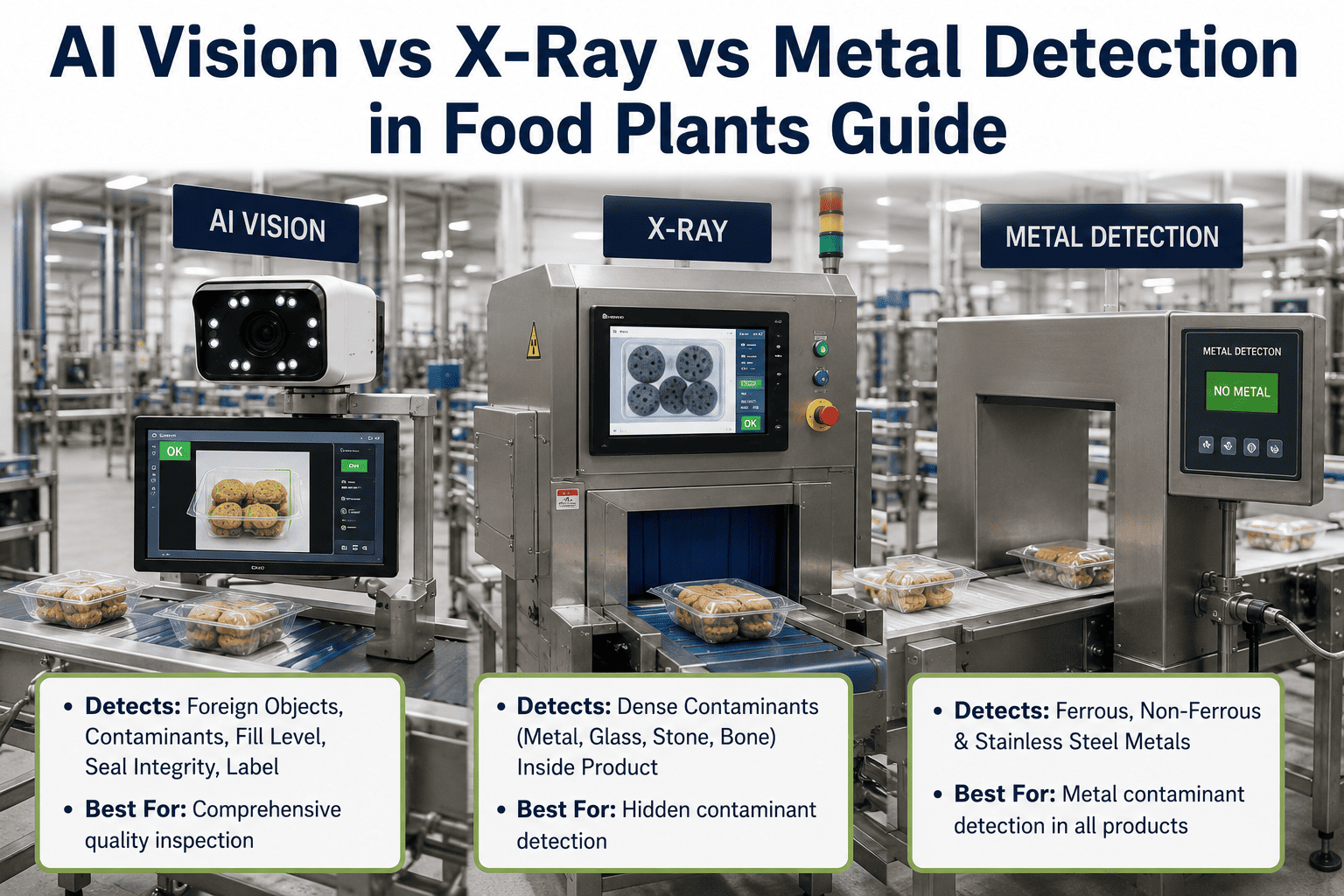
A metal fragment in a jar of baby food, a shard of glass in a bottled sauce, a fleck of blue HDPE in a bag of frozen vegetables — foreign material complaints are the single fastest way a food brand loses a customer for life. Unlike a taste or texture miss, a foreign object turns up in someone's mouth, and the reaction is never mild. Most plants already run metal detectors and call it done, but metal is only one of six or seven material families that actually show up in complaint data. A real foreign material control program layers detection technology by material type, backs it with a written prevention policy for glass, hard plastic, and wood, and uses AI vision to catch the categories that metal detection and X-ray were never built to see. Book a detection gap assessment to find out which material families your current line is blind to.
Metal Detection Was Never the Whole Program
Layer detection technology by material type and close the gap that metal detectors and X-ray leave open — plastic, wood, insect fragments, and organic foreign material that only a trained eye or AI vision can catch.
What Foreign Material Actually Costs a Brand
Foreign material complaints rarely stay contained to a single unit. A single confirmed report can trigger a full lot investigation, a retailer delisting review, and in the worst cases a recall — long before the root cause is even understood.
consumer food complaints in the US involve a foreign object, more than any other single category
distinct material families — metal, glass, hard plastic, wood, stone, insect — each needing its own control
typical window regulators expect for a documented investigation once a complaint is confirmed
smallest fragment size modern X-ray and vision systems can reliably flag on dense product
Detection Technology by Material Type
No single detection technology catches everything. Every credible program layers two or more methods so the blind spot of one is covered by the strength of another.
Where Foreign Material Actually Enters the Line
Detection catches what has already entered the product stream. Prevention closes the entry points before material ever reaches the line — and most plants have more open entry points than they realize.
Incoming ingredients and packaging
Stone, glass, and insect fragments most often arrive already inside a raw material shipment rather than originating on the line itself.
Equipment wear and breakage
Worn belts, cracked scraper blades, and degraded gaskets shed fragments gradually — the failure is rarely sudden or obvious to an operator.
Maintenance activity
Loose fasteners, dropped tools, and wire fragments from repair work are a leading root cause traced through complaint investigations.
Employee personal items
Pens, jewelry, hairnet clips, and glove fragments enter through gaps in a personal-item policy rather than a process failure.
Facility structure
Overhead glass light fixtures, wooden pallets near open product, and flaking paint are structural risks a walk-through audit is built to find.
Pest activity
Insect fragments and rodent evidence are the material category most likely to be missed entirely by metal and X-ray systems.
Find the Material Category Your Line Can't See
iFactory scans a sample run of your product against real foreign material specimens across all six categories and shows you, on video, exactly what your current detection setup misses.
The Written Policies Every Program Needs
Detection technology only works alongside written prevention policy. Auditors ask for these documents by name, and gaps in any one of them are among the most common findings on a GFSI audit.
Glass and brittle plastic policy
A registered inventory of every glass and brittle plastic item within reach of exposed product, with scheduled inspection and a documented breakage response procedure that holds and inspects affected product.
Sieve and screen management
Integrity checks on every sieve, screen, and filter before and after each run, with a torn-mesh escalation procedure that treats a failed check as a full-batch hold pending investigation.
Wood and pallet control
A no-wood-near-open-product rule enforced through layout design, with heat-treated pallet certification tracked for anything that must enter a processing area.
Personal item and PPE policy
Metal-detectable plasters, no-loose-jewelry rules, and PPE fragment logging so a torn glove or hairnet is documented and searched for rather than assumed gone.
Tool and equipment control
Shadow-boarded tool inventories with count verification before and after every maintenance activity performed near open product.
What Changes When Detection Is Layered by Material
Figures drawn from typical deployments across snack, bakery, and packaged protein lines within the first six months of layering AI vision alongside existing metal and X-ray detection.
A Plant Manager's View on Closing the Detection Gap
We had metal detectors on every line and felt covered. Then a customer complaint came back with a hard plastic fragment and we realized our X-ray was tuned for density ranges that plastic simply doesn't register on. Adding vision inspection at the same checkpoint closed that gap within a month, and it caught two more plastic fragments from a supplier packaging issue before a single complaint reached a customer.
Frequently Asked Questions
Do we need X-ray if we already run a metal detector on every line?
Metal detectors only find metal. Glass, dense stone, and bone fragments are invisible to a coil-based metal detector regardless of how well it is tuned, which is why X-ray exists as a separate layer. If your product category carries glass packaging risk or bone-in ingredients, X-ray is generally treated as a required control, not an optional upgrade. Book a gap assessment to see which layer your product category actually needs.
Can AI vision detect foreign material inside opaque packaging?
No — vision inspection requires a line of sight to the product surface, which is why it is deployed at open-product stages such as filling, forming, or before final seal, rather than after packaging is closed. For sealed or opaque packaging, X-ray remains the correct technology since it penetrates the package itself.
How often should sieves and screens be inspected for damage?
Best practice is integrity verification before the first run of each shift and again at the end, with any torn or damaged mesh treated as an immediate stop event rather than a note for the next changeover. A batch that ran through a compromised sieve should be held and inspected before release, not passed on the assumption that the screen was likely fine.
What is the most commonly missed foreign material category in audits?
Insect fragments and organic foreign material consistently rank as the most under-controlled category, largely because neither metal detection nor most X-ray configurations can reliably flag them. This is the category where AI vision inspection adds the most net-new coverage rather than duplicating an existing control.
How long does it take to add AI vision inspection to an existing line?
A single-station pilot typically installs and validates within four to six weeks, including camera placement, lighting setup, and model tuning against your specific product and known foreign material specimens. Talk to a specialist about your line layout and product type for a specific timeline.
The Bottom Line on Foreign Material Control
No single detection technology covers every material a customer could report. Metal detection, X-ray, and AI vision each cover a different slice of the risk, and written prevention policy closes the entry points detection was never meant to catch. The plants with the fewest complaints are not the ones with the most expensive single machine — they are the ones whose layers overlap with no gap left uncovered.
See What Your Current Detection Setup Is Missing
Book a 30-minute assessment. iFactory reviews your existing metal, X-ray, and vision coverage against your complaint history and shows exactly which material category needs a new layer.